Definition and Core Functions of Storage Chips
Storage chips, also known as semiconductor memory, are memory devices that use semiconductor circuits as storage media. Their core function is to mark different storage states by charging and discharging electrons or charges in the storage medium, thereby achieving data storage capabilities.
 As a key component for data storage in embedded systems and various electronic devices, storage chips integrate functions such as storage controllers and protocol management into a single chip using Application-Specific Integrated Circuit (ASIC) or Field-Programmable Gate Array (FPGA) technology, supporting advanced features like storage protocol compatibility, data encryption, and virtualization.Hot topics and trends on September 25 are as follows:
 September 23
Driving Factors
Domestic chips: TSMC’s advanced process price increase; Changchun’s third phase established, storage chips continue to rise; Moore Threads’ Sci-Tech Innovation Board IPO will be reviewed on September 26.
Photolithography machines (胶): Shanghai Securities News: SMIC is testing deep ultraviolet photolithography machines manufactured by Yuliangsheng.
Medium to long-term trend analysisStorage chips, as the cornerstone of the information age, are indispensable core components in modern electronic devices.
Storage chip technology is undergoing rapid evolution to meet the growing demands for data storage and processing efficiency. From the current research and development directions and industry dynamics, several key technological development trends are shaping the future landscape of storage chips.
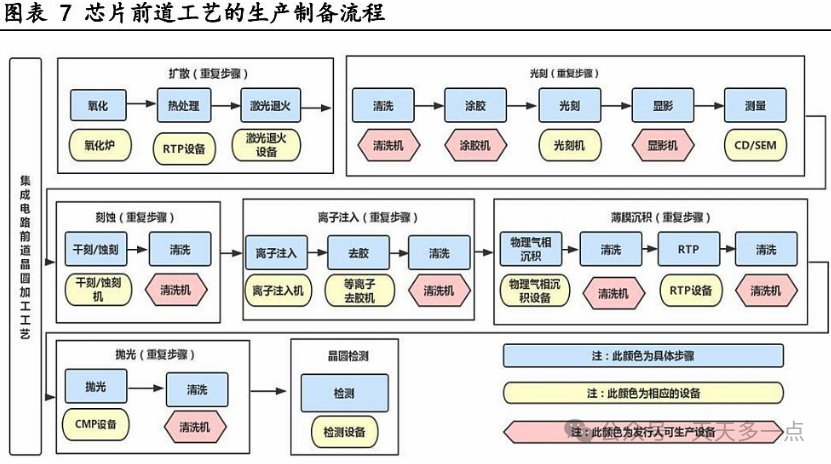
Storage chips’ industry chain structure is similar to that of the general semiconductor industry chain, divided into three segments: upstream materials and equipment, midstream chip production (design, manufacturing, packaging and testing), and downstream applications.
Unlike the Fabless + Foundry + OSAT vertical division of labor model used by most logic chips, the storage chip industry has the following characteristics:
-
Upstream segment: Mainly includes semiconductor materials (wafers, photoresists, specialty gases, etc.) and semiconductor equipment (photolithography machines, etching machines, deposition equipment, etc.). These fields have high technical barriers and are currently dominated by international giants.
-
Midstream segment: Storage chip manufacturers typically adopt the IDM model, integrating design, manufacturing, and packaging/testing capabilities. This model is beneficial for optimizing proprietary processes and rapidly increasing production capacity.
China’s storage industry chain is building local IDM capabilities, but there is still a gap compared to international giants.
-
Downstream segment: Covers multiple application fields such as consumer electronics, data centers, industrial control, and automotive electronics. With the development of AI, 5G, and the Internet of Things, the application scenarios for storage chips are continuously expanding.