 Click the blue text above to subscribe.
To solve the lithium dendrite problem and improve the interface stability between solid polymer electrolytes (SPE) and lithium metal anodes (LMA), numerous strategies have been developed, including the creation of artificial SEI films, preparing SPEs with higher lithium ion transference numbers, and using special active components with lithium-attracting/lithium-repelling sites. However, achieving uniform lithium deposition at the SPE/LMA interface and regulating lithium ion flow in the SPE matrix, especially under low-temperature conditions, presents significant challenges.
In light of this, Professor Pan Qinmin from Harbin Institute of Technology and Dr. Zhang Xingzhao proposed a branched star-shaped polymer electrolyte based on agarose to address the uneven lithium ion deposition in solid-state lithium batteries at low temperatures. By grafting poly(ethylene glycol) methyl ether methacrylate (PEGMEMA) and 2-acrylamido-2-methylpropanesulfonic acid lithium (LiAMPS) onto tannic acid (TA), a branched star polymer (BSP) was synthesized. The branched structure allows the resulting polymer electrolyte (UTPE) to have high adhesion to the electrodes, maintaining tight interfacial contact. Furthermore, BSP not only regulates the lithium ion flow in the electrolyte but also adjusts the interface between the electrolyte and the electrode. This unique all-around transport can effectively enhance lithium ion conductivity and reduce polarization. Simultaneously, the electrostatic interactions between lithium ions and sulfonate groups can synergistically modulate the spatial configuration of BSP, promoting uniform distribution of lithium ions across the surface of the lithium anode, preventing lithium ion aggregation, and alleviating dendritic growth. This research provides a promising strategy to address uneven lithium deposition at the SPE/LMA interface, with potential applications for wide-temperature-range, long-life solid-state batteries. This work is published in Small methods under the title “A Star-Structured Polymer Electrolyte for Low-Temperature Solid-State Lithium Batteries,” https://doi.org/10.1002/smtd.202400356. The corresponding author of the article is Professor Pan Qinmin from the School of Chemical Engineering and Technology at Harbin Institute of Technology, and the first author is Dr. Zhang Xingzhao from Harbin Institute of Technology.TA has abundant phenolic groups, which can react with glycidyl methacrylate (GMA) to form the product TA-GMA (TA-G). Subsequently, PEGMEMA and LiAMPS react with TA-G, generating the target BSP through radiation polymerization. BSP exhibits good viscosity and can be stretched.
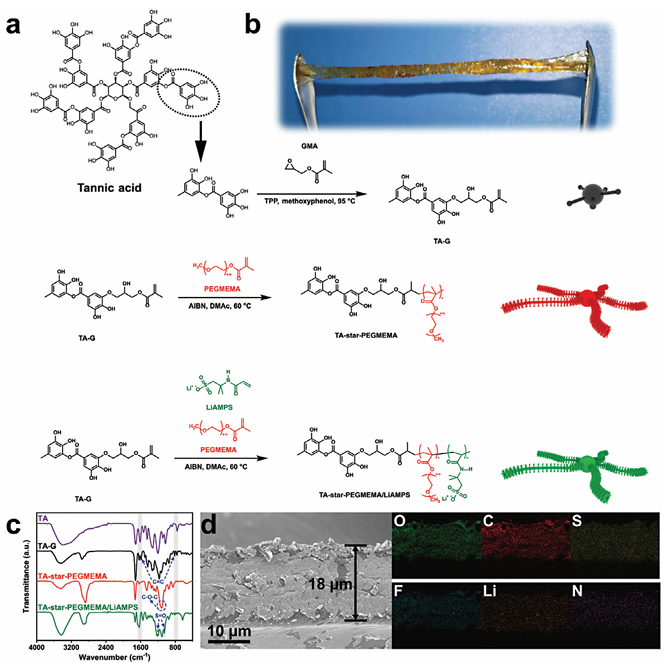
Figure 1. The preparation process of BSP and the physical characterization of UTPE.TA-star-PEGMEMA/LiAMPS UTPEs demonstrate a room temperature conductivity of 1.6*10-4 S cm-1 with minimal activation energy and maximum diffusion coefficient. This is attributed to the unique branched structure of TA-star-PEGMEMA/LiAMPS UTPE, which exhibits an all-around lithium ion flux in the electrolyte through the binding/unbinding of lithium ions with active groups, significantly improving the lithium ion transfer rate. Moreover, the branched structure endows UTPE with good adhesion and excellent mechanical stability, helping to suppress lithium dendrite formation.
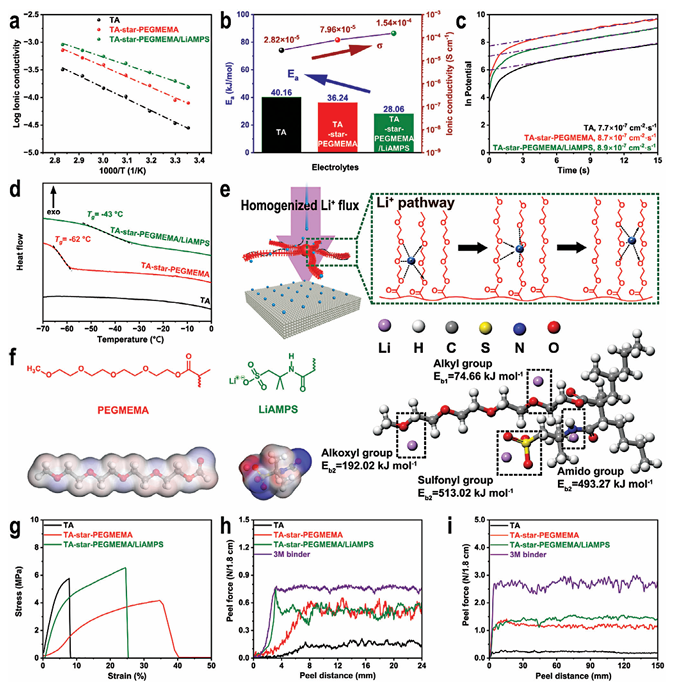
Figure 2. The electrochemical parameters and adhesion tests of UTPE.Due to the sulfonate-modified branched structure, strong lithium-attracting sites can be formed, allowing for uniform migration of lithium ions to the surface of the lithium metal anode. The abundant lithium-attracting sites and uniformly distributed lithium ions facilitate even nucleation of lithium ions and prevent lithium ion aggregation, thus achieving a non-dendritic morphology. The star-shaped polymer with PEGMEMA branches imparts high ionic conductivity and excellent adhesion to the electrolyte, and allows lithium ions to hop along the PEGMEMA branches through the binding/unbinding with ether oxygen groups. More importantly, the electrostatic interactions between lithium ions and ether oxygen groups can synergistically adjust the spatial configuration of BSP, promoting uniform distribution of lithium ions across the entire LMA surface and suppressing dendritic growth (Figure 3j). Therefore, a rapid and uniform flow is formed both within the electrolyte and at the electrolyte/electrode interface. These characteristics ensure the stability of the interface during stripping/plating processes.
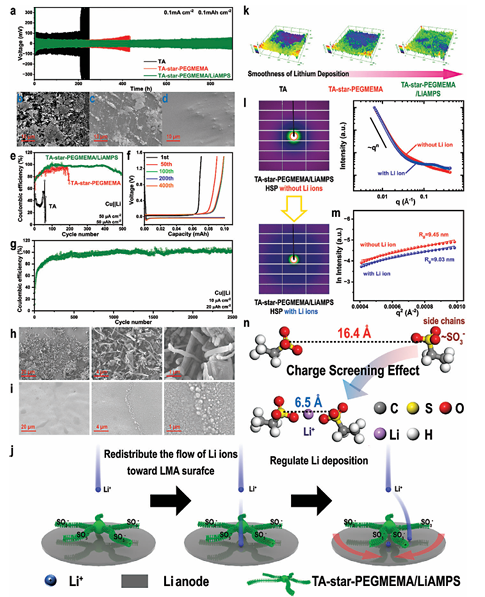
Figure 3. The study of the effect of BSP on lithium deposition.The assembled Li||LFP battery can stably cycle 800 times at room temperature under 0.5C.
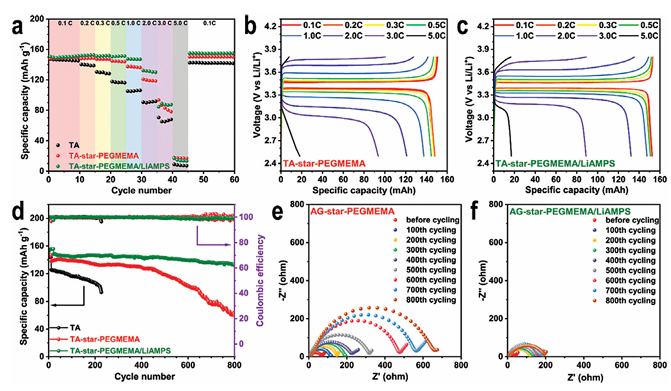
Figure 4. The room temperature cycling performance of UTPE.The assembled Li||LFP battery can stably cycle 150 times at 0.1C under -15 degrees Celsius.
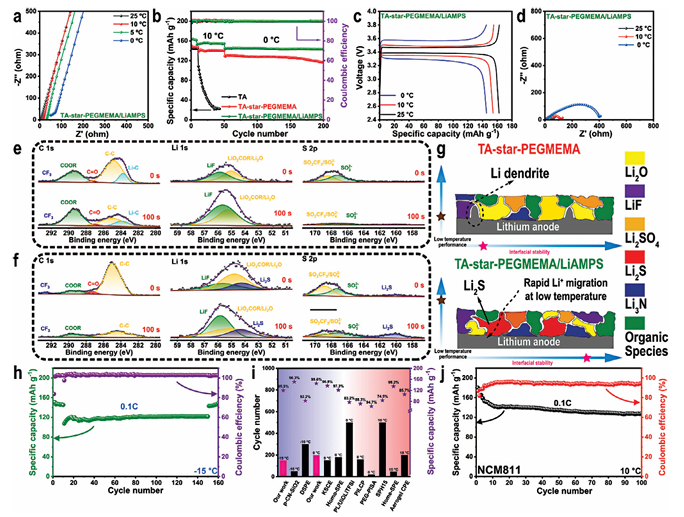
Figure 5. The low-temperature cycling performance of UTPE.The assembled Li||LFP battery can stably cycle 80 times at room temperature under 0.1C.
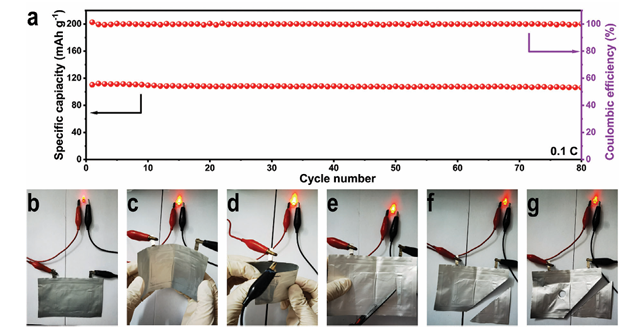
Figure 6. The cycling performance of soft-pack batteries using UTPE.The authors proposed an agarose-based electrolyte that exhibits high ionic conductivity, high adhesion, and excellent dendrite suppression capability, suitable for solid-state lithium metal batteries under low temperatures. This UTPE is composed of agarose chains and a unique star-shaped polymer, synthesized by grafting PEGMEMA and LiAMPS onto TA. This UTPE possesses high ionic conductivity (1.6 × 10⁻⁴ S cm-1), adhesion (1.4 N), and good compatibility with lithium metal anodes. The solid-state lithium iron phosphate battery made using TA-star-PEGMEMA/LiAMPS UTPE shows remarkable cycling performance, maintaining a specific capacity of 134 mAh g-1 after 800 cycles at room temperature under 0.5 C, and stable performance even at -15 ℃ after 180 cycles under 0.1 C. The outstanding performance of the solid-state battery is attributed to the ability of BSP to provide excellent internal compatibility for the UTPE and facilitate rapid, all-around lithium ion migration, regulating lithium ion flow. Simultaneously, the electrostatic interactions between lithium ions and sulfonate groups can synchronously modulate the spatial configuration of BSP, promoting uniform distribution of lithium ions across the entire LMA surface and preventing lithium ion aggregation, thereby alleviating dendritic growth. Therefore, this work provides a promising strategy to address the uneven lithium deposition issue at the solid polymer electrolyte/electrode interface, with potential applications in solid-state batteries.
Original link
https://doi.org/10.1002/smtd.202400356
Related progress
Professor Chen Yongming’s team at Sun Yat-sen University, Associate Professor Shi Yi, Macromolecules: Achieving rapid and efficient synthesis of star-shaped polymers with different compositions and sizes.
Li Bin’s research group at Sun Yat-sen University, Macromolecules: Exploring the self-assembly behavior of star-shaped polyelectrolytes in different solution environments using coarse-grained molecular simulations.
Researcher Cheng Fangyi and Professor Zhang Wangqing’s team at Nankai University: Star-shaped block copolymer electrolytes.

This is an original article from Polymer Science and Technology. Personal forwarding and sharing are welcome. For reprints by publications or media, please contact: [email protected]

Call for Submissions
Experts and scholars are welcome to submit manuscripts (papers, project introductions, new technologies, academic exchanges, unit news, conference information, recruitment, admissions, etc.) to [email protected], and please indicate detailed contact information. Polymer Science and Technology® will promptly push and publish on China Polymer Online.
Welcome to Join WeChat Groups To meet the needs of colleagues in the polymer industry-academia-research, dozens of special discussion groups have been opened, including a group for polymer experts and scholars, covering all aspects of the polymer industry or field. Currently, it has gathered thousands of top experts, scholars, technicians, and entrepreneurs from domestic and foreign universities, research institutes, and corporate R&D centers.
To apply for group entry, please first add the review WeChat ID PolymerChina (or long press the QR code below), and please be sure to indicate: Polymer + Name + Unit + Title (or Degree) + Field (or Industry), otherwise it will not be processed. Qualification will be reviewed before entry into the relevant professional group.

Click here to read the original text for more information.