 PART 01
 Background and Objectives
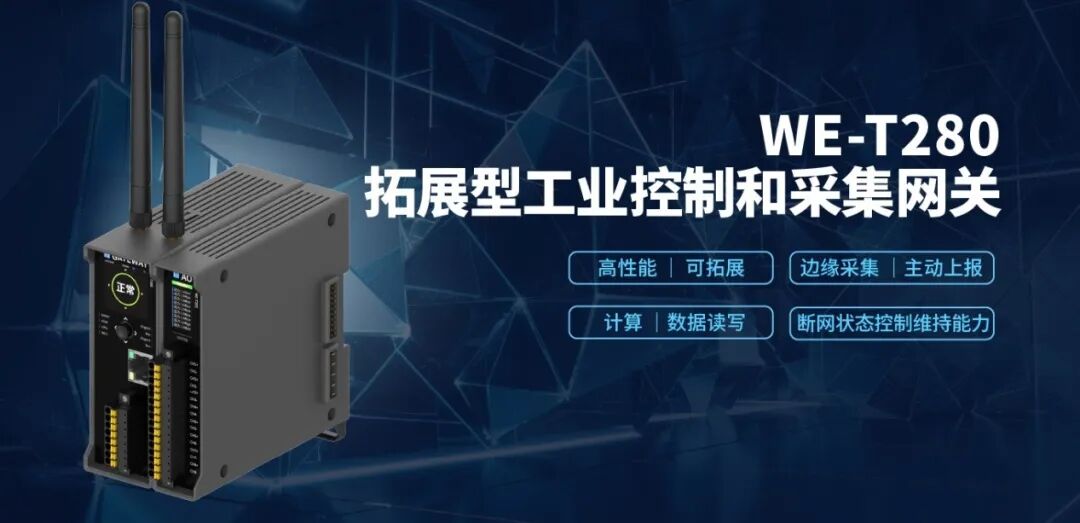
According to the “Implementation Plan for the Digital Transformation of the Textile Industry”, by 2027, the proportion of key business processes in large-scale textile enterprises that are fully digitalized must exceed 70%. This plan centers around the WE-X280 industrial gateway, integrating wireless I/O, analog data collection, and sensor technology to assist textile enterprises in achieving equipment interconnectivity, real-time data analysis, enhancing production efficiency, and optimizing energy efficiency, thereby meeting the digitalization benchmark construction goals required by policy.
 PART 02
 Architecture and Technical Highlights
1. Data Collection Layer
● WE-X280 Industrial Gateway:
✔ Supports multiple protocol access including Modbus, Modbus RTU/TCP, integrates wireless I/O modules and analog data collection interfaces, suitable for real-time data collection from textile equipment (such as looms, dyeing machines) (pressure sensors, flow sensors, solenoid valves, stepper motor controllers, photoelectric sensors, displacement sensors, non-contact thermometers, contact sensors, proximity sensors, actuators, photoelectric sensors, displays, vibration temperature sensors, etc.).
✔ Edge Computing Capability: Built-in lightweight AI models can locally process data such as vibration and temperature, enabling equipment fault early warning (e.g., bearing wear prediction).
✔ AI + Vision Capability: By adding AI cameras and platform AI algorithms through the gateway, old meter data can be collected without protocol integration, directly uploading photos for data extraction by the platform.
● Sensor Network:
✔ Temperature/Humidity Sensors: Monitor environmental parameters in dyeing workshops, dynamically adjusting dyeing processes in conjunction with the gateway’s analog data collection function.
✔ Vibration Sensors: Deployed on loom spindles, identifying abnormal vibrations through spectrum analysis, providing 2-3 days early warning of equipment failures.
✔ Current Sensors: Real-time monitoring of motor load, optimizing energy consumption management.
(Case: XXXX Textile reduced power consumption per ton of yarn by 5% using similar technology).
✔ Displacement/Photoelectric Sensors: Depending on the interface, I/O devices may require various modules such as AD converters. The X-280 master station and remote I/O modules can centralize on-site I/O devices, significantly reducing costs.
2. Network Transmission Layer
● 4G Wireless and RJ45 Wired Communication: WE-X280 supports high-speed wireless transmission, ensuring low-latency data return, suitable for the complex environment of textile workshops.
● Edge-Cloud Collaboration: The gateway preprocesses data before uploading it to the platform, reducing cloud pressure.
(Case: XXX project improved production efficiency by 25% using a similar architecture).
3. Platform Application Layer
● Industrial Internet Platform: Integrates device management and AI analysis modules, supporting remote monitoring and process optimization.
(Case: XXX reduced process issues by 30% through platform analysis of sewing machine data).
● Digital Twin System: Constructs a virtual production line to simulate the effects of process adjustments.
(For example, XXX achieved supply chain data sharing, enhancing collaborative efficiency).
PART 03 Core Application Scenarios and Cases
1. Intelligent Control of Dyeing Processes
● Pain Point: Traditional dyeing relies heavily on manual experience, leading to significant dye waste.
● Solution:
■ Temperature/Pressure sensors monitor dyeing tank parameters in real-time, with WE-X280 collecting data and uploading it to the platform.
■ The platform’s AI algorithms dynamically adjust dyeing amounts and heating curves, reducing dye waste by 15%.
(Similar to the case of XXX Textile, where power consumption per ton of yarn was reduced by 5%).
2. Predictive Maintenance of Equipment
● Pain Point: Sudden failures of looms lead to downtime and high repair costs.
● Solution:
■ Vibration sensors collect spindle data, with WE-X280 performing spectrum analysis to identify bearing wear characteristics.
■ The platform generates maintenance work orders, providing 2-3 days of early warning, reducing unplanned downtime by 40%.
(Case: XXX improved machine utilization by 22% using similar technology).
3. Energy Efficiency Management and Carbon Footprint Tracking
● Pain Point: High energy consumption in textile enterprises and significant pressure for carbon reduction.
● Solution:
■ Current sensors monitor motor load rates, with WE-X280 calculating real-time energy consumption.
■ The platform combines production order data to generate energy efficiency dashboards, identifying high-energy consumption areas.
(Case: XXX reduced overall energy consumption by 12% using a similar solution).
4. Quality Traceability and Process Optimization
● Pain Point: Fabric defect detection relies on manual inspection, leading to low traceability efficiency.
● Solution:
■ Deploy visual sensors on fabric inspection machines to collect fabric image data.
■ WE-X280 transmits data to the platform, where AI models automatically identify defect types and locations.
(Case: XXX improved product quality rate to 95% using similar technology).
PART 04 Advantages of the Solution and Policy Alignment
⑴ Wireless Deployment: WE-X280 supports wireless I/O, reducing wiring costs and adapting to the complex scenarios of mobile devices in textile workshops (Case: WD140 terminals saved 30% in similar scenarios).
⑵ Protocol Compatibility: Covers mainstream industrial protocols, seamlessly integrating with existing equipment (such as Siemens, Omron PLCs).
⑶ Security Protection: Supports encrypted data transmission and firewall functions, complying with the industrial network security classification and management requirements in the “Implementation Plan”.
⑷ Benchmark Demonstration: The solution can assist enterprises in applying for policy benchmark cases, meeting the requirement of 70% digitalization by 2027.
PART 05 Implementation Path and Expected Outcomes
① Pilot Verification (3-6 months):
◆ Select 1-2 production lines to deploy sensors and WE-X280, verifying data collection accuracy and system stability.
◆ Case: After the first pilot, XXX improved process accuracy by 20%.
② Scale Promotion (6-12 months):
◆ Gradually cover all factory equipment, integrating into existing MES/ERP systems.
◆ Case: XXX shortened order delivery cycles by 10% through comprehensive deployment.
③ Capability Upgrade (12-24 months):
◆ Introduce digital twin and AI optimization modules to achieve adaptive production control.
◆ Case: XXX improved production efficiency by 25% through digital twin technology.
Expected Outcomes:
➧ Efficiency Improvement: Overall Equipment Effectiveness (OEE) increased by 15%-20%, and order delivery cycles shortened by 25%.
➧ Cost Reduction: Energy consumption per unit product decreased by 12%, and maintenance costs reduced by 30%.
➧ Compliance Achievement: Meets the goal of 70% digitalization of key business processes by 2027 as outlined in the “Implementation Plan”, assisting enterprises in applying for benchmark cases.
PART 06 Conclusion
This solution, centered around the WE-X280 industrial gateway, constructs a closed loop of “perception-transmission-analysis-decision”. In conjunction with policy requirements and industry cases, it provides a reusable digital transformation path. Through the integration of scenario-based technologies, it promotes the transformation of textile enterprises towards high-end, intelligent, and green development, assisting in achieving a leap in the entire value chain.
 END
END
Copywriter: He Yunfei Editor: Wang Yijia

West Electric Technology Online Mall
www.west-hn.com