Hydrogen energy, as a clean energy source, relies heavily on the safety of its use, which is highly dependent on high-sensitivity and fast-response hydrogen sensors. The Xu Jiaqiang team at Shanghai University proposed a “vacancy-assisted single-atom synergistic strategy” by simultaneously constructing Pd single atoms and sulfur vacancies on the surface of molybdenum disulfide (MoS₂), significantly enhancing hydrogen sensing performance. This sensor exhibits a response of up to 2.32 to 400 ppm hydrogen at a low temperature of 120°C, with a detection limit as low as 5 ppm, and demonstrates excellent selectivity and humidity stability.
01
Research Background
Strategic Value of Hydrogen Energy
As a clean energy carrier with high energy density and zero carbon emissions, hydrogen energy is a core force in achieving the “carbon neutrality” goal, widely used in fuel cells, new energy vehicles, industrial production, and other fields.
Core Pain Points of Hydrogen Safety
Hydrogen is colorless and odorless, with a wide explosion limit (4%-75% in air), and can easily cause safety accidents after leakage. Therefore, high-sensitivity and fast-response trace hydrogen sensors (<100 ppm) are needed for real-time monitoring.
Technical Bottlenecks of Existing Sensors
Traditional metal oxide semiconductor (MOS) sensors: operate at temperatures up to 300°C, high power consumption, prone to burning, and have cross-response issues;
Pure MoS₂ sensors: have few active surface sites and strong substrate inertness, leading to low sensitivity and poor stability in humid environments;
Traditional Pd nanoparticle modifications: low atomic utilization, high cost, and difficulty in balancing performance and economy.
02
Research Highlights
Synergistic Strategy:For the first time, Pd single atoms are combined with sulfur vacancies to form atomic-level Pd-S-Mo bonds, regulating the electronic structure.
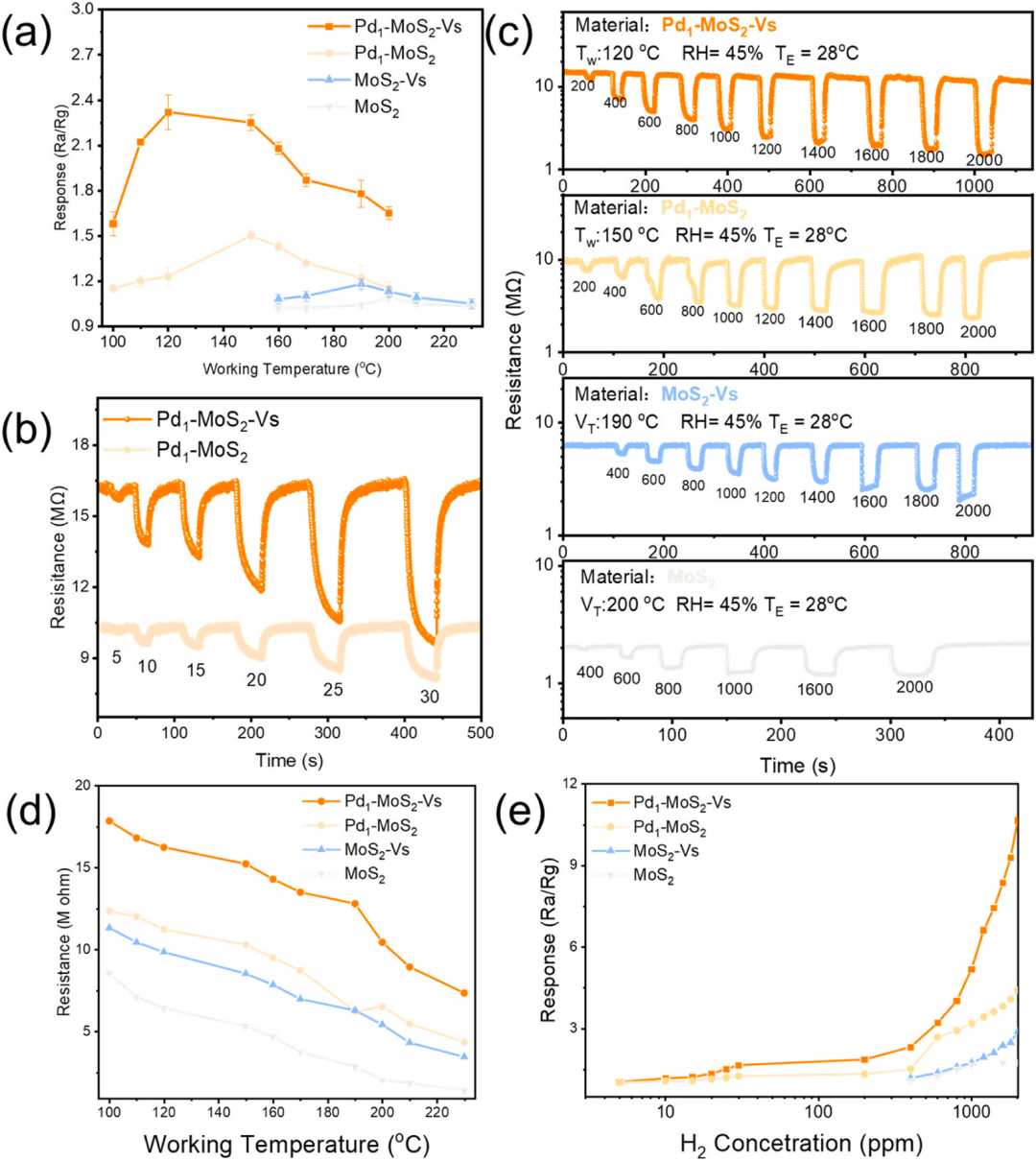
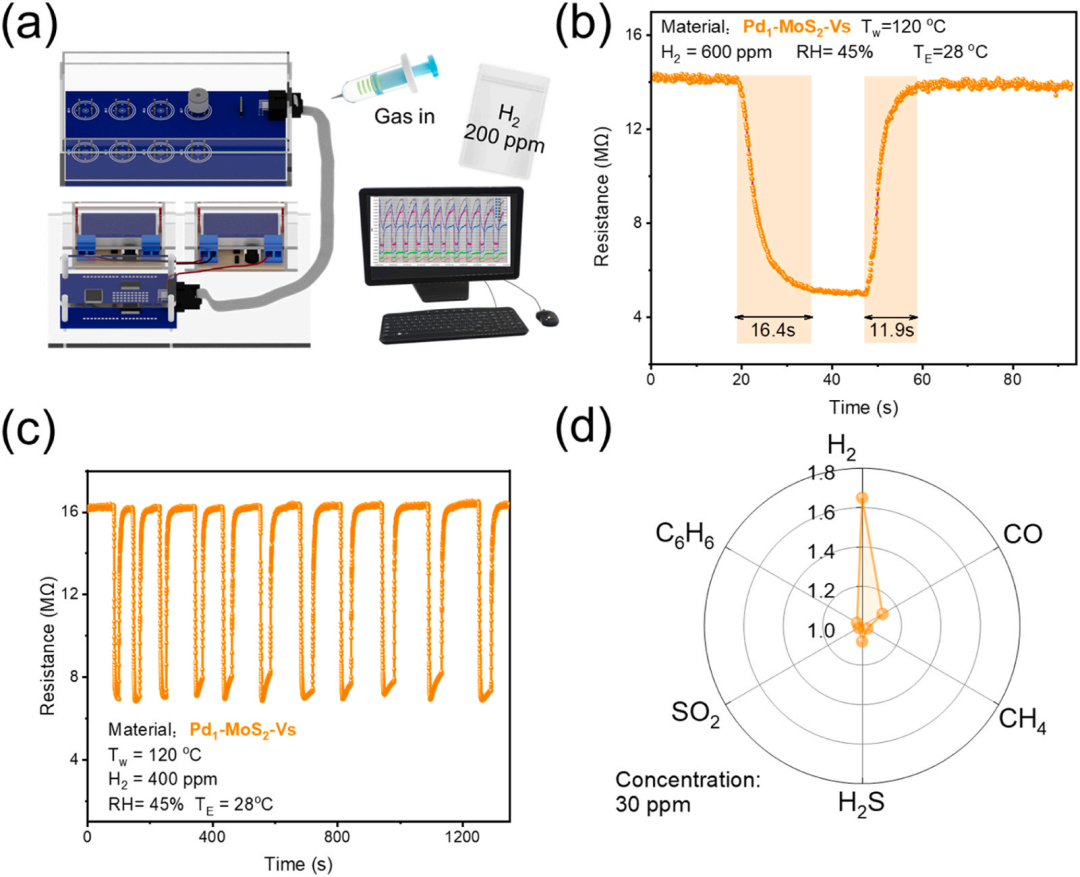
Low Temperature Efficiency:Operating temperature reduced to 120°C, with response speeds of 11.8 s/11.4 s (response/recovery).
Ultra-High Sensitivity and Low Detection Limit:Response of 1.03 to 5 ppm hydrogen.
Strong Anti-Interference Capability:Exhibits high selectivity against gases such as CO, H₂S, SO₂, and C₆H₆.
03
Material Design
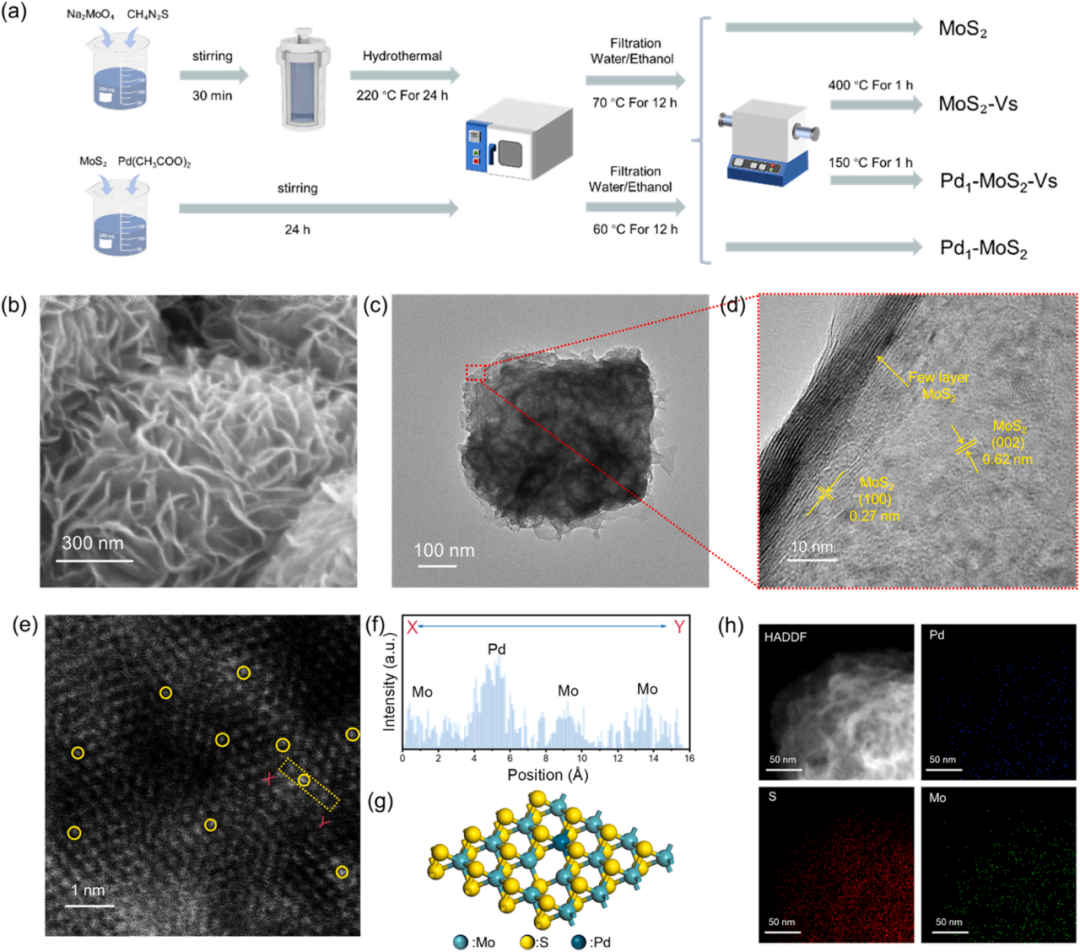
MoS₂-Vs:Introduced sulfur vacancies through H₂/Ar annealing.
Pd₁-MoS₂:Pd single atoms anchored on the MoS₂ surface through electrostatic adsorption.
Pd₁-MoS₂-Vs:Further introduced sulfur vacancies on the basis of Pd₁-MoS₂ to form a synergistic structure.
04
Performance Testing
-
Sensing Performance
Response Value:2.32 at 400 ppm H₂, which is 2.1 times that of pure MoS₂ and 1.5 times that of Pd₁-MoS₂;
Response/Recovery Time:16.4s and 11.9s at 600 ppm H₂, demonstrating fast response speed;
Detection Limit:As low as 5 ppm, meeting the needs for trace leakage monitoring;
Operating Temperature:Optimal at 120°C, significantly lower than traditional MOS sensors (around 300°C).
-
Stability and Selectivity
Humidity Stability:Within the range of 30%-90% RH, response decay is < 5%, suitable for complex environments;
Long-Term Stability:Tested continuously for 50 days, with response deviation < 5%, demonstrating stable and reliable performance;
Selectivity:Response to H₂ is significantly higher than that to CO, CH₄, H₂S, SO₂, benzene, and other interfering gases, showing strong anti-interference capability.
-
Adsorption Performance
Through quartz crystal microbalance (QCM) testing, the H₂ adsorption capacity of Pd₁-MoS₂-Vs reached 6.327 wt%, which is 3.6 times that of pure MoS₂, confirming its excellent hydrogen adsorption capability.
05
Working Mechanism
-
Core of Synergistic Effect
Pd Single Atoms:Optimize the electronic structure of in-plane S atoms through Pd-S bonds, reducing the H₂ dissociation energy barrier and promoting charge transfer;
Sulfur Vacancies:Enhance H₂ adsorption kinetics, forming atomic-level Pd-S-Mo bonds, further regulating the electronic states of S atoms;
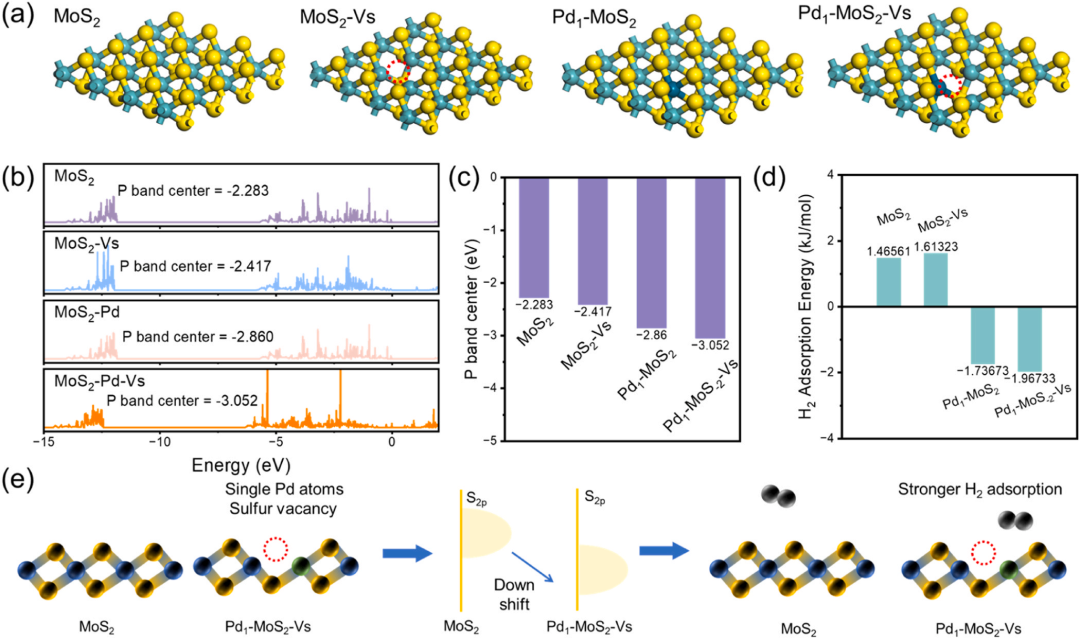
Synergistic Effect:The combination lowers the p-band center of S atoms to -3.052 eV, enhancing the interaction between H₂ and the material surface, increasing the adsorption energy (up to -1.967 kJ/mol).
-
Electron Transfer Mechanism
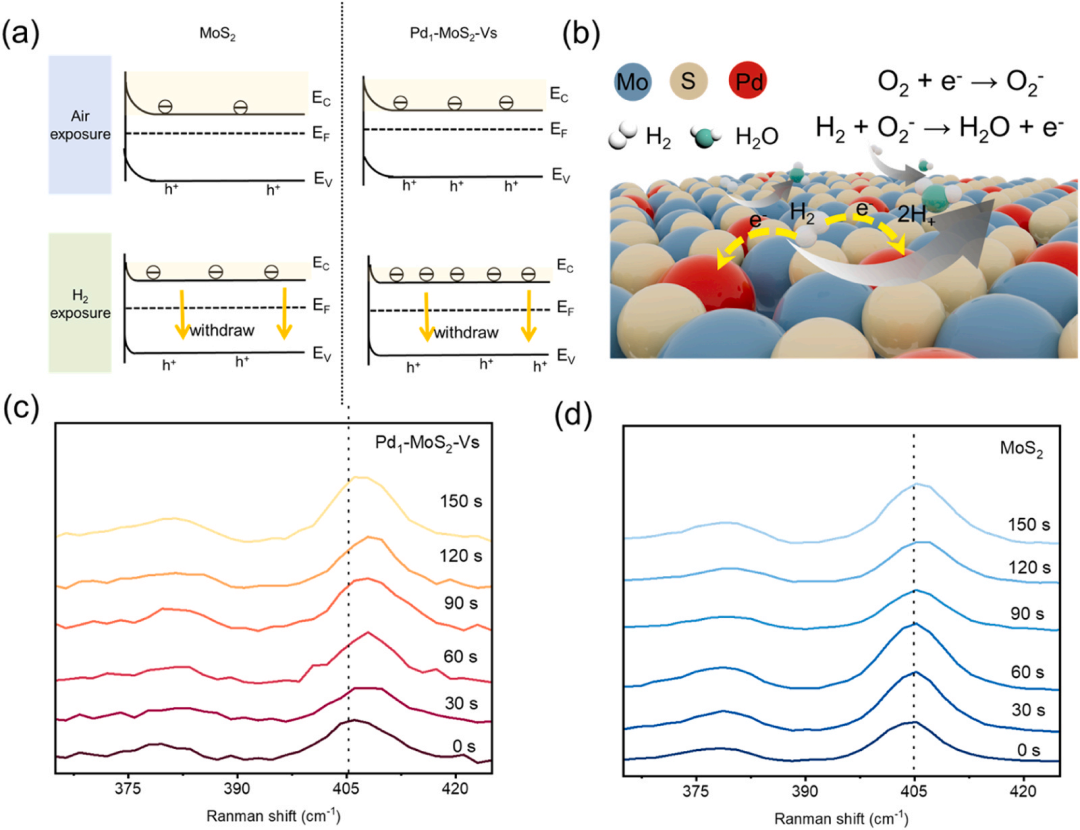
In Air Environment:The material surface adsorbs O₂ and captures electrons, forming an electron depletion layer;
When Exposed to Hydrogen:H₂ reacts with adsorbed O₂ to generate H₂O, releasing electrons back to the material conduction band, causing changes in the thickness of the depletion layer, resulting in resistance changes that generate sensing signals;
In Situ Raman Verification:Significant peak shifts occur when Pd₁-MoS₂-Vs interacts with H₂, confirming more intense electron transfer.
-
DFT Calculations Support
First-principles calculations confirm that the H₂ adsorption energy on the surface of Pd₁-MoS₂-Vs is the strongest, with a more favorable density of electronic states distribution, theoretically validating the rationality of the synergistic strategy.
06
Application Prospects
Hydrogen Safety Monitoring:Applicable for leakage warning in scenarios such as fuel cell vehicles, hydrogen storage tanks, and hydrogen refueling stations;
Industrial Production Detection:Can be integrated into industrial processes involving hydrogen use, such as chemical and semiconductor manufacturing, for real-time monitoring of trace leaks;
Miniaturized Sensing Devices:Compatible with MEMS chips, can be fabricated into portable, miniaturized sensors to meet mobile monitoring needs;
Material Design Reference:Provides a general idea of “single atom + defect engineering” for performance optimization of other gas sensors (such as NO₂, CO, etc.).
07
Paper Information
Xin Jia, et al. “Vacancy-assisted Pd single-atom catalysts unlocking highly effective hydrogen sensing”. Sensors and Actuators: B: Chemical, Volume 448, (2026), 139038
https://doi.org/10.1016/j.snb.2025.139038

“Frontiers in Intelligent Sensing Research” is committed to sharing valuable research information through academic sharing. We strictly respect intellectual property rights. If any copyright disputes arise during the dissemination of information, please contact us promptly. We will make corrections or deletions as soon as verified, to jointly maintain a good academic exchange environment.