Daily 5G Technology News
September 16, 2025, Tuesday

Today’s Hot Topics
❶MediaTek Achieves Breakthrough with 2nm Chip❷Beijing 5G-A Signal Coverage: Unlocking New Communication Experiences
❸China Telecom Quantum Group Procures “Strongest Superiority” Superconducting Quantum Computer
❹China Launches Dual Investigations on US Analog Chips
❺Qualcomm Launches New 5G RedCap Modem

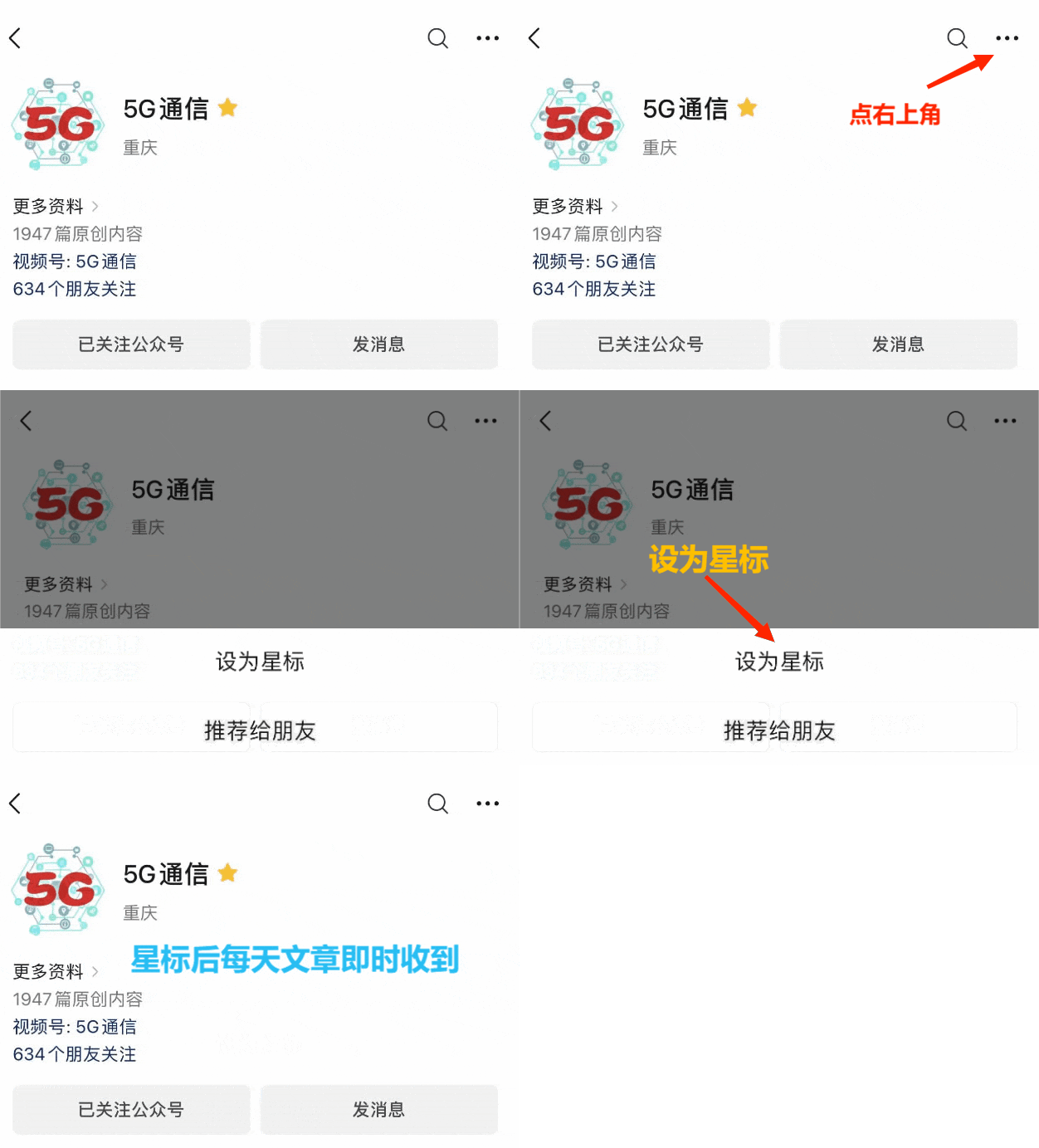
Follow + Star Mark
↑ Click above5G Communication to follow and grasp 5G dynamics in 2 minutes daily
Global 5G, 6G
UK EE First to Deploy ARC Technology, 5G Performance “Soars” Upgraded
Recently, UK mobile operator EE announced it has become the first in the world to deploy Ericsson’s advanced Radio Access Network (RAN) coordination technology (ARC), injecting new momentum into the development of 5G in the UK.
The core of ARC technology allows nearby mobile base stations to remotely pair and share capacity, enhancing network performance without the need for additional base stations, especially effective during peak hours in busy areas. EE has deployed inter-site 5G downlink carrier aggregation technology in a distributed RAN, integrating the remaining capacity of independent base stations, resulting in an average improvement of about 20% in downlink data performance, and more than doubling under ideal conditions.
This technology relies on the fiber infrastructure of BT Group, EE’s parent company, enabling real-time coordination between sites with a latency of less than half a millisecond. Currently, this technology has been launched in major cities such as Manchester and Edinburgh after trials in Bristol, providing faster and more reliable 5G connections for customers in busy locations like train stations and commercial streets.
In the coming year, EE plans to deploy this technology in busy cities in the UK such as London and Leeds. By September 2024, EE has launched a 5G standalone (5G SA) network in 15 cities in the UK and plans to expand to another 17 towns by the end of December 2025, providing 5G SA services to over 41 million people by spring 2026, with 17 locations including Basildon and Bolton set to benefit.
Greg McCall, Chief Network Officer of BT Group, stated that EE customers will be the first to benefit, with significant improvements in 5G connection performance, marking a strong move towards building a 5G standalone network and providing a quality network experience.
Ericsson Aduna Progresses Rapidly: Contracts Signed with 24 Global Telecom Operators
Recently, at the “2025 Ericsson North America Industry Analyst Day” held in Boston, USA, Ericsson showcased its latest achievements across multiple fields, with numerous analysts, partners, and customers participating.
The event focused on several key advancements. The Ericsson executive team introduced breakthroughs in virtual and dedicated networks, wireless wide area networks (WWAN), and AI-enabled capabilities, while its subsidiaries Vonage and Aduna demonstrated high-performance programmable networks that empower new services and business models. Ericsson’s Chief Technology Officer Erik Ekudden stated that we are entering a new era of advanced connectivity technologies that will spur a wave of innovation.
In the field of enterprise connectivity management, Åsa Tamsons, head of Ericsson’s enterprise wireless solutions business, introduced an upgrade to the NetCloud platform’s AI capabilities, evolving from a simple assistant to a multi-agent system that can proactively troubleshoot network issues, applicable to both public and private 5G networks, enhancing return on investment and simplifying management processes.
On API-driven innovation, Vonage CEO Niklas Heuveldop stated that they are combining mobile network capabilities with the developer community and Aduna’s global telecom aggregation capabilities to provide developers with a powerful toolkit. Aduna CEO Anthony Bartolo mentioned that the joint venture is expanding rapidly, having signed contracts with 24 telecom operators, potentially covering 2.5 billion users.
In the critical mission network field, Ericsson introduced the next generation of critical mission networks that replace narrowband systems with high-performance, highly secure 4G/5G connections, aiding real-time collaborative sharing in government and other sectors, solidifying its leadership position in relevant deployments.
During this event, Ericsson also invited many partners and customers, including Verizon and T-Mobile, to discuss industry trends and developments together.
SpaceX Acquires Spectrum for $17 Billion, Starlink Disrupts the Communications Industry
Recently, SpaceX announced it would acquire EchoStar’s AWS-4 (2GHz) and H-band wireless spectrum for $17 billion, planning to use it for the Starlink satellite network. Musk stated that he aims to make Starlink a global mobile operator, attracting widespread attention in the industry.
Currently, Starlink has over 7 million users, and direct-to-device (D2D) service is an important incremental market for it. Previously, due to the lack of dedicated frequencies, D2D services had to cooperate with terrestrial operators, limiting service autonomy and expansion space. After this spectrum acquisition, Starlink satellites will be able to provide high-bandwidth connections directly to mobile phones, although achieving this goal will still take about two years, requiring collaboration with mobile manufacturers to modify chips and build satellites that support the new spectrum.
Musk’s stance on the competitive relationship between Starlink and mobile operators is “ambiguous,” leaving room for cooperation while hinting at potential acquisition actions. Industry experts believe that as Starlink gains control of core resources, terrestrial mobile network operators (MNOs) are gradually becoming its distributors.
Starlink’s “confidence” comes from cognition, performance, and cost. Cognitively, the mobile direct-to-satellite model is widely recognized; in terms of performance, Starlink has a large number of satellites in orbit and plans to expand, with the third-generation satellite network having high capacity and low latency; in terms of cost, with technological iterations, satellite internet costs are decreasing, showing significant advantages in remote areas.
Regarding whether the Starlink model will be replicated domestically, industry veteran Xie Ying believes it is impossible. Domestic spectrum resources are regarded as national strategic resources, and their allocation and use serve the overall communication layout; domestic telecom operators are transitioning rapidly, with distinctive business innovations, and have significant advantages in resource integration and service implementation. The future focus of competition in the communication industry will shift from “coverage” to “service and innovation,” leading the industry towards “network collaboration.”
This $17 billion spectrum acquisition makes Starlink a “disruptor” in the communications industry, but mobile operators will not be overturned. The future communications industry will find a new balance in “integrated space and earth,” and China is expected to carve out a unique path in satellite internet and commercial space development.
China Launches Dual Investigations on US Analog Chips
Recently, the Ministry of Commerce of China simultaneously released two significant announcements, launching anti-dumping investigations on relevant analog chips originating from the United States and initiating anti-discrimination investigations regarding the US measures in the integrated circuit sector towards China. This move marks a new phase in the semiconductor game between China and the US.
Since January 20, 2025, when Trump began his second term, the US has tightened its technology restriction policies towards China, considering placing several Chinese chip manufacturing companies on an export blacklist and conducting trade investigations on traditional semiconductors made in China, potentially imposing tariffs. The Ministry of Commerce’s actions are a direct response to a series of restrictive measures from the US, with the anti-dumping investigation holding three strategic values: compliance, reciprocity, and precision. This investigation was initiated at the request of the Jiangsu Semiconductor Industry Association, reflecting the industry’s demands and proactive awareness of rights protection.
The investigation targets general interface chips and gate driver chips, which are crucial in industrial control, automotive electronics, and communication equipment. Market data shows that from 2022 to 2024, the market share of relevant analog chip products from the US in the Chinese market has significantly increased, while prices have plummeted, with import volumes rising, forming a “volume increase and price drop” dumping characteristic.
Currently, China is the world’s largest consumer market for analog chips, but the domestic production rate is only about 10%, with all top ten global suppliers of analog chips being foreign companies. The domestic replacement of analog chips faces challenges such as technical dependence on engineers’ experience, complex special processes, high requirements for product line integrity, and long customer verification cycles. This investigation specifically targets products with a “40nm process and above,” for which mainland Chinese companies have the technical and production capacity, stable market demand, and can provide development time and capital accumulation for Chinese enterprises.
After the implementation of anti-dumping duties, US analog chip companies selling in China will be directly affected, with industry giants like Texas Instruments and ADI potentially facing rising costs and declining competitiveness. Meanwhile, domestic analog chip companies such as Sanken Electric and Aiwai Electronics are expected to gain greater market opportunities, driving technological upgrades and capacity expansion. This investigation strengthens the awareness of supply chain security in China’s manufacturing industry and serves as a reciprocal response to the weaponization of US trade policies, promoting the establishment of a fair and reasonable international technology cooperation order. The Chinese semiconductor industry needs to seize this strategic opportunity to accelerate independent innovation and build a more resilient and autonomous industrial chain system.
Nokia Bell Labs Demonstrates New 5G Millimeter Wave Dynamic Beamforming Technology
- Event Content: Nokia showcased an advanced 5G millimeter wave technology at its Bell Labs. This technology, through innovative dynamic beamforming algorithms, can more accurately and quickly track high-speed moving user devices, addressing the long-standing issues of limited coverage and easy interruption during mobile handovers for millimeter wave signals. The on-site demonstration showed that in scenarios with speeds exceeding 120 km/h, network connection stability improved by over 40%.
- Potential Impact: This breakthrough technology is expected to accelerate the commercial application of 5G millimeter waves in high-speed moving scenarios such as vehicle networking, high-speed rail, and drone communication. It reduces the difficulty and cost of deploying millimeter waves, making them no longer limited to static scenarios like fixed wireless access, opening up new possibilities to leverage their ultra-large bandwidth advantages.
Qualcomm Launches New 5G RedCap Modem
- Event Content: Qualcomm has released its second-generation 5G RedCap (Reduced Capability) modem chipset – Snapdragon X35M. This chipset significantly reduces power consumption, complexity, and cost while maintaining key 5G features. It is primarily aimed at mid-speed IoT applications such as industrial sensors, wearable devices, smart grids, and low-cost video surveillance, filling the market gap between traditional 5G eMBB and low-power wide area networks (LPWAN).
- Potential Impact: The launch of the new generation RedCap chip will greatly promote the adoption of 5G in the IoT field. It provides a viable solution for numerous IoT devices that are sensitive to cost and power consumption to access 5G networks, helping to build a more comprehensive 5G IoT ecosystem, expected to generate billions of new connections and drive the prosperity of related modules and terminal industries.
Huawei Releases New Generation of Ascend AI Cluster Products
- Event Content: At its annual Connect conference, Huawei released the new generation Atlas Ascend AI computing cluster. This product significantly enhances the computing density and energy efficiency of a single cabinet through liquid cooling and system-level optimization. Huawei emphasized that this cluster will be primarily applied in the core networks and BSS/OSS systems of telecom operators, empowering intelligent network operations, precise marketing, and automated management through AI.
- Potential Impact: The launch of the new generation AI cluster will accelerate the intelligent transformation of communication networks. Operators can utilize more powerful and efficient computing power to process massive network data, enhancing automation levels and operational efficiency, reducing energy consumption, and providing a hardware foundation for developing more complex AI-driven network applications.
Data Focus
iPhone 17 Series Demand in First Week Exceeds 16 Series, Base Model May Become Dark Horse
Recently, JPMorgan analysts analyzed the market demand for Apple’s recently launched iPhone 17 series. The report shows that based on the performance in the first week of launch, the market demand for the iPhone 17 series is stronger than that of last year’s 16 series, primarily based on key market delivery times.
In the first week of launch, the delivery times for the iPhone 17 series in markets such as the US, China, Germany, and the UK were all “slightly higher” than those of the 16 series. Among them, the base model of the iPhone 17 and the newly launched ultra-thin Air model saw a significant increase in demand compared to the base and Plus models of the 16 series. Although initial market demand for the Pro version of the iPhone 17 is slightly weaker compared to the base model, JPMorgan believes this does not necessarily mean that Pro version demand will be lower than last year. Meanwhile, if the current trend continues, the demand growth for the base model iPhone 17 may far exceed market expectations.
Tech Giants
MediaTek Achieves Breakthrough with 2nm Chip
Recently, the semiconductor industry has been dynamic. MediaTek announced today that its first flagship system-on-chip (SoC) using TSMC’s 2nm process has completed design tape-out and is expected to enter mass production by the end of next year. TSMC’s enhanced 2nm process has significant advantages, with logic density increased by 1.2 times compared to the existing N3E process, performance improved by up to 18% at the same power consumption, and power consumption reduced by about 36% at the same speed.
In terms of market performance, a report from Counterpoint Research on global smartphone application processors for Q1 2025 shows that MediaTek ranks first with a market share of 36%, followed by Qualcomm (28%) and Apple (17%).
On the product side, MediaTek’s Dimensity flagship SoC has shipped over 30 million units, with the latest flagship Dimensity 9400+ launched on April 11, 2025, using TSMC’s 3nm process, with models such as OPPO Find X8s series, vivo X200s, and Realme GT7 being the first to adopt it. Apple’s latest iPhone 17 Pro is equipped with a third-generation 3nm chip, utilizing evaporative cooling technology, combined with laser-welded VC thermal plates and aluminum metal integrated body, achieving efficient heat dissipation and strong performance.
China Telecom Quantum Group Procures “Strongest Superiority” Superconducting Quantum Computer
On September 4, 2025, China Telecom Sunshine Procurement Network announced that China Telecom Quantum Information Technology Group Co., Ltd. is publicly soliciting procurement for a 280+ qubit “strongest superiority” superconducting quantum computer key hardware components, with the supplier being Shanghai Guodun Quantum Information Technology Co., Ltd. The public announcement period is from September 5 to September 8. On the evening of September 12, Guodun Quantum announced contract information, stating it would provide supporting products and services for this project, with a contract amount expected to be 63.054 million yuan.
Quantum superiority refers to the computational capability that exceeds that of classical computers for specific problems. China is the only country in the world to achieve “quantum superiority” through both superconducting quantum and photonic quantum routes, with the “Zuchongzhi No. 3” already achieving this goal. The superconducting quantum computer being procured may be the same model as “Zuchongzhi No. 3,” with procurement content including key hardware components such as electronic measurement and control equipment.
Previously, China Telecom’s “Tianyan” quantum computing cloud platform has integrated “Guoyun” Tianyi Cloud supercomputing and 176 superconducting qubit computing power, selected as one of the “Top Ten National Key Equipment of Central Enterprises in 2024.” The superconducting quantum computer being procured is expected to be integrated into the “Tianyan” platform, promoting its capability upgrade and expanding application scenarios.
In recent years, quantum computing has attracted attention from mainstream countries. The deployment of the “strongest superiority” superconducting quantum computer by China Telecom Quantum Group, combined with the relevant technologies of the “Tianyan” cloud platform, will promote the practical advancement of China’s quantum computing industry ecosystem.
Beijing 5G-A Signal Coverage: Unlocking New Communication Experiences
Beijing’s streets and alleys have quietly achieved 5G-A signal coverage, with the 5G-A package launched by Beijing Telecom providing a new solution to communication challenges, comprehensively upgrading user experience.
In terms of speed and latency, Beijing Telecom’s 5G-A demonstrates outstanding performance. With peak downlink speeds of 3Gbps and peak uplink speeds of 400Mbps, downloading movies is instantaneous, gaming is lag-free, and VR immersive experiences are seamless, resolving issues like mosaic in live streaming and high latency in cloud gaming.
In uplink transmission, 5G-A significantly enhances speeds, allowing short videos to be posted to social media instantly, live streaming to be smooth and uninterrupted, and industrial monitoring images to be transmitted in real-time without delay, solving problems like video buffering and live streaming lag.
For special scenario communication challenges, 5G-A integrates mobile direct-to-satellite technology, achieving comprehensive coverage between earth and sky. Whether climbing mountains, going to sea, or in emergency scenarios, users can stay connected anytime and anywhere, saying goodbye to “information islands.”
In crowded places, 5G-A supports massive user access simultaneously, allowing everyone in a venue with thousands of people to surf the internet smoothly and share exciting moments in real-time. Currently, Beijing Telecom has achieved continuous 5G-A coverage within the Fourth Ring Road and is expanding coverage to important living and business scenarios outside the Fourth Ring Road. In the future, Beijing Telecom will continue to adhere to the user-centered philosophy, expanding scenario applications to allow more users to enjoy “faster, more stable, and smarter” 5G-A services.
Jiangsu Cable Strengthens “Provincial Government Cloud”: Achievements in Domestic Replacement “Battle”
Yesterday, Jiangsu Cable announced that its board of directors approved a proposal for its wholly-owned subsidiary Jiangsu Cable Data Network Co., Ltd. to carry out the “Provincial Government Cloud” construction project. This project includes computing resources, dedicated container services, AI computing capabilities of GPU servers, domestic databases, and operating systems, aiming to meet the resource service needs of the provincial government cloud.
Under the promotion of digital transformation and the strategy of self-controllable key core technologies, domestic replacement has become crucial for ensuring information security and promoting independent industrial development. Jiangsu Cable actively responds to national strategies, accelerating its deep cultivation of the domestic replacement business market. Since the beginning of the year, the company’s government and enterprise business has focused on the annual theme and the 2025 work plan, with “domestic replacement” as a priority, establishing special teams and formulating action plans, with provincial, municipal, and county-level collaboration launching a “battle.”
Currently, significant project transformation results have been achieved at the provincial and multiple municipal companies. Recently, branches in Taizhou, Yancheng, Zhenjiang, and Xuzhou have simultaneously made efforts, winning bids for various domestic replacement projects for local party and government agencies and enterprises, with a cumulative bid amount exceeding 80 million yuan, demonstrating the mission and responsibility of state-owned cultural and technological enterprises in digital transformation.

Submission Email:[email protected]
Public Account Rules Change,Set Star Markto see each article
END
Previous Highlights
Unicom Obtains Satellite License, Immediately Launches Satellite Business: 10 Yuan/Month; Xiaomi Executive Dismissed for Serious Violations Including Leakage; China Mobile Layouts Core Chips
September 9, 2025
Nokia’s New 5G-A Base Station, 30% Improvement; OpenAI Develops AI Chip; “850,000 Procurement of 270 Yuan Router” Farce Comes to an End
September 8, 2025
MWC to Focus on 6G; China Academy of Information and Communications Technology Releases “China Computing Network Development White Paper (2025)”; Huawei Mate XTs Extraordinary Master Release
September 5, 2025
World’s First “All-Frequency” 6G Chip Born in China; Huawei Holds New Product Launch; Ministry of Commerce Takes Action Against US Fiber
September 4, 2025
China National Petroleum Transfers Shares to China Mobile for 0 Yuan; Nvidia Denies H100/H200 Supply Restrictions; China’s 6G Chips Use “Light” as Medium
September 3, 2025
iPhone 17 May Eliminate Physical SIM Card Slot; China Takes Lead in 6G Core Standards for the First Time; Nvidia’s H20 Faces “Waterloo” in China: Zero Orders
September 2, 2025