Author: Li NingyuanIoT Think Tank Original
As a typical intelligent hardware product, robots have not demonstrated significant intelligence in their commercial applications for a long time. Traditional robots can be categorized based on their limitations: weak environmental perception, isolated operation of unimodal sensors, lack of multimodal fusion algorithms and anti-interference hardware; shallow interaction, reliance on preset interaction rules, and the ability to capture only limited states, lacking semantic understanding and contextual memory; limited local processing capabilities, with insufficient computational power on the robot side leading to decision delays and an inability to finely process multimodal data; rigid decision logic, lacking dynamic optimization strategies and real-time decision-making capabilities. This has resulted in traditional robots being unable to achieve deeper perceptual interaction in unstructured scenarios, making it nearly impossible to generalize applications in “long-tail scenarios”.
With the gradual improvement of perception technology, control technology, and computational power, as well as the rapid iteration of AI models and their accelerated deployment on the edge, the robotics industry is undergoing a significant transformation. Especially with the rise of the concept of embodied intelligence, many companies are entering the embodied intelligence track, and this year’s policy-level attention to embodied intelligence marks this technology as a “key area” in technological competition.
With the push from top-level policies and the proactive layout of enterprises, the domestic embodied intelligence industry is showing a vigorous development trend. As the culmination of intelligent hardware and artificial intelligence, embodied intelligent robots are beginning to lead the robotics industry towards a turning point in intelligence. Embodied intelligence interacts with hardware agents and the environment to acquire information, understand problems, make decisions, and execute actions, thereby exhibiting intelligent behavior and adaptability. Traditional artificial intelligence typically relies on abstract symbolic computation, while embodied intelligence emphasizes cognition through physical body perception, movement, and interaction with the external environment, achieving higher-order autonomous intelligence based on these cognitions.
Breaking Through the Pain Points of Embodied Intelligence, Robrain AI Achieves ‘Perception-Decision-Interaction’ Closed-Loop Intelligence
As a product that integrates cutting-edge scientific technologies, each technical framework of embodied robots, including perception, decision-making, and execution layers, has a vast space for intelligence. Multimodal embodied perception is a crucial step in upgrading traditional robots to embodied robots and is a foundational capability of embodied intelligent robots. An embodied intelligent robot requires a complete multimodal embodied perception system to drive changes in motion control paradigms through multidimensional perception data collection.
Recently, during the 2025 MWC Shanghai, Quectel and Zhujie Dynamics jointly released a groundbreaking Robrain AI robot solution. This solution adopts an innovative edge-cloud collaborative architecture and microphone array pickup technology, deeply integrating edge intelligence with the advantages of cloud-based large models, endowing robots with near-human “thinking” and “listening” capabilities, elevating their perception to embodied perception.
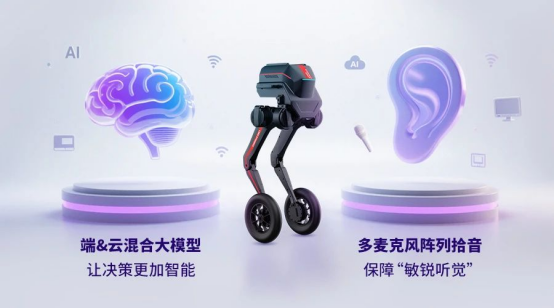
This solution has been successfully implemented on Zhujie Dynamics’ flagship product, the multi-form biped robot TRON 1, effectively overcoming key challenges such as AI model customization, lightweight deployment, and low-latency interaction response, propelling robots from “mechanical execution” to “active perception, intelligent thinking, and natural communication” as AI intelligent agents.
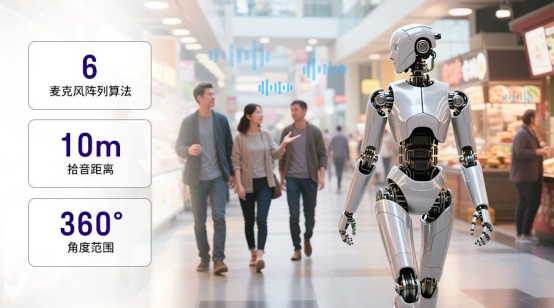
Voice perception interaction in robots has always faced several challenges: first, omnidirectional far-field pickup is difficult; second, there are many dynamic scene noise sources; additionally, the robot’s own movement can generate noise that interferes with voice capture. Robrain AI employs advanced 4/6 microphone array algorithms, using spatial filtering technology to form directional pickup beams, effectively suppressing environmental noise and enhancing the human voice from the source, allowing for precise capture even in noisy environments. The ASR model applied by Quectel at the perception layer, through a large number of self-developed end-to-end voice processing algorithms, ensures high-quality front-end acoustic processing, providing a guarantee for accurate model recognition and endowing robots with keen “hearing”.
Based on keen perception, how to make decision interaction warmer is also a core measure of the robot’s intelligence and commercial value. This requires equipping robots with a brain capable of reasoning and deep semantic understanding, helping them truly comprehend the world, deconstruct human commands, perform logical reasoning, and plan decisions. For embodied intelligent robots, model technology is the cornerstone of realizing their vision, and fully leveraging the advantages of a model brain is not an easy task.
Quectel’s Robrain AI robot solution, based on deep adaptation and continuous optimization of AI engineering technology, constructs a deep collaborative system between edge and cloud large models around Quectel’s AI modules and their powerful computing capabilities. The cloud large model fully utilizes its rich data reserves, allowing robots to seamlessly access mainstream cloud large models and professional search tools such as Doubao and DeepSeek, enhancing deep semantic understanding and reasoning capabilities, and addressing the limitations of shallow interaction.
The edge model focuses on local real-time reasoning, granting robots millisecond-level response capabilities and reliable offline functionality. Whether it is commands for moving forward, turning, stepping in place, standing up, or squatting, or specialized Q&A needs in enterprise-specific fields, robots can provide instant feedback. Additionally, the solution supports the local deployment of customized knowledge bases for enterprises, allowing robots to still provide professional and accurate Q&A services even in offline states. In terms of model efficiency and accuracy, to compensate for the losses of AI intelligence on the edge model, Quectel employs a series of technologies such as vector databases, RAG, and model fine-tuning to enhance the intelligence level on the edge.
With the deep collaboration between edge and cloud large models, the Robrain AI robot solution has achieved significant improvements in situational understanding, knowledge fusion, intelligent interaction, and rapid response, which were previously lacking in weak interaction and reasoning robots, enabling robots to achieve deep anthropomorphic perception and interaction in unstructured scenarios, and quickly generalize applications in “long-tail scenarios”.
As Pang Bo, co-founder of Zhujie Dynamics, stated, “By integrating Quectel’s Robrain AI robot solution, our biped robot possesses excellent edge performance, enabling quick responses and precise interactions even in complex environments, significantly enhancing the product’s generalization capability and market deployment potential.”
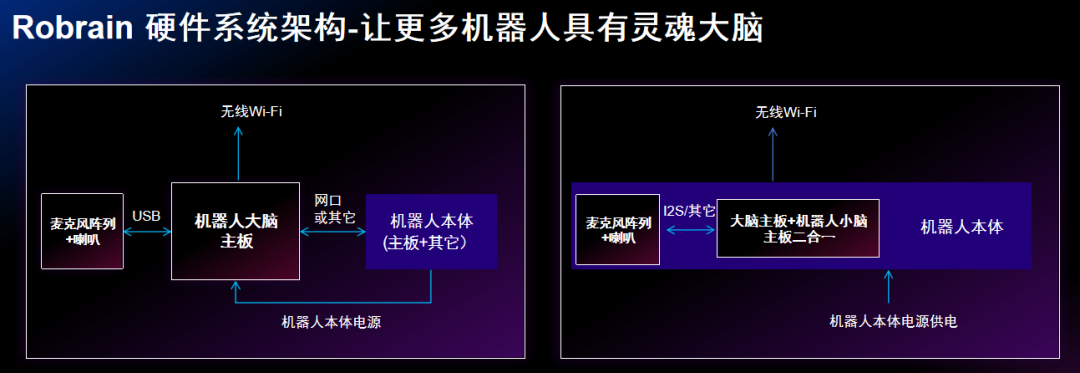
It is reported that the Robrain AI currently offers two specific solutions. The first is a rapid integration solution, which provides a separate robot brain outside the robot body, with each module of the solution being relatively independent, facilitating quick integration and enabling traditional robots to possess decision-making and voice interaction capabilities. The second is a deep integration solution, which has a higher degree of integration, and the reliability of the integrated hardware and software design is also higher, suitable for robots that require deep integration of embodied intelligent scenario applications.
From perception to decision to interaction execution, Robrain AI constructs a complete closed-loop intelligent solution, enabling robots to truly possess the ability to “observe the world, think about problems, and solve problems” through deep technological collaboration and efficient data flow between edge and cloud. Based on accurate and comprehensive perception and personalized decision-making, Robrain AI brings the AI capabilities of robots into practical pathways. This full-link intelligence transforms robots from mere mechanical executors into embodied intelligent agents capable of understanding intentions and taking proactive actions.
Accelerating the Arrival of the Endgame of Embodied Intelligence, Quectel Promotes the ‘Soul Awakening’ of Robots
At the turning point of the upgrade in the embodied intelligence industry, the value brought by Robrain AI to the robotics industry goes far beyond a simple technical upgrade. For the robotics industry, generalizing applications in long-tail scenarios has become a commercial landing challenge that has plagued the industry for many years. How to promote Robrain AI to industrial, commercial, and service-oriented sub-scenarios has become the key to accelerating the transformation of the robotics industry.
The deep voice interaction experience brought by Robrain AI addresses the long-standing lack of emotional responses, enhancing the affinity of human-robot interaction; its adaptability demonstrated in complex scenarios has made significant strides in solving the generalization of robot scenario applications; coupled with the optimized computing power distribution in the edge-cloud collaboration of the solution, it reduces cloud dependency, making it possible for robots to enter more application scenarios, while also improving response speed and cost-effectiveness, balancing cost and efficiency, and accelerating the penetration of robots into more application scenarios. These technology empowerments, starting from scene landing, not only promote the leap of robots from “mechanical execution” to “soul awakening” but also accelerate the development of robots towards the endgame of embodied intelligence.
It is worth mentioning that when designing this robot solution, Quectel has already considered the possibility of continuous evolution of robots. The Robrain AI robot solution, equipped with Quectel’s AI computing module, can be customized for various forms and different scenarios of robots, continuously providing functional evolution through end-to-end AI technology, anchored by scene requirements, driving the application of robots into various industries. Building an AI technology stack around the specific scene’s embodied intelligence needs is undoubtedly the core proposition for advancing the arrival of the embodied intelligence era, both for Quectel and for the entire industry chain.
In a recent live broadcast, Quectel shared previous landing cases, such as the De Yi All-Purpose AI Embodied Robot, built using Quectel’s edge AI overall solution and the high-performance AI computing module SG885G-WF, which can quickly and accurately understand user commands and intentions expressed in natural language without the need for a therapist’s intervention or network connection, efficiently completing tasks such as general chatting, medical field RAG Q&A, and command control.
In diverse fields such as cleaning robots, companion robots, educational robots, and transport robots, Quectel is also accelerating its layout, relying on the deep collaboration of the soul brain with perception, AI, and communication across the entire technology stack to promote intelligent leaps in robots across different application directions.
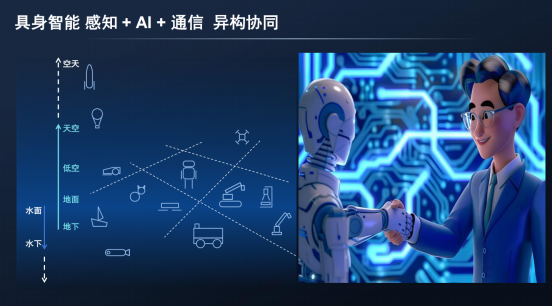
For embodied robot terminal devices with execution capabilities, further building multimodal embodied large models is an essential path to achieving higher-order intelligence in the future. Meanwhile, the adaptation of multimodal models and hardware computing power is key to whether the capabilities of embodied large models can be truly applied, and it is also crucial for advancing the landing of embodied robots.
Quectel has also revealed in a recent live broadcast that its solution planning is advancing in the direction of enhancing planning and decision-making capabilities from multimodal perception, continuously expanding the end-to-end AI engineering capabilities, improving the applicability and coverage of the solution, and providing customers with a one-stop embodied robot solution to accelerate the arrival of the endgame of embodied intelligence.
Final Thoughts
The Robrain AI robot solution provides an opportunity for collaborative cooperation across the upstream and downstream of the industry chain, allowing all parties to leverage their technical expertise to continuously explore the application scenarios of robots. With the support of cutting-edge technologies such as model technology, multimodal interactive perception technology, and control technology, the development of embodied intelligent robots is driving AI towards a direction where it can understand, reason, and interact with the physical world. As NVIDIA’s Jensen Huang stated, the endgame of AI technology lies in physical AI, and the next wave of the AI era is the “embodied intelligence” era.