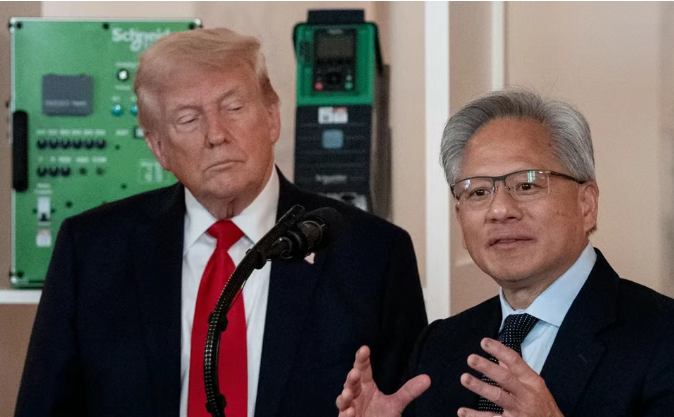
At a critical juncture where global technology intersects with geopolitics, NVIDIA CEO Jensen Huang’s itinerary has garnered significant attention. According to insiders, Huang met with U.S. President Donald Trump at the White House on Thursday (July 10) and is set to travel to China the following day. This trip coincides with NVIDIA’s market capitalization surpassing $4 trillion for the first time, making it the first company globally to reach this milestone.
White House Meeting: The Game of Market Value and Export Controls
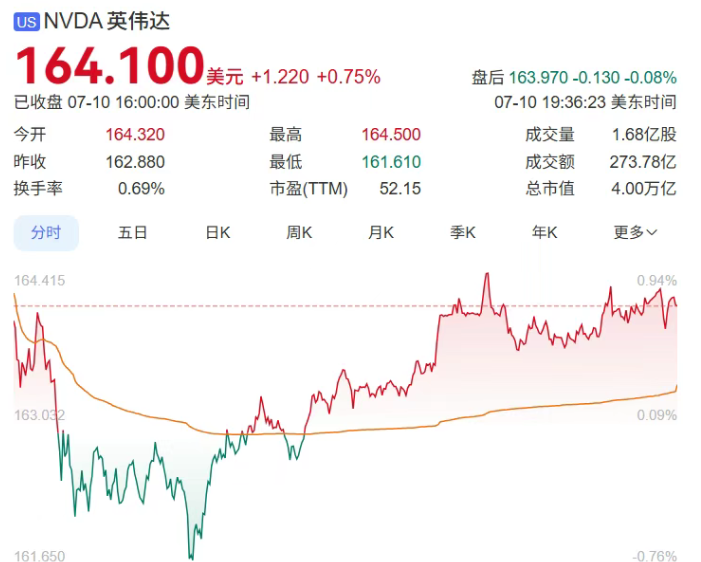
The backdrop of this meeting is quite delicate. On the day of the meeting, NVIDIA’s stock price rose slightly by 0.75%, closing at $164.10, with a total market capitalization reaching $4.004 trillion, surpassing Apple and Microsoft to become the highest-valued company in the world. Trump praised NVIDIA’s performance on social media, stating, “Since the implementation of Trump tariffs, NVIDIA’s stock has increased by 47%. The U.S. has gained hundreds of billions in revenue through tariffs.” He also emphasized, “Our country is ‘back’ again.”
However, the specific details of the discussions between the two parties have not been made public. An NVIDIA spokesperson declined to comment, stating only that the company has been responding to the Trump administration’s export controls on AI chips implemented in April this year under the guise of national security. At that time, the U.S. government informed NVIDIA that its H20 processor, designed specifically for the Chinese market, would require an export license. Huang had previously told investors that this requirement “cut off NVIDIA’s sales without any grace period.” It is estimated that this policy has led to NVIDIA losing up to $8 billion in orders in the quarter ending in July.
Jensen Huang’s upcoming visit to China is also drawing attention. He plans to attend the China International Supply Chain Promotion Expo in Beijing next week and may meet with senior Chinese officials. One of the core topics of this visit is NVIDIA’s plan to launch a new AI chip designed specifically for the Chinese market as early as September. This chip is reportedly a downgraded version of the existing Blackwell RTX Pro 6000 processor, removing advanced technologies such as high-bandwidth memory (HBM) and NVLink to comply with U.S. export control regulations.
However, the prospects for this “China-specific” chip remain uncertain. NVIDIA needs to obtain a clear assurance from the Trump administration that the chip will not be banned shortly after its launch. Huang has previously criticized the U.S. export controls on chips to China as a “failure,” pointing out that these restrictions harm U.S. companies far more than they affect China. In an interview in May, he stated that U.S. regulatory measures have led to NVIDIA losing $15 billion in sales and forced the company to exclude the Chinese market from its revenue forecasts.
NVIDIA in the Geopolitical Tech Struggle
NVIDIA’s situation reflects the complex interplay between current global technological competition and geopolitics. On one hand, the explosive growth in demand for AI computing power has driven NVIDIA’s market value to historic highs; on the other hand, U.S. technology blockade policies against China pose severe challenges in the Chinese market. China plans to deploy over 115,000 high-end NVIDIA AI chips in regions such as Xinjiang and Gansu, but these chips fall under the types banned from export by the U.S. since 2022. U.S. officials estimate that there are currently only about 25,000 banned NVIDIA chips within China, far from sufficient to support its massive AI data center plans.
Jensen Huang’s “White House-Beijing” dual-city trip may be a crucial step for NVIDIA in seeking balance amidst globalization and geopolitical pressures. As AI technology becomes a core area of competition among major powers, NVIDIA’s chips are not only tied to commercial interests but also influence the future trajectory of the global technology landscape.