On September 17, Dongshan Precision stated during an institutional survey that the core of the company’s AI strategic layout is to build competitiveness around the hardware infrastructure needs of the AI industry ecosystem.
Currently, the optical chip market is experiencing a significant shortage due to the explosive demand for high-speed optical modules driven by AI, especially for 800G and above high-speed products, where the supply gap is particularly prominent, and the tight supply situation is unlikely to ease in the short term.After acquiring Solsci, the company’s long-term goal will focus on the demand for 1.6T optical modules from top global technology customers.
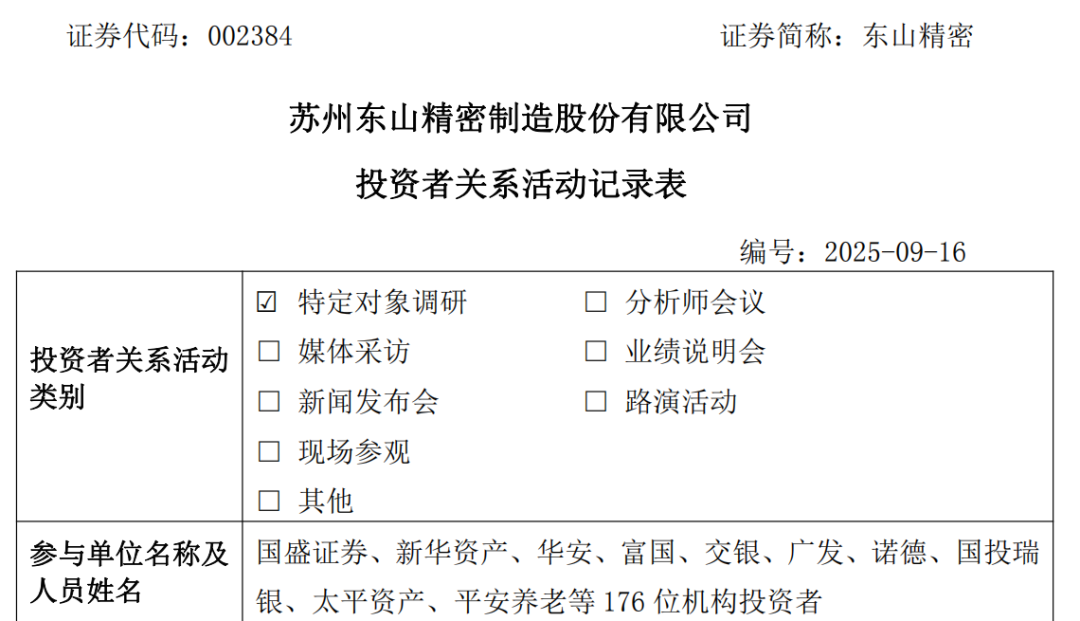
Dongshan Precision stated:
1. The core of the company’s AI strategic layout is to build competitiveness around the hardware infrastructure needs of the AI industry ecosystem. Currently, the company has covered internationally leading top customers in consumer electronics and new energy vehicles, maintaining steady progress in its basic business, and will focus on promoting the research and production of high-end PCBs and optical modules required for AI computing power in high-growth, high-performance scenarios, increasing capital expenditure around these two major products, enhancing capacity construction and large-scale delivery capabilities, and solidifying its core competitive position in the AI hardware supply chain.
2. The foundation of the company’s AI PCB business development is based on Multek’s deep technical accumulation and resource reserves. Multek was originally a subsidiary of Flex, with significant technical capabilities, serving internationally renowned customers, and has accumulated a mature technical system in the high-end PCB field; its high-quality customer resources save time in building a customer network from scratch. From a technical perspective, Multek is one of the few companies in the industry that can master core technologies such as HDI (High-Density Interconnect) and high-layer PCBs simultaneously, having accumulated solid manufacturing process experience through the large-scale application of high-layer PCBs in communication equipment, and subsequently forming multi-stage HDI product capabilities through technological integration, which can accurately meet the core needs of AI devices for “high density + multi-layer” products, and possesses the technical strength to match high-performance AI scenarios, fully meeting the performance requirements of high-end AI applications.
3. To ensure the timely release of AI PCB business capacity, the company has proactively implemented equipment and supply chain assurance strategies, securing capacity resources for core production processes such as laser drilling, providing solid hardware support for the large-scale release of business capacity. As the demand for AI computing power continues to grow, the number of layers in PCB products will further increase, and product prices will also rise accordingly. We believe that future industry demand and product value will both show an upward trend. With Multek’s technical barriers and early layout capacity advantages, the company occupies a favorable position in market competition and is expected to achieve business expansion relying on both technology and capacity support.
4.Currently, the acquisition of Solsci is progressing smoothly,and the core transaction processes are advancing as planned.
5.Currently, the optical chip market is experiencing a significant shortage due to the explosive demand for high-speed optical modules driven by AI, especially for the supply gap of high-speed products of 800G and above, and the tight supply situation is unlikely to ease in the short term. From the perspective of the expansion cycle, there are significant differences between optical chips and optical modules; the expansion of optical chips requires about a year of capacity construction and must go through a customer verification process lasting up to three years; while the expansion of optical modules is more flexible, and the expansion pace can quickly respond to changes in customer demand. This difference in cycles means that the speed of alleviating the shortage of optical chips is much slower than that of optical modules, and suppliers with technological accumulation and customer verification advantages will occupy a more favorable position in the current landscape.
6. In the field of optical chips, the company believes that Solsci’s core competitiveness lies in its self-research capabilities,and the expansion plan after the acquisition will focus on the demand for high-end optical modules (800G, 1.6T, etc.), promoting technological iteration and capacity optimization. After the equity transfer of Solsci, relying on strategic synergy, the company will increase capital and supply chain support for Solsci, ensuring stable capacity and controllable costs through the IDM vertical integration model, while promoting the mass production of high-end chip research and development, and responding promptly to the needs of AI server or data center customers.
7. Solsci focuses on market penetration of high-end optical module products with major customers, and after the acquisition, the long-term goal will focus on the demand for 1.6T optical modules from top global technology customers, while optimizing production bases to solidify capacity foundations for business volume expansion by 2026.
8. In terms of optical module technology layout, Solsci adopts a dual-track strategy of EML and silicon photonics. Currently, the EML solution is the main focus for advancing the sampling of 800G/1.6T products, while also emphasizing the cultivation of silicon photonics technology—its silicon photonics solution has significant cost advantages and has priority for application in scenarios such as LRO, DSP halving, and LPO.
Some materials are sourced from: relevant online media
Integration: Optoelectronic Link, if the integrated content involves copyright issues, please contact us, and we will take appropriate measures in a timely manner.
Recommended Reading
· Tencent fully opens AI capabilities, adapting domestic chips to promote industrial transformation
· Chinese researchers make new progress in the field of inorganic photovoltaic material thin films
· Today! Hesai Technology lists on the Hong Kong Stock Exchange! Market value of 35.2 billion
· Huawei’s chip business personnel changes: Gao Ji takes over as chairman of HiSilicon, Xu Zhijun resigns
· Lingming Photon completes C3 round financing, receiving nearly 100 million investment from Zhejiang State-owned Assets Platform