Table of Contents | Issue 5, 2025 Special Topic: Wireless Communication Technologies for the Industrial InternetObservations and Trend Analysis of 6G International StandardsAnalysis of Deterministic Short-Range Wireless Networking and Applications for IndustryMethods for Simplified Transmission and Organization of Industrial Networks with Reduced System EntropyReview of Research on Deterministic Networks Integrating Wired and Wireless for the Industrial Internet04Wireless Communication Technologies for the Industrial InternetMobile Communications, Issue 6, 2025
Research on 5G-TSN Integrated Networking Technology and Deployment Scheme for Industrial Scenarios
Li Xianda, Pei Yushan, Huang Rong, Li Ruihua
(China United Network Communications Group Co., Ltd. Research Institute, Beijing 100000)
【Abstract】With the deterministic communication requirements for industrial application scenarios, 5G-TSN technology has received widespread attention in recent years. However, the 5G-TSN industry is still in its early stages of development, and there are many challenges to overcome for deep applications in the industrial field. This paper reviews the evolution of 5G-TSN standards and the current state of the industry chain, introduces the architecture and key technologies of 5G-TSN integrated networking, analyzes the urgent problems that need to be solved for industrial applications, and proposes a lightweight deployment scheme for 5G-TSN, along with performance verification results.
【Keywords】5G; TSN; Integrated Networking; Industrial Internet
doi:10.3969/j.issn.1006-1010.20250325-0004
Classification Number: TN92 Document Code: A
Article Number: 1006-1010(2025)05-0027-07
Citation Format: Li Xianda, Pei Yushan, Huang Rong, et al. Research on 5G-TSN Integrated Networking Technology and Deployment Scheme for Industrial Scenarios[J]. Mobile Communications, 2025,49(5): 27-33.
LI Xianda, PEI Yushan, HUANG Rong, et al. Research on 5G-TSN Integrated Networking Technology and Deployment Scheme for Industrial Scenarios[J]. Mobile Communications, 2025,49(5): 27-33.
0 Introduction
The low latency, high bandwidth, and high reliability of 5G networks have attracted attention from various vertical applications such as industry, power, and vehicle networking, becoming an important supporting technology for accelerating the transformation of traditional industries and cultivating new business formats. However, there is still a gap in the current network capabilities of 5G to meet the stringent deterministic requirements of core industrial production operations. In recent years, due to the deterministic capabilities of TSN, the integration of 5G and TSN technologies has become one of the research directions for enhancing the capabilities of 5G networks. How to integrate the architecture and mechanisms of TSN into the 5G system to further enhance the determinism and stability of data transmission in 5G systems is currently a focal point of industry attention.[4].
This paper first reviews the standard progress and current state of the 5G-TSN industry chain; then introduces the integrated deployment architecture of 5G-TSN, the interaction processes of network elements, clock synchronization mechanisms, and joint scheduling mechanisms, analyzing the main problems faced in the deployment of industrial scenarios; finally, to address the difficulties encountered in the current deployment of 5G-TSN, a lightweight deployment scheme is proposed, and performance verification is conducted in both laboratory and actual industrial scenarios.
1 Current Development Status of 5G-TSN
1.1 Standard Evolution
TSN has evolved from the IEEE AVB (Audio Video Bridging) technology, which has attracted the attention of industrial enterprises due to its good real-time assurance for audio and video services. Currently, IEEE has established a series of standards such as IEEE 802.1Q, IEEE 802.1AS, and IEEE 802.1CB, which specify TSN in terms of time synchronization, reliability assurance, bounded low latency, and resource management.
The 3GPP 5G R16 standard enhances support for vertical industry applications, one important feature being the proposed collaboration between 5G and TSN networks, where the 5G system is integrated as a transparent transmission bridge into the TSN network, enabling interaction between the TSN system and the 5G system through converters located at the edge of the 5G network.
In the 3GPP R17 version, more flexible application scenarios are supported, introducing 5G intrinsic deterministic communication without the need for an external TSN network, simplifying the complexity of service networking. The R17 version also adds IEEE 1588v2 time synchronization capabilities, no longer limited to the 802.1AS time synchronization mechanism. Additionally, by introducing service lifetime parameters, the AF can provide more comprehensive service characteristic information to the 5GS, enhancing the 5G network’s perception of services and SLA assurance capabilities.
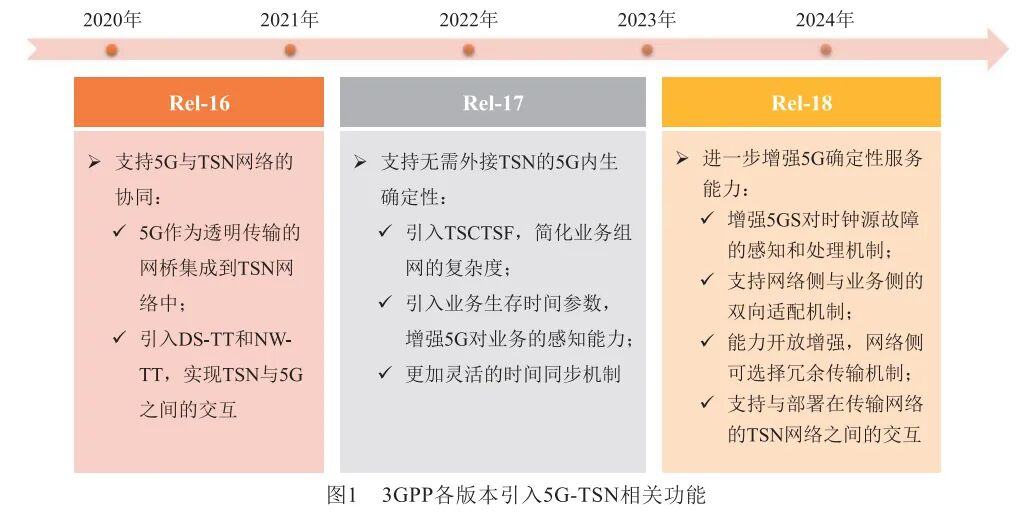
The 3GPP R18 version continues to enhance the deterministic service capabilities of the 5G network, including improved perception and handling mechanisms for clock source failures; supporting AF requests for time synchronization services in specific coverage areas; supporting AF requests for PER (Packet Error Rate) metrics, with the network side selecting user plane redundancy transmission mechanisms based on these requests; supporting adaptation mechanisms between the network side and service side, allowing services to adjust packet sending times and cycles based on feedback from the 5GS; and supporting interaction mechanisms with TSN networks deployed in the transport network to achieve efficient N3 transmission and enhance end-to-end determinism. The gradual introduction of 5G-TSN related functions in various versions of 3GPP is illustrated in Figure 1..
The domestic CCSA has also conducted technical research on 5G-TSN integrated networking, and has established a series of standards such as “Technical Requirements for 5G Mobile Communication Networks Supporting Time-Sensitive Networks (TSN)” and “Technical Requirements for the Integrated Deployment of Time-Sensitive Networks and Mobile Fronthaul Networks in the Industrial Internet”.
1.2 Current State of the Industry Chain
Currently, factory automation control networks are still primarily based on traditional fieldbus technologies and industrial Ethernet technologies, and the application of TSN in the industrial field is still in its early stages, but it has great development potential. TSN has gradually gained industry recognition, with organizations such as the Industrial Internet Consortium and 5G-ACIA actively promoting the development of TSN. The core technologies of TSN switches, gateways, network cards, etc. (such as time synchronization, traffic scheduling, and priority management) have matured, and domestic and foreign manufacturers have launched several commercial products that can meet the microsecond-level latency requirements of industrial automation and vehicle networks.[5]However, the related technologies of TSN controllers are still under development, mainly used for network configuration and traffic scheduling. Some manufacturers have launched related products, but the overall industry chain is not yet fully mature, with significant issues in standardization and interoperability. The complexity of network management and configuration increases during large-scale deployment, requiring further optimization and solutions.
The integrated deployment of 5G and TSN requires functional enhancements to 5G base stations and core network elements, while introducing new network elements on both the terminal and network sides. Currently, the industry is still in the exploratory and pilot stage, with no mature products suitable for large-scale deployment.
2 5G-TSN Integrated Deployment Architecture and Key Technologies
2.1 Standardized Deployment Architecture
The 3GPP R16 standard defines the 5G-TSN collaborative architecture model,as shown in Figure 2. By adding new functional entities to both the user plane and control plane of the 5G system, it enables cross-domain business parameter interaction (time information, priority information, packet size and interval, flow direction, etc.), port and queue management, QoS mapping, and other functions, supporting end-to-end deterministic transmission of business flows across 5G and TSN. To adapt to the TSN network, the 5G network must meet the requirements defined for bridges in the centralized configuration model of TSN networks as specified in IEEE 802.1 Qcc, and support the following functions to adapt to the TSN network: support Ethernet traffic through MAC addressing; ensure differentiated service traffic, enabling deterministic transmission of various service traffic between UPF and UE; support TSN centralized architecture and time synchronization mechanisms; and support management and configuration of TSN networks.[11].
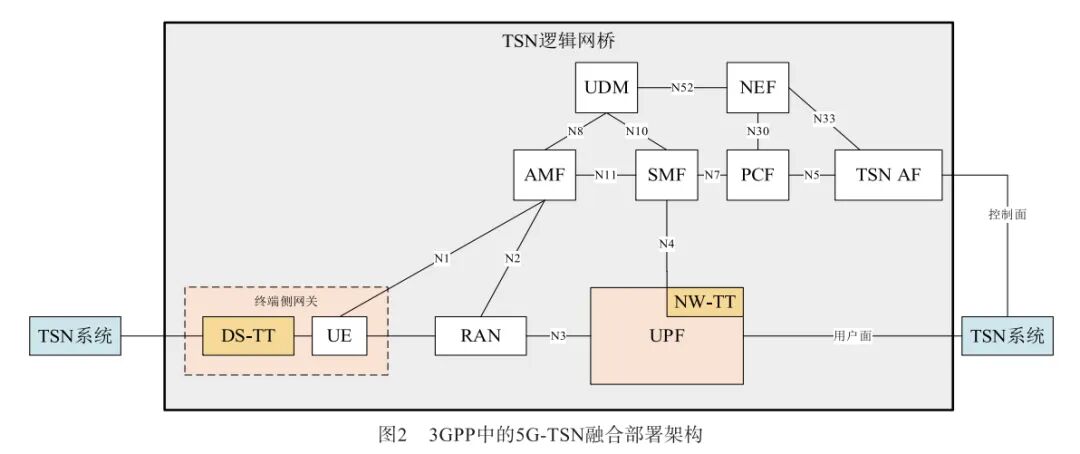
Among them, the control plane of the 5G core network needs to add a TSN application function entity (TSN AF), which mainly performs three functions: first, interacting with the centralized network configuration (CNC) entity in the TSN domain to achieve the transmission direction, flow cycle, transmission delay budget, and service priority parameters with 5G; second, interacting with network elements such as PCF, SMF, and AMF to correct and transmit key parameters of TSN business flows under the 5G clock, and configure corresponding 5G QoS templates based on the priority of TSN business flows to ensure QoS within 5G; finally, interacting with NW-TT and DS-TT to achieve port configuration and management functions for the 5G-TSN bridge.
On the user plane, to achieve interface interoperability between the 5G network and the TSN network without making significant changes to the internal network elements of 5G, two protocol conversion gateways are added at the boundaries of the 5G system: a network-side TSN converter (NW-TT) is added in the UPF, and a device-side TSN converter (DS-TT) is added on the terminal side. NW-TT and DS-TT support the scheduling mechanisms and message caching forwarding mechanisms defined by IEEE, to meet the different requirements of various categories of traffic for network available bandwidth and end-to-end latency. On the other hand, DS-TT and NW-TT achieve synchronization between the TSN network and the 5G clock.
In addition, the control plane elements such as PCF, AMF, SMF, and the user plane UPF elements need to be functionally enhanced to adapt to the 5G and TSN networks, obtaining TSN configuration information and related business information.
2.2 Interaction Process of Network Elements
To support the TSN system architecture and scheduling processes specified in the IEEE standards, the 5G system needs to support the following functions:
1) Configure the bridge information of the 5G system;
2) After establishing the PDU session, report the bridge information of the 5G system to the TSN network;
3) Receive configuration information from the TSN network;
4) Map the TSN configuration information to the QoS information of 5G.
In the 5G-TSN integrated deployment architecture, the newly added network element TSN AF is responsible for information exchange between the 5G system and the TSN system.
(1) Interaction between TSN AF and CNC
On one hand, TSN AF sends bridge information (including bridge name, number of ports, address, etc.) and delay information of the bridge to CNC. On the other hand, TSN AF obtains business mode parameters, including business flow direction, burst arrival time, cycle, etc., based on the PSFP information sent by CNC, and generates TSCAC (Time-Sensitive Communication Auxiliary Container) to provide to PCF and SMF.
(2) Interaction between TSN AF and DS-TT and NW-TT
TSN AF can exchange port management information with DS-TT and NW-TT through PMIC (Port Management Information Container), and can also exchange user plane node management information with NW-TT through UMIC (User Plane Node Management Information Container). Through information exchange with DS-TT or NW-TT, TSN AF can retrieve or send port management information or user plane node management information, subscription information change notifications, and delete specific parameter items.
(3) QoS Mapping
TSN AF obtains TSN QoS information based on the information it receives, including traffic categories and priorities for each port, burst size of TSN flows, 5GS bridge delay, propagation delay, and UE-DS-TT stay time, and provides it to PCF. PCF maps TSN QoS to 5G QoS configuration profiles based on the PCF mapping table, and then establishes new 5G QoS flows.
2.3 Clock Synchronization Mechanism
The mainstream time synchronization technology in the 5G-TSN network views the 5G system as an IEEE 802.1AS time-aware system from a global perspective, dividing the entire integrated network into 5G clock domains and TSN clock domains. NW-TT receives gPTP messages from TSN, adds a 5G entry timestamp (TSi) to the message header, and sends the gPTP message to DS-TT through UPF. After DS-TT receives the gPTP message, it creates an exit timestamp (TSe), calculates the residence time of the message in 5G, sets the gPTP message header for delay compensation, and completes synchronization with the clock of the TSN domain on the network side and with the time synchronization of the TSN terminal station.
For the 5G network, the accuracy of air interface time synchronization will affect the accuracy of its timestamps, thereby impacting the accuracy of end-to-end time synchronization. The 3GPP R16 introduced enhancements to air interface time synchronization, reducing the clock granularity of air interface time synchronization to 10 ns, achieving an air interface time synchronization accuracy of within 250 ns. To meet the precision requirements of air interface clock synchronization, 3GPP R17 introduced propagation delay compensation technology for air interface timing, supporting TA-based propagation delay compensation and RTT-based propagation delay compensation. Among them, RTT-based propagation delay compensation can provide higher synchronization accuracy than TA-based propagation delay compensation.[13].
2.4 Joint Scheduling Mechanism
To meet the deterministic transmission requirements of different services, the IEEE standards define various TSN service scheduling mechanisms, such as CBS (Credit-Based Shaping), TAS (Time-Aware Shaping), CQF (Cyclic Queuing and Forwarding), etc. These scheduling mechanisms require network devices to maintain time synchronization. Additionally, for network devices in asynchronous states, the standard proposes the ATS (Asynchronous Traffic Shaping) mechanism. The TAS mechanism is mainly suitable for ensuring the transmission of periodic industrial control data, while CBS, ATS, and other mechanisms are more suitable for bursty, non-periodic service data. If the network carries multiple types of services, a combination of various mechanisms can be used.
Due to the uncertainty of air interface delays introduced by wireless channels, there is significant randomness in the transmission of service data. The 3GPP R15 and R16 standards introduced various technologies such as flexible subcarrier spacing configuration, non-slot scheduling, uplink configured grant (CG), semi-persistent scheduling (SPS), and lower MCS (Modulation and Coding Scheme) to further reduce wireless network scheduling waiting delays and transmission delays. In the 3GPP R17 and R18 versions, interaction mechanisms between the network side and service side were introduced, allowing the 5G network to obtain information such as service cycles and expected sending times of service messages, enabling precise planning of air interface resources. When network resources cannot meet demand, feedback can be provided to the service side regarding the expected packet sending time or packet cycle, allowing the service side to make corresponding adjustments, thereby enhancing the matching of network capabilities with service demands.
For the 5G-TSN integrated networking scenario, in addition to the scheduling mechanisms and enhancement technologies of each network, it is more important to achieve joint scheduling of the entire system from a global perspective. A large amount of research is currently being conducted in this area[7], focusing on key issues including:
(1) Solving the precise mapping of service QoS parameters from TSN to 5G. If the standardized 5G QoS templates cannot accurately match service requirements, customized QoS configurations may be considered. Additionally, based on the real-time transmission status of services and the real-time load of the network, the QoS level of services can be dynamically adjusted to ensure the latency and reliability of high-priority services.[8-9].
(2) Addressing the mismatch between service cycles and 5G transmission intervals, as well as potential conflicts in scheduling multiple TSN data flows with different cycles in 5G. For example, adaptive CG or SPS configuration algorithms can be introduced[18], or dynamic LCP (Logical Channel Priority) can be introduced in the higher protocol stack to dynamically sort priorities at the RLC layer.[14].
(3) Solving the joint scheduling problem between 5G and TSN networks. By modeling the end-to-end 5G-TSN system as a joint optimization problem with multiple constraints, reinforcement learning algorithms can be introduced to find the optimal network configuration scheme.[10, 19].
3 Challenges Faced by 5G-TSN Integrated Deployment in Industrial Scenarios
Although technical research and application exploration have been conducted for 5G-TSN integrated networking in the industry, there are still many challenges to overcome for the deep application of 5G-TSN in the industrial field.
From the perspective of technological maturity, first, TSN is based on Ethernet architecture, transmitting data through wired networks, which have relatively stable channel characteristics. In contrast, 5G networks transmit data through wireless air interfaces, requiring solutions to the uncertainties brought by varying wireless channels. Although a series of technologies have been gradually introduced in the 3GPP standards to enhance the low-latency and high-reliability service capabilities of 5G networks, there is still a gap compared to the stringent application requirements in industrial automation. For example, industrial control services typically require end-to-end transmission latencies of 10 milliseconds or lower, and reliability rates exceeding 99.999%. Additionally, for devices such as vehicles and robots that may move at high speeds over large areas, extra transmission delays due to UE mobility and cell handovers must also be considered.
Secondly, the 5G-TSN network in industrial scenarios often needs to carry multiple types of services simultaneously, including deterministic periodic services, such as motion control and AGV; deterministic non-periodic services, such as burst alarm information reporting and remote inspection; and non-deterministic services, such as file transfers. These mixed flow services require efficient and precise orchestration management to meet the differentiated transmission needs of different service flows. Currently, extensive research is being conducted in the industry to enhance the perception and collaboration between 5G and TSN networks, achieving fine-grained awareness of scheduling cycles and resource states at each node, and timely detection of service anomalies. AI algorithms are also being explored to enhance the intelligence of the network, achieving optimal traffic scheduling and orchestration through learning network behavior. However, these technical solutions are still in the research stage and are not yet ready for large-scale practical application.
From the perspective of device implementation, TSN gateway devices need to support functions such as network docking, traffic scheduling, and business system mapping, meeting requirements for time synchronization, low latency, high reliability, and resource management, which require powerful and highly deterministic computing capabilities. During product design, a balance between functional flexibility and performance needs to be considered, with reasonable software and hardware functional division and appropriate virtualization technologies selected.
From the perspective of deployment and application, the 5G-TSN protocol architecture is complex, requiring comprehensive upgrades of 5G terminals, base stations, and core networks, and necessitating the redeployment and adaptation of existing services, leading to long transformation times and high costs. Currently, related network element devices and end-to-end deployment solutions are not mature, and the industry generally adopts private solutions for service orchestration management, making it difficult to achieve interoperability between different manufacturers. Industrial enterprises are still primarily observing the introduction of new technologies, lacking a strong willingness to adopt.
4 Research on Lightweight Deployment Scheme for 5G-TSN
4.1 Overall Architecture
To address the current challenges faced by 5G-TSN in industrial scenario deployment, and considering the maturity of the current industry chain and the urgency of industry application needs, a lightweight deployment scheme for 5G-TSN is proposed, which can construct 5G deterministic network capabilities at a lower cost, facilitating implementation at this stage.
This scheme is based on cloud-native technology, deploying DS-TT and NW-TT functional modules on a container platform, prioritizing the opening of data plane functions, achieving cross-domain clock transmission and synchronization between 5G and TSN, QoS collaboration, mixed flow service orchestration, and other basic TSN functions, ensuring performance while simplifying the deployment architecture and saving deployment costs, as shown in Figure 3. Subsequently, based on demand, the deployment of TSN controllers can be added, and core network elements such as TSN AF, NEF, and PCF can be improved to achieve complete 5G-TSN protocol functionality.
4.2 Implementation Scheme
(1) Terminal-side Implementation Scheme
The DS-TT module is deployed in the 5G gateway in a containerized manner, achieving time synchronization between the TSN domain and the 5G domain, as well as scheduling and forwarding mechanisms. The hardware architecture of the DS-TT module is based on general-purpose processors and layer 2 network cards, with functional modules including timestamp processing, clock systems, IEEE 802.1 Qbu frame preemption functions, IEEE 802.1Qbv time-aware scheduling shaping mechanisms, and hardware synchronization processing; the software part includes cloud-native operation and maintenance management, protocol stack functions, synchronization signal transmission processing, and TSN network management subsystems. The DS-TT module can utilize existing gateway hardware that meets software installation conditions for software deployment, or new hardware can be installed, with functions expandable as needed.
1) Cloud-native Operation and Maintenance Management: The processes related to TSN protocol processing run in container form on the hardware platform. Standard cloud-native northbound interfaces are used to achieve remote batch management and configuration of DS-TT from the network side. Additionally, the containerized deployment method can dynamically adjust resource allocation based on business load to address business tidal phenomena flexibly.
2) Software Platform Acceleration: To enhance processing performance, DPDK is used to bypass the traditional network stack, processing packets directly in user space. Furthermore, VPP data plane is used to process multiple network packets simultaneously in a vectorized manner, improving processing efficiency.
3) Protocol Stack Functions: This includes modules for layer 2 network protocol stacks, TSN network protocol stacks, etc., where the layer 2 network protocol stack supports layer 2 forwarding of broadcast and multicast packets, as well as VLAN functions and spanning tree protocols; the TSN network protocol stack supports network topology discovery, IEEE 802.1AS / IEEE 1588 synchronization protocols, IEEE 802.1Qbv time-aware scheduling shaping protocols, and IEEE 802.1Qbu priority-based frame preemption mechanisms.
4) Synchronization Signal Transmission Processing: A hardware-based B-code synchronization processing module is equipped, supporting high-precision synchronization configuration of 5G modules to output time to the B-code parsing module via SIB9 messages.
5) TSN Network Management: This includes management of the TSN domain and the 5G domain. The 5G domain management supports the access of DS-TT to the 5G signaling process. DS-TT can support management data transmission through the 5G data plane and identify management data from 5G user data.
(2) Network-side Implementation Scheme
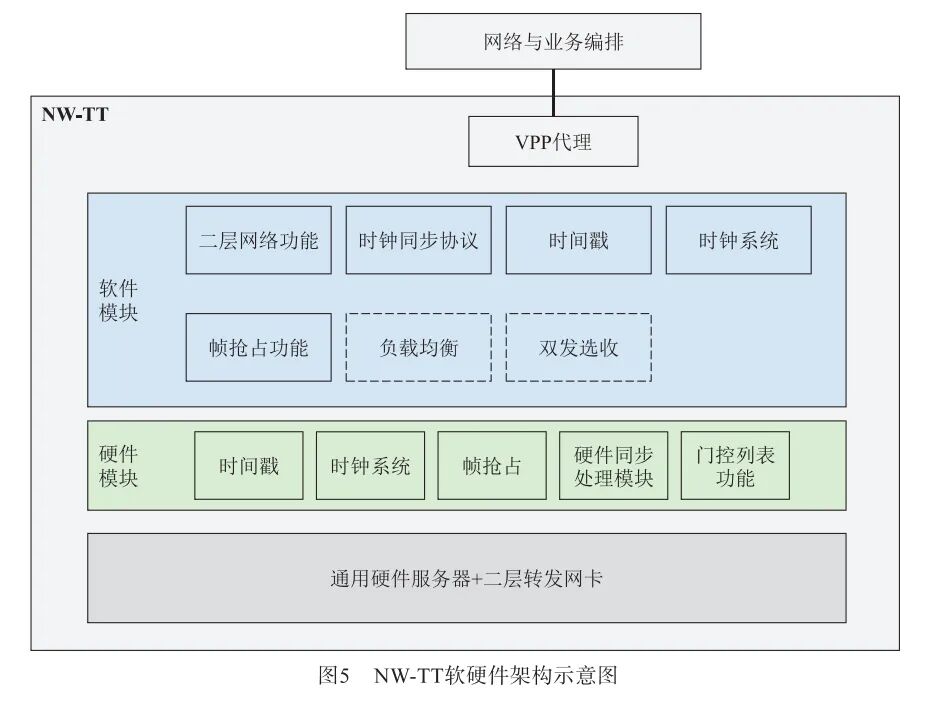
NW-TT is also deployed in a containerized manner as a functional module in the UPF, with a hardware architecture similar to that of DS-TT,as shown in Figure 5. NW-TT supports dual network card hardware clock synchronization, can obtain 5G clock and TSN clock, and calculate the time error between local time and time source, using this error to accurately adjust local time, achieving high-precision synchronization between local time and time source. NW-TT also supports 802.1AS and 802.1Qbv, used for achieving TSN domain clock synchronization and downstream gating. Additionally, NW-TT can flexibly expand to support load balancing, dual sending and receiving, and other functions.
4.3 Performance Verification
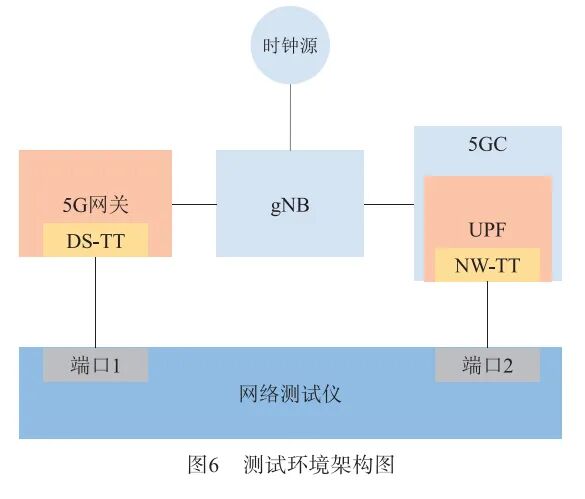
Through network testing instruments, the end-to-end delay and synchronization accuracy of the scheme are verified, with the testing architectureas shown in Figure 6. For delay testing, the testing instrument’s port 1 sends upstream TSN traffic data, and port 2 counts the received packets. For synchronization accuracy testing, port 2 sends PTP messages, which are extended by NW-TT in the PTP message TLV field and sent to DS-TT through gNB. After DS-TT analyzes and processes the PTP messages, it forwards them to testing instrument port 1, which counts synchronization accuracy based on the sent and received PTP messages. Test data shows that the end-to-end transmission delay of this scheme can be as low as 10 ms, and synchronization accuracy can be achieved to less than 600 ns.
To further verify the performance of the scheme in actual application scenarios, a household appliance production workshop was selected to validate the deterministic assurance capability for PLC control services based on the actual network environment.
In a single-user testing scenario, the testing environment connects one user terminal, sending upstream data at a cycle of 10 ms. When the TSN gating orchestration function is turned off, the average transmission jitter of the upstream data packets is 41 μs. After enabling the TSN gating orchestration function, the average transmission jitter of the upstream data packets is reduced to 3 μs.
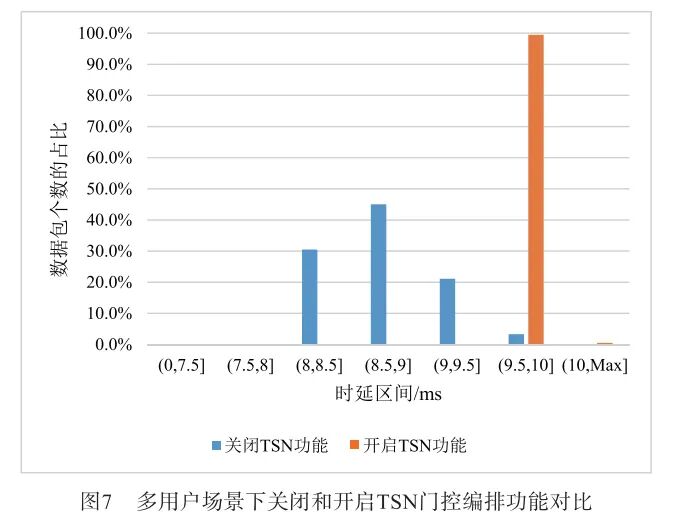
In a multi-user concurrent testing scenario, the testing environment connects a total of 8 user terminals, with 2 carrying deterministic assurance services, sending upstream data at a cycle of 10 ms, and the other 6 as background services, each sending 25 Mbps of upstream data. The end-to-end delay and jitter are tested under both conditions of turning off and enabling TSN gating orchestration. The test datais shown in Figure 7, where, when the TSN gating orchestration function is turned off, the transmission delay of packets fluctuates significantly, with about 96.3% of packets having jitter less than 1 ms. After enabling the TSN gating orchestration function, the upstream transmission delay stabilizes within the range of 9.5 to 10 ms, with about 99.8% of packets having jitter less than 1 ms. The test results verify that under high-load network environments, the jitter of data packets can be significantly reduced, ensuring deterministic service for the business.
5 Conclusion
As the application of 5G in the industrial field gradually penetrates into workshop-level/field-level networks, the demand for deterministic networks is becoming increasingly strong. All parties in the industry chain are actively conducting research on deterministic network standards, technical breakthroughs, application scenario explorations, product solution development, and industry pilot verification. This paper analyzes the key technologies and challenges faced by 5G-TSN integrated deployment, proposing a lightweight deployment scheme for 5G-TSN, aiming to provide a feasible solution for industrial enterprises to quickly build 5G deterministic networks at this stage. In the future, the deployment and application of 5G-TSN can be promoted in phases: first, achieving necessary functional upgrades of 5GC, improving 5G-TSN scheduling and management functions, and enhancing interoperability between different manufacturers; second, improving the interaction mechanism of service characteristic information and network status information to enhance the adaptability of the network to services; third, promoting the integration of 5G timing, business flow scheduling management, and other functions and capabilities with open combinations, deeply integrating with industry applications.
References:(Scroll to browse)
[1] 3GPP TS 23.501. System architecture for the 5G System (5GS)[S]. 2025.
[2] 3GPP TS 23.502. Procedures for the 5G System (5GS)[S]. 2025.
[3] 3GPP TR 23.700-25. Study on timing resiliency and TSC and URLLC enhancements[R]. 2025.
[4] Huang Rong, Tang Xiong Yan, Pei Yushan, et al. Discussion on 5G Industrial Private Network Architecture and Key Technologies[J]. Mobile Communications, 2022,46(8): 8-14.
[5] Industrial Internet Consortium. TSN Solution White Paper[R]. 2023.
[6] Zhang Qiang, Wang Weibin, Lu Guanghui. Research on Key Technologies of 5G TSN in Industrial Internet Scenarios[J]. ZTE Communications Technology, 2020,26(6): 21-26.
[7] Sasiain J, Franco D, Atutxa A, et al. Toward the Integration and Convergence Between 5G and TSN Technologies and Architectures for Industrial Communications: A Survey[J]. IEEE Communications Surveys & Tutorials, 2025,27(1): 259-321.
[8] Satka Z, Ashjaei M, Fotouhi H, et al. QoS-MAN: A Novel QoS Mapping Algorithm for TSN-5G Flows[C]//2022 IEEE 28th International Conference on Embedded and Real-Time Computing Systems and Applications (RTCSA). IEEE, 2022: 220-227.
[9] Cai Y, Zhang X, Hu S, et al. Dynamic QoS mapping and adaptive semi-persistent scheduling in 5G-TSN integrated networks[J]. China Communications, 2023,20(4): 340-355.
[10] Cheng Z, Yang D, Guo R, et al. Joint Time-Frequency Resource Scheduling Over CQF-Based TSN-5G System[C]//2023 15th International Conference on Communication Software and Networks (ICCSN). Shenyang, China, 2023: 60-65.
[11] Wu Siyuan, Bi Zihang, Wang Jianquan, et al. Research on 5G-TSN Collaborative Network Architecture and Key Transmission Processes[J]. Postal Design Technology, 2022(3): 29-35.
[12] Sun Lei, Wang Jianquan, Lin Shangjing, et al. Research on Joint Scheduling Mechanism of 5G and TSN Based on Wireless Channel Information[J]. Journal of Communications, 2021,42(12): 65-75.
[13] Xu H, Xin J, Xu S, et al. RAN Enhancement to Support Propagation Delay Compensation of TSN[C]//2021 IEEE 9th International Conference on Information, Communication and Networks (ICICN). Xi’an, China: IEEE, 2021: 179-182.
[14] Krummacker D, Veith B, Fischer C, et al. Analysis of 5G Channel Access for Collaboration with TSN Concluding at a 5G Scheduling Mechanism[J]. Network, 2022,2(3): 440-455.
[15] Zhu Jinyu, Zhang Hengsheng, Chen Jie. Requirements and Network Architecture Evolution for TSN and 5G Integrated Deployment[J]. ZTE Communications Technology, 2021,27(6): 47-52.
[16] Li Weihua, Sun Lei, Wang Jianquan, et al. Key Technologies for 5G and TSN Collaboration Aimed at Industrial Automation[J]. Journal of Engineering Sciences, 2022,44(6): 1044-1052.
[17] Guan Wanqing, Liu Nuoyan, Li Weihua, et al. Resource Scheduling for 5G TSN Integrated Network Slicing Aimed at Industrial Time-Sensitive Services[J]. Telecommunications Science, 2024,40(3): 53-63.
[18] Yang M, Lim S, Oh S-M, et al. An Uplink Transmission Scheme for TSN Service in 5G Industrial IoT[C]//2020 International Conference on Information and Communication Technology Convergence (ICTC). Jeju, Korea (South), 2020: 902-904.
[19] Wang X, Yao H, Mai T, et al. Reinforcement Learning-Based Particle Swarm Optimization for End-to-End Traffic Scheduling in TSN-5G Networks[J]. IEEE/ACM Transactions on Networking, 2023,31(6): 3254-32683.
[20] Zhang Y, Xu Q, Guan X, et al. Wireless/wired integrated transmission for industrial cyber-physical systems: risk-sensitive co-design of 5G and TSN protocols[J]. Science China(Information Sciences, 2022,65(1): 56-71.
[21] Industrial Internet Consortium. White Paper on 5G+TSN Integrated Deployment Scenarios and Technology Development[R]. 2021. ★
Scan the QR code to read and download this paper

★Original article published in Mobile Communications, Issue 5, 2025★
doi:10.3969/j.issn.1006-1010.20250325-0004
Classification Number: TN92 Document Code: A
Article Number: 1006-1010(2025)05-0027-07
Citation Format: Li Xianda, Pei Yushan, Huang Rong, et al. Research on 5G-TSN Integrated Networking Technology and Deployment Scheme for Industrial Scenarios[J]. Mobile Communications, 2025,49(5): 27-33.
LI Xianda, PEI Yushan, HUANG Rong, et al. Research on 5G-TSN Integrated Networking Technology and Deployment Scheme for Industrial Scenarios[J]. Mobile Communications, 2025,49(5): 27-33.
Author Information
Li Xianda:Master’s degree from Beijing University of Posts and Telecommunications, currently working at the Research Institute of China United Network Communications Group Co., Ltd., mainly engaged in research on wireless communication technologies and 5G private network solutions for industries.
Pei Yushan:PhD from Beijing University of Posts and Telecommunications, currently working at the Research Institute of China United Network Communications Group Co., Ltd., mainly engaged in research on wireless communication technologies and 5G private network solutions for industries.
Huang Rong:PhD from Beijing University of Posts and Telecommunications, currently working at the Research Institute of China United Network Communications Group Co., Ltd., mainly engaged in research on wireless communication technologies and 5G private network solutions for industries.
Li Ruihua:Master’s degree from the Institute of Computing Technology, Chinese Academy of Sciences, currently working at the Research Institute of China United Network Communications Group Co., Ltd., mainly engaged in research on wireless communication technologies and 5G private network solutions for industries.
Mobile CommunicationsSubmission Website:https://ydtx.cbpt.cnki.net★Previous Recommendations★

Table of Contents | Issue 5, 2025 Special Topic: Wireless Communication Technologies for the Industrial Internet
Table of Contents | Issue 6, 2025 Special Topic: 6G Satellite Internet
Summary | 2025 Second Half Special Call for Papers Link
 #Scan to follow us#Mobile CommunicationsInterpreting Communication with Papers
Mobile Communications magazine is supervised by China Electronics Technology Group Corporation and hosted by the Seventh Research Institute of China Electronics Technology Group Corporation. It is a “dual-effect journal” in the Chinese journal matrix, a high-quality electronic journal of the Ministry of Industry and Information Technology, a source journal for Chinese scientific and technological papers, a journal included in the high-quality scientific journal grading directory of the China Communications Society, and a journal included in the high-quality scientific journal grading directory of the China Electronics Society. Domestic continuous publication number: CN44-1301/TN, International continuous publication number: ISSN1006-1010, Postal distribution code: 46-181.
<img src=”https://mmbiz.qpic.cn/mmbiz_jpg/69Kkzaq68ZgZqPjyXaU0icK78dnZSPUxUpWiaicp6rWKWrL7Vomn3jxnptzRN4QqCDVTz81CMq5Bqn1u782XJ6vjQ/640?wx_fmt=other&from=appmsg&wxfrom=5&wx_lazy=1&wx_co=1&tp=webp”