After a three-month wait, today we finally welcome the official release of the fourth stable version of OpenWrt 24.10, OpenWrt 24.10.3. Previously, stable versions were released every two months, but this time it has been extended by an additional month, indicating that the changes or improvements in stability may be slightly more challenging. Let’s first look at the version number information:
_______ ________ __ | |.-----.-----.-----.| | | |.----.| |_ | - || _ | -__| || | | || _|| _| |_______|| __|_____|__|__||________||__| |____| |__| W I R E L E S S F R E E D O M ----------------------------------------------------- OpenWrt 24.10.3, r28872-daca7c049b -----------------------------------------------------The release notes for this version can be found at:
https://openwrt.org/releases/24.10/notes-24.10.3
The detailed changelog for this version can be found at:
https://openwrt.org/releases/24.10/changelog-24.10.3
Next, let’s take a detailed look at the specific changes.New Device Support
-
mediatek: Cudy TR3000 256MB v1 flash version
-
mediatek: Huasifei WH3000 Pro
-
mediatek: ipTIME AX3000Q
-
mediatek: ipTIME AX3000SM
-
mediatek: OpenFi 6C
-
mediatek: Zbtlink ZBT-Z8102AX v2
-
qualcommax: ipq807x: Linksys HomeWRK
-
ramips: Hongdian H7920 v40
-
rockchip: Radxa ROCK 4C+
-
rockchip: Radxa ROCK 4SE
This stable version adds support for a total of 10 new hardware devices, including two very popular high-cost-performance Wi-Fi 6 travel routers: Cudy TR3000 v1 256MB NAND FLASH version:There is also an earlier 128MB NAND FLASH version:The price difference is 30 yuan, which is not worth it if you do not have a large capacity requirement. These two devices only differ in NAND Flash capacity, and the detailed specifications are compared in the image below: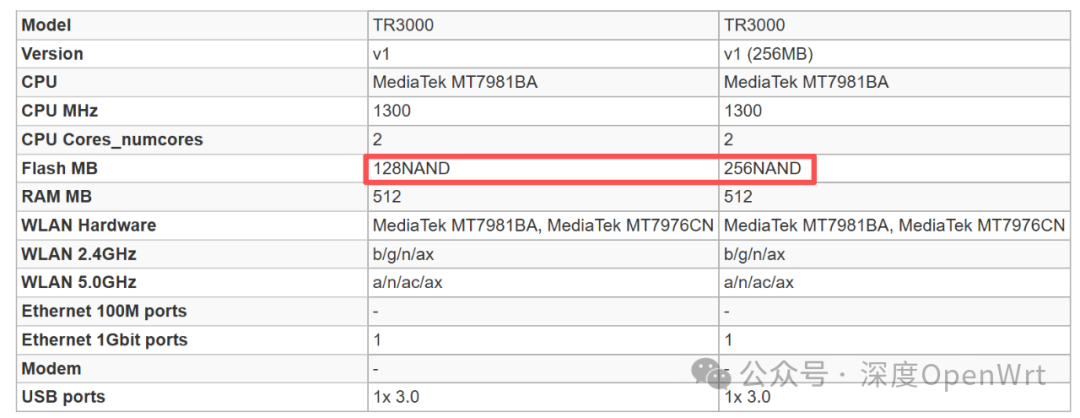 The OpenWrt team is very attentive to this product and has even maintained a dedicated page for it:
https://openwrt.org/toh/cudy/tr3000
Another interesting product is the 5G CPE travel router Huasifei WH3000 Pro, which also features the MT7981 Wi-Fi 6 3000M solution, but with a 5G module that supports nano SIM cards.
https://www.huasifei.com/product/wh3000-pro/
OpenFi 6C is also a DIY CPE product, indicating that the newly added devices are mainly Wi-Fi 6 routers.Bug Fixes and ImprovementsThe list of bugs fixed in this release is quite long, indicating that many issues have indeed been identified. Key issues are listed below.
-
armsr: Fix problem creating kthread in boot up on qemu
-
armsr: Fix serial console regression on device tree systems
-
ath79: COMFAST CF-EW71 v2: Fix LED GPIOs
-
ath79: MikroTik hAP ac: Enable USB by default
-
ath79: Ubiquiti: Fix flash write unlock on multiple devices
-
ath79: Xiaomi AIoT AC2350: Fix 5GHz Wifi
-
imx: Add device tree overlay support
-
ipq40xx: Reduce SPI clock frequency to 24MHz
-
lantiq: DSL: Fix reading downstream band borders
-
lantiq: Fix occasional kernel panic in ltq-adsl driver
-
mediatek: Cudy tr3000 v1: Add ubootmod layout
-
mediatek: Fix tx vlan tag for llc packets
-
mediatek: mt7981: Reduce DMA memory usage regression
-
mediatek: mt7986: Reduce DMA memory usage regression
-
mediatek: Prevent PPE flow tables from leaking across reboots
-
mediatek: Ruijie RG-X60 Pro: Fix LAN port status light
-
mediatek: Xiaomi AX3000T: Fix Foresee NAND
-
mpc85xx: TP-Link: TL-WDR4900: Add back 5ghz LED
-
ramips: mt7621: Reduce DMA memory usage regression
-
ramips: rt5350: Reduce DMA memory usage regression
-
ramips: TP-Link mr600: Fix 5 GHz Wifi
-
realtek: Avoid interrupt storm on mass packet receive
-
realtek: Fix stall after restart of otto timer
-
rockchip: Fix for MSI/MSI-X bug: no MSI/MSI-X, Back to INTx.
-
rockchip: NanoPC-T6 with A3A444 chips: Fix eMMC corruption
-
rockchip: rk35xx: Increase the number of serial ports
-
tegra: Bring back workaround for spurious interrupts
-
x86: Fix boot problems by activating CONFIG_PCI_MMCONFIG
-
busybox: Fix login applet on selinux
-
hostapd: Reduce debug logging
-
kernel: Add support for FudanMicro FM25S01A SPI-NAND
-
kernel: Fix netdev trigger for PHY LEDs
-
mac80211: Improve WiFi-7 TX performance
-
mt76: Improve system recovery routine for MT7915
-
wifi-scripts: Correctly set basic-rates with wpa_supplicant
Among the optimizations, the memory optimization for the MediaTek chip solutions is quite prominent, so users should pay attention to whether their daily platforms can benefit from this.Core Component UpdatesThis stable version has upgraded the following core components:
-
Linux kernel: update from 6.6.93 to 6.6.104
-
mac80211: update from 6.12.6 to 6.12.44
-
mt76: update from 2025-02-14 to 2025-09-15
-
kmod-r8125: update from 9.016.00 to 9.016.01
-
kmod-r8126: update from 10.015.00 to 10.016.00
-
kmod-r8127: update from 11.014.00 to 11.015.00
-
libubox: update from 2024-12-19 to 2025-07-23
-
udebug: update from 2023-12-06 to 2025-08-24
-
ucode: update from 2025-05-11 to 2025-07-18
-
uhttpd: update from 2023-06-25 to 2025-07-06
-
uqmi: update from 2024-08-25 to 2025-07-30
-
rpcd: update from 2024-09-17 to 2025-09-01
-
ubus: update from 2025-05-16 to 2025-07-02
-
libxml2: update from 2.13.6 to 2.14.5
-
mbedtls: update from 3.6.3 to 3.6.4
-
openssl: update from 3.0.16 to 3.0.17
-
ca-certificates: update from 20241223 to 20250419
-
wireless-regdb: update from 2025.02.20 to 2025.07.10
There is no major version change for the kernel in this upgrade, still using Linux 6.6, with minor version upgrades in Wi-Fi services, especially for MediaTek mt76 products. Detailed changes can be found in the corresponding software package changelogs.Known IssuesThis stable version release has two known issues that users can evaluate based on their business needs:
-
LEDs for Airoha AN8855 are not yet supported. Devices like the Xiaomi AX3000T with an Airoha switch will have their switch LEDs powered off. This issue will be addressed in an upcoming OpenWrt SNAPSHOT and the OpenWrt 24.10 minor release.
-
5GHz WiFi is non-functional on certain devices with ath10k chipsets. Affected models include the TP-Link Archer C60 v1, and possibly others. For details, see issue #14541.
Overall, the impact will not be too significant, but users of products with the ath10k chipset should pay attention to the second issue.ConclusionThis OpenWrt 24.10.3 can be considered a mid-version of the 24.10 series. According to the plan, the entire 24.10 version will be supported until the end of 2026, with about three more minor version updates to come, but the overall framework will not undergo major adjustments. Therefore, if you are developing new products for next year, you may consider using this version as a baseline.The release history of the OpenWrt 24.10 series is as follows:OpenWrt 24.10 first stable version releaseOpenWrt 24.10.1 stable version releaseOpenWrt 24.10.2 stable version release