The team led by Professor Ai Bo from the School of Electronic Information Engineering at Beijing Jiaotong University proposed an offloading method based on cellular vehicular networks, building on previous research in vehicular edge computing. The relevant research results were published in the “Acta Electronica Sinica” 2024, Issue 2, under the title “Q-Learning Based Joint Offloading Strategy for C-V2X Based Vehicular Edge Computing System”.
To read the original article, please click:

Article Overview
The rise of various delay-sensitive and high computational demand services in vehicular networks presents new opportunities and challenges for these systems. To address the issue of significant processing delays caused by insufficient computational power in vehicles, the vehicular edge computing system (VEC) has emerged as a new auxiliary computing and integration platform, leveraging edge computing technology. It can provide computational support for services by configuring computing units at roadside units (RSUs) or other nearby vehicles, thus ensuring performance for intelligent services. Vehicles can offload these tasks to edge computing units or nearby idle vehicles for auxiliary computation, thereby reducing task processing delays and meeting the latency performance requirements of vehicular network services.
Although certain research results have been achieved in offloading strategies for vehicular edge computing, current designs do not take into account the transmission characteristics of cellular vehicular networks (C-V2X) links. They overlook the resource collisions that occur when vehicles transmit information through the PC5 interface, leading to an overestimation of link transmission rates, resulting in unreasonable offloading strategies that increase system delays. In fact, the vehicle perception under the C-V2X architecture is not stable due to rapid changes in topology, making it a significant challenge to characterize the success transmission probability of C-V2X to match offloading strategies compared to traditional strategies. Furthermore, the current offloading strategies for vehicular edge computing are based on base station bandwidth allocation, performing uniform resource scheduling and distribution. After considering the PC-5/Uu communication method, the collision characteristics of the PC-5 interface and the resource coupling characteristics between PC-5 and Uu interfaces make it difficult to solve the offloading strategy.
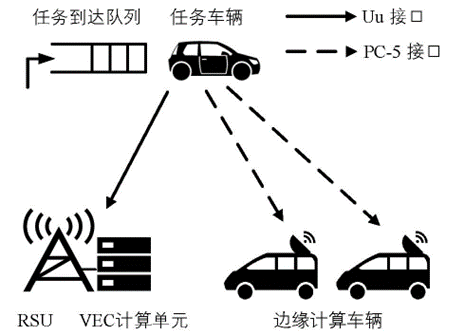
Figure 1: Task Migration Model for C-V2X Vehicular Network System
This work proposes an offloading migration mechanism for the C-V2X vehicular edge computing system based on Q-learning. Task vehicles generate a series of tasks that can be offloaded to VEC computing units via the Uu interface of the onboard C-V2X terminal or to nearby vehicles via the PC-5 interface, as shown in Figure 1. To characterize the impact of the resource collision characteristics of the PC-5 interface on offloading delay, this work derives the success transmission probability for vehicle-to-vehicle communication. Next, it describes the queue states of vehicles and servers, as shown in Figure 2, and constructs a constrained Markov Decision Process (CMDP) to minimize system delay under constraints of vehicle transmission power and energy consumption.
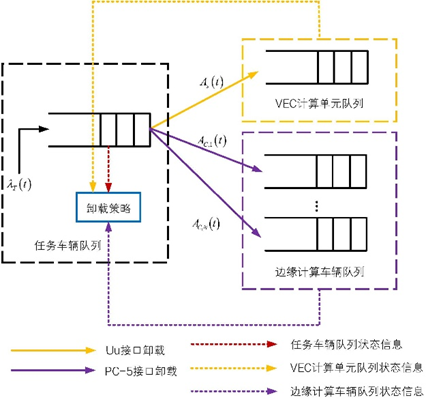
Figure 2: Queue Model for C-V2X Vehicular Network System
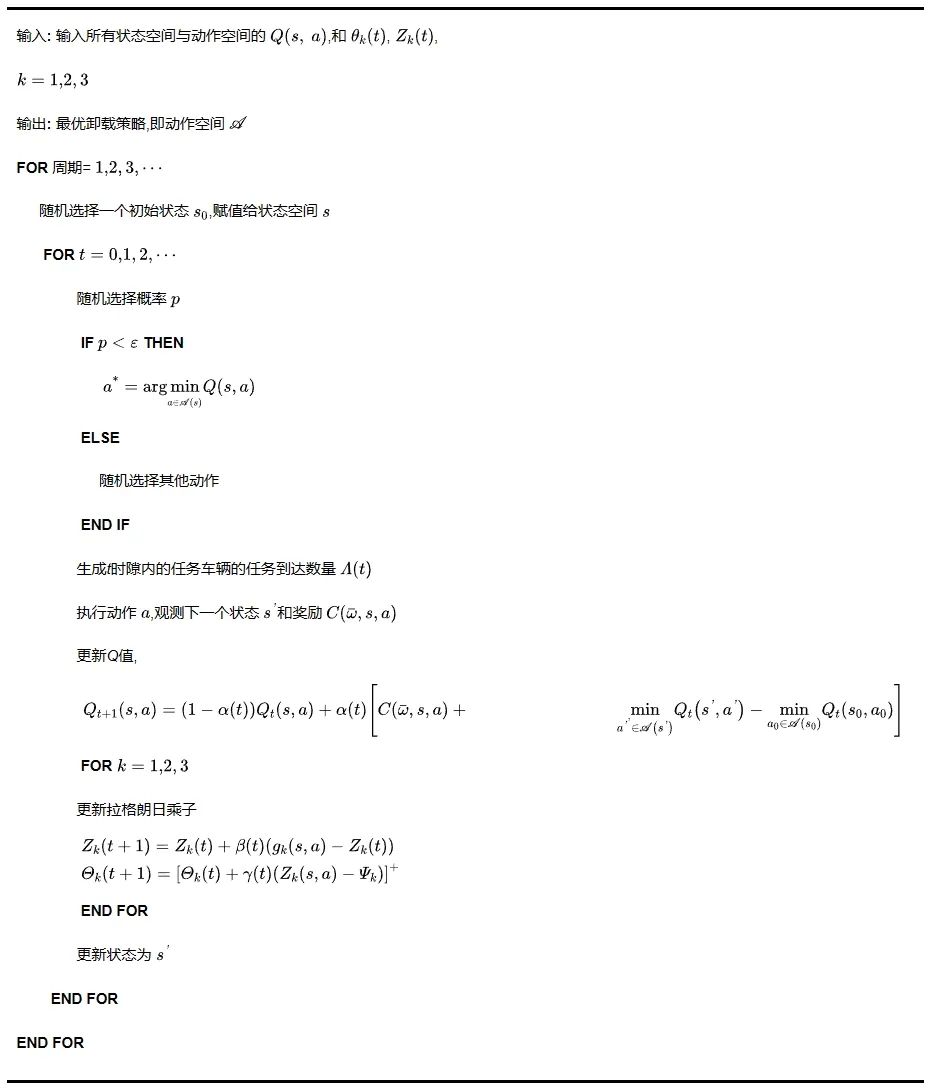
Using the Lagrangian method, the constrained Markov Decision Process problem is transformed into an equivalent unconstrained Markov Decision Process, and Q-learning is introduced to design the offloading strategy, leading to the proposed Q-learning based offloading strategy for the cellular vehicular network edge computing system, as shown in Algorithm 1. Simulation results indicate that the proposed algorithm can reduce system delay by more than 27.3% compared to other comparative schemes.
Algorithm 1: Q-Learning Based C-V2X Offloading Algorithm
The offloading mechanism of cellular vehicular networks differs from traditional vehicular networks, focusing on dynamic topologies of cellular vehicular networks for task queue modeling and proposing a joint offloading architecture for PC5 and Uu interfaces based on different link characteristics, providing a feasible approach for further research into offloading mechanisms for cellular vehicular networks.
Author’s Biography

Feng Wei-yang, male, born in November 1996, from Linyi, Shandong. Currently a PhD student at the School of Electronic Information Engineering, Beijing Jiaotong University. His main research direction is vehicular networks and edge computing.

Lin Si-yu (Corresponding Author), male, born in December 1984, from Beijing. Currently a professor and doctoral supervisor at the School of Electronic Information Engineering, Beijing Jiaotong University. His main research directions are wireless communication, vehicular networks, and dedicated communication for rail transit.

Feng Jing-tao, female, born in December 1997, from Xingtai, Hebei. She obtained her master’s degree from the School of Electronic Information Engineering, Beijing Jiaotong University in 2022. Her main research direction is vehicular networks and edge computing.

Li Yun, male, born in March 1982, from Taiyuan, Shanxi. Currently the deputy director and senior engineer at the Information Dispatch Center of China Railway Information Technology Group Co., Ltd. His main research direction is computer network technology.

Kong Fan-peng, male, born in April 1982, from Beijing. Currently the director of the Information Technology Research Office at CRRC (Beijing) Network Technology Research Institute Co., Ltd. His work focuses on information network technology, communication technology, and network operation and maintenance technology.

Ai Bo, male, born in February 1974, from Xi’an, Shaanxi. Professor and doctoral supervisor at Beijing Jiaotong University, deputy director of the National Key Laboratory of Rail Transit Control and Safety. His main research direction is broadband mobile communication systems and dedicated mobile communication.
Citation Format
Feng Wei-yang, Lin Si-yu, Feng Jing-tao, Li Yun, Kong Fan-peng, Ai Bo. Q-Learning Based Joint PC-5/Uu Offloading Strategy for C-V2X Based Vehicular Edge Computing System[J]. Acta Electronica Sinica, 2024, 52(2): 385-395 https://doi.org/10.12263/DZXB.20220922
FENG Wei-yang, LIN Si-yu, FENG Jing-tao, LI Yun, KONG Fan-peng, AI Bo. Q-Learning Based Joint PC-5/Uu Offloading Strategy for C-V2X Based Vehicular Edge Computing System[J]. ACTA ELECTRONICA SINICA, 2024, 52(2): 385-395 https://doi.org/10.12263/DZXB.20220922
Click the “Read Original” button below to visit the official website of this journal to read the full article.