Research Progress
Follow the WeChat account for domestic component supply and demand matching to learn more about component and chip supply and demand information, industry information, and industrial information, making it a valuable public account.
Source: Institute of Semiconductors, Chinese Academy of Sciences
The rapid development of transformative technologies such as artificial intelligence and high-performance computing poses significant challenges to existing information transmission and processing technologies. Silicon photonic integration, based on CMOS technology, is an important technological path in the post-Moore era. Silicon-based quantum dot lasers fabricated on unstrained silicon substrates through heteroepitaxy are the core light sources for silicon photonic integrated circuits. Currently, related FP lasers, DFB lasers, and micro-ring lasers have been publicly reported, but research on directly modulated lasers, which have advantages such as compact structure and low cost, is relatively lacking.
Recently, the team of researchers led by Professor Yang Tao and Professor Yang Xiaoguang from the Solid-State Optoelectronic Information Technology Laboratory at the Institute of Semiconductors has made significant progress in the research of high-speed, anti-reflection silicon-based quantum dot directly modulated lasers. At room temperature, the modulation bandwidth of the device reaches 3.8 GHz, supporting 12.5 Gbit/s NRZ format direct modulation. Additionally, the device exhibits excellent anti-reflection characteristics, with a bit error rate as low as 10–5 for a 10 Gbit/s NRZ signal under feedback strength conditions of -9 dB in a back-to-back configuration and -12 dB over 2 kilometers of single-mode fiber transmission. This work provides an excellent light source solution for high integration, low power consumption, low cost, and no need for optical isolators in silicon photonic integrated circuits.
The related research results were published in the paper titled 12.5 Gbit/s directly modulated InAs/GaAs quantum dot lasers grown on Si (001) substrate with strong optical feedback resistance in Optics Express, and were selected as a highlight work by the editors. PhD student Wang Shenglin from the Institute of Semiconductors is the first author of the paper, and Professor Yang Xiaoguang is the corresponding author. Researcher Lu Dan from the Institute of Semiconductors provided significant support in device performance testing. This research work was strongly supported by the National Natural Science Foundation (62334007, 62035012) and others.
Paper link: https://doi.org/10.1364/OE.561251
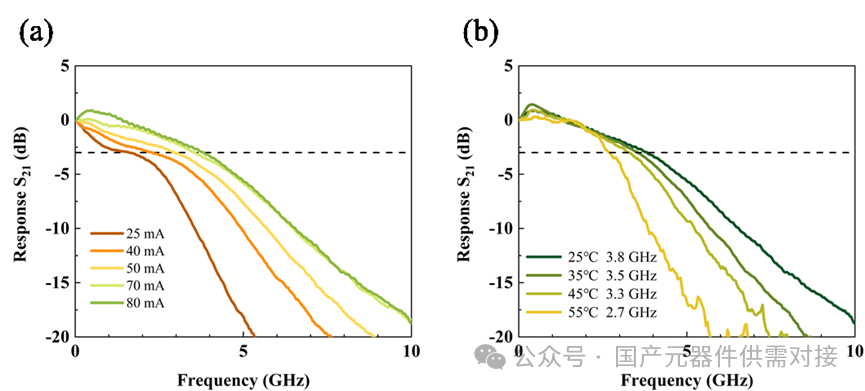
Figure 1: Device small-signal frequency response under (a) room temperature varying current and (b) varying temperature conditions.
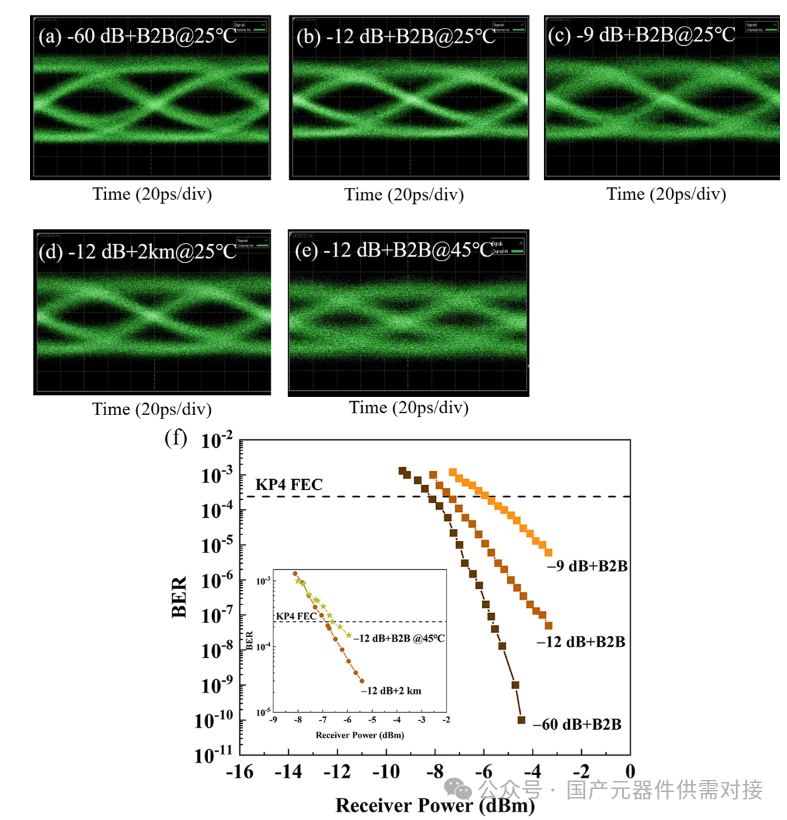
Figure 2: 10 Gbit/s NRZ modulation eye diagrams and (f) system bit error rates under different (a-c) optical feedback strengths, (d-e) transmission distances, and operating temperature conditions.
 Public Account Introduction

This public account is dedicated to promoting the localization of components and chips, aiming to become a platform for supply and demand matching, a window for information exchange, and a space for knowledge sharing. Regarding all original written content of this public account, the following statement applies:
1. Reproduction of related content requires contacting this public account;
2. Any big data scraping of this public account’s information, including AI, is prohibited.
Otherwise, we reserve the right to pursue all responsibilities.