Click the blue text above to follow us
#Wangjiang Technology#
Architectural Design and Development Trends of IoT in Elevators
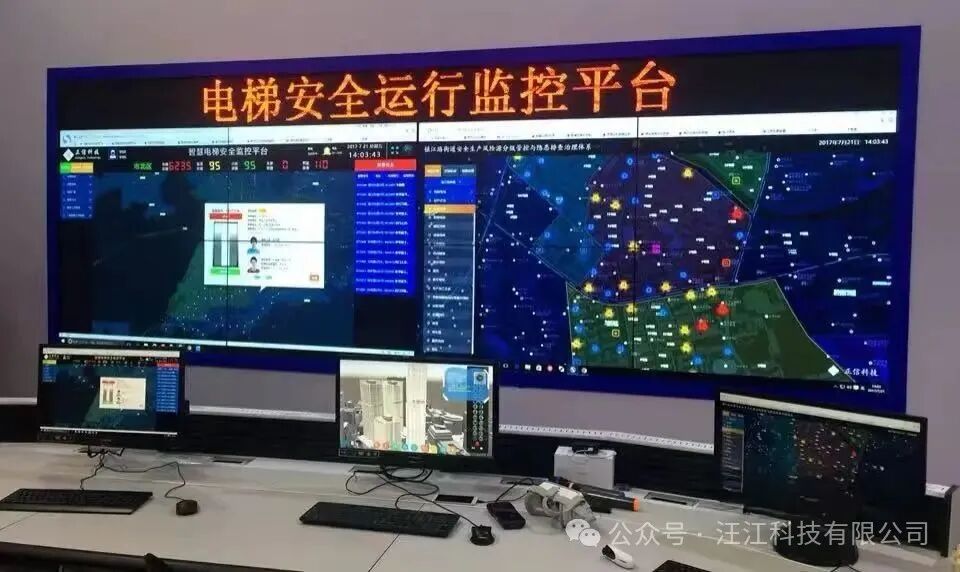
With the rapid development of our country’s social economy and the increasing level of scientific and technological advancement, IoT technology, as a new information technology, has been widely applied in today’s society. It integrates existing internet technology, video recognition technology, sensor technology, etc. In elevator engineering, the application of IoT technology is mainly reflected in the collection and processing of various information data of elevators through sensor technology, and then using information technology to connect the data to the internet. This application technology enables information sharing and data exchange among property management units, elevators, users, inspection departments, regulatory departments, and manufacturers, facilitating the monitoring of elevators. In case of a malfunction, it allows for timely analysis and handling of the fault. Therefore, the application of IoT technology in elevators will have a profound impact on their daily operation.
Design of IoT
The Internet of Things, as the name suggests, is the internet that connects everything. There are two layers of meaning here: first, the core and foundation of the IoT is still the internet; it is a network that extends and expands based on the internet; second, its user end extends and expands to any item, enabling information exchange and communication between items.
1. Design Ideas for IoT in Elevators
1) Software adopts a cloud service architecture;
2) Hardware adopts industrial-grade embedded systems;
3) Fully consider the different needs of multiple users;
4) Fully consider the different requirements and economic aspects of elevators;
5) Full business process;
6) Software with multiple interfaces for quick integration with government regulatory platforms;
7) Reserve for big data mining in the system.
1.2 Architectural Design of IoT in Elevators
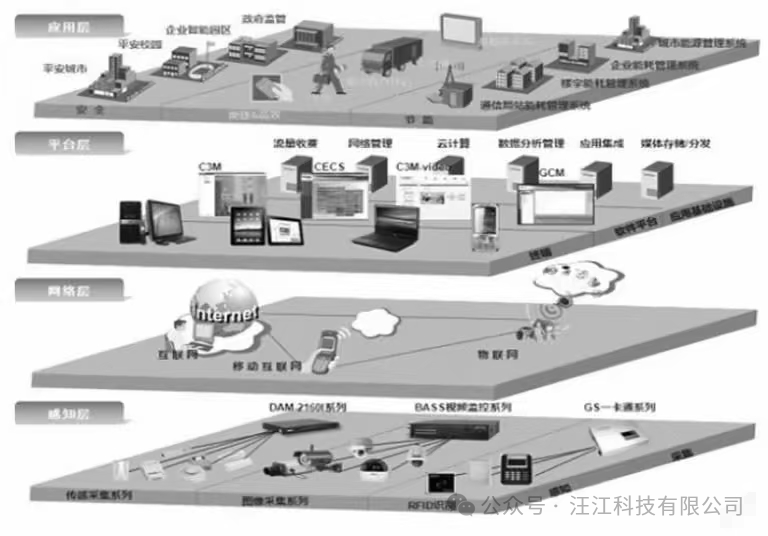
The IoT in elevators adopts a four-layer architectural design: perception layer, network layer, platform layer, and application layer.
1) The perception layer is responsible for collecting and measuring the raw data of the elevator and converting it into a series of data;
2) The network layer is responsible for transmitting the processed and analyzed data, thus achieving data sharing;
3) The platform layer performs calculations and analyses on the data transmitted over the network to derive corresponding logical results;
4) The application layer applies the logical results derived from the analysis and calculations to the actual operational activities of the elevator.
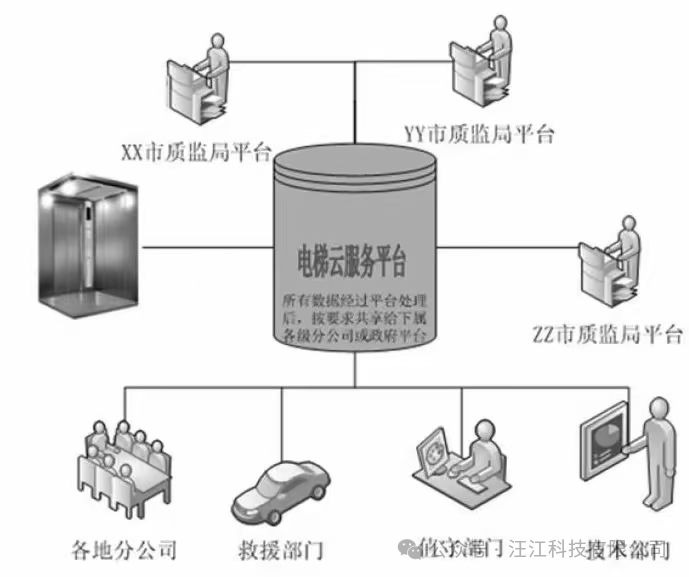
Data Application Map of IoT
Using Units: Real-time monitoring of elevator operation, effective supervision of elevator maintenance, and visual monitoring of elevator operation to ensure the safety of owners. Based on the requirements of using units, hierarchical management of data access permissions can be implemented. Maintenance Enterprises: Real-time monitoring of elevator operation. After big data analysis, technical guidance can be provided to maintenance personnel, improving their professionalism and maintenance quality, ensuring elevator safety. Manufacturing Enterprises: Real-time monitoring and statistics of elevator operation big data. Through big data analysis, the quality of elevator products can be summarized and analyzed, facilitating effective improvement of product quality and creating a virtuous cycle.
Social Public: Visualizing elevator operation to achieve social supervision and attention to elevator safety, building a safety defense line for elevators together.
Emergency Rescue Center: Fully coordinating the elevator emergency grid rescue system to achieve quick and effective rescue of people trapped in elevators. This avoids safety issues caused by people being trapped in elevators, ensuring the timeliness of elevator rescue.
Government Regulatory Departments: Government departments can conduct information-based and data-based supervision of elevator maintenance, using scientific data analysis and judgment to enhance comprehensive regulatory capabilities and data visualization supervision.

Long press the QR code to follow us