What is picolibc? What can it do?
If you often engage in embedded development, you might encounter a common problem—libraries are too large, and memory is limited, making it impossible to fit everything. Or perhaps you want a lighter, faster C library to save precious space? That’s where picolibc comes in! It is an ultra-lightweight C standard library specifically designed for resource-constrained embedded systems.
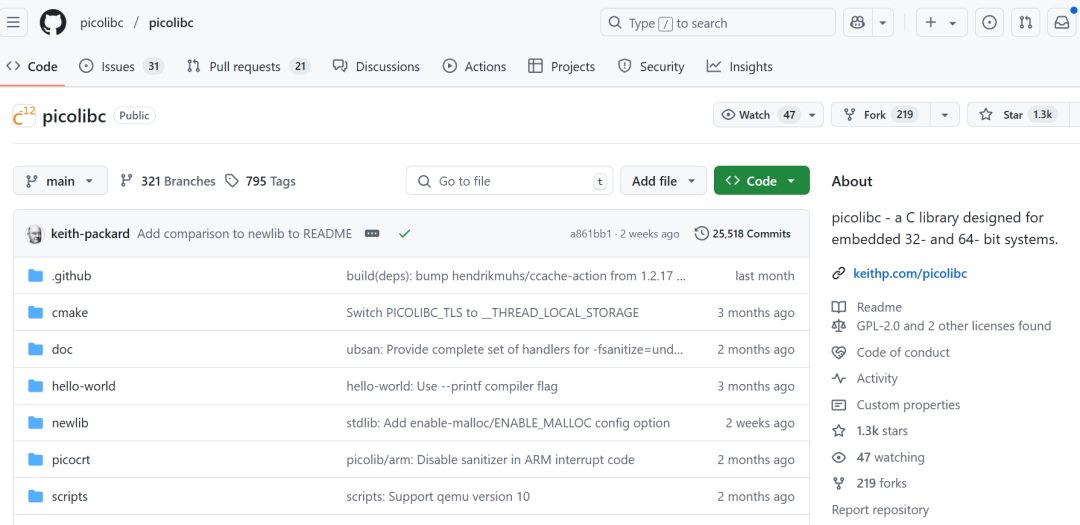
In simple terms, picolibc is a “mini version” of a C library, aimed at allowing you to handle various basic C standard APIs like printf, malloc, file I/O, etc., even with limited RAM. It combines the advantages of Newlib and AVR Libc, removing all unnecessary parts and focusing on the core functionalities.
It can help you:
- • Minimize library size by using minimal memory while providing a complete C standard API.
- • Support multiple architectures including commonly used embedded architectures like ARM, RISC-V, MIPS, LoongArch, PowerPC, SPARC, etc.
- • Ensure compatibility and stability by inheriting the code structure of Newlib, ensuring API consistency.
- • Multi-platform support (Linux, Zephyr, Coreboot, MacOS, etc.) that can run on bare metal as well as in simulators or specific OS environments.
In summary, picolibc is a “slim yet fully functional” C library, particularly suitable for memory-constrained and space-sensitive embedded projects.
What pain points does it address? Why use picolibc?
Many developers face a common issue in embedded projects: libraries are too large, leading to bloated code that may even exceed hardware space. Traditional Newlib, while feature-rich, is bulky and brings significant overhead.
picolibc perfectly addresses these pain points:
- • Space constraints, limited memory Traditional libraries may occupy hundreds of KB or even over MB of storage space. In contrast, picolibc, after careful trimming, can make your program “light as a feather,” requiring only tens of KB.
- • High speed requirements, quick startup A compact library means fast loading and initialization, without dragging down performance.
- • Privacy and security Runs entirely locally, with no reliance on the cloud or network, ensuring data security.
- • Easy customization Supports multiple architectures and compilers, allowing for custom compilation based on project needs.
- • Open-source freedom BSD license, no pressure in usage, no restrictions.
- • Support for multiple architectures, widely applicable Whether you’re using ARM Cortex-M, RISC-V, or MIPS, picolibc can be “tailored” for you.
In short, picolibc helps you solve the problems of “large libraries, insufficient space, and low efficiency,” allowing you to use standard C APIs even under extreme conditions.
What are its highlights? Why choose picolibc?
1. Extremely lightweight, space-saving
The biggest selling point of picolibc is its “ultra-light” nature. Its design goal is to make the library as small as possible, even requiring only tens of KB. For example, its tinystdio (mini stdio) requires very little memory while supporting basic file operations and printf.
2. Multi-architecture support, flexible expansion
From ARM, RISC-V, MIPS to LoongArch, PowerPC, it covers almost all mainstream embedded architectures in the market. Developers can choose the corresponding configuration based on the hardware.
3. BSD license, open-source without pressure
No GPL restrictions, more freedom in usage, can be directly integrated into commercial projects.
4. Complete C standard API support
Despite its small size, it still provides a complete set of standard APIs, such as malloc, printf, string, math, etc., meeting daily development needs.
5. Support for multi-platform builds
Supports cross-compilation for platforms like Linux, Zephyr, Coreboot, Mac OS, making the development process more flexible.
6. Modern build system
Uses meson for building, with fast compilation speed and easy configuration. It supports automatic detection of hardware features, reducing configuration difficulties.
7. Easy customization and extension
Supports modifying architecture-specific code and optimizing performance to meet different project needs.
What are its shortcomings? What “disadvantages” should be noted?
Of course, no tool is absolutely perfect. While picolibc is “light and agile,” there are some points to be aware of:
- • Still in development, some features are not mature Currently in Beta stage, some advanced features are still being refined, and you may encounter some bugs.
- • Configuration and debugging require a certain technical foundation As it is aimed at embedded development, involving cross-compilation and architecture customization, it may pose a barrier for beginners.
- • Lack of some advanced POSIX features Primarily aimed at microcontrollers, it does not support a complete file system or thread model (e.g., no complete thread library), only supporting the most basic APIs.
- • Complex build dependencies Requires using meson with clang/gcc, making configuration somewhat cumbersome.
- • Limited hardware support Although it supports a wide range of architectures, some special platforms are not yet supported and need to be extended manually.
In conclusion: picolibc is suitable for scenarios with extremely high space and speed requirements, but it may not be sufficient for complex operating system functionalities.
Summary: A Worthwhile Embedded C Library Tool!
Overall, picolibc is a “miracle library” that is “smaller in space, richer in functionality,” particularly suitable for resource-limited and efficiency-seeking embedded development.
With its streamlined design, multi-architecture support, and assurance of basic API integrity, it can significantly reduce program size. Although it is still being improved, it has already shown great potential.
If you are working on microcontrollers, IoT devices, or extreme space scenarios, picolibc is definitely a tool worth considering. More architecture support and feature optimizations will come in the future, making it worth keeping an eye on.
If you want to give it a try, get started quickly; it might help you “save” more space and make your project even better!
Summary
picolibc is an ultra-lightweight C standard library tailored for embedded systems, perfectly addressing the pain points of “space constraints and high performance requirements.” It supports multiple architectures, has an open-source license, provides a complete API, and is extremely simple and efficient. Although it is still growing, its prospects are limitless.
If you want to achieve the most basic C functionality with the smallest space, picolibc is definitely your ideal choice.
Project Address: https://github.com/picolibc/picolibc