Overview
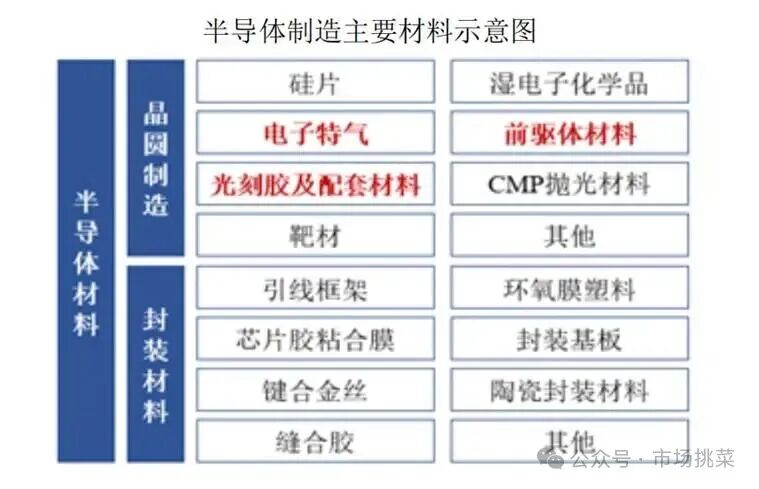
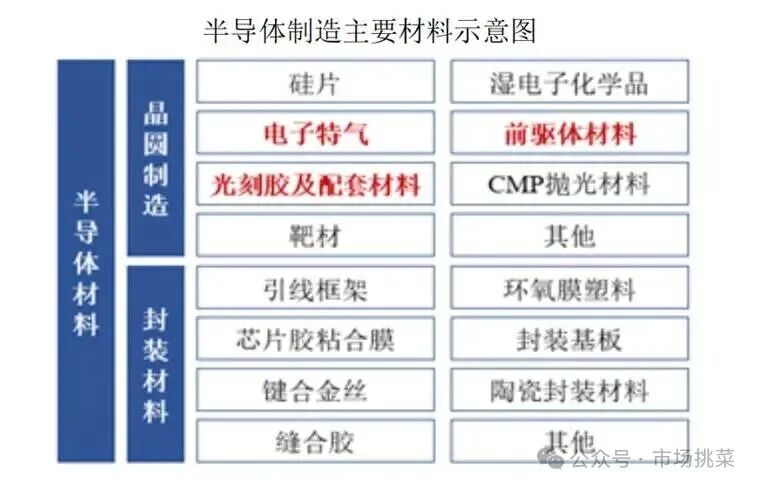
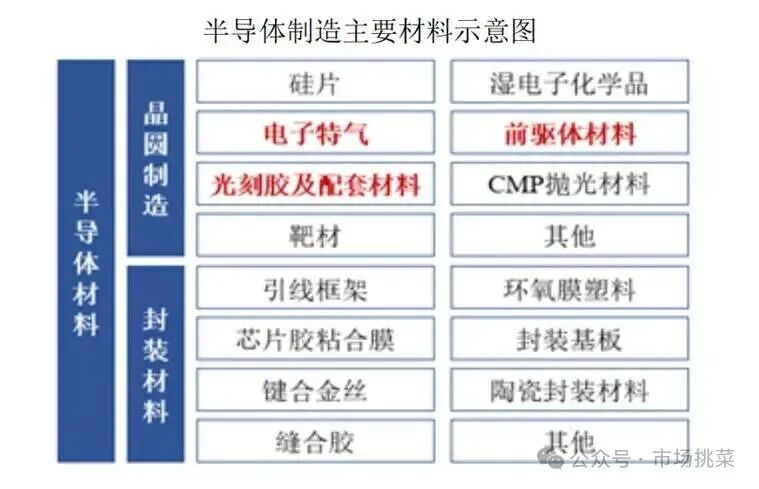
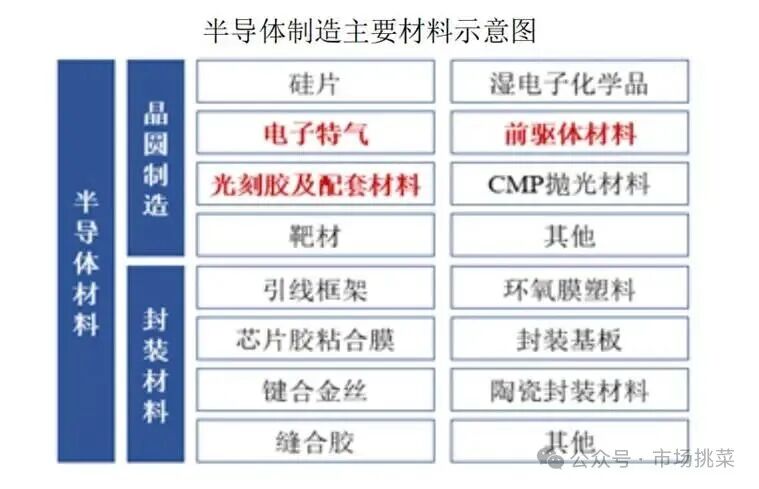
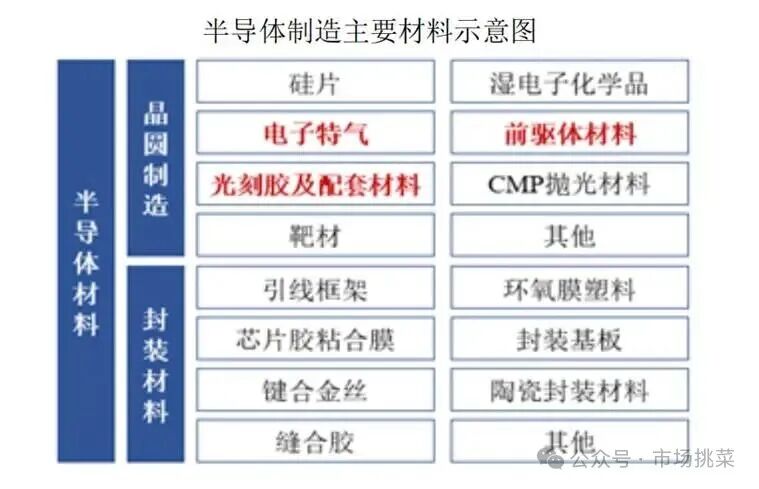
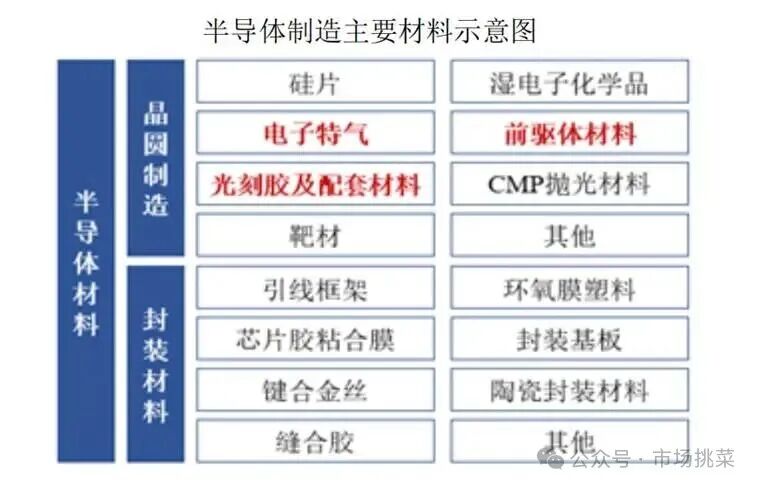
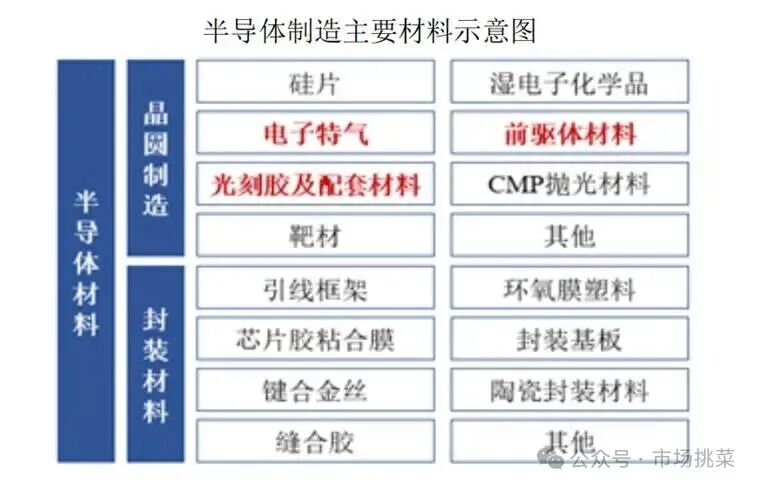
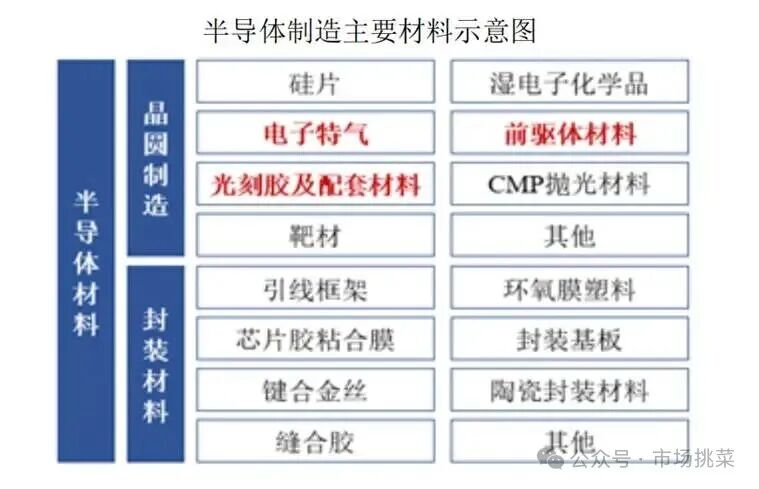
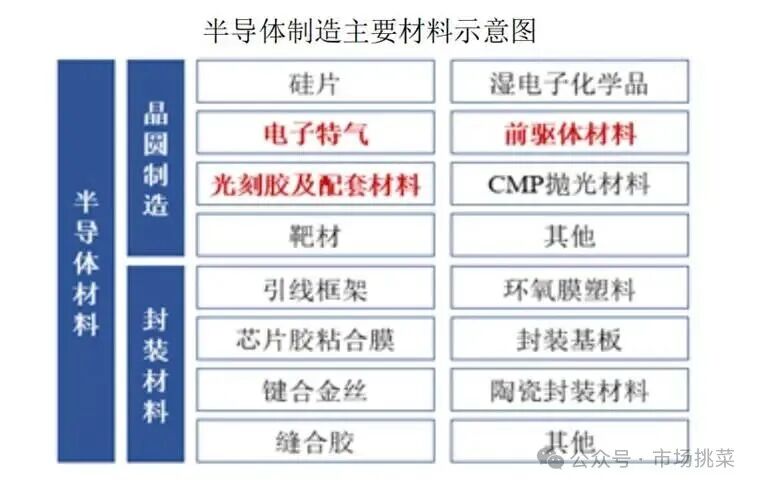
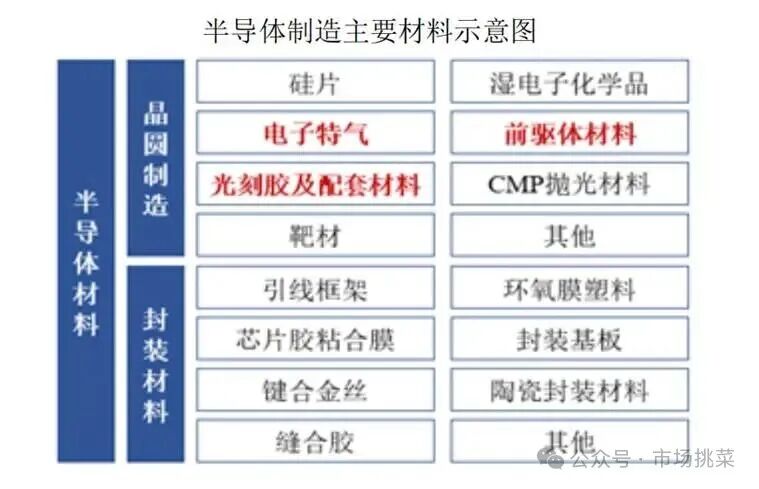
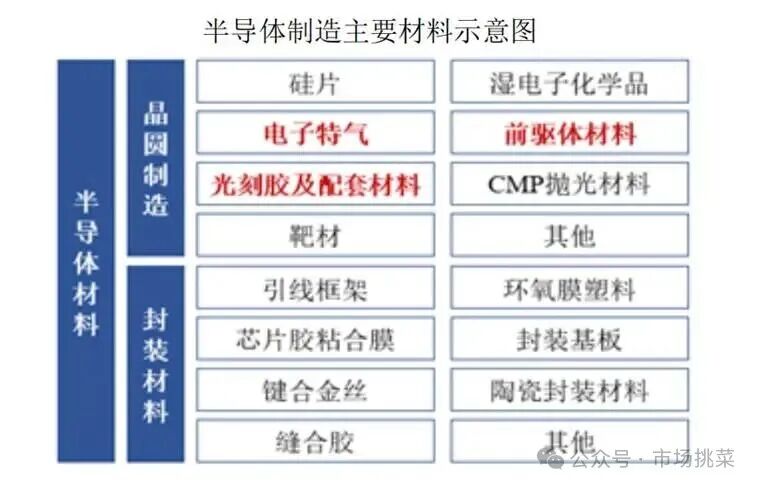
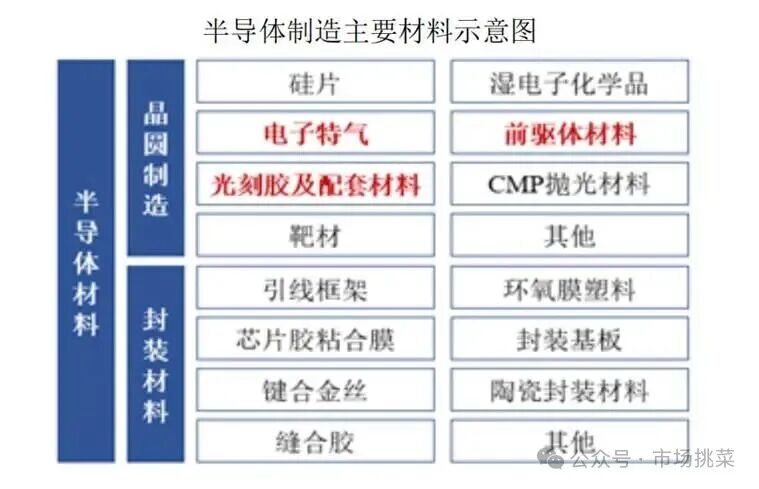
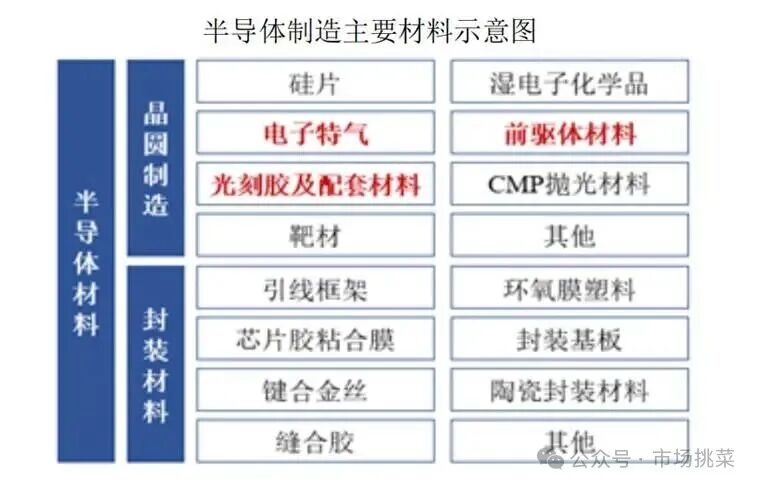
Semiconductor materials can be categorized by application into wafer manufacturing materials (accounting for 63.6%) and packaging materials (36.4%), among which the core categories of wafer manufacturing materials include silicon wafers, electronic specialty gases, photoresists, and CMP materials, which are considered the “bottleneck” core categories.
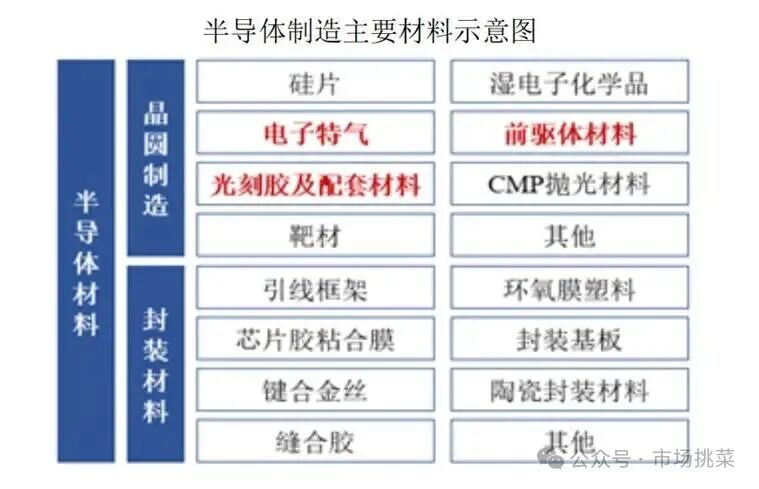
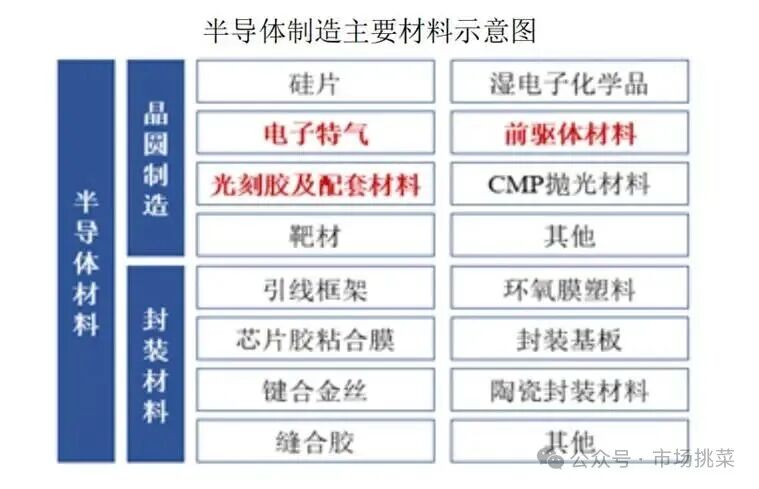
In terms of cost distribution among various materials, silicon wafers account for the largest share, approximately 33%; followed by photolithography materials, approximately 15%, which mainly include SOC (Spin On Carbon), ARC (Anti-reflective Coating), photoresists, top coatings, diluents, rinsing solutions, developing solutions, etc.; electronic specialty gases and masks account for approximately 13%; precursor materials, wet electronic chemicals, and polishing materials account for approximately 5-6%.
1.Silicon Wafers
According to SEMI, it is expected that by 2030, the global semiconductor market size will reach trillions of dollars. Assuming the current growth rate is maintained, the global silicon wafer market size is expected to double, exceeding 20 billion dollars.
According to SEMI, the shipment area of 12-inch silicon wafers has increased from 63.83% in 2018 to 76.30% in 2024, becoming the absolute mainstream in the market.
The global demand for 12-inch silicon wafers is expected to reach 10 million pieces/month by 2026, with demand in mainland China exceeding 3 million pieces/month, accounting for about 1/3 of global demand.
The top five global producers account for 70%, with Japan close to 43%. Xi’an Yichai is the sixth globally and the first domestic supplier in China.
8-inch silicon wafers: domestic production rate is 55%, with basic self-sufficiency in the mid-to-low end, only special specifications (such as SOI) need to be imported;
12-inch silicon wafers: import dependence exceeds 90% (advanced processes 5nm-14nm), with less than 20% of domestic demand supplied by local companies;
According to the prospectus of Xi’an Yichai, Xi’an Yichai has the largest domestic capacity, followed by Shanghai Silicon Industry, Zhonghuan, and Lian Micro, etc.
2. Photolithography Materials
Globally, the main companies producing SOC and anti-reflective coatings include Japan Synthetic Rubber, Shin-Etsu Chemical, DuPont from the USA, Brewer Science, Merck from Germany, PIBOND, etc.
In the field of 12-inch integrated circuit wafer manufacturing, the main companies producing semiconductor photoresists globally include Japan Synthetic Rubber, Shin-Etsu Chemical, Tokyo Ohka, Fujifilm, and DuPont from the USA. Domestic companies, apart from Hengkun New Materials, have achieved mass production of i-Line photoresists and KrF photoresists.
Other domestic companies such as Nanda Optoelectronics, Beijing Kehua, Shanghai Xinyang, and Ruihong Suzhou also have semiconductor photoresist products in the verification or mass production supply process.
According to Frost & Sullivan market research, in the field of 12-inch integrated circuits, the domestic production rate of i-Line photoresists and SOC is around 10%, while the domestic production rate of BARC and KrF photoresists is around 1-2%, and the domestic production rate of ArF photoresists is less than 1%.
3. Electronic Specialty Gases
Specialty gases can be classified by application into electronic specialty gases, medical gases, standard gases, laser gases, food gases, and gas for electric light sources.
Electronic specialty gases, abbreviated as electronic specialty gases (ESG), are an important branch of specialty gases, characterized by high technology and high added value. They are widely used in cleaning, photolithography, etching, doping, and epitaxial deposition processes, where their purity, cleanliness, and stability affect chip yield and performance. Their purity (usually required to be in the range of 5N-9N) and stability directly determine chip yield and performance.
According to Linx Consulting data, the market size of electronic specialty gases in 2021 was 4.423 billion dollars, with the top ten electronic specialty gases in the global market being:
According to TECHCET and Guanyan Tianxia data, it is expected that by 2025, the global electronic specialty gas market size will reach 6.023 billion dollars, with a CAGR of 6.39% from 2022 to 2025.
In high-end applications such as semiconductors, the specialty gas market is dominated by foreign gas companies such as Air Liquide, Linde Group, Japan Oxygen Holdings, and Merck (which acquired the electronic specialty gas and semiconductor materials company Versum spun off from AP).
2. China’s Import Dependence
Overall import dependence: from 75% in 2020 to 30-40% by 2025;
High-end categories: the dependence on hexafluorotungsten and high-purity helium still exceeds 50%, and the dependence on hexafluorobutadiene exceeds 80%.
3. Domestic Replacement Companies and Progress
China Shipbuilding Specialty Gases: Fully mastered the synthesis, purification, analysis, detection, and filling processes and core technologies of electronic specialty gases such as nitrogen trifluoride and hexafluorotungsten. In 2021, the company’s electronic specialty gas revenue ranked ninth globally. The company’s capacity and revenue scale rank first among domestic enterprises.
Huate Gas: The company’s electronic specialty gas products have achieved import substitution in the electronic field, including high-purity tetrafluoromethane, high-purity hexafluoroethane, photolithography gases, high-purity carbon dioxide, high-purity carbon monoxide, high-purity ammonia, high-purity nitrogen monoxide, high-purity trifluoromethane, high-purity perfluoropropane, germane, high-purity ethylene, high-purity methane, high-purity perfluorobutadiene, and many other products. The products have been supplied to production lines of 14nm, 7nm, and some of the company’s fluorocarbon products and hydrides have entered advanced process technologies of 5nm and are continuously expanding their coverage.
Nanda Optoelectronics: The company’s electronic specialty gas segment mainly includes hydrogen electronic specialty gas products and fluorine-containing electronic specialty gas products, such as phosphine, arsine, nitrogen trifluoride, and sulfur hexafluoride.
Haohua Technology: The main products include nitrogen trifluoride, tetrafluoromethane, sulfur hexafluoride, hexafluorotungsten, phosphine, arsine, high-purity helium, VOCs standard gases, and standard mixed gases.
Jinhong Gas: Ultra-pure ammonia, high-purity nitrous oxide, ethyl silicate, high-purity carbon dioxide, and other specialty gases as well as electronic-grade oxygen and nitrogen.
Yake Technology: Hexafluorine, tetrafluoromethane, etc.
4. Masks
Photomasks, also known as photomasks or reticles, are the graphic templates used in photolithography processes commonly used in microelectronics processing technology.
Most of the masks used by advanced process wafer manufacturers are produced internally by their specialized factories, such as Intel, Samsung, TSMC, and SMIC, where the masks are mainly provided by their in-house mask departments. For masks used in more mature processes above 28nm, chip manufacturers tend to procure from independent third-party mask manufacturers to reduce costs while meeting technical requirements. According to Bain & Company’s “China Semiconductor White Paper,” the revenue from processes above 28nm accounts for about 55.38% of the global wafer manufacturing foundry revenue, dominating the wafer foundry revenue.
The independent third-party mask market is mainly controlled by American Photronics (Photronics), Japan’s Toppan (Toppan Printing Co., Ltd.), and Japan’s DNP (Dai Nippon Printing Co., Ltd.), with the three companies controlling over 80% of the market size, indicating a high market concentration.
Domestic semiconductor mask manufacturers include only SMIC Mask Factory, Dis Micro (affiliated with China Resources Microelectronics Foundry Group), Zhongwei Mask, Longtu Mask, and Qingyi Optoelectronics (which has achieved mass production of 6-inch and 8-inch semiconductor masks at the 250nm process node), and Luwei Optoelectronics (which has achieved mass production of semiconductor masks at the 180nm process node), as well as Taiwan’s mask manufacturers.
5. Wet Electronic Chemicals
Wet electronic chemicals, also known as ultra-clean high-purity electronic chemicals, are a branch of electronic chemicals, used in wet processes (mainly including wet etching, cleaning, developing, stripping, etc.) in microelectronics and optoelectronics, and are key basic chemical materials in the electronic information industry.
From a global market perspective, in 2023, the market size of wet electronic chemicals applied in the integrated circuit industry accounts for 67.54% of the total market size.
According to data from the China Electronic Materials Industry Association, the overall domestic production rate of wet electronic chemicals for integrated circuits reached 35% in 2021, rising to 38% in 2022, and further increasing to 44% in 2023. However, the domestic production rate of functional wet electronic chemicals used in advanced technology nodes below 28nm still needs improvement.
In terms of general wet electronic chemicals, BASF from Germany is a leading global company, holding the highest market share of major varieties of wet electronic chemicals for integrated circuits; in addition, South Korean chemical companies represented by Dongwoo, Belgian Solvay, Taiwan’s Lian Shi, and several Japanese companies also hold a significant market share in the general wet electronic chemicals field.
In terms of functional wet electronic chemicals, foreign companies such as DuPont, Entegris, BASF, and Tokyo Ohka have market share advantages in specific varieties. Currently, domestically produced and supplied products mainly include plating solutions, silicon etching solutions, various cleaning agents for technology nodes above 28nm, and a small number of etching solutions and stripping solutions.
There are more than 50 domestic companies engaged in the research and production of wet electronic chemicals, but currently, there is a lack of leading enterprises with a high market share across multiple varieties, and the advantageous products of each company are relatively singular.
6. CMP Materials
The USA and Japan dominate, with CR3 (Cabot, Dow, and Japan’s Fujimi) accounting for 75% of the global market:
|
Global Leaders |
Market Share |
Core Advantages |
Core Products |
|
Cabot (USA) |
35% |
Leading in polishing slurry globally, compatible with 2nm processes |
Copper / Tungsten polishing slurry |
|
Dow (USA) |
25% |
Leading technology in polishing pads |
CMP polishing pads |
|
Fujimi (Japan) |
15% |
Leading in silicon wafer polishing slurry |
Silicon wafer polishing slurry |
Polishing slurry: from 80% in 2020 to 55% by 2025;
Polishing pads: dependence still exceeds 80% (summary 3, 6).
|
Domestic Companies |
Core Products |
Technological Advancement |
Production Scale |
Replacement Rate |
|
Anji Technology |
CMP polishing slurry |
The only company globally to enter TSMC’s 2nm production line; 14nm copper polishing slurry passed a thousand-hour verification |
Domestic 14nm market share exceeds 60% |
Polishing slurry domestic share 45% |
|
Dinglong Co., Ltd. |
Polishing slurry, polishing pads |
Broke Cabot’s monopoly; tungsten polishing slurry is in verification |
Supplies domestic mainstream wafer manufacturers |
Polishing slurry domestic share15% |