Deep Learning in AI Papers: Multi-Layer Visual Feature Fusion in Multimodal LLMs: Methods, Analysis, and Insights
Author: Lin et al.PDF Link: https://arxiv.org/pdf/Lin_Multi-Layer_Visual_Feature_Fusion_in_Multimodal_LLMs_Methods_Analysis_and_CVPR_2025_paper.pdf
Introduction: Why Can We “See” Clearly but Not “Speak” Accurately?
Multimodal large language models (MLLMs) can now describe images, answer visual questions, and even perform OCR. But have you ever wondered:
- Which layers of visual features should be used for an image?
- At which position in the LLM should these features be “inserted” and in what manner?
This CVPR 2025 paper thoroughly dissects these two questions using over 50 experimental setups, 8 benchmarks, and 3 data scales. By the end, you will realize that having “multiple layers of visual features” is not necessarily better; the key lies in “how to select and how to fuse” them.
1. Research Background: The “Black Box” of Visual Encoders
Currently, mainstream MLLMs directly feed the last layer features of CLIP-ViT into the LLM, a simple yet potentially suboptimal approach.
- Controversy: Models like MiniCPM and LLaVA perform well with a single layer, while EVLM and Dense Connector show improved performance with multiple layers.
- Pain Point: How to select layers? Where to fuse? Should modules be added? All of this is based on empirical experience.
The authors abstract the problem into two main dimensions:
- Visual Layer Selection (Which layers?)
- Fusion Strategy (Where & How to fuse?)
Figure 1 illustrates four typical paradigms clearly:
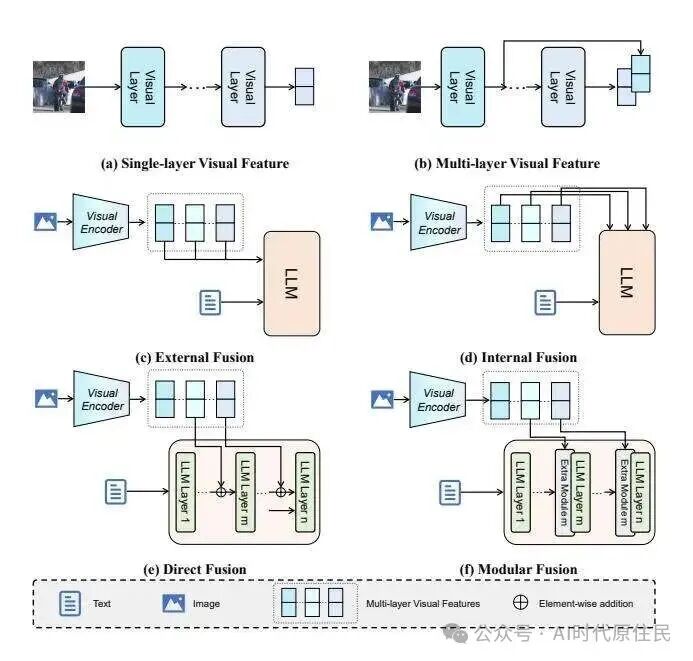
- (a)(b) Single-layer vs Multi-layer Feature Extraction
- (c)-(f) External/Internal × Direct/Modular Four Fusion Strategies
2. Methodology: Two Criteria, Four Strategies
2.1 How to Select Visual Layers? — Two Paths: “Similarity” and “Proportion”
The authors propose two simple yet effective criteria:
- Based on Similarity: Divide the 24 layers of ViT into three segments (beginning, middle, end) based on cosine similarity, selecting one representative from each segment.
- Based on Proportion: Split into front, back, or all layers in a 1:1 depth ratio, aligning with existing work.
Experiments reveal:
- Selecting one layer from each stage (e.g., {3,18,23}) > selecting multiple layers from the same stage > selecting all layers.
- Too many layers can lead to performance drops, as LLMs struggle with redundant information.
2.2 How to Determine Fusion Strategy? — External vs Internal, Direct vs Modular
The authors break down fusion into a 2×2 matrix:
| Position | Mode | Representative Implementation | Parameter Count | Characteristics |
|---|---|---|---|---|
| External (Input Side) | Direct | Dense Connector | Very Low | Stable, Easy to Scale |
| External | Modular | MMFuser | Medium | Learnable Weights |
| Internal (LLM Intermediate Layer) | Direct | DeepStack | Low | Requires LLM Structure Modification |
| Internal | Modular | Cross-Attention | High | Flexible but Hard to Train |
Quick Overview of Formulas:
- Internal Fusion:
- External Fusion:
3. Experiments: Over 50 Ablation Studies, Conclusions Are Clear
3.1 Benchmarks and Setup
- Model: Mini-LLaVA (1.4B LLM + CLIP-ViT-L/14)
- Data: Pre-trained on 558k image-text pairs, instruction fine-tuned on 665k dialogues
- Evaluation: 8 tasks including GQA, MMBench, TextVQA, OCRBench, POPE, etc.
3.2 Internal Fusion Results
Modular (Cross-Attention)
- Double {3,18} average 48.74 > Single 48.60 > Triple 46.91
- All directly trained to failure (loss 6+ not converging)
- Early layers significantly aid OCR and detail tasks, while too many late layers can interfere.
Direct Fusion (DeepStack)
- Increasing the number of layers improves performance, indicating that direct addition is more favorable for LLMs.
- Latter outperforms Former, as LLMs have weaker attention on later tokens, resulting in smoother fusion.
3.3 External Fusion Results
- External Direct Fusion averages 49.88, the best overall, with the smallest variance.
- Modular (MMFuser) drops 0.69 when using All layers, indicating that complex modules are more sensitive to layer selection.
4. Further Analysis: Data Scale and Model Components
4.1 Larger Data, Better Internal Fusion
- As SFT data increases from 332k to 737k, the internal fusion curve steepens while external fusion saturates.
- Conclusion: With sufficient data, internal direct fusion can rival external methods.
4.2 Changing ViT and LLM Also Holds
- Replacing CLIP with SigLIP, external direct fusion improves from 49.18 to 51.76.
- Switching from a 1.4B LLM to a 2.7B model further enhances performance to 52.63.
- Internal modular performance drops to 43.27 under SigLIP, indicating a risk of overfitting with complex modules.
5. Practical Guide: How to Implement in Your Project?
| Scenario | Recommended Configuration | Reason |
|---|---|---|
| Data < 1M | External + Direct Fusion | Stable, easy to train, no performance drop |
| Data > 1M | External or Internal + Direct Fusion | Releases internal potential with fewer parameters |
| Extremely Limited Resources | Select only {Beginning, Middle} two layers | Performance close to three layers, halving computation |
| Want to Rank High | External Direct + SigLIP + 2.7B LLM | Same SOTA combination as in the paper |
6. Conclusion and Further Thoughts
This paper thoroughly explains the use of “two criteria + four strategies” for multi-layer visual features:
- Layer Selection: Select one representative from each stage, avoiding redundancy.
- Fusion: External direct is the most robust, internal direct has potential, while modular should be approached with caution.
Future considerations could include:
- Dynamic Layer Selection: Can the model decide which layers to use?
- Task Adaptation: Do OCR and VQA require different layer combinations?
- End-to-End Optimization: Can we train the visual encoder together, breaking the “freeze ViT” limitation?
Feel free to like, comment, and share.