1. Introduction
Multi-Agent Reinforcement Learning (MARL) is an important branch of reinforcement learning that extends the traditional single-agent reinforcement learning concept to multi-agent environments. In MARL, multiple agents learn optimal strategies through interactions with the environment and other agents to maximize cumulative rewards in cooperative or competitive scenarios.
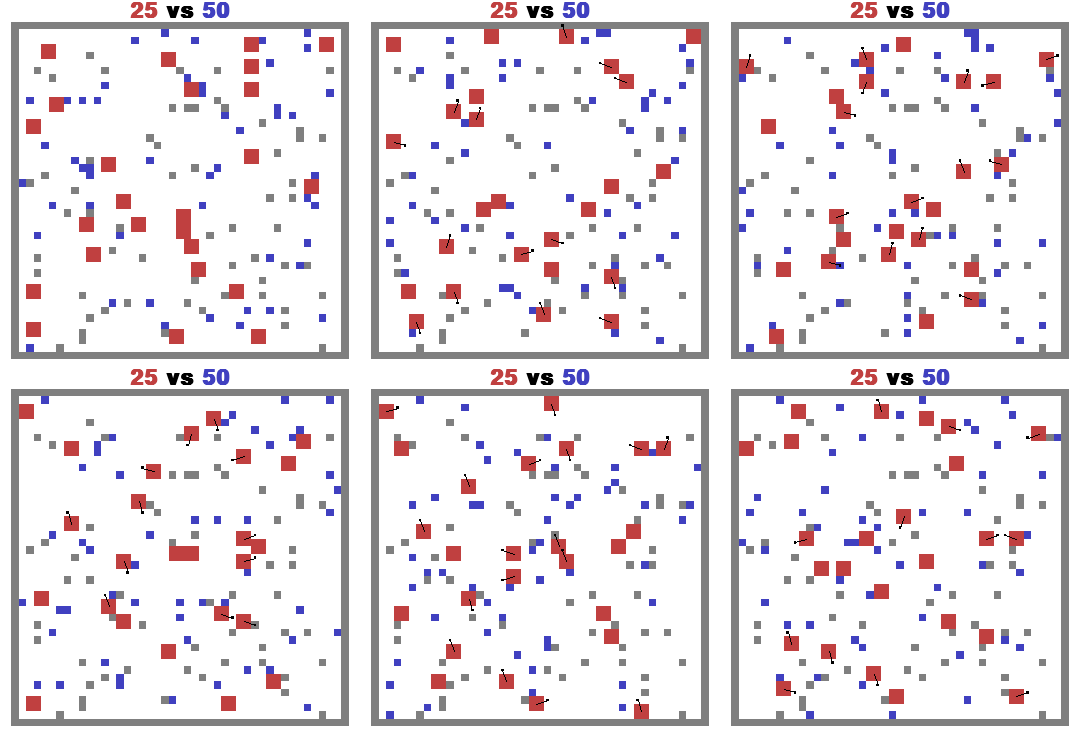
Adversarial interactions among agents in MAgent (mixed MARL example)
The formal definition of MARL is as follows: Multi-Agent Reinforcement Learning is a subfield of reinforcement learning that focuses on studying the behavior of multiple learning agents coexisting in a shared environment. Each agent is driven by its individual rewards and takes actions to advance its own interests; in certain environments, these interests may conflict with those of other agents, leading to complex group dynamics.
2. Review of Single-Agent Reinforcement Learning
Before delving into MARL, it is essential to review the fundamental concepts of single-agent reinforcement learning.
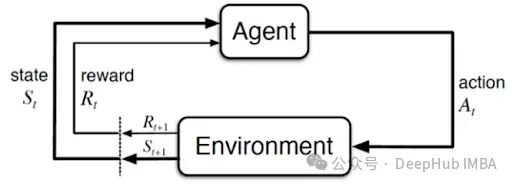
Illustration of the classic Markov decision process (source: R. Sutton and A. Barto)
2.1 Core Concepts
-
Agent: An agent is an entity that interacts with the environment, taking actions based on observations or states, with the goal of maximizing cumulative rewards.
-
State and Environment: The environment is the external system in which the agent operates. It provides state information to the agent, receives the agent’s actions, and returns new states and rewards. The state is a representation of the current situation of the environment that the agent can observe.
-
Markov Decision Processes (MDPs): Reinforcement learning problems are typically formulated as Markov Decision Processes, represented by a tuple
. Where S and A are the state space and action space, respectively, P(s’ | s, a) is the probability of transitioning from state s to s’ given action a, R is the reward function, and γ is the discount factor.
2.2 Policy
The behavior of the agent is guided by its policy π: given a state, the policy outputs an action or a probability distribution over actions. The goal of reinforcement learning is to find the optimal policy π*, which maximizes long-term cumulative rewards.
3. Methods for Solving Single-Agent MDPs
The core objective of solving MDPs is to maximize cumulative rewards over time. Major reinforcement learning methods can be divided into two categories:
3.1 Value-Based Methods
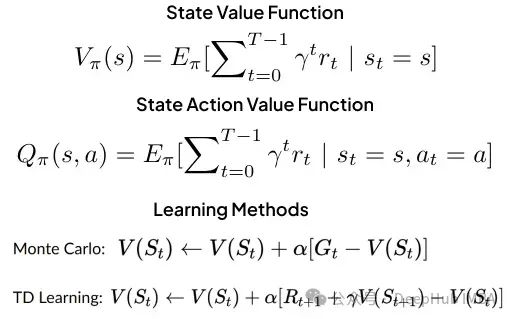
Overview of value functions and learning methods
In value-based methods, agents learn value functions to evaluate the value of states or state-action pairs and select actions based on these values. Typical value-based algorithms include Q-learning, SARSA, and Temporal Difference (TD) learning.
3.2 Policy-Based Methods
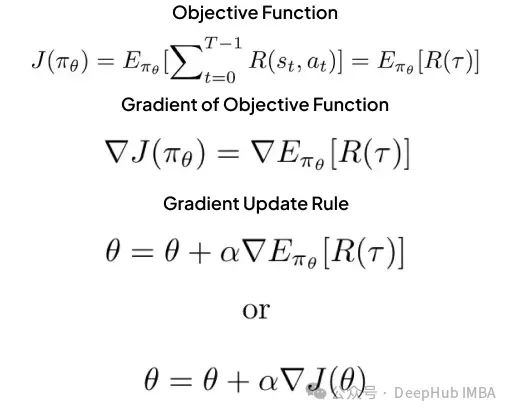
Overview of policy gradient methods and update rules
Policy-based methods directly learn the optimal policy, mapping states to actions to maximize long-term rewards. Common policy-based algorithms include policy gradients and actor-critic methods.
4. Characteristics and Challenges of Multi-Agent Reinforcement Learning
Extending single-agent reinforcement learning to multi-agent environments requires rethinking system modeling approaches. Multi-agent environments are often modeled as Markov games, where multiple agents interact simultaneously, each affecting state transitions and reward distributions.
4.1 Markov Games
Markov games are defined by the tuple (N, S, A, P, R, γ):
-
N: Number of agents
-
S: State space
-
A = A₁ × A₂ × … × Aₙ: Joint action space
-
P: State transition probability function
-
R = (R₁, R₂, …, Rₙ): Set of reward functions for each agent
-
γ: Discount factor
4.2 Categories of MARL
Multi-Agent Reinforcement Learning can be classified into the following categories based on the interaction methods among agents:
-
Cooperative MARL: Agents learn to accomplish tasks together, maximizing shared rewards. Suitable for scenarios like multi-robot systems.
-
Competitive MARL: Agents maximize their own rewards in adversarial or zero-sum games, such as board games or competitive scenarios.
-
Mixed-Incentive MARL: Agents have both cooperative and competitive relationships, with partially aligned and partially conflicting goals. Common in complex scenarios like trading, traffic, and multiplayer video games.
4.3 Major Challenges Facing MARL
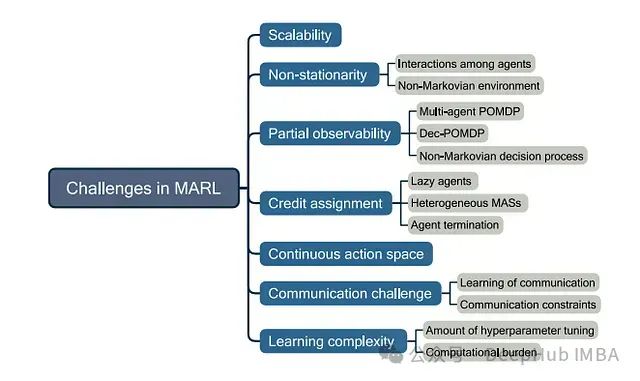
Major challenges in MARL
4.3.1 Non-Stationarity
In multi-agent environments, the environment faced by each agent is dynamically changing, as other agents are also continuously learning and adjusting their strategies. This violates the Markov property, making traditional reinforcement learning methods difficult to apply directly.
-
Impact: State transition probabilities and reward functions are no longer static.
-
Consequences: The optimal strategy of an agent may change with the behavior of other agents, leading to instability in the learning process.
4.3.2 Partial Observability
In most multi-agent scenarios, a single agent cannot obtain complete information about the environment state or the actions of other agents.
-
Modeling: The problem transforms into a Partially Observable Markov Decision Process (POMDP).
-
Challenges: Agents need to infer hidden states based on incomplete information, increasing the complexity of policy learning.
4.3.3 Scalability and Joint Action Space
As the number of agents increases, the complexity of the system grows exponentially.
-
Joint Action Space: For n agents, the joint action space is A₁ × A₂ × … × Aₙ.
-
Computational Challenges: The rapid expansion of the state-action space significantly increases computational complexity, reducing the efficiency of traditional RL methods.
-
Scalability Needs: There is a need to develop algorithms that can handle large-scale multi-agent systems.
4.3.4 Credit Assignment Problem
In cooperative scenarios, accurately assessing each agent’s contribution to team goals becomes particularly complex.
-
Challenges: It is difficult to determine which agents’ actions were crucial in achieving the common goal.
-
Limitations: Traditional methods often fail to provide clear insights into individual contributions, affecting the fairness and effectiveness of reward distribution.
These challenges collectively constitute the core issues in MARL research, driving the ongoing development of algorithms and theories in this field. In the following sections, we will explore some of the main methods and algorithms to address these challenges.
5. Decision-Making and Learning Paradigms in MARL
Multi-Agent Reinforcement Learning (MARL) has significant applications in various real-world domains, especially in robotics. MARL algorithms aim to enable each agent to learn how to maximize its own rewards while maintaining its contribution to the maximization of global rewards.
5.1 Main Learning Paradigms in MARL
5.1.1 Centralized Training with Decentralized Execution (CTDE)
CTDE is a widely used paradigm in MARL that employs different information access strategies during training and execution phases:
-
Training Phase: Agents can access global information.
-
Execution Phase: Agents make decisions based solely on local observations.
This approach balances learning efficiency with the needs of practical deployment.
5.1.2 Fully Decentralized Learning
In this paradigm, agents cannot access information from other agents during both training and execution:
-
Each agent independently updates its own policy.
-
The goal is to maximize the total rewards of all agents.
The main challenge faced by this method is the non-stationarity of the environment, as changes in the behavior of other agents can lead to dynamic changes in the environment from each agent’s perspective.
5.2 Core Algorithms
5.2.1 Value Decomposition Networks (VDN)
VDN is a method used within the CTDE framework, where the core idea is to decompose the global Q-value into the sum of individual agents’ Q-values.
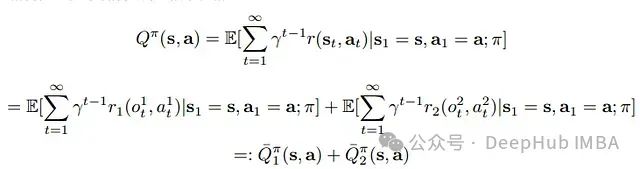
Q_tot as the sum of individual agents’ Q-values
The basic assumption of VDN is that the joint Q-function can be additively decomposed into individual agents’ Q-functions:
Q_tot = ∑ Q_i
Advantages:
-
Allows decentralized execution
-
Each agent can independently optimize its own policy
Limitations:
-
Simple summation may lead to reduced policy diversity
-
Prone to getting stuck in local optima, especially when Q-networks are shared among agents
5.2.2 QMIX
QMIX is an improvement over VDN, introducing a mixing network to combine individual agent values into a joint Q-value.
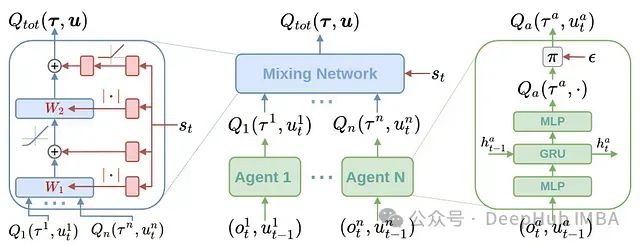
QMIX architecture
Core Features:
-
Uses a mixing network to represent the non-linear relationship between individual agent values and the joint Q-value
-
Maintains monotonicity constraints to ensure consistency in action selection

Q_tot as the output of the mixing network
QMIX follows the standard Q-learning paradigm, updating the global Q-value using the temporal difference (TD) error:
TD_error = r + γ * max_a‘ Q(s’, a‘) – Q(s, a)
5.2.3 Independent Proximal Policy Optimization (IPPO)
IPPO is a simple yet effective MARL algorithm where each agent operates independently during training and execution.
Key Features:
-
Each agent has its own independent policy and critic network
-
Uses the PPO algorithm for policy updates
IPPO employs the clipped objective function of PPO to prevent excessively large policy updates:

PPO clipped objective used in IPPO
Advantages:
-
Simple and easy to implement
-
Good scalability
Limitations:
-
May struggle to achieve global optimality, especially in tasks requiring high coordination
5.2.4 Multi-Agent Proximal Policy Optimization (MAPPO)
MAPPO is an extension of the PPO algorithm for multi-agent scenarios, adopting the CTDE approach.
Core Idea:
-
Uses a centralized critic to address non-stationarity issues
-
The critic can access joint states to learn more stable value functions
MAPPO executes policy updates by maximizing the following PPO objective:

Where L_i_PPO is the PPO objective for agent i.
The centralized critic updates by minimizing the following error:

MAPPO excels in handling non-stationary environments by combining centralized training with decentralized execution.
In the next section, we will continue to explore more advanced MARL algorithms and communication strategies in multi-agent systems.
6. Advanced MARL Algorithms and Communication Strategies
6.1 Multi-Agent Deep Deterministic Policy Gradient (MADDPG)
MADDPG is an extension of the Deep Deterministic Policy Gradient (DDPG) algorithm in multi-agent environments. It adopts a centralized training decentralized execution (CTDE) strategy, introducing a centralized Q-function to handle the joint actions of all agents.
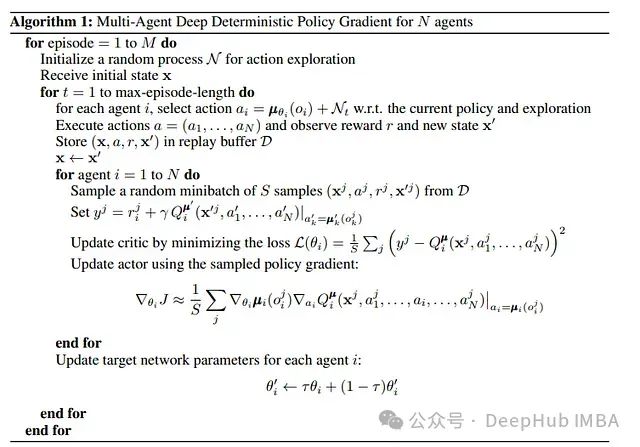
MADDPG algorithm flow
Core Features:
-
Each agent has its own actor (policy) and critic network
-
The critic network can access the observations and actions of all agents during training
-
Uses target networks to stabilize the learning process
The critic network of MADDPG updates following the standard Q-learning paradigm:
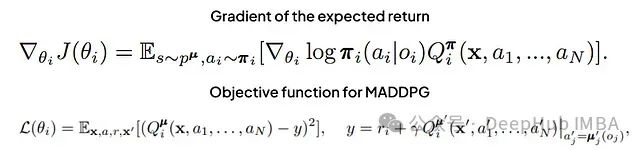
Where the Q-function is the centralized action-value function that takes actions from all agents as input.
Policy updates are achieved by maximizing the expected Q-value:

MADDPG effectively addresses the challenges of non-stationary environments by allowing agents to learn the policies of other agents.
6.2 Communication Strategies in MARL
In multi-agent systems, effective communication is crucial for coordination and decision-making. However, communication also faces challenges such as bandwidth limitations and unreliable channels.
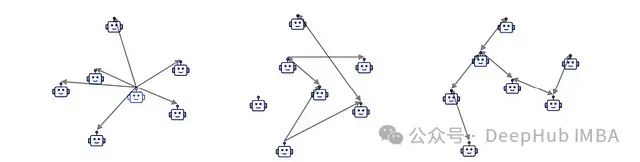
Three different communication strategies among agents
6.2.1 Differentiable and Reinforced Inter-Agent Learning (RIAL/DIAL)
RIAL and DIAL are important methods for exploring efficient communication among agents:
-
RIAL: Combines DRQN and Independent Q-learning for action selection and communication, respectively
-
DIAL: Introduces differentiable communication channels to support end-to-end learning
6.2.2 SchedNet
SchedNet introduces a learning-based scheduling mechanism, allowing agents to learn which agents should be permitted to broadcast messages.
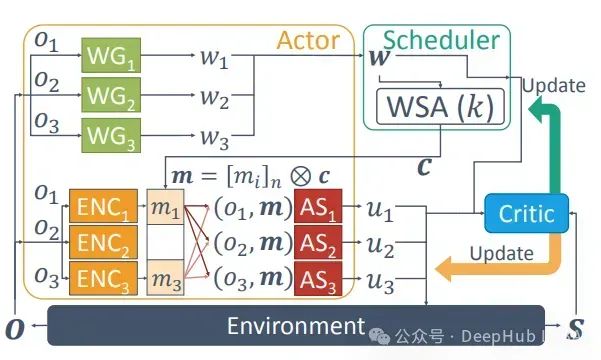
SchedNet architecture
Main components:
-
Scheduling mechanism
-
Message encoding
-
Action selection based on limited communication and local observations
6.2.3 Targeted Multi-Agent Communication (TarMAC)
TarMAC focuses on improving the efficiency and effectiveness of communication among agents.
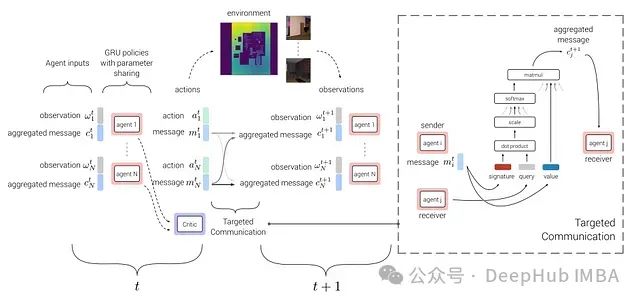
TarMAC architecture
Core Idea:
-
Uses target communication strategies, allowing agents to selectively communicate with specific peers
-
Employs a signature-based soft attention mechanism for message directionality
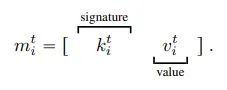
Messages constructed using signatures and values
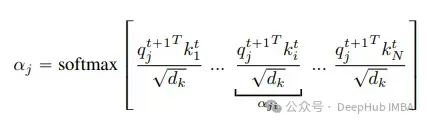
Attention for cross-agent computation
6.2.4 Autoencoder-Based Communication Methods
This method aims to develop a communication language in multi-agent systems, focusing on how to use autoencoders to establish a language foundation in the environment.
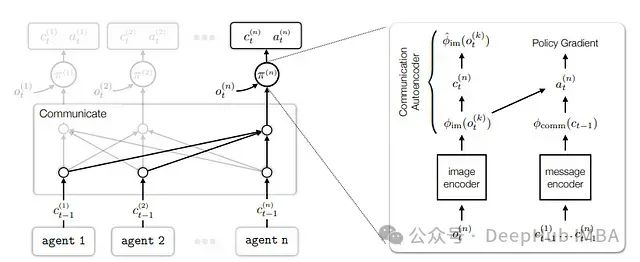
Autoencoder-based communication architecture
Main components:
-
Image encoder: Embeds raw pixel observations into a low-dimensional feature space
-
Communication autoencoder: Learns the mapping from feature space to communication symbols
-
Receiver module: Processes encoded image features and message features using GRU strategies
7. Conclusion and Future Directions
Multi-Agent Reinforcement Learning (MARL) greatly expands the boundaries of traditional reinforcement learning by introducing the complexity of multiple agents interacting in shared environments. The challenges of non-stationarity, partial observability, scalability, and credit assignment in MARL have driven rapid advancements in this field.
Future Research Directions
-
Scalability: Developing algorithms that can effectively handle large-scale multi-agent systems remains a key challenge.
-
Decentralized Training and Decentralized Execution (DTDE): Exploring fully decentralized training and execution methods to address more complex real-world scenarios.
-
Communication Strategies: Further research into efficient and robust inter-agent communication mechanisms, especially under limited bandwidth and unreliable channels.
-
Transfer Learning: Investigating how to transfer learned policies from one multi-agent environment to another.
-
Modeling MARL: Combining model learning with MARL to improve sample efficiency and generalization capabilities.
-
Fairness and Ethics: Exploring fairness issues in MARL systems and how to incorporate moral and ethical considerations into multi-agent decision-making.
As research deepens and technology advances, MARL is expected to play a key role in addressing more complex real-world problems, driving the application of artificial intelligence in multi-agent systems forward.
References
-
Deep Recurrent Q-Learning for Partially Observable MDPs: https://arxiv.org/abs/1507.06527
-
Is Independent Learning All You Need in the StarCraft Multi-Agent Challenge?: https://arxiv.org/abs/2011.09533
-
The Surprising Effectiveness of PPO in Cooperative, Multi-Agent Games: https://arxiv.org/abs/2103.01955
-
Multi-Agent Actor-Critic for Mixed Cooperative-Competitive Environments: https://arxiv.org/abs/1706.02275
-
Value-Decomposition Networks For Cooperative Multi-Agent Learning: https://arxiv.org/abs/1706.05296
-
QMIX: Monotonic Value Function Factorisation for Deep Multi-Agent Reinforcement Learning: https://arxiv.org/abs/1803.11485
-
Learning to Communicate with Deep Multi-Agent Reinforcement Learning: https://arxiv.org/abs/1605.06676
-
Learning to Schedule Communication in Multi-agent Reinforcement Learning: https://arxiv.org/abs/1902.01554
-
TarMAC: Targeted Multi-Agent Communication: https://arxiv.org/abs/1810.11187
-
Learning to Ground Multi-Agent Communication with Autoencoders: https://arxiv.org/abs/2110.15349
If you like it, please follow us:
Editor / Feng Yu
Review / Fan Ruiqiang
Verification / Fan Ruiqiang
Click below
Follow us