Citation Information


Ma J, Xing TZ, Xi W et al. HeartIt: Low-power smoking detection with a smartwatch on either wrist. JOURNAL OF COMPUTER SCIENCE AND TECHNOLOGY, 40(2): 552−571, Mar. 2025. DOI: 10.1007/s11390-024-2981-3
Long press to scan the QR code to read the full text
The World Health Organization reports that over 8 million people die each year from smoking-related diseases, making smoking one of the greatest public health threats. Quitting smoking is one of the key measures to reduce smoking-related diseases and deaths. However, studies show that without effective “quit smoking” reminders, only 4% of smokers can successfully quit. In contrast, effective “quit smoking” reminders can more than double the chances of quitting successfully.
Traditional smoking detection methods mainly rely on visual detection, non-sensor detection, and Inertial Measurement Units (IMUs). However, visual detection cannot accurately detect smoking outside the line of sight, non-sensor detection is not suitable for all-day smoking detection, and IMU-based smoking detection methods require smokers to always hold the cigarette and wear the smartwatch on the same hand, making it difficult to distinguish smoking behavior from other similar gestures.
Based on observational experiments, heart rate changes caused by nicotine and oxygen exhibit a series of short-duration square waves, which is a distinct and specific physiological response, making it very suitable for smoking detection. Therefore, we propose the HeartIt smoking detection model based on smartwatches. To accurately detect heart rate waveforms, we introduce the Heart Smoke Match (HSM) model to detect smoking behavior. Additionally, to achieve continuous all-day detection, we designed an adaptive tracker that triggers heart rate sensing for smoking detection by recognizing the action of lighting a cigarette, effectively reducing the energy consumption of HeartIt.
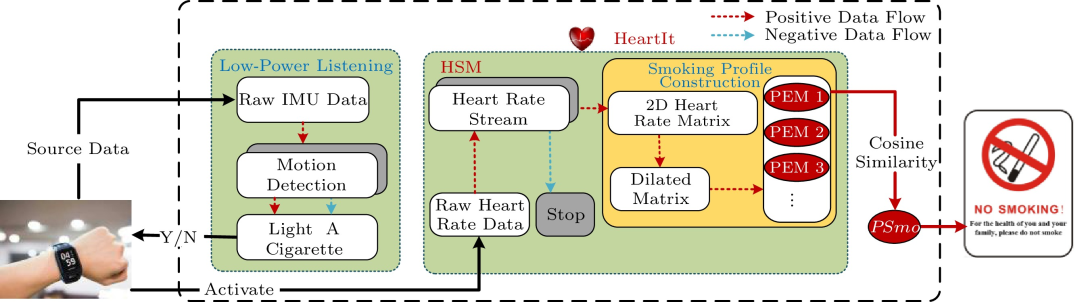
Figure 1 Overview of HeartIt
We tested and evaluated the performance of HeartIt across different populations, postures, and scenarios. The results show that HeartIt achieves an accuracy of 96.7% and a recall rate of 99.8%.

Click to read the original text

Get the full electronic version for free
JCST provides all readers withfree PDF versions of papers. If you are interested in our paper, please send a private message with “Article Title/DOI + Email Address“, or email to[email protected]. The editorial office will send you the electronic version as soon as possible.
▼ Recommended Reading ▼
Key articles recommendedKey Recommendation | Thematic Selection | High-Performance Computing and Parallel System OptimizationKey Recommendation | Review by Cheng Xiangqi’s team at the Institute of Computing Technology, Chinese Academy of Sciences: Domain Adaptation Techniques for Graph Representation Learning—Challenges, Progress, and ProspectsKey Recommendation | Intelligent Software Engineering: Software Testing and Maintenance
Key Recommendation | Professor Chen Jiajun’s team at Nanjing University | Hybrid Language Relation Extraction: Datasets and Methods
Key Recommendation | Review by Chen Yunqiang’s team at the Institute of Computing Technology, Chinese Academy of Sciences: Intelligent Computing Systems for Large Model Training
Key Recommendation | Joint Research by Tsinghua University, Huawei, and China Mobile: openGauss: Enterprise-Level Open Source Database System Method
Key Recommendation | Researcher Chen Yiqiang’s team at the Institute of Computing Technology, Chinese Academy of Sciences | FedBone: A Large-Scale Multi-Task Federated Learning Method
Key Recommendation | Overview of Large Language Model Datasets: From Autoregressive Models to Conversational Agents
Key Recommendation | Review by Professor Li Xi’s team at Zhejiang University, in collaboration with Dr. Wang Jingdong from Baidu: Overview of Multimodal Controllable Diffusion Models
Key Recommendation | Professor Tang Jinhui and Professor Pan Jinshan’s team at Nanjing University of Science and Technology: Overview of Video Colorization
Key Recommendation | Exploring the Integration of Artificial Intelligence and Art: Selected Papers from JCST
Key Recommendation | Professor Lu Yutong’s team at Sun Yat-sen University: Scalable Evaluation Methods for Understanding Intelligent Computing Capabilities of High-Performance Computing Systems
Key Recommendation | Review by Professor Chen Wei’s team at Zhejiang University: Investigation of Computer Technology Applications in Chinese Traditional Painting
Key Recommendation | Professor Ma Xiaoxing’s team at Nanjing University: Effectiveness and Challenges of Java Automation Testing Generation Tools—Empirical Research
Key Recommendation | [Invited Review] Professor Chen Wenguang from Tsinghua University: Graph Accelerators—Successful Cases of Sparse Data Processing
Key Recommendation | Review by Professor Li Cuiping’s team at Renmin University of China: Enhancing Storage Efficiency and Performance—A Review of Data Partitioning Techniques
Key Recommendation | [Cover Article] Professor Jin Hai and Professor Liao Xiaofei’s team from Huazhong University of Science and Technology: Hardware/Software Co-design for High-Performance Graph Computing Solutions
Key Recommendation | Professor Shi Weisong’s team at the University of Delaware: VPI: Programming Interface Design for Vehicle Computing
Key Recommendation | [Cover Article] Review by Professor Zhang Youhui’s team at Tsinghua University: Research on General Brain-like Computing Systems
Key Recommendation | Latest Papers on Perception and Interaction
Key Recommendation | Review | Key Technologies of Time Series Databases
Key Recommendation | [Invited Review] Professor Xu Zhiwei from the Institute of Computing Technology (Editor-in-Chief of JCST): Decoupled Data Centers for Future Cloud Computing
Key Recommendation | [Cover Article] Joint Research by the Institute of Computing Technology, Chinese Academy of Sciences & Huawei Cloud: Cloud Computing System Software for Resource Decoupling Architecture
Key Recommendation | Joint Research by the Institute of Computing Technology, Chinese Academy of Sciences, University of New South Wales: Automatic Generation of Target Description Files
Previous Issues Directory
[Vol.40 No.2 2025]
[Vol.40 No.1 2025]
[Vol.39 No.6 2024]
[Vol.39 No.5 2024]
[Vol.39 No.4 2024]
[Vol.39 No.3 2024]
[Vol.39 No.2 2024]
[Vol.39 No.1 2024]
Academic ActivitiesNew Starting Point, New Journey | JCST Selected for the Excellence Action Plan Phase II Project of Chinese Science and Technology Journals
5·30 National Science and Technology Workers’ Day | Towards 2035, Building a Strong Science and Technology Nation

Statement
All original articles published by this public account are welcome to be forwarded and reprinted, but the author and article source must be indicated as “Journal of Computer Science and Technology JCST” public account; no media, website, or individual may modify or excerpt the content of original articles from this public account. Except for the original graphics and texts of this public account, the graphics and texts published by this public account are intended for academic exchange, and the copyright belongs to the original author. This public account will not bear any legal responsibility; non-original content has been marked with sources, and if there is any infringement, please leave a message to this public account, and we will handle it promptly. The Journal of Computer Science and Technology (English) has the final interpretation right.