 Produced by Zhineng Zhixin
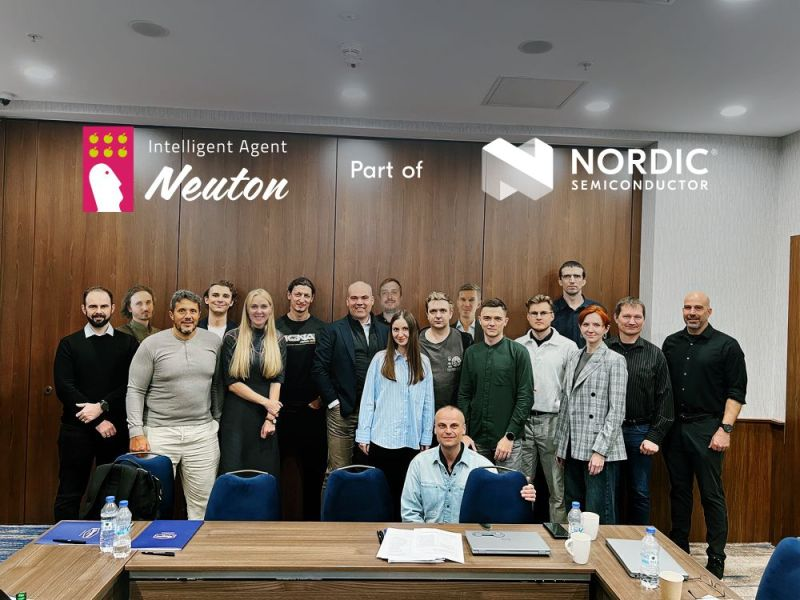
Nordic Semiconductor has announced the acquisition of the core technology and intellectual property of edge AI startup Neuton.AI. This move aims to integrate its product line in low-power wireless communication with Neuton.AI’s lightweight neural network framework, providing local intelligent computing capabilities for resource-constrained devices.
From an industry perspective, this acquisition reflects the gradual transition of edge AI from experimentation to practical application, seeking a balance between power consumption, security, and deployment thresholds.
By analyzing the characteristics of Neuton.AI’s platform and Nordic’s product strategy, we can see the practical significance and limitations of this integration in scenarios such as smart terminals, wearable devices, and industrial automation.
 Part 1
The Lightweight Nature of Neuton.AI
TinyML Technology Framework and Application Reality
Neuton.AI is a platform company focused on automating TinyML tools, characterized by its ability to automatically generate ultra-small neural network models without traditional data science processes and manual tuning.
Its core advantages are reflected in two aspects:
◎ First, the model size is small, often less than 5KB;
◎ Second, it can run on low-cost MCUs with 8-bit, 16-bit, or even 32-bit architectures, enabling local inference and response.
This approach is particularly attractive for embedded devices.
Currently, most wearable, medical sensors, or smart edge nodes are limited by power supply, storage, and computing capabilities, making traditional AI models difficult to deploy.
Neuton’s platform can automatically generate models without predefined network structures, allowing engineers without an AI background to quickly test and deploy intelligent applications, thus lowering the development threshold.
However, its limitations cannot be ignored.
◎ First, although these models are compact, they have inherent boundaries in precision and the ability to handle complex tasks, making them difficult to apply in image recognition or complex natural language scenarios.
◎ Second, while model generation does not require a deep learning background, ensuring the quality of training data and the model’s generalization ability still requires experienced guidance.
◎ Finally, the ecosystem in the embedded AI field is still immature, with related toolchains, validation processes, and platform compatibility continuously evolving within the industry.
While Neuton.AI has certain productization advantages, its influence is still concentrated in narrow scenarios such as lightweight classification and sensor data analysis.
This integration with Nordic reflects more of a trend towards local intelligence demand in the low-power IoT market rather than a short-term technological breakthrough.
Part 2
Nordic’s Acquisition Strategy
Linking with the Edge AI Industry Landscape
From Nordic Semiconductor’s recent product path, its focus has been on low-power Bluetooth, Wi-Fi, Thread, and other wireless SoC platforms, primarily serving scenarios such as wearables, consumer electronics, industrial automation, and smart homes.
The nRF54 series is its next-generation flagship platform, showing significant improvements in power consumption, performance, and integration compared to previous products.
This acquisition aims to combine Neuton.AI’s AI model generation platform with the nRF series wireless SoCs, intending to fill the gap in Nordic’s “connectivity + intelligence” integrated system.
In the future, developers are expected to achieve both wireless communication and local intelligent computing on the same chip, building more responsive terminal devices without increasing hardware costs.
The acquisition enhances Nordic’s capabilities in the edge AI field, but it also faces multiple challenges in integration and market implementation.
◎ First, there is the issue of adapting Neuton models to Nordic’s existing SDKs and development platforms,
◎ Second, the technology relies heavily on the developer tool ecosystem, training resources, and technical support.
If the subsequent integration pace is too fast or the platform is not open enough, it may raise customer conversion costs instead.
Moreover, the edge AI track itself presents a diverse competitive landscape. Chip manufacturers such as STMicroelectronics, Infineon, Cypress, and NXP are also laying out lightweight neural network toolkits and SoC integrated AI capabilities.
◎ For example, STMicroelectronics’ NanoEdge AI Studio emphasizes on-site learning and local deployment on STM32 MCUs, with a more complete toolchain than Neuton.
◎ Meanwhile, Infineon is promoting AI experiences in wearable applications through collaboration with SensiML, also providing overall solutions from a platform integration perspective.
For Nordic, the acquisition of Neuton.AI brings platform-level flexibility and a certain degree of differentiation space, but how to establish a stable tool ecosystem, simplify the development process, and lower the learning threshold will be key to its future industrialization.
Conclusion
From an industry trend perspective, edge AI has become an important development direction for low-power IoT, particularly optimizing response speed, data privacy, and network dependency.
This acquisition of Neuton.AI by Nordic aims to achieve vertical integration across chip, communication, and algorithm levels, thereby constructing replicable, deployable, and scalable local intelligent solutions in AIoT devices.
Currently, TinyML is still in its early stages, with issues such as model size, training processes, deployment efficiency, and tool compatibility not yet fully resolved.
While Neuton.AI has advantages in lightweight deployment, it still needs to further enrich its functionality and ecosystem to attract a broader developer community in the face of increasingly complex embedded applications.