Click the “Turing Artificial Intelligence” above to select the “Star” public account
Get the AI insights you want delivered to you first
 For academic sharing only, please leave a message for deletion if there is any infringement
Introduction
The trajectory of scientific discovery is like a brilliant tapestry woven into human history, undergoing a series of paradigm evolutions. Early explorations primarily relied on empirical discoveries driven by intuition, trial and error, or serendipity. Subsequently, theoretical frameworks represented by Newtonian mechanics provided the foundation for our insights into the fundamental principles of natural phenomena. The rise of high-performance computing ushered in the era of computational science characterized by interdisciplinary and multiscale modeling. The massive data generated by these processes has pushed us towards a data science paradigm centered on revealing hidden relationships in high-dimensional data.
Today, we are on the brink of a potentially new paradigm—Agentic Science. In this paradigm, AI agents can (semi) autonomously explore and learn, unlocking unprecedented pathways for scientific discovery.
Keywords: AI agents, automated scientific discovery

Author: Zeng Li | Reviewer: Zhou Li
Paper Title: Towards agentic science for advancing scientific discovery
Paper Link: https://www.nature.com/articles/s42256-025-01110-x
Publication Date: September 10, 2025
Source: Nature Machine Intelligence
The Rise of AI Agents: From Expert Systems to General Large Models
Historically, the concept of AI agents can be traced back to the dawn of AI. In 1965, the <span><span>DENDRAL</span></span> system applied rule-based reasoning to analyze chemical data and infer molecular structures, becoming one of the earliest domain-specific AI systems [1]. In 1966, <span><span>ELIZA</span></span> demonstrated the potential of natural language interaction by simulating a psychotherapist’s text dialogue [2]. Over the following decades, expert systems, probabilistic models, and machine learning techniques continuously expanded the capabilities of AI agents.
The revolutionary breakthroughs in deep learning during the 2010s enabled systems to process unstructured data on a large scale and learn complex patterns. Recently, the rapid development of large language models (LLMs) has significantly broadened the accessibility, adaptability, and scientific relevance of AI agents, opening a new era for their integration across research fields.
Core Capability: How Do AI Agents Think and Act?
A decisive feature of AI agents is their independent agency [3]. This flexibility is driven by the core multimodal large language models, enabling them to perform advanced reasoning across text, images, audio, video, and even structured data such as chemical formulas and mathematical expressions.
Through active learning and seamless integration with external tools (such as software and automated laboratory hardware), AI agents can interact directly with the physical world and digital resources to collect new data. Recent advancements, such as the “Model Context Protocol” and “Agent2Agent” communication protocols, are paving the way for building distributed systems where multiple autonomous agents collaborate.
These developments collectively empower AI agents to interpret observations, understand user instructions, formulate action plans, and adjust strategies in real-time. Their multi-step strategic thinking allows them to anticipate the consequences of actions and balance short-term and long-term goals. With their foresight, modular architecture, and robust tool integration capabilities, AI agents are leading scientific research from large-scale data analysis to a new era of autonomous experimental design.
The foundation of this transformation is the AI agent framework aimed at automating the entire scientific workflow—from hypothesis generation, experimental planning, data analysis to the final publication of results.
Practical Frontiers: When AI Enters the Laboratory
-
Sakana AI has launched systems like
<span><span>AI Scientist</span></span>that attempt to autonomously manage the entire research cycle, including conception, design, analysis, and even manuscript writing and review, striving to minimize human intervention [4].
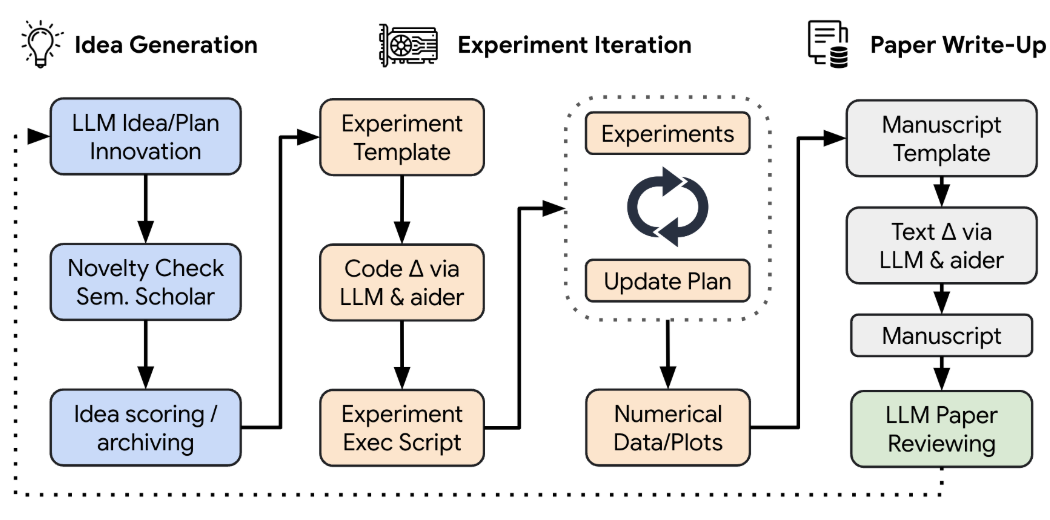
Figure 1: Description of the AI Scientist system designed by Sakana AI.The AI scientist first brainstorms a set of ideas, then evaluates their novelty. Next, it edits the codebase supported by the latest progress generated by automated code generation to implement novel algorithms. The scientist conducts experiments to collect results composed of digital data and visual summaries. It produces a scientific report explaining the results and placing them in context. Finally, the AI scientist generates automated peer reviews based on the standards of top machine learning conferences. This review helps refine the current project and provides open-ended information for future generations.
-
<span><span>FutureHouse</span></span>platform demonstrates how to combine multiple specialized AI agents (such as literature analysts, novelty detectors, and experimental planners) into a powerful chemical research pipeline [5].
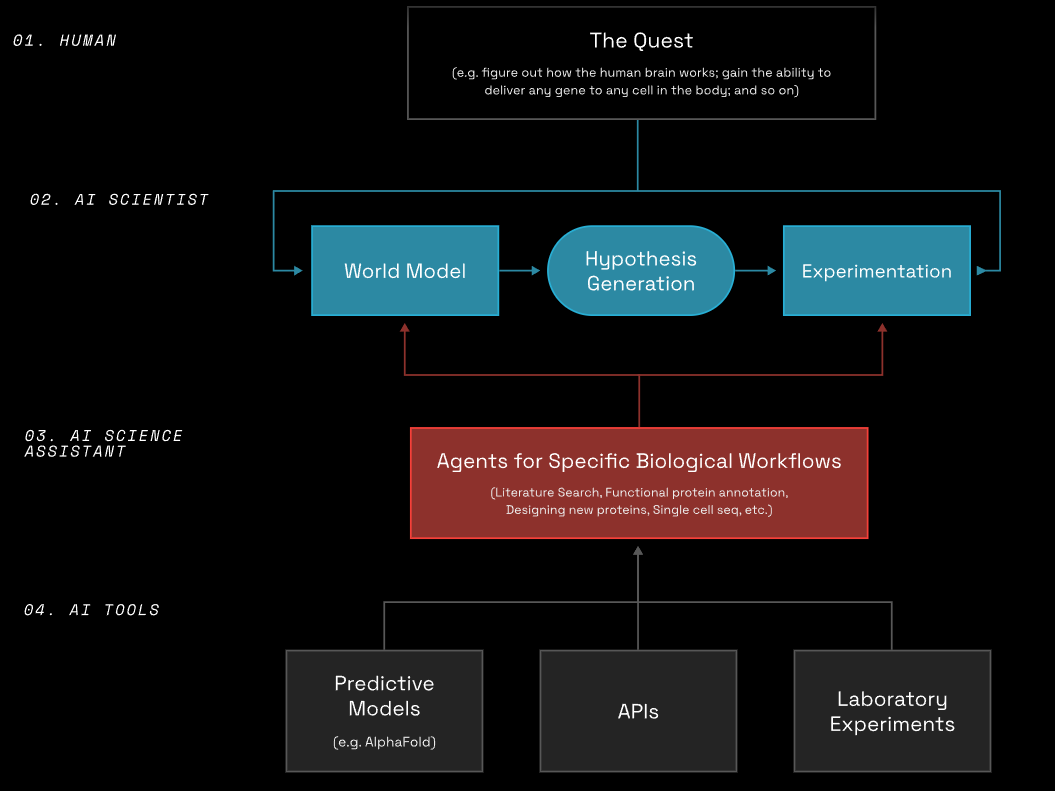
Figure 2: The four-layer architecture of the multi-agent scientific discovery system proposed by FutureHouse.This figure illustrates the collaborative relationship between human scientists and AI systems in the research process: the top layer consists of human scientists proposing core scientific questions and exploration goals, serving as the driving force for the entire system; the second layer of AI scientists constructs world models, generates hypotheses, and conducts experiments, forming an automated cycle of scientific reasoning and validation; the third layer of AI research assistants consists of agents tailored to specific disciplinary processes, such as executable literature searches, protein function annotation, new protein design, and single-cell sequencing analysis, providing data and knowledge support for the reasoning of AI scientists; the bottom layer of AI tools includes predictive models (such as AlphaFold), API interfaces, and laboratory automation systems, providing algorithmic support and experimental validation for the upper layers of agents. The entire architecture reflects a progressive collaboration from tools to agents to intelligent scientists, aiming to promote the intelligent and systematic approach to complex research tasks.
-
Focusing on materials science, the
<span><span>LLaMat</span></span>model has demonstrated unprecedented capabilities in generating chemically viable crystal structures and extracting technical data from literature [6].
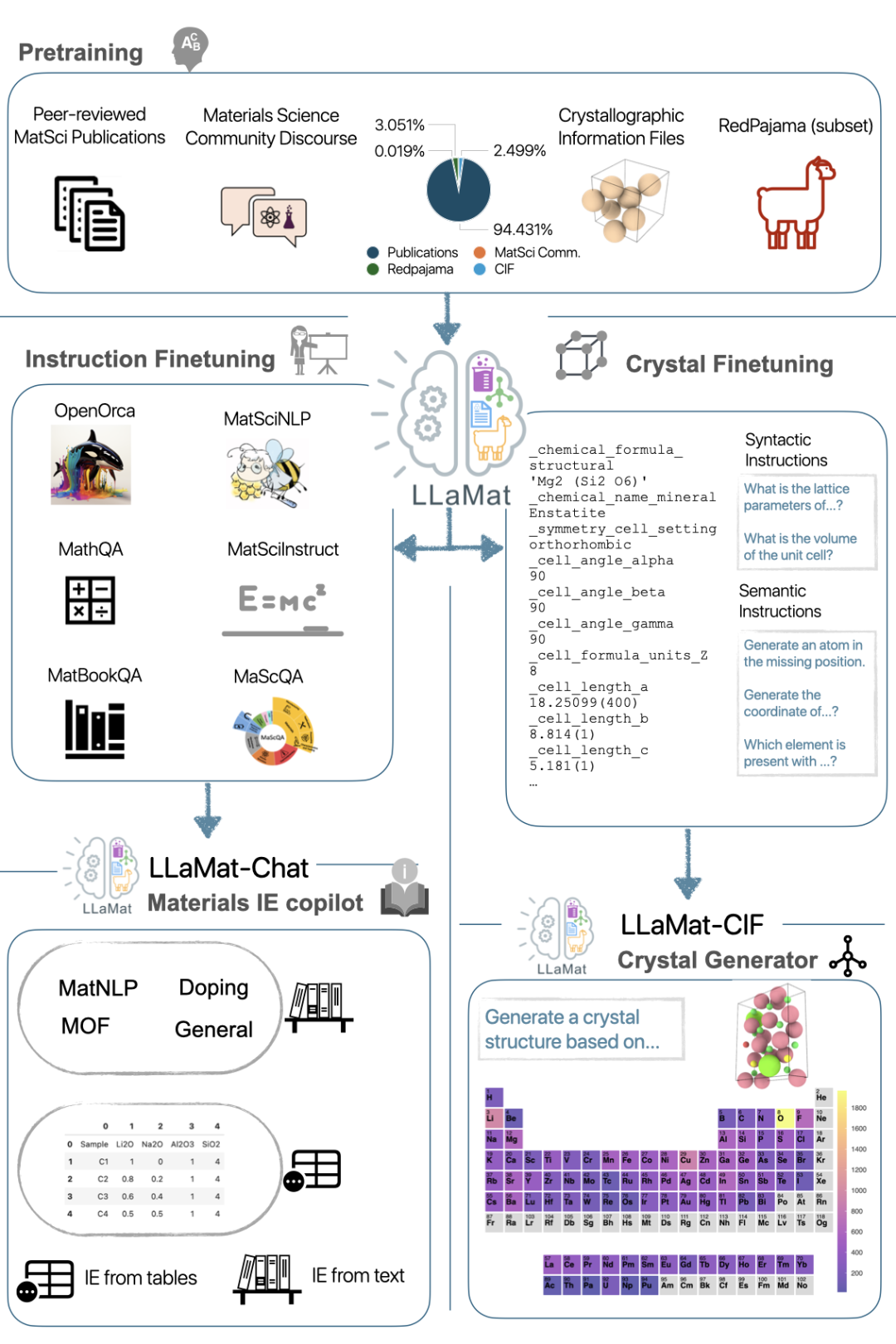
Figure 3: Development process and functional diagram of LLaMat in the field of materials science.This figure illustrates the two-phase development process of LLaMat: first, continuous pre-training based on materials science corpora (top), followed by optimization through two specialized instruction fine-tuning paths (left and right branches). The pre-training data primarily comes from academic papers, crystal structure files, and general text corpora. The two fine-tuning paths produce two models: LLaMat-Chat—which assists in materials research, executing structured information extraction and materials language processing tasks; and LLaMat-CIF—which focuses on the analysis and generation of crystal structures. The examples in the figure demonstrate the model’s performance in addressing different types of materials science problems and tasks.
These emerging frameworks are driving us towards a scalable, transparent, and collaborative ecosystem of agents to accelerate scientific discovery.
Interdisciplinary Differences: Not All Fields Are Ready
It is important to recognize that the impact of AI agents varies by discipline. In fields like chemistry and materials science, where problems are structured, data-rich, and highly automated, agent-based approaches have brought tangible benefits.
-
In the field of chemistry, the
<span><span>Coscientist</span></span>system utilizes LLMs to interpret natural language instructions, autonomously design experiments, and operate cloud laboratory equipment via APIs [7].
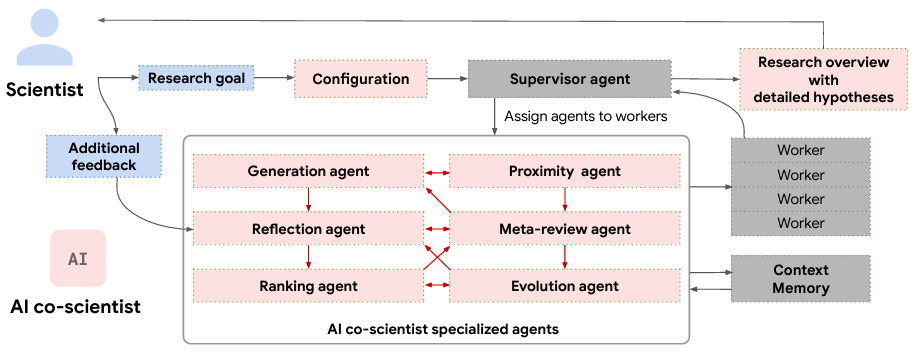
Figure 4: Multi-agent architecture design of the AI co-scientist.This system can receive research objectives input by researchers in natural language and parse them into executable research plan configurations. The plan is then sent to a supervising agent, which evaluates the overall scheme, allocates weights and resources to various specialized agents, and queues them based on priority. Each working process sequentially executes the tasks of the agents in the queue, and the system ultimately integrates all results to generate outputs that include research overviews, detailed hypotheses, and proposal suggestions to support researchers. In the figure, the red boxes in the “Dedicated agents of the AI co-research agent” section represent independent agents with different logics and functions, while the blue boxes indicate the stages of researcher involvement and feedback; the dark gray arrows represent the information transfer paths within the system, while the red arrows represent the feedback loops between specialized agents.
-
In the field of materials science, the
<span><span>A-Lab</span></span>serves as a fully autonomous solid-state synthesis laboratory, integrating robotics, machine learning, and ab initio calculations. Although it also uses LLMs to predict synthesis schemes, it has not yet formed a closed-loop agent behavior [8]. In contrast, the<span><span>LLaMP</span></span>framework, which employs retrieval-augmented generation (RAG), achieves true high-fidelity knowledge dynamic synthesis through layered reasoning-action agents [9].
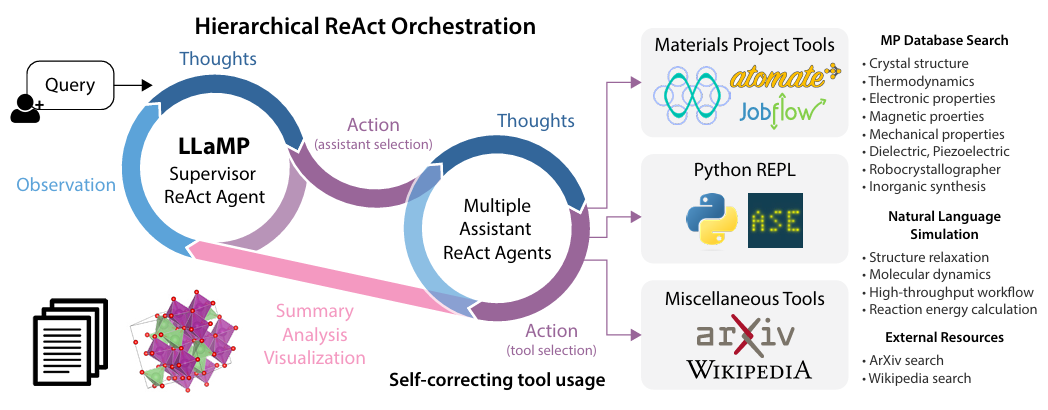
Figure 5: Layered ReAct agent planning architecture in the LLaMP system.This architecture deploys two layers of agents through standardized LangChain interfaces: the upper layer consists of supervisory ReAct agents, while the lower layer comprises multiple assistant ReAct agents. The supervisory agent is responsible for coordinating and scheduling the work of the lower assistant agents, each equipped with independent toolsets and data/document storage to complete different types of research tasks, including high-fidelity material information retrieval, atomic-level modeling and simulation, and literature searches.
However, in fields like social sciences, where unified datasets are scarce and research questions are vaguely defined, AI still struggles to perform effectively. Similarly, in tasks requiring nuanced human judgment and ethical sensitivity, such as clinical diagnosis or animal behavior research, AI agents must defer to human experts, with clearly defined boundaries.
Core Challenge (1): The Boundary Between Hallucination and Fact
A key challenge for AI agents in scientific applications is the inherent tendency of LLMs to produce “hallucinations”—information that sounds plausible but is unverifiable or incorrect. While such inferences may occasionally touch upon unknown innovative areas, they are also likely to introduce errors that undermine scientific rigor.
To manage the complexity of scientific reasoning, AI agents must be rooted in domain knowledge. By integrating structured resources such as knowledge graphs (e.g., chemical reaction networks, gene ontologies), agents can cross-verify their outputs and reduce factual errors.
However, the forms of “hallucination” can be more subtle. A phenomenon known as “slopsquatting”—where LLMs “invent” and cite non-existent software packages or literature—highlights the significant risk of unwarranted confidence in outputs lacking a knowledge foundation. This issue is particularly pronounced in long-term, multi-step tasks requiring sustained reasoning and contextual awareness.
Recent benchmark tests, such as <span><span>METR</span></span>, indicate that even advanced LLM agents struggle with such tasks, often accumulating and amplifying small errors over time. This underscores the importance of integrating domain knowledge, external validation, and human oversight to ensure the safe and reliable deployment of AI agents [10].
Core Challenge (2): How to Evaluate an “AI Scientist”?
While improving factual reliability, another fundamental challenge lies in how to assess the performance of AI agents. Traditional machine learning metrics (such as accuracy, precision) are clearly unsuitable. For an interactive, multi-step, goal-driven “AI scientist,” how do we measure its effectiveness?
Recently, the academic community has proposed some new metrics, such as <span><span>pass@k</span></span> (success at least once in k attempts), steps, and shortest path distance in reasoning graphs [11]. Domain-specific benchmark tests are also emerging, such as the <span><span>AFMBench</span></span> benchmark, which tests LLM-driven agents in real laboratory tasks, revealing critical failure modes in complex scientific workflows [12].
However, these metrics and benchmarks are far from standardized and lack cross-domain applicability. In fields like materials science, the diversity of workflows, variability of experimental results, and the highly context-dependent definitions of success make consistent evaluation exceptionally challenging. Ultimately, the true test of these systems may lie not only in formal metrics but in whether they can provide measurable utility in actual scientific research.
Core Challenge (3): The “Butterfly Effect” of Prompts
Closely related to the evaluation challenge is the issue of prompt fragility: agent systems are extremely sensitive to subtle changes or ambiguities in natural language inputs. Like initial conditions in dynamic systems, a poorly phrased or ambiguous prompt can lead the model down entirely different or even erroneous paths.
This “fragility” is particularly dangerous in scientific contexts. To address this issue, agent frameworks must incorporate verification mechanisms and safety interlocks. For instance, at critical decision points, intermediate outputs should be reviewed by human experts or specialized “verification agents.” Once inconsistencies or unreasonable actions (such as proposing the use of non-existent compounds or violating safety protocols) are detected, the system should be able to automatically pause or correct the plan. Without such safeguards, multi-step autonomy could accumulate small errors into significant scientific derailments.
Addressing these technical barriers requires a multifaceted approach: standardization of communication protocols and data formats, scalable computational resources, and integration of advanced learning methods such as transfer learning, self-supervised learning, and reinforcement learning.
Beyond Technology: Reshaping Rigor and Ethics in Research
In addition to addressing technical challenges, AI agents have the potential to fundamentally enhance the rigor and reproducibility of scientific research. By systematically analyzing literature, identifying contradictions, and uncovering overlooked gaps, AI agents can help researchers validate hypotheses more deeply and consistently.
To achieve this goal, scientific reports involving AI agents must include detailed transparent documentation (such as the model versions used, representative prompts, and agent dialogues) to enable others to reproduce the work. Journals and conferences should also establish standardized reporting guidelines similar to experimental protocols.
Meanwhile, ethical considerations are central to the deployment of AI agents. We must be vigilant against algorithmic biases (for example, AI may tend to reinforce mainstream trends while neglecting non-traditional paths) and ensure transparency in decision-making processes. Setting up checks and balances throughout the entire AI pipeline and maintaining a “human-in-the-loop” approach, allowing human scientists to provide strategic oversight and critical review, is crucial.
Conclusion: Moving Towards a Future of Human-Machine Collaboration
Responsibly integrating AI agents requires a holistic approach that ensures these technologies serve as catalysts for scientific discovery while remaining aligned with rigorous scientific spirit and societal values. A new paradigm of human-machine collaboration, where AI handles high-throughput tasks and humans provide strategic oversight and ethical guidance, is approaching us. It promises not only to accelerate the pace of science but also to elevate the standards of scientific inquiry, fostering a more transparent and trustworthy research culture.
References
[1] Lindsay, R. K., Buchanan, B. G., Feigenbaum, E. A. & Lederberg, J. Artif. Intell.61, 209–261 (1993).
[2] Weizenbaum, J. Commun. ACM9, 36–45 (1966).
[3] Masterman, T., Besen, S., Sawtell, M. & Chao A. Preprint at https://doi.org/10.48550/arxiv.2404.11584 (2024).
[4] Lu, C. et al. Preprint at https://doi.org/10.48550/arxiv.2408.06292 (2024).
[5] Narayanan, S. M. et al. Preprint at https://doi.org/10.48550/arxiv.2506.17238 (2025).
[6] Mishra, V. et al. Preprint at https://doi.org/10.48550/arxiv.2412.09560 (2024).
[7] Boiko, D. A., MacKnight, R., Kline, B. & Gomes, G. Nature624, 570–578 (2023).
[8] Szymanski, N. J. et al. Nature624, 86–91 (2023).
[9] Chiang, Y., Hsieh, E. Chou, C.-H. & Riebesell, J. Preprint at https://doi.org/10.48550/arxiv.2401.17244 (2024).
[10] Kwa, T. et al. Preprint at https://doi.org/10.48550/arxiv.2503.14499 (2025).
[11] Yao, S., Shinn, N., Razavi, P. & Narasimhan K. Preprint at https://doi.org/10.48550/arxiv.2406.12045 (2024).
[12] Krishnan, N. M. A. et al. Preprint at https://doi.org/10.48550/arxiv.2501.10385 (2024).


Selected Articles:
1. The Six Giants of AI Share the Stage for the First Time! Discussing Forty Years of AI Trends, Bubble Debates, and AGI Timelines2. The World Model Debate Between Li Fei-Fei and LeCun3. Li Fei-Fei’s Major Article: Beyond Language Models, Spatial Intelligence is the Next Decade of AI4. AI Pioneer Li Fei-Fei’s Ten Thousand-Word Article Ignites Silicon Valley! The Path of Large Language Models is Wrong; This is the Only Path to AGI5. Turing Award Winner Yoshua Bengio Becomes the First Scientist with One Million Citations!6. AI Father, Turing Award and Nobel Prize Winner Geoffrey Hinton in CBS Interview: AI is Now a Cute Little Tiger Raised by Humans, Beware of Its Backlash7. Turing Award Winner Bengio Predicts AGI Cannot Be Achieved! Nature’s Authoritative Interpretation of AI’s Astonishing Evolution, the Ultimate Boundary is in Sight8. Turing Award Winner and Father of Reinforcement Learning Rich Sutton: Large Language Models are a Wrong Starting Point9. Turing Award Winner Yang Likun: Large Language Models Lack Understanding and Reasoning Ability of the Physical World, Unable to Achieve Human-Level Intelligence10.Turing Award Winner Geoffrey Hinton: From Small Language to Large Language, How Does AI Understand Humans?