
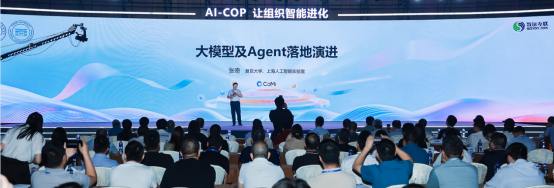
In the context of rapid evolution of artificial intelligence technology and deepening digital transformation of enterprises, how to make large models and AI Agents transition from “technically feasible” to “business usable” has become a focal point of attention. On August 9, at the “2025 Collaborative Management Forum and the 15th User Conference” hosted by Zhiyuan Interconnect, Professor Zhang Qi from the School of Computing and Intelligent Innovation at Fudan University, Chief Scientist of the “MouSi” (MouSi) large model project, and Deputy Director of the Shanghai Key Laboratory of Intelligent Information Processing, pointed out:“The true value of AI lies in finding scenarios that can create actual business and management effectiveness.” Zhiyuan Interconnect provides a practical approach to this concept through its AI-COP low-code customization and AI Agent dual-mode application development platform capabilities, promoting AI into real workflows to achieve controllable and sustainable human-machine collaboration.
Large models are not a universal key; scenarios are the core of value
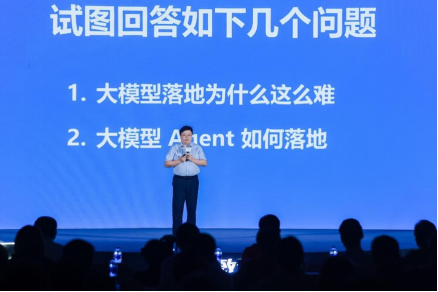
At the forum, Professor Zhang Qi delivered a presentation titled “The Evolution of Large Models and Agent Implementation,” analyzing the boundaries of large model capabilities and the challenges of implementation based on his 20 years of experience in natural language processing research. He pointed out that while large models have made breakthroughs in multi-task processing and generative capabilities, their essence remains a statistical memory paradigm, and their accuracy still struggles to achieve stable breakthroughs when faced with unfamiliar structures or tasks that rely heavily on reasoning.
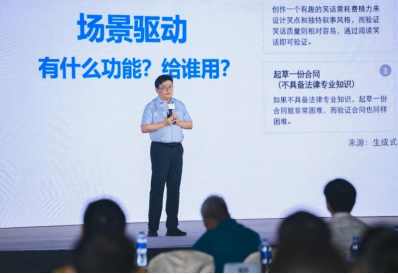
“True AI implementation does not lie in installing a large model, but in using the appropriate model in the right scenario, customized for the business.” Zhang Qi stated. He emphasized that in many businesses, under human-machine collaboration, it is easier to create long-term value than full automation replacement: AI is suitable for high-repetition tasks with quickly verifiable results, while humans handle complex reasoning and result adjudication, forming a safe, efficient, and controllable business closed loop.
AI-COP: “Low-code + Agent” dual-mode application development, embedding intelligence into business
In the “last mile” of AI implementation, Zhiyuan Interconnect has proposed its own answer— leveraging over twenty years of platform accumulation in collaborative operations management to support the practical application of AI.
The AI-COP platform is based on a low-code framework, providing flexible AI Agent platform capabilities, allowing enterprises to independently combine and customize Agent functional modules according to their business needs, rapidly building intelligent applications that adapt to organizational processes. From knowledge Q&A, process handling, to data extraction and decision support, AI can be “embedded” into various micro-scenarios, highly aligning with different enterprises’ management and business demands.
This model not only significantly reduces deployment thresholds and iteration costs but also enables enterprises to continuously optimize intelligent capabilities at their own business pace, achieving a transition “from usable to commonly used, from demonstration to creating value.”
Scenario-driven human-machine collaboration unleashes greater management potential
Industry experts believe that the “low-code + Agent” dual-mode application development represents a pragmatic path for AI implementation:
Customization: Ensuring that AI deeply adapts to the business forms of enterprises rather than being rigidly applied.
Human-machine collaboration: Leveraging the efficiency of AI and the judgment advantages of humans to enhance overall output quality.
Scenario priority: Focusing on scenarios that can quickly verify results and provide high-value returns, achieving steady progress.
AI-COP not only aims to make AI “usable” but also to become a reliable partner in organizational management, process execution, knowledge operation, and decision support. In the future, the company will deepen its co-creation mechanism with industry clients, allowing AI Agents to release value in more fields and promote the transition of enterprise collaborative management from digitalization to intelligence.
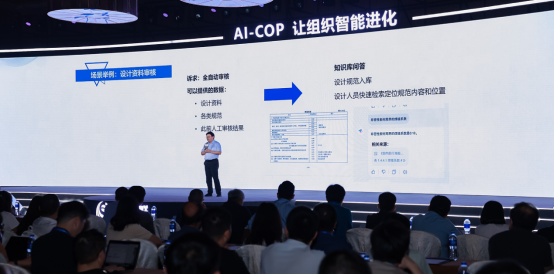
As AI technology accelerates its transition from “laboratory” to “production line,” those who can first identify the “core scenarios that match their value chain” will gain a first-mover advantage in the new round of intelligent competition. The “low-code and Agent” dual-mode application development capability of AI-COP may become the key bridge for organizations to cross the “last mile” of AI implementation.
——–
— Today’s Live Broadcast —
 The article is good, give it a“❤”☟☟☟