
AI Agents are gradually transforming from “task tools” into “autonomous economic participants”.
Authors丨Yingxuan Yang Weinan Zhang

The current most popular agentic AI applications, such as ChatGPT Agent, can autonomously browse the web and perform complex tasks, while GitHub Copilot is evolving from an editing assistant to an intelligent partner.
As we discuss “AI Agents”, “multi-agent collaboration”, and “agentic AI”, we are also experiencing a deeper transformation: AI Agents are gradually changing from “task tools” into “autonomous economic participants”.
They are no longer just passive tools that receive commands, call APIs, and complete preset tasks, but rather intelligent agents with autonomous judgment, negotiation capabilities, and incentive expectations. When faced with complex tasks and multi-party negotiation environments, Agents can not only autonomously formulate strategies and participate in resource allocation but also collaborate and compete in virtual markets, gradually revealing their economic behaviors.

01
What is the “Agent-Centric Economy”?
The traditional view holds that as long as there is a powerful general model (like GPT-4), it can cover all tasks.
However, real-world tasks often have the following characteristics:
-
High Complexity: Cross-modal inputs, multi-stage processes, and interwoven cross-domain knowledge;
-
High Cost of General Models: Inference is time-consuming and resource-intensive, making it unsuitable for handling daily affairs or structured tasks;
-
Lightweight Agents are More Efficient: In specific tasks, dedicated Agents are faster, cheaper, and more accurate;
-
Collaboration Becomes a Necessity: Many tasks require multiple Agents to collaborate across organizations and systems.
Therefore, the Agent-Centric Economy proposes a completely new idea:
Instead of relying on a universal model, let multiple dedicated Agents collaborate, compete, and divide tasks in the market.
The core change here is that in the Agent-Centric Economy, agents are no longer tools executing scripts but rather “digital participants” with goals, capable of weighing gains and losses, and actively participating in market collaboration and competition.
02
Agent Exchange (AEX): The “Exchange” for AI Agents
In a research paper co-authored by Shanghai Jiao Tong University, Shanghai Chuangzhi Academy, and University College London (UCL) titled “Agent Exchange: Shaping the Future of AI Agent Economics”, the researchers proposed and implemented a cutting-edge system:Agent Exchange (AEX).
This is a “smart exchange” designed for AI Agent economic activities, drawing on the RTB (Real-Time Bidding) mechanism from the advertising industry, allowing AI Agents to bid for tasks, collaborate, coordinate resources, and distribute profits like DSPs, thereby constructing a decentralized, market-oriented, self-operating agent economic structure.
In the AEX framework, AI Agents are no longer passive tools executing instructions but rather “intelligent economic entities” that can actively bid for tasks, collaborate in teams, and participate in profit distribution.
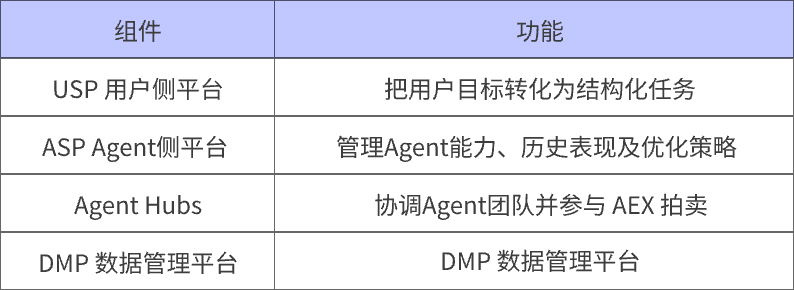
AEX abstracts the entire system into four core platforms:
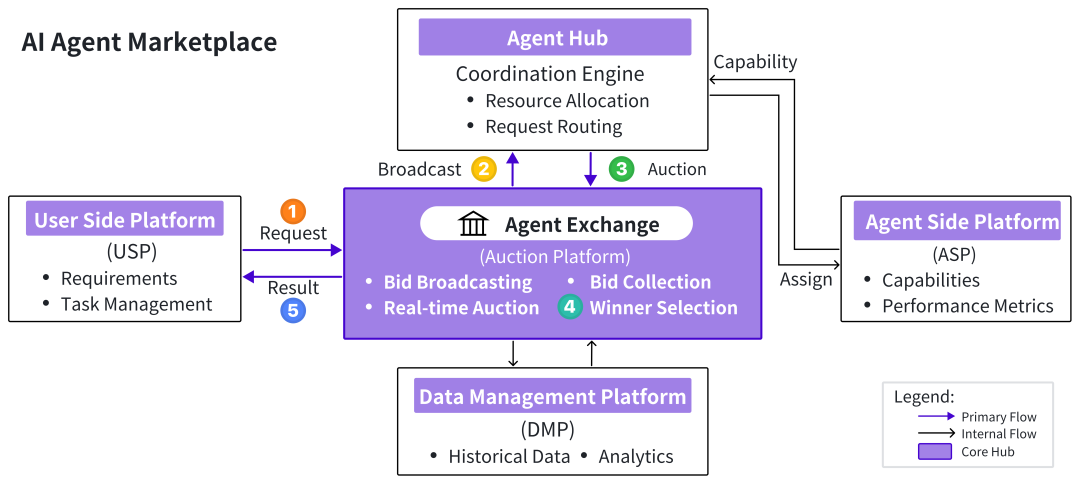
The operation process of Agent Exchange includes:
1️⃣ Broadcasting task requests to multiple Agent Hubs;
2️⃣ Receiving and summarizing the bidding proposals submitted by each Hub;
3️⃣ Initiating a real-time auction mechanism, evaluating based on price, quality, risk, and other multi-dimensional indicators;
4️⃣ Determining the winning proposal and coordinating task allocation;
5️⃣ After task completion, distributing profits based on a value attribution mechanism (such as Shapley value).
03
Example: When an AI Agent Takes on a “Business Trip to Beijing”
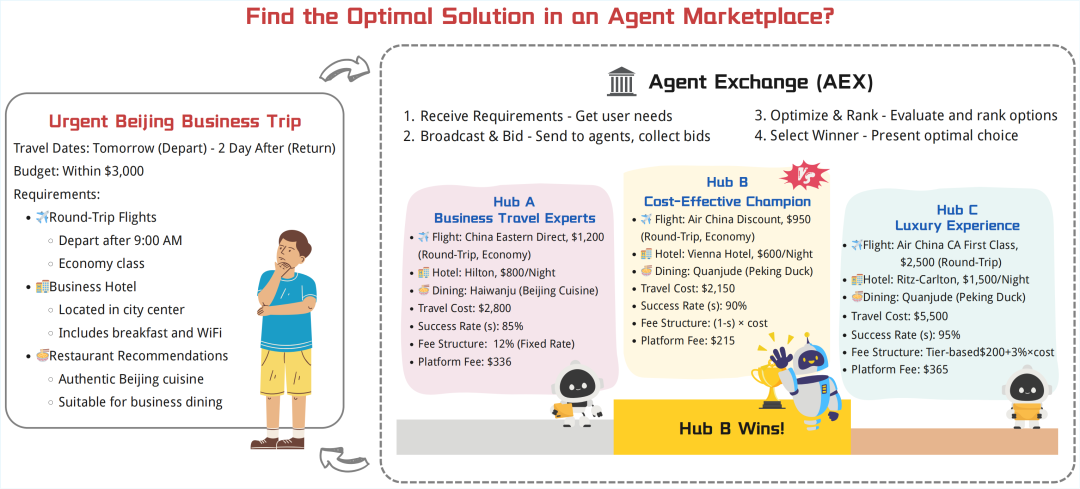
The paper simulates the actual process of AEX through a specific task: a user wishes to arrange an urgent business trip with the following requirements:
-
Departing the next morning, round trip within 48 hours;
-
Economy class tickets, a hotel in the city center, including breakfast and WiFi;
-
Recommend suitable local restaurants for business discussions in Beijing;
-
Total budget under $3000.
After receiving the request, AEX broadcasts it to various Hubs, and Hubs A, B, and C provide different quotes and proposals:
-
Hub A offers mid-range flights + business hotel, quoted at $2800, with an 85% success rate;
-
Hub B offers discounted flights + chain hotel, quoted at $2150, with a 90% success rate;
-
Hub C offers first-class tickets + high-end hotel, quoted at $5500, with a 95% success rate.
Ultimately, AEX selects Hub B based on cost/success rate evaluation. Subsequently, the internal Agents of that Hub complete the execution of the three sub-tasks: ticket booking, hotel reservation, and dining recommendations, and after task completion, the Shapley value distribution of profits is completed through the DMP platform.
The authors believe that auctions may occur at two different levels:Overall proposal competition at the Hub level and Specific resource allocation within the Hub.
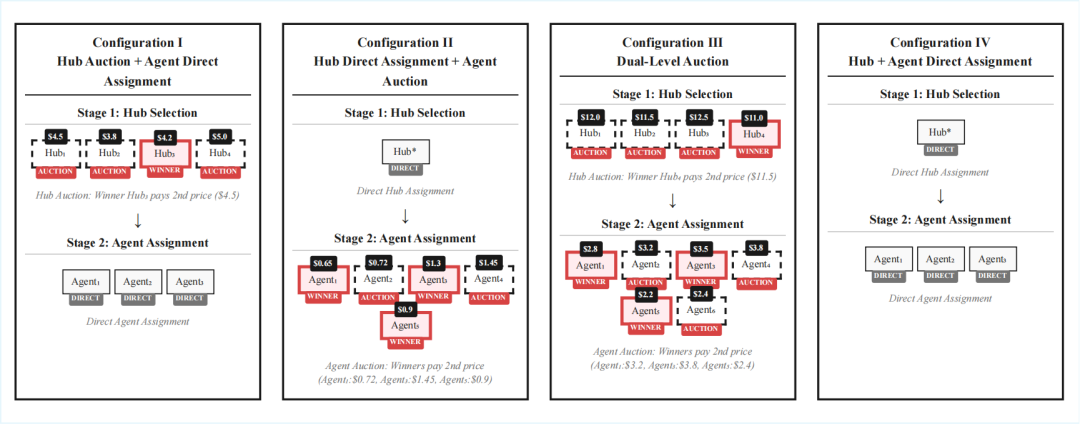
At the Hub level, different clusters of Agents compete for the entire project—such as a Hub specializing in data analysis competing with a Hub focused on content creation for a market research task. Within the Hub, specific execution units (various LLM APIs, MCP servers, specialized tools) will compete for the execution rights of sub-tasks.
Both levels can choose “auction” or “direct allocation”, resulting in four combinations:
-
Hub auction + Hub internal allocation: corresponds to a competitive service provider market, where the platform bids for projects, and internally allocates tasks through pre-allocated agents.
-
Hub allocation + Hub internal auction: similar to an outsourcing platform model, where clients directly choose service providers, and then internal competitive bidding is conducted to execute specific tasks.
-
Double-layer auction: reflects a complex multi-layer market involving large-scale projects, with both platform competition and internal resource competition.
-
Double-layer allocation: represents a long-term cooperation model and contractual relationship, where platform selection and task allocation are predetermined.
These four configurations correspond to different economic scenarios and coordination needs in reality. When participants are sufficient, the auction mechanism can leverage market forces to achieve optimal resource allocation; when market liquidity is limited, the direct allocation mechanism can avoid inefficient competition through capability-based matching and standardized pricing, ensuring that coordination costs do not exceed efficiency gains.
04
Preliminary Experimental Validation: Effectiveness and Robustness of the Auction Mechanism
To provide a structured proof-of-concept (PoC), this section conducts preliminary empirical research based on a one-shot task-agent allocation setting in a controlled simulation environment. The focus of the research is to verify whether the auction mechanism (Auction-based allocation) theoretically possesses multi-objective optimization capabilities and system robustness.
The experiments revolve around four core dimensions: task complexity, market state, Agent capability structure, and task allocation strategies:
-
Task Complexity: Setting three types of tasks (simple, medium, complex), each containing multiple sub-tasks with different capability requirements, weights, and complexity coefficients.
-
Market Liquidity: Simulating three market states (high, medium, low) by controlling the number and quality fluctuations of agents to model the degree of competition and uncertainty.
-
Agent Construction: The experiment sampled 10 real MCP servers from the smithery.ai registration platform to serve as simulated agents in the experiment, representing the diversity of capabilities in real deployments.
-
Capability Representation Method: The system analyzes the functional descriptions of agents through keyword matching, inferring their strengths in various task capabilities, and converting the results into standardized numerical vectors for task allocation. To avoid missing potential but not explicitly stated capabilities, each capability is assigned a minimum scoring threshold (θ_min = 0.05).
-
Comparison of Allocation Strategies: A total of five task allocation strategies were compared:
-
Auction: A multi-attribute weighted mechanism considering capabilities, quality, cost, and time constraints;
-
Greedy Allocation: Prioritizing allocation to the agents with the highest success rates, setting capability thresholds;
-
Cost-Optimal Allocation: Minimizing total budget expenditure while meeting capability requirements;
-
Capability-First Allocation: Maximizing the matching degree between task requirements and agent capabilities;
-
Random Allocation: A baseline strategy that does not consider any factors.
Through simulation experiments, the following key results were observed:
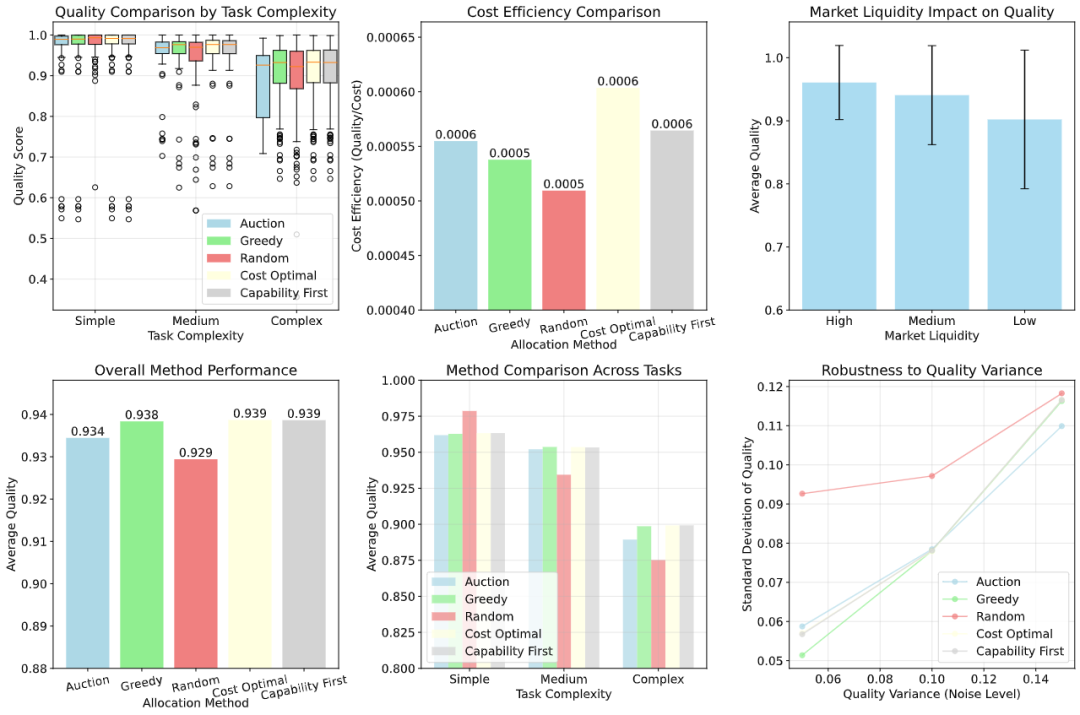
Through simulation experiments, researchers observed the following results:
-
The auction mechanism performs well across multiple dimensions: in terms of task success rates, cost efficiency, and system robustness, the Auction mechanism shows overall robustness, especially in complex tasks or low market liquidity scenarios;
-
Local advantages of Cost-Optimal and Capability-First: Although Cost-Optimal and Capability-First are slightly superior in specific dimensions (such as cost efficiency or capability matching), their performance is relatively dependent on market stability.
-
Robustness performance: The auction mechanism consistently maintains a low standard deviation across all noise levels, demonstrating its good adaptability to environmental uncertainties.
These experimental results validate the theoretical feasibility of the auction mechanism in the AEX framework. In terms of multi-objective optimization, the auction mechanism demonstrates good balance, especially in task allocation and the attribution of contributions from collaborative agents (based on Shapley values).
However, there are still significant gaps between some idealized assumptions in the current simulation (such as agents having complete and accurate information, agent capabilities remaining constant, and agents reporting honestly) and the complexities of real markets.
Therefore, the existing results primarily demonstrate theoretical feasibility rather than practical deployment effects. Future research needs to further explore the scalability limitations of the system and delve into key issues such as modeling strategic behavior in dynamic agent environments to promote the application of this framework in real production environments.
05
Future Challenges and Summary
Realizing this vision of an agent economy still faces many challenges:
-
Value Attribution in Collaboration is the most critical issue—when multiple agents collaborate to complete complex tasks, how to fairly distribute value contributions? The paper proposes a solution based on Shapley values, but practical applications still need to address the dynamic changes in agent capabilities, learning effects in collaboration, and the complexities of quantifying “soft contributions”.
-
Standardized Capability Verification Framework is also crucial. In an open agent market, how to establish a unified capability description standard that allows heterogeneous agents to understand and collaborate with each other? This is not only a technical issue but also involves cross-organizational industry standard setting and governance mechanism establishment.
-
Adaptive Coordination Protocol Design faces scalability challenges. When the number of agents reaches tens of thousands, how to ensure the scalability and stability of coordination mechanisms? How to make optimal coordination decisions in complex dynamic environments in real-time? This requires in-depth research breakthroughs in game theory, mechanism design, and distributed systems.
The proposal of Agent Exchange is an unprecedented exploration: it not only provides a technical operational mechanism for collaboration among AI Agents but also importantly proposes a institutionalized “decentralized agent economy” framework.
Beyond the centralized development path of large models, AEX shows us another possibility: without relying on a single “super brain”, distributed agents can compete and collaborate through market mechanisms, “making a living” in competition, ultimately forming a self-operating, sustainable intelligent ecosystem. This model is expected to unleash more diverse AI innovation potential, allowing organizations and individuals of different sizes to participate in the intelligent economy.
The transition from theory to practice is full of challenges, as mentioned in the paper, these challenges are precisely opportunities for institutional design and technological innovation. AEX demonstrates a new direction for AI development: not only technological innovation but also in constructing an economic and social system composed of agents, which is worth our continuous exploration.
📚 Reference Information
This research is based on the multi-agent system research project of Shanghai Chuangzhi Academy, focusing on behavior modeling and institutional mechanisms of multi-agents in task collaboration, resource bidding, and incentive alignment, proposing a decentralized Agent market framework, exploring a new paradigm for AI Agents participating in economic activities.
-
Paper Title: Agent Exchange: Shaping the Future of AI Agent Economics
-
Authors: Yingxuan Yang, Ying Wen, Jun Wang, Weinan Zhang
-
Affiliations: Shanghai Jiao Tong University, Shanghai Chuangzhi Academy, University College London
-
Link: https://arxiv.org/pdf/2507.03904
//Recommended Reading
Why Does China Only Have One DeepSeek?

We investigated 12 listed companies regarding the truth about the DeepSeek integrated machine.

Unauthorized reproduction in any form on websites, forums, or communities is strictly prohibited without the authorization of “AI Technology Review”.
For reprints on public accounts, please leave a message in the “AI Technology Review” backend to obtain authorization, and the source must be indicated along with the insertion of this public account’s business card.