💥💥💞💞Welcome to this blog❤️❤️💥💥
🏆Author’s Advantage: 🌞🌞🌞The blog content aims to be logically coherent and clear for the convenience of readers.
⛳️Motto: A journey of a hundred miles begins with a single step.
📋📋📋The content of this article is as follows:🎁🎁🎁
⛳️Gift to Readers
👨💻Conducting research involves a profound system of thought, requiring researchers to be logical, diligent, and serious. However, effort alone is not enough; leveraging resources is often more important than hard work. Additionally, one must have innovative ideas and inspirations. Readers are advised to browse in order to avoid suddenly falling into a dark maze without finding their way back. This article may not reveal all the answers to your questions, but if it can clarify some of the doubts rising in your mind, it may create a beautiful sunset of colors. If it brings you a storm in your spiritual world, then take the opportunity to brush off the dust that has settled on your ‘lying flat’ mindset.
Perhaps, after the rain, the sky will be clearer…….🔎🔎🔎
1. Abstract
The share of solar energy from residential rooftop photovoltaic (PV) systems in the energy structure is increasing, along with the electrification of the transportation sector through electric vehicles (EVs). These are some of the main reasons behind unprecedented technological growth in low voltage distribution networks (LVDG) over the past few years. These advancements pose new challenges for distribution system operators (DSOs) regarding the secure and reliable operation of their networks. Therefore, it is crucial to have accurate and reliable tools for research, identifying potential issues, and proactively mitigating these problems before costly failures or equipment malfunctions occur. The most commonly used tool for such research is power flow analysis, which can provide the magnitude and angle of all voltages and currents in the power system for a given set of input parameters. Traditional Gauss-Seidel and Newton-Raphson power flow methods focus on balanced operations, allowing analysis only for positive sequences. In contrast, distribution systems, especially LVDGs, operate under highly unbalanced conditions. Therefore, negative sequence components and even zero sequence components cannot be ignored, necessitating the use of multiphase analysis. Currently, the main methods for solving power flow problems in distribution networks either focus on current injections based on the Newton-Raphson formula or the forward-backward substitution method.
The forward-backward substitution method is the most commonly used power flow calculation method in radial low voltage distribution networks (LVDG). In most cases, the Kron reduction method is used to merge the neutral line with the phase lines. However, neglecting the influence of the neutral line through the Kron reduction may result in the loss of important information, as most loads in low voltage distribution networks are single-phase connected and powered through phase and neutral lines. In this article, the forward-backward substitution method is modified to consider the neutral point voltage. Test results indicate that understanding the exact configuration of the neutral conductor in LVDG is crucial before conducting power flow studies, as it significantly affects the accuracy of the results.
2. Comparison of Traditional Forward-Backward Substitution Method and Modified Forward-Backward Substitution Method
Due to the unbalanced characteristics of low voltage distribution networks and the predominance of single-phase loads (asymmetric load conditions), a significant portion of the total load current flows through the neutral conductor. This is especially true in systems where the neutral conductor is grounded only at MV-LV substations, leading to noticeable voltage drops at both ends. Simplifying the problem using Kron reduction and merging the neutral conductor with the phase conductors not only produces incorrect results but also loses important information, as most loads in such systems are connected between the phase conductors and the neutral line. This article draws inspiration from [1] and expands upon it to apply it to LVDGs where the neutral line is grounded only at MV-LV substations. Additionally, a comparison is made between the traditional forward-backward substitution method using Kron reduction (
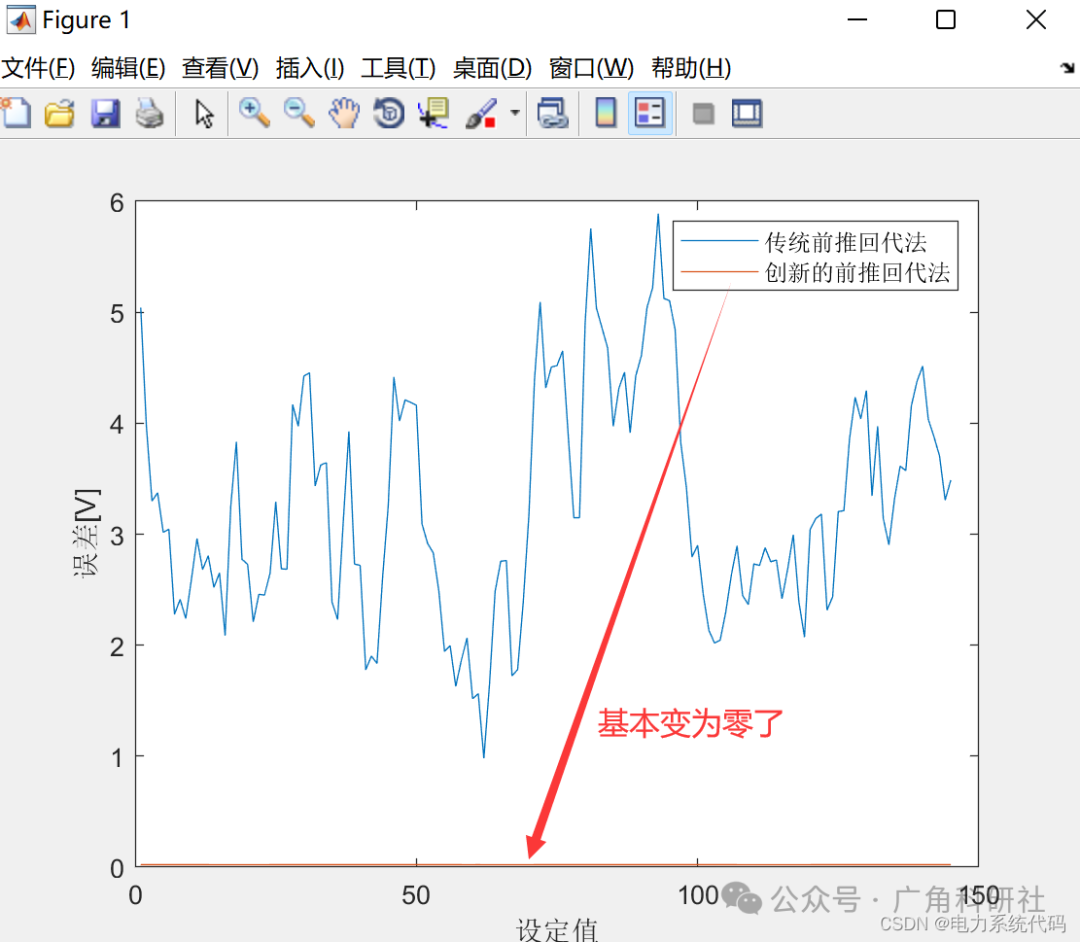
 ), the FBS method described in
 ) and the method presented in this article. The results show a significant improvement in accuracy and robustness, indicating the importance of understanding the exact configuration of the neutral conductor before conducting power flow studies in LVDG.

3. Simulation Results

4. References
Some content in this article is sourced from the internet, and references will be noted. If there are any inaccuracies, please feel free to contact us for removal. (The content of the article is for reference only; specific results are subject to actual outcomes)
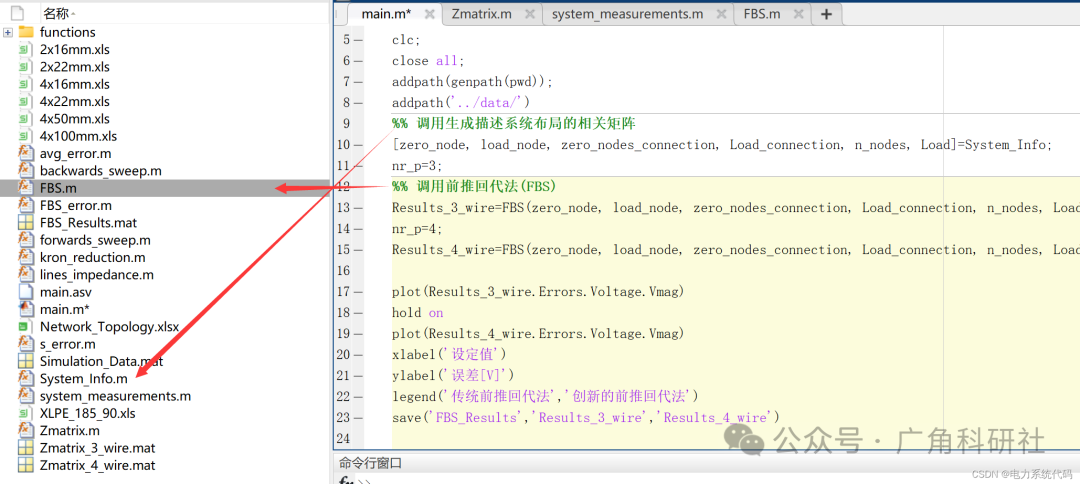
5. MATLAB Code Implementation
For more resources, including MATLAB | Simulink | Python resources, follow us for more benefits.