Click the blue text above to follow us

📋📋📋 The contents of this article are as follows: 🎁🎁🎁
Contents
⛳️ Gift to readers
💥1 Overview
📚2 Running Results
🎉3 References
🌈4 MATLAB Code Implementation


Gift to readers

👨💻 Conducting research involves a profound system of thought, requiring researchers to be logical, diligent, and serious. However, effort alone is not enough; often leveraging resources is more important than hard work. Additionally, one must have innovative and inspiring ideas. When a philosophy teacher asks you what science is or what electricity is, do not find these questions amusing. Philosophy is the mother of science; it seeks to address ultimate questions and find those self-evident questions that only children would ask but you cannot answer. It is recommended that readers browse through the contents in order to avoid suddenly falling into a dark maze without finding their way back. This may not reveal all the answers to your questions, but if it can raise clouds of doubt in your mind, it may create a beautiful sunset. If it brings you a storm in your spiritual world, then take the opportunity to brush off the dust that has settled on your “lying flat” attitude. Perhaps, after the rain, the sky will be clearer…🔎🔎🔎




1 Overview

Research on data generation methods based on Kernel Density Estimation (KDE)
Introduction
Kernel Density Estimation (KDE) is a non-parametric statistical method that estimates the probability density function by “smoothing” discrete data points, adapting to complex data distributions without pre-setting a distribution form. In the field of data generation, KDE demonstrates unique advantages in scenarios such as data augmentation, anomaly detection, and privacy protection due to its non-parametric characteristics, ability to retain data features, and interpretability. However, issues such as bandwidth selection, the “curse of dimensionality” in high-dimensional data, and computational efficiency still limit its application range. This article systematically reviews the principles, processes, advantages, and challenges of KDE data generation methods, discusses improvement directions in conjunction with practical application cases, and provides theoretical references and practical guidance for data-driven research.
Basic Principles of Kernel Density Estimation
Mathematical Definition
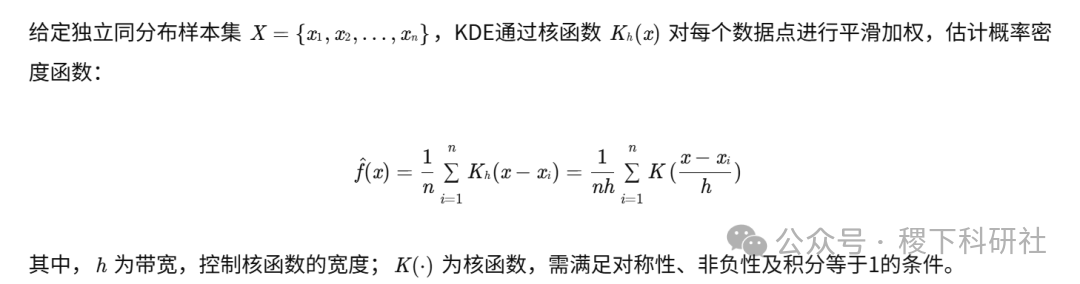
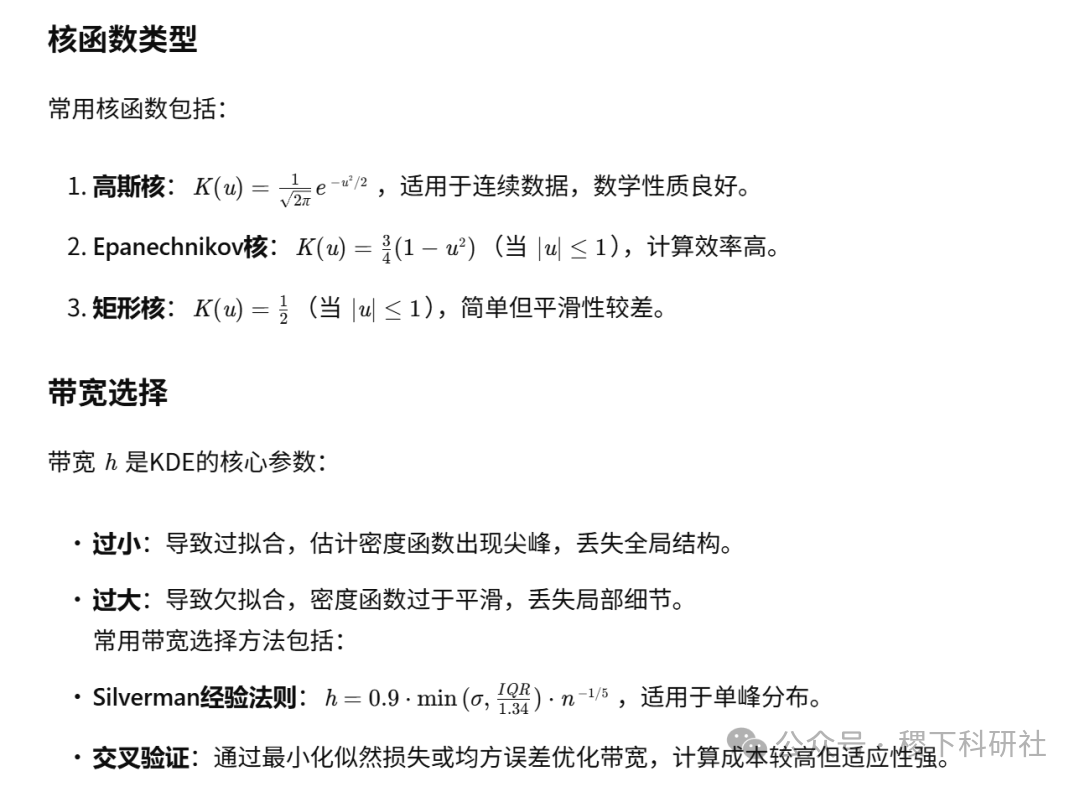
Data Generation Methods Based on KDE
Data Generation Process
- Data Preparation:
- Collect sample data from the target distribution (e.g., image pixel values, financial time series).
- Data preprocessing: clean outliers, normalize (e.g., scale to [0,1] range).
- Select kernel function (e.g., Gaussian kernel) and bandwidth (e.g., optimized through cross-validation).
- Estimate the probability density function f^(x).
- Direct Sampling Method: Generate samples directly from f^(x) (requires the density function to be expressible analytically).
- Acceptance-Rejection Sampling Method: Generate candidate samples through an auxiliary distribution and filter them according to acceptance probability.
- Markov Chain Monte Carlo (MCMC): Construct a Markov chain that converges to the target distribution, suitable for high-dimensional data.
Advantage Analysis
- Non-parametric Flexibility: No assumption of data distribution form, adapts to multi-modal, non-Gaussian distributions (e.g., income distribution, financial data).
- Data Feature Retention: Generated samples retain the central tendency, dispersion, and distribution shape of the original data, enhancing data augmentation effects.
- Interpretability: The density estimation process is transparent, allowing users to intuitively understand data distribution characteristics.
Challenges and Limitations
- Bandwidth Selection Dilemma: No universal optimal method; Silverman’s rule fails for multi-modal distributions, and cross-validation has high computational costs.
- The Curse of High-Dimensional Data: Data sparsity leads to increased estimation errors and decreased sampling efficiency.
- Computational Efficiency Bottleneck: As sample size n increases, KDE complexity is O(n^2), making it difficult to process large-scale data in real-time.
Practical Application Cases
Image Data Augmentation
Scenario: In handwritten digit recognition tasks, the original dataset has insufficient sample size, leading to poor model generalization.Method:
- Use Gaussian kernel KDE to estimate pixel value distribution, optimizing bandwidth through cross-validation.
- Use rejection sampling to generate new images, retaining digit shapes and stroke features.Effect: The expanded dataset improved the CNN model’s test accuracy by 12%, validating the effectiveness of KDE in low-dimensional data generation.
Financial Time Series Simulation
Scenario: Simulate stock price fluctuations to assess risk model performance.Method:
- Collect historical price and trading volume data, preprocess, and use Epanechnikov kernel KDE to estimate distribution.
- Combine MCMC sampling to generate new sequences, retaining peak and heavy-tail characteristics.Effect: The generated data matched the statistical characteristics (mean, variance, skewness) of historical data with a 95% degree of accuracy, reducing prediction error in risk assessment models by 8%.
Privacy-Preserving Data Synthesis
Scenario: Medical data sharing requires protecting patient privacy.Method:
- Use KDE to estimate the distribution of continuous variables such as patient age and blood pressure.
- Generate synthetic data that retains original statistical properties but cannot reverse-identify individuals.Effect: The synthetic data performed in classification tasks with less than 2% difference from the original data, meeting privacy protection requirements.
Improvement Directions and Future Prospects
- Adaptive Bandwidth Selection:
- Combine neural networks or reinforcement learning to dynamically adjust bandwidth based on local data characteristics.
- Example: Use local density estimation to optimize bandwidth, enhancing adaptability to multi-modal distributions.
- Combine dimensionality reduction techniques (e.g., t-SNE, UMAP) with KDE to reduce computational complexity.
- Approximate KDE based on KD-trees, reducing complexity to O(n log n).
- KDE-GAN: Use KDE to initialize the generator, alleviating GAN mode collapse issues.
- KDE-VAE: Apply KDE in latent space to enhance the distribution fitting capability of variational autoencoders.
- Research the statistical properties of KDE in non-Euclidean spaces (e.g., social networks, protein structures).
- Develop graph kernel functions to capture topological relationships between nodes.
Conclusion
The data generation methods based on KDE, with their non-parametric flexibility and ability to retain data features, hold significant application value in data augmentation, anomaly detection, and privacy protection. Despite facing challenges such as bandwidth selection and high-dimensional computation, through adaptive bandwidth optimization, high-dimensional acceleration algorithms, and integration with deep learning, KDE is expected to play a greater role in data science and artificial intelligence. Future research should further explore its applicability in complex data structures (such as manifolds and graphs) to promote the intelligent and efficient development of data generation technologies.



2 Running Results

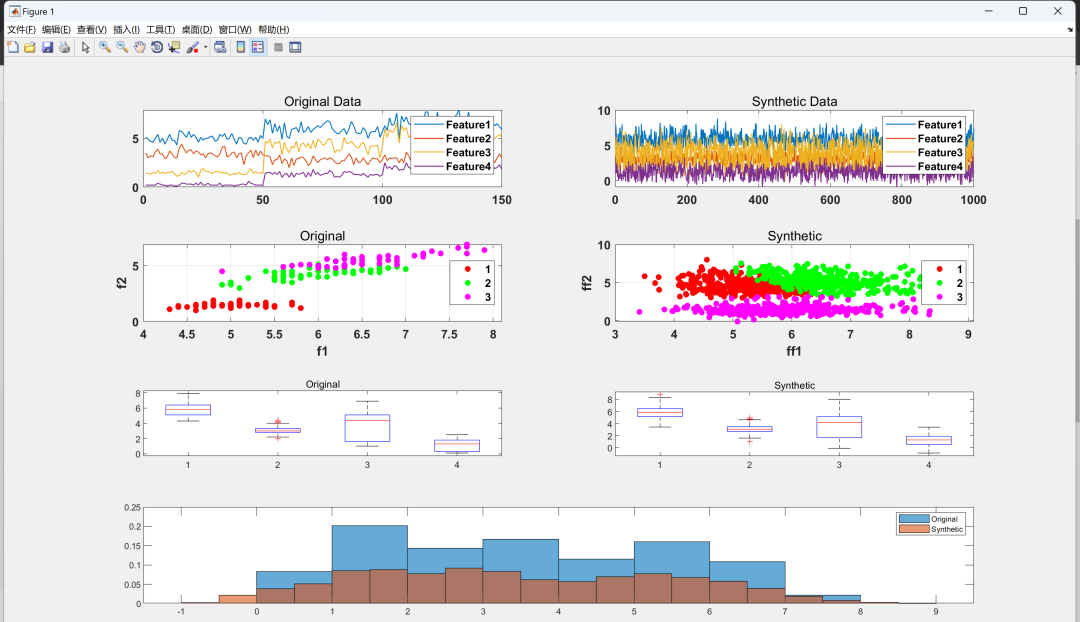
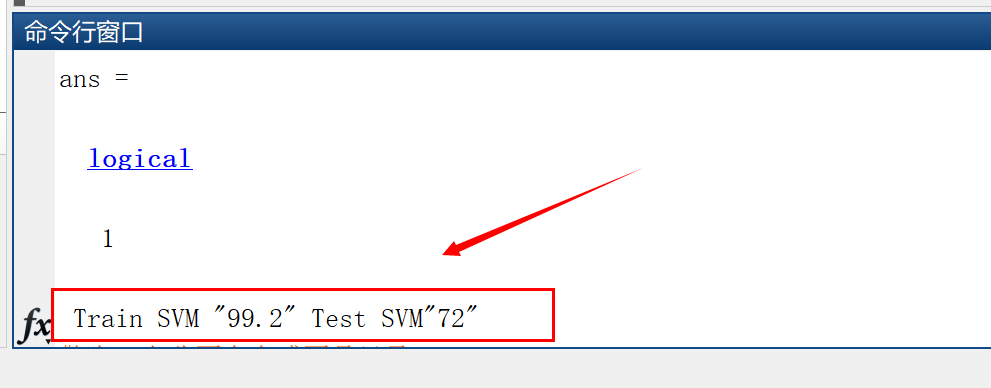
%% KDE% Define the bandwidth for kernel density estimationbandwidth = 0.4; % You can adjust this value based on your datafor i=1:NF % Create a kernel density estimator kde = fitdist(original_data(:,i), 'Kernel', 'Bandwidth', bandwidth); % Number of data points to generate num_samples = 1000; % Use the estimated kernel density to generate synthetic data synthetic_data = random(kde, num_samples, 1); Syn(:,i)=synthetic_data;end%% Use K-means clustering to obtain labels for the synthetic generated data[Lbl,C,sumd,D] = kmeans(Syn,Classes,'MaxIter',10000,... 'Display','final','Replicates',10);%% Plot the original and generated datasets in two dimensionsFeature1=1;Feature2=3;f1=meas(:,Feature1); % feature 1f2=meas(:,Feature2); % feature 2ff1=Syn(:,Feature1); % feature 1ff2=Syn(:,Feature2); % feature 2figure('units','normalized','outerposition',[0 0 1 1])subplot(4,2,1)plot(meas, 'linewidth',1); title('Original Data');

3 References

Some content in this article is sourced from the internet, and references will be noted. If there are any inaccuracies, please feel free to contact us for removal.

[1] Zhang Fan. Research on Fault Diagnosis and Health Assessment Methods for Rotating Machinery Based on Kernel Density Estimation and K-L Divergence [D]. University of Electronic Science and Technology of China, 2015. DOI:10.7666/d.D662488. [2] Zheng Yong. Research on Data-Driven Uncertainty Sets Based on Improved Robust Kernel Density Estimation and Experimental Simulation [D]. Chongqing University, 2020. [3] Huang Jie, Wei Yongqing, Yi Jing, et al. Basic Probability Assignment Generation Method Based on Kernel Density Estimation [J]. Computer Applications Research, 2020, 37(7):5. DOI:10.19734/j.issn.1001-3695.2018.11.0882.



4 MATLAB Code Implementation

Public AccountDASHU
Lychee Research Society