1. Why do 90% of embedded projects fail during the “maintenance phase”?
👇 Let’s start with a soul-searching question
-
When requirements change, do the driver layer, business layer, and UI all need to change too?
-
When a newcomer takes over the code, do they spend two weeks just trying to find the entry point?
💡 The root cause: There is no unified “architecture standard”!
Today, I will guide you step by step to make your project a “maintainable, portable, and upgradable” model project!
2. Remember these five core goals!
|
Goal |
One-sentence mantra |
|
Readability |
Code is documentation |
|
Maintainability |
Low coupling of modules |
|
Reliability |
Defensive programming |
|
Portability |
Hardware abstraction layer |
|
Compliance |
Supported by industry standards |
3. Programming standards: Nipping “bad code” in the bud
1️⃣ Documentation first
-
Doxygen generates API documentation with a comment rate of ≥ 30%.
2️⃣ Modular design
-
Function granularity: adc.c, uart.c, app.c.
-
Global variables are strictly prohibited; everything should be encapsulated in structs.
3️⃣ Hardware isolation
-
Register operations → hal_xxx.c
-
Business logic → app_xxx.c
📌 Tip: Treat “portability” as a requirement, not a fire drill!
4. Version control & documentation management: Say goodbye to “legacy code”
-
Commit message template
Fix: ADC sampling frequency configuration error Feat: Added Bootloader OTA upgrade Docs: Updated pin mapping table-
Documentation essentials
-
Requirements specification
-
Architecture design document
-
Interface definition document
-
Change log (Changelog)
5. Testing and validation: Discover bugs early, keep your hair!
|
Test Type |
Methods & Tools |
Key Metrics |
|
Unit Testing |
Ceedling / Unity |
100% coverage of boundary conditions |
|
Integration Testing |
Logic analyzer + host script |
0% packet loss in UART communication |
|
Hardware Testing |
Oscilloscope + temperature chamber |
Stable operation from -40 to 85 ℃ |
6. Safety and reliability: No crashes on-site, no running away from the boss
-
Watchdog
Independent hardware watchdog + software window watchdog for double insurance.
-
Exception handling
Sensor reading → timeout 50 ms, retry 3 times
HardFault → save registers + logs + revive in place
-
Functional safety
Automotive products: ISO 26262 (ASIL-C)
Industrial control: IEC 61508 (SIL-2)
7. Resource optimization: Saving Flash is earning
-
ROM slimming
Place const constants in Flash, trim redundant library functions with one click.
-
RAM slimming
Use static variables instead of malloc, statically calculate stack depth.
8. Debugging & upgrading: On-site upgrades without disassembly
-
Debug interface
Reserve SWD + UART RTT, with 5-level log filtering (DBG/WARN/ERR/FATAL).
-
OTA upgrade
Bootloader → dual partition + CRC32 verification + breakpoint resume.
9. Team collaboration: The correct posture for Code Review
-
Merge Request template
-
Motivation for changes
-
Risk points
-
Screenshot of test report
-
Review Checklist
-
Does it comply with MISRA-C?
-
Is there exception handling?
-
Unit test coverage ≥ 80%
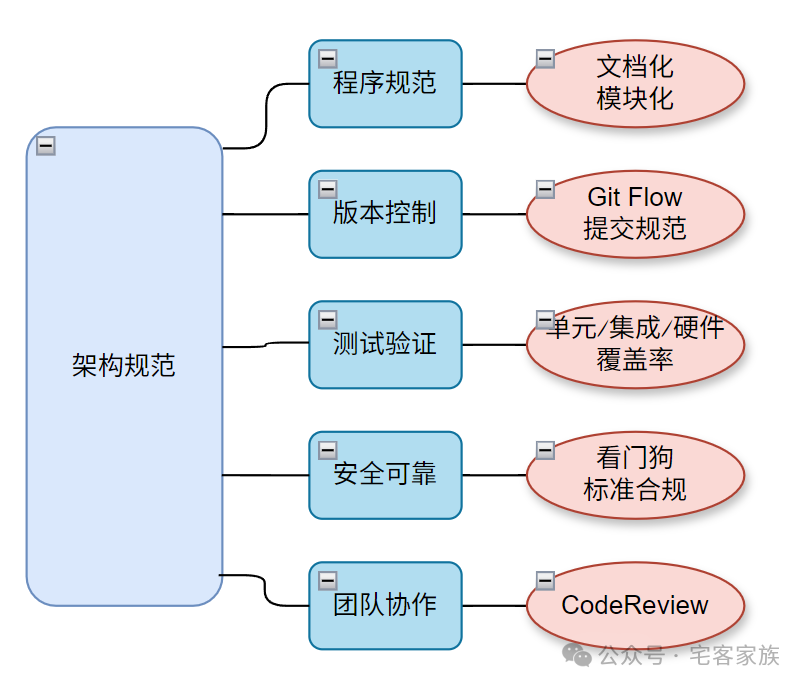
10. A mind map to take away the full text!
🚀 Put the standards into practice, so that the next maintainer will be “grateful” to you!