In chip design, power consumption optimization is a key factor determining chip performance, battery life, heat dissipation, and cost. The sources of power consumption mainly involve power supply voltage, clock frequency, number of devices, and process technology (which affects threshold voltage and leakage current). From the composition of power consumption, we can optimize at different levels.
| Level | Power Consumption Impact Ratio | Typical Optimization Methods |
| System Level | >70% | Co-design of hardware and software, power management |
| Architecture Level | 40%~70% | Voltage/frequency adjustment, multiple voltage domains, power gating, asynchronous design |
| Circuit Level | 15%~40% | Clock gating, unique code encoding, microarchitecture optimization, special writing methods |
| Transistor Level | 10%~15% | Multi-threshold technology, layout optimization, advanced process technology |
From the table above, we can see that in chip power management, system-level optimization has the greatest impact, determining the power consumption architecture and strategy of the entire platform. System-level low power design mainly includes co-design of hardware and software and power management mechanisms.
1. Co-design of Hardware and Software
The essence of power consumption is hardware consumption, but software has a crucial impact on power consumption. In the design process, the functionality of a system can be realized through hardware or software, and the different implementation methods will affect the overall power consumption.
1.1 Low Power Optimization PrinciplesHardware/software division should be reasonable — Balancing performance and power consumption, based on meeting system applications and performance, hardware unit speed should be as slow as possible, and voltage should be as low as possible.
For example, in embedded system design, some computation-intensive tasks can be offloaded to hardware acceleration (such as DSP, NPU, dedicated hardware circuits) to reduce the load on the CPU, thereby lowering overall power consumption. At the same time, non-critical path functions can be implemented in software to reduce hardware resource usage.
1.2 Examples
- In mobile SoCs, video encoding and decoding tasks are typically handled by dedicated hardware (VPU), rather than directly computed by the CPU, thus completing tasks with lower power consumption.
- In low-power devices like smartwatches, low-power MCUs handle most tasks, while the main CPU only wakes up when necessary to reduce power consumption.
2. Power Management Mechanisms
During system operation, the usage states of different hardware units vary. If certain hardware modules are currently not in use, but still powered on, it will lead to unnecessary power consumption losses. Therefore, a core strategy for low power design is Dynamic Power Management (DPM).
2.1 Core Methods of Power Management(1) Dynamic Power Gating: Turn off unused modules directly to reduce static power consumption.(2) Dynamic Voltage/Frequency Scaling (DVFS): Dynamically adjust voltage and frequency based on computational load.(3) Low Power Mode Management: Provide multiple low power modes, such as Sleep Mode and Deep Sleep Mode, entering different power states based on demand.
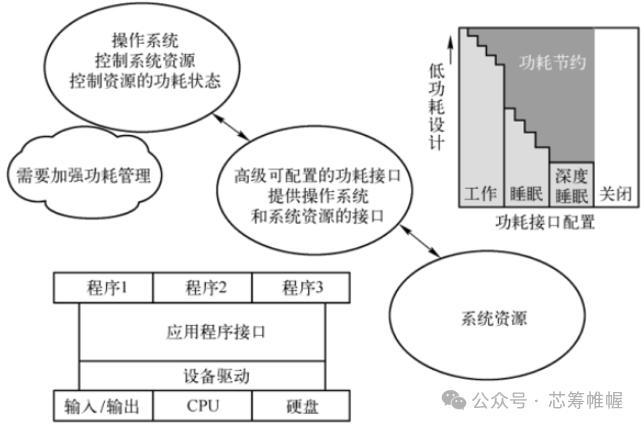 System Power Management Diagram (Image from the Internet)
2.2 Examples
Power Management in Smartphones
- Intelligent scheduling (Big.LITTLE architecture): High-performance tasks are executed by big cores, while low-power tasks are handled by little cores to achieve efficient performance ratios.
- Reduce main frequency/turn off some peripherals, such as Wi-Fi, Bluetooth, and other non-essential modules into low power states when the screen is off.
- Application-level power optimization: Background task scheduling, reducing screen refresh rates, limiting background application operation, etc.
3. Conclusion
The application of low power management strategies requires hardware support, and at the same time, there is a trade-off between power management and performance, needing to find the optimal solution in different application scenarios.