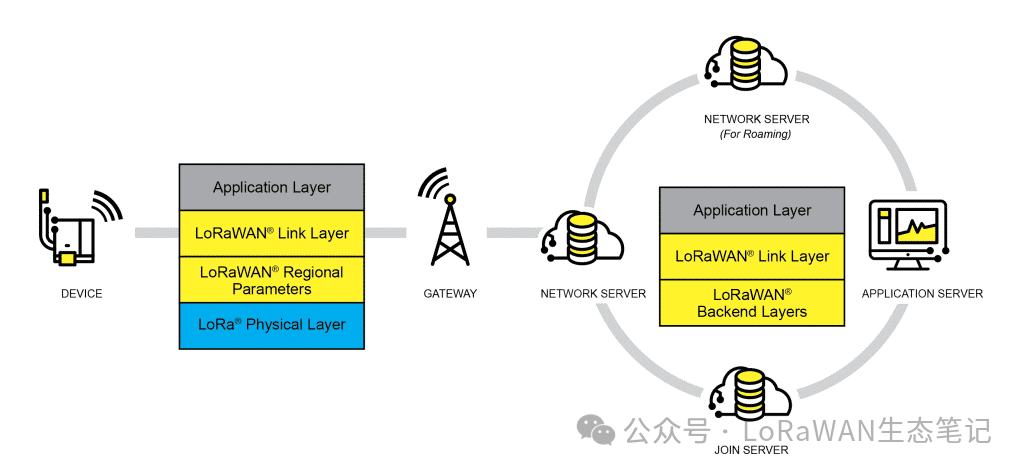
 Ten Years of LoRaWAN
Ten years ago, the LoRa Alliance had only dozens of members; today, it has grown to over 350 corporate members and covers over 125 million devices in a global IoT ecosystem. The past decade of LoRaWAN has been a period of continuous evolution of standards, expanding ecosystem collaboration, and accelerating application deployment.
1.The Power of Standards Enables IoT to Go Further
Since the release of its first standard in 2015, LoRaWAN has become a backbone of global IoT communication, leveraging its unique advantages of “low power, long range, open standards, and low cost”.
The unified standard allows devices from different manufacturers and regions to achieve “plug-and-play” interoperability, avoiding fragmentation in the IoT landscape. Over the past decade, LoRaWAN has evolved from “a connection protocol” to a “global IoT infrastructure”, connecting countless scenarios such as smart cities, industrial monitoring, agriculture, and energy management.
2.Why LoRaWAN Can Continue to Evolve
The continuous evolution of LoRaWAN stems from an open standards organization and a collaborative ecosystem.
It is not a proprietary technology of a single company, but is driven collectively by LoRa Alliance members:
-
Technical Committee (TC): Responsible for the formulation and upgrading of standards;
-
Certification Committee (CC): Ensures global consistency of devices;
-
Regional Parameters Working Group (RPWG): Adapts to national frequency and regulations;
This open collaboration mechanism allows LoRaWAN to continuously iterate based on ecosystem feedback, evolving from standards to ecosystems, and from protocols to applications.
3.The Four Stages of LoRaWAN Standard Evolution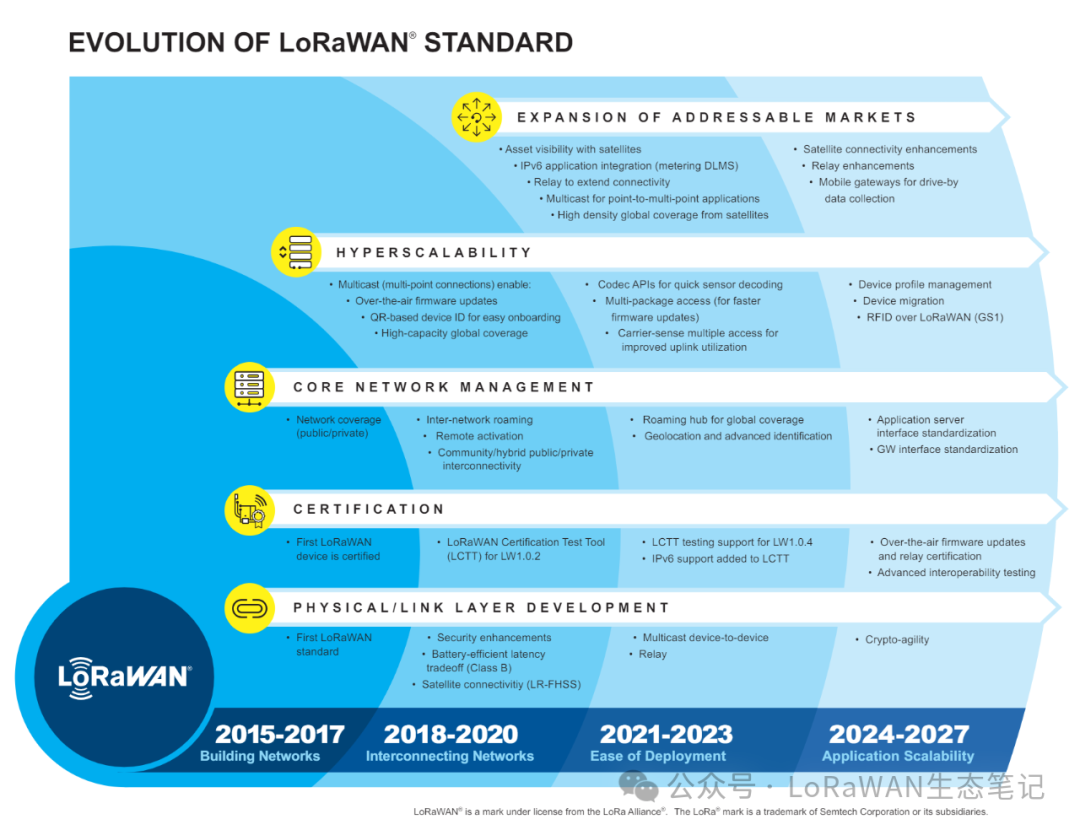
🔹 2015–2017: Network Building Phase
This is the starting point of LoRaWAN. • The first LoRaWAN standard was released; • The first batch of LoRaWAN devices were certified and began deployment; • The focus was on getting LoRaWAN to “run“, with networks and devices to achieve basic connectivity. This phase can be described as “from 0 to 1“.
🔹 2018–2020: Interconnecting Networks Phase
As networks and applications gradually increased, interconnectivity became key. • Link Layer Optimization: Enhanced security, battery efficiency optimization (Class B), and added satellite connectivity (LR-FHSS); • Certification System: Introduced the LoRaWAN Certification Test Tool (LCTT) for standardized testing; • Network Management: Supported remote activation, interconnection of public and private networks, and community/hybrid network interoperability. At this time, LoRaWAN began to transition from a “single network” to an “interconnected ecosystem“, allowing more companies to collaborate under a unified standard.
🔹 2021–2023: Ease of Deployment Phase
LoRaWAN entered a period of large-scale deployment, focusing on being “user-friendly“. • Link Layer: Supports multicast, relay, direct device-to-device connections, and OTA firmware upgrades; • Certification: Supports IPv6, relay and OTA certification, enhancing interoperability; • Network Management: Global roaming, geolocation, and interface standardization; • Scalability: Quick network access via QR codes, multi-application data distribution, and application layer decoding APIs. This phase made LoRaWAN easier to use and more efficient to deploy.
🔹 2024–2027: Application Scalability Phase
In the next four years, LoRaWAN will enter a period of explosive application growth. • Link Layer: Enhanced encryption capabilities (Crypto-agility) and efficient multicast; • Certification: Deeper interoperability testing to ensure seamless global collaboration; • Network Management: Standardization of Server-Gateway and Server-Application interfaces; • Market Expansion: – Enhanced satellite connectivity for true global coverage; – Expansion of mobile gateways (Drive-by) for data collection scenarios;
– Absorbing and integrating more existing IoT applications across industries. This means that LoRaWAN will not only be about “connectivity” but will also serve as the foundation for scalable applications across various industries.
4.Typical Technical Milestones and Representative Events
-
2015: LoRa Alliance was established, releasing LoRaWAN 1.0;
-
2017: Released LoRaWAN Backend, introducing Join Server and dual-layer security architecture;
-
2018–2019: Introduced the LCTT tool and certification system, standardizing device interoperability testing;
-
2020: Improved features such as FUOTA, Relay, and Class B, significantly enhancing network maintainability;
-
2021: LoRaWAN became an ITU international standard;
-
2022: Supported Relay and IPv6;
-
2023: Added CSMA feature to improve spectrum efficiency;
-
2025: Released Regional Parameters RP2-1.0.5 update, introducing new rate levels SF5/SF6—achieving higher data rates, shorter air time, and greater network capacity and energy efficiency.
5.Trends in the Integration of LoRaWAN with Emerging Technologies
-
AI and Edge Intelligence (AIoT): Running lightweight AI models on the terminal side, combined with LoRaWAN’s low-power reporting, achieving “local data decision-making and remote result synchronization”;
-
Energy Harvesting: Combining photovoltaic, thermoelectric, and vibration energy to achieve a “zero-battery IoT”;
-
Satellite Communication (Satellite LoRaWAN): Forming an “integrated network of earth and sky”, extending LoRaWAN coverage to oceans, deserts, and polar regions;
-
RFID-over-LoRaWAN: Transmitting RFID data via LoRaWAN for large-scale asset identification.
6.Global Ecosystem Standard Collaboration and Open Cooperation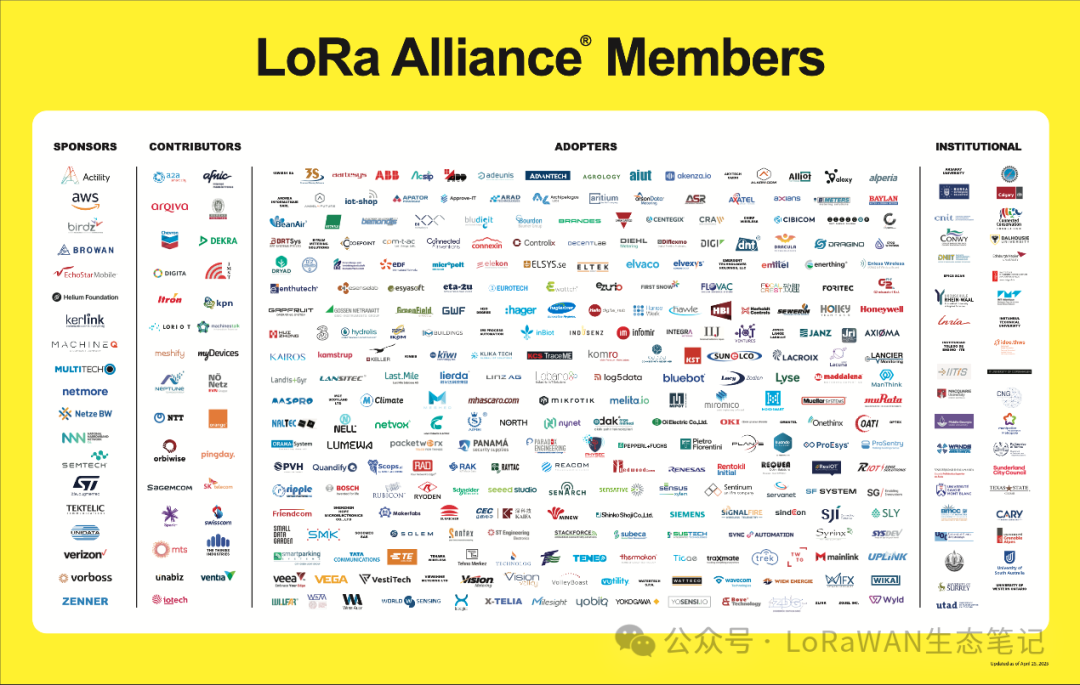
Over the past decade, the LoRa Alliance has grown from dozens of members to over 350 corporate members, supporting the operation of over 125 million LoRaWAN devices. The alliance ensures global interoperability of devices and networks through technical working groups, certification systems, and regional parameter mechanisms, promoting the deep implementation of LoRaWAN standards in industries such as buildings, energy, agriculture, and manufacturing in collaboration with global ecosystem partners.
Conclusion: LoRaWAN, the “Low-Power Pulse” Connecting the World
The accumulation of ten years has made LoRaWAN not just a communication protocol, but a belief in the ecosystem—
Allowing every node to achieve the longest-lasting connection with the lowest energy consumption. The power of standards enables IoT to go further; the co-construction of the ecosystem truly connects everything.
The story of LoRaWAN continues.
THE END
This public account is officially authorized by the LoRa Alliance and is the only official WeChat account of the alliance in China. Here, we will publish the alliance’s official information, the latest standard developments, application cases, and market dynamics in real-time. Follow us to directly obtain the most authoritative LoRaWAN ecosystem information.
 LoRaWAN
Scan to follow and join the ecosystem