Today’s Sharing
【Introduction】For LoRa, the past decade has been a period of rapid development and significant breakthroughs. Looking ahead, LoRa still holds unlimited potential………
Embracing Digital Buildings with LoRaWAN
Currently, integrated solutions based on the LoRaWAN radio standard are becoming increasingly popular in renovation and new construction projects within the building automation field. Connecting sensors, meters, or operational devices via LoRaWAN offers several advantages compared to other wireless technologies, such as:
-
Low configuration costs for necessary infrastructure
-
High security through encrypted data transmission
-
Minimal wiring required for installation in buildings
-
Simple and cost-effective integration of products in existing buildings
-
Battery life of up to 10 years (depending on sensor type)
-
High range and penetration in buildings
The combination of modern IoT and cloud solutions with the flexibility of LoRaWAN enables new efficient use cases: the goal is to alleviate technical facility management, reduce operational costs, transparently handle building data, and inspire new comfort features for building owners.
What is LoRaWAN?
LoRaWAN stands for “Long Range Wide Area Network”, a power-efficient radio technology developed specifically for the Internet of Things (IoT) with ultra-long range. It belongs to the so-called LPWAN technologies (Low Power Wide Area Network, LoRaWAN Alliance), with a battery life of up to 10 years, depending on sensor type and data transmission. It can cover distances of up to 15 kilometers (depending on the environment and external factors). Another major advantage of LoRaWAN is its high building penetration. However, the combination of low power and long range limits the maximum data rate to 50kbit/s.
Advantages of LoRaWAN
-
Extremely high coverage
-
Widespread distribution and rapid growth
-
Years of battery life
-
Low network construction costs
-
Low permeability and interference resistance
LoRaWAN in Buildings
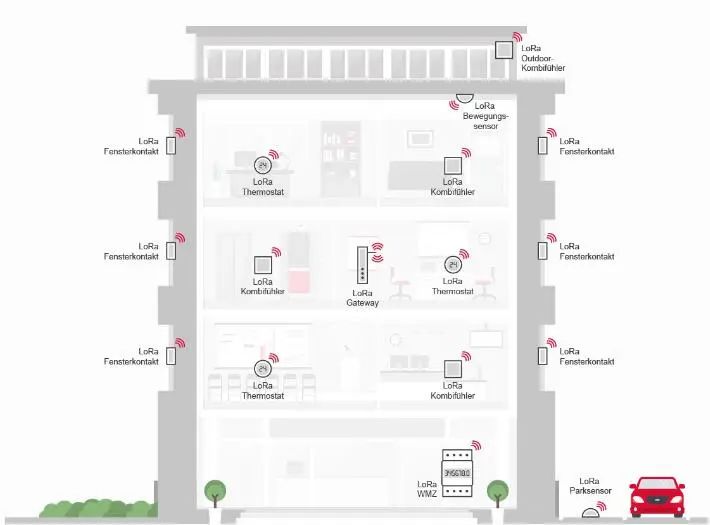
In building automation, especially in smart buildings, the focus is on data transparency to operate buildings as energy-efficiently as possible. LoRaWAN was developed to meet the demands of IoT, featuring high radio range and excellent building penetration. This allows even an entire corporate building and its associated premises to be covered by just one gateway. Even basements, which are usually difficult to integrate into wireless networks, do not pose a problem for the LoRa wireless network.
Since IoT sensors and actuators consume very little data, almost any number of sensors can communicate with the network server via a single gateway. This makes the integration of LoRa wireless sensors very advantageous, as neither a large number of gateways nor repeaters are required.
Moreover, low-power data transmission enables LoRa sensors and LoRa actuators to operate energy-efficiently using batteries. At the same time, their battery life can reach up to 15 years. This minimizes maintenance work in facility management and makes the renovation of existing buildings easy since rewiring is not necessary.
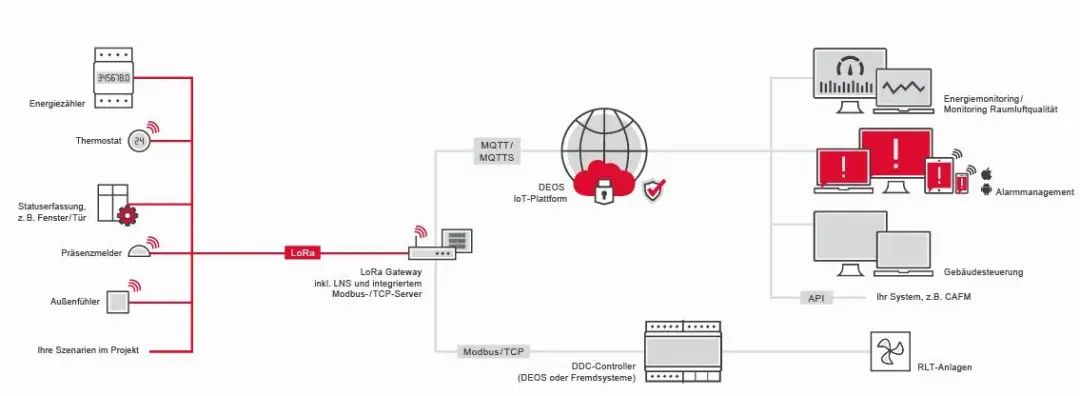
To integrate into existing building automation systems, some LoRa gateways already have standardized GA interfaces, such as Modbus. This way, data collected from LoRa terminal devices can easily flow back to the building control system. This communication is bidirectional, allowing for simple and cost-effective integration.
Source: DEOS
Taking DEOS’s LoRaWAN solution as an example. Its LoRa gateway has an integrated LoRa Network Server (LNS) that can store IoT data on the local network. Additionally, the standard Modbus TCP interface allows for easy decoupling of IoT data to any DDC controller in the building that supports Modbus. Thus, LoRa terminal devices can exchange data bidirectionally with existing GA systems or provide collected data to DEOS pro.Building Suite (IoT platform).
This platform visualizes data from various applications, such as smart metering, on-demand cleaning, or predictive maintenance. Data can also be forwarded to pro.Building Suite or any MQTT broker via MQTT. To facilitate easy debugging of LoRa sensors using the DEOS solution, they provide a tool for large-scale integration. This means that a large number of sensors can be integrated into the network with just a few clicks to activate. This minimizes deployment work.
Therefore, DEOS’s solution provides all the advantages of the LoRaWAN radio protocol and offers additional features and services specifically designed for building automation applications.
Source: DEOS
Use Cases of LoRaWAN in Buildings
LoRaWAN has significant advantages, and its visibility and importance are steadily increasing. But what exactly should LoRaWAN solutions be used for in the field of building automation? Through application examples in the smart building sector, we showcase some of the most interesting use cases.
Post-Digitalization of Existing Buildings
Statistics show that approximately 80% of total building costs occur during the usage phase or operational period of the building. Therefore, there is immense potential for savings that must be leveraged. The simple integration of LoRa wireless sensors during operation, such as digitalizing and automating heating control, is child’s play. This greatly reduces energy costs, with low investment costs.
Heating Control with Smart Thermostats
Using smart LoRaWAN thermostats can enhance the efficiency of existing buildings with old radiators. Heating control no longer requires manual adjustments but is instead intelligently and fully automatically controlled based on needs. Energy-saving plans stored can minimize heating output at specific times (e.g., weekends).
Smart Metering
LoRaWAN radio solutions are suitable for automating time-consuming and error-prone meter readings. Data logging and historical records improve the transparency and verifiability of past period data… Interfaces with billing systems are also conceivable. Therefore, manual readings are no longer necessary, alleviating the burden on technical facility management.
Making Energy Consumption Transparent
Transparency in buildings is paramount. Using LoRaWAN energy meters, the energy consumption of buildings can be monitored. Due to shorter recording intervals, daily consumption can be accounted for. Similarly, evidence of energy efficiency can be collected, and data can be used for further optimization of energy flows within the building.
Predictive Maintenance
LoRaWAN solutions can be used to alleviate facility management and identify errors or faults before they occur. Typically, the status of applications or devices is monitored and critical values are reported in a timely manner. For example, the fill level of filter pads in ventilation systems can be transmitted, allowing for timely replacements and avoiding downtime.
On-Demand Cleaning
Field staff’s attendance times are becoming increasingly personalized. Periods of varying utilization are now the norm. Therefore, one day a room may be nearly empty, while the next day it is overcrowded. For on-demand cleaning management, data is collected and forwarded to service providers using LoRa presence detectors. This makes operations using data more efficient.
Indoor Air Monitoring
Using CO2 signal lights or alternative sensors that support LoRaWAN to monitor and optimize indoor air quality for building occupants is essential, especially in light of the impact of the COVID-19 pandemic. Creating a sense of safety for building users is very important. However, an optimized indoor air climate can also significantly improve productivity and reduce employee sick leave.
How to Choose: LoRaWAN, WiFi, Bluetooth, EnOcean, or Sigfox?
The increasing importance of IoT and the strong demand for specific application solutions are currently bringing many new technologies to a competitive market. Each of these technologies has its reason for existence, making direct comparisons challenging. When deciding on a technology, it’s important to consider individual application scenarios.
Especially in the consumer sector, such as smart homes, protocols like WiFi and Bluetooth are often used to control or read lighting, shading, or even provide room information such as temperature. The main reason for this is that such infrastructure is typically already in place and is usually perfectly suited for home applications.
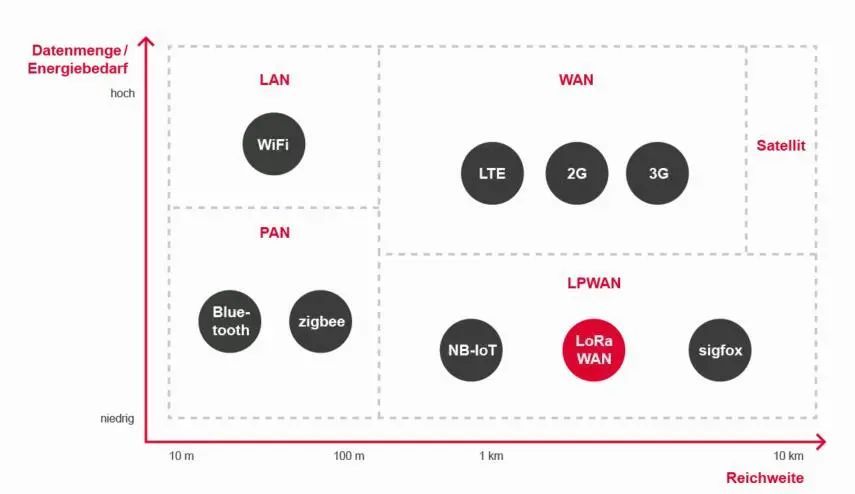
However, for industrial uses, local area networks (LAN) often perform poorly or do not meet most requirements at all. For instance, these technologies are primarily designed for high data volumes over short distances, and costs are also very high. However, this large bandwidth is not necessary, as the data volume in smart buildings is typically very low. According to data from 3GPP (the global mobile communications standardization body), approximately 99.9% of LPWAN devices consume less than 150 KB of data per month. Hence, data volume, energy requirements, and range are directly related to one another.
Source: DEOS
Further Reading
Growing Together with the IoT Industry — A Review of LoRa®’s Rapid Development Over the Past Decade
2009 was a turning point for China’s IoT industry, as the visionary “Perceiving China” IoT strategy was proposed, leading the IoT industry into a fast track of rapid development. The recently released “14th Five-Year Plan for Digital Economy Development” has listed IoT as one of the seven key industries of China’s digital economy. According to IDC analysts’ predictions, global enterprise investment in IoT is expected to reach a staggering $1.1 trillion by 2026, while China’s IoT IT spending will approach $298.12 billion. With such strong development momentum and investment, the IoT industry is filled with infinite potential for innovation and growth.
The thriving IoT market provides fertile ground for the rapid development of various IoT communication technologies. Semtech’s LoRa® technology is a typical example. Since its global promotion began in 2012, LoRa has experienced rapid growth alongside the development of the IoT market in China and globally. Today, LoRa has become the leading technology in the low-power IoT communication field, forming very mature applications across various verticals and being widely adopted in all industries. A large and vibrant ecosystem (LoRa Alliance) has already formed around LoRa technology and continues to grow.
In terms of deployment, LoRa has also achieved outstanding results over the past decade. As of March 30, 2023, there were 6 million LoRa-based gateways deployed globally, 300 million LoRa-based terminal nodes, and 181 public network operators using LoRaWAN connections, with numbers continuing to increase.
LoRa Development Milestones
-
2012: Semtech acquires LoRa technology through the acquisition of Cycleo
-
2013: Semtech releases the first LoRa chip product
-
2015: The LoRa Alliance is established, launching the LoRaWAN standard and gradually forming a broad industrial ecosystem
-
2018: Semtech acquires TrackNet, laying the technical foundation for asset tracking products
-
2019: Semtech launches the first LoRa CloudTM service platform
-
2020: Semtech releases the LoRa EdgeTM geolocation platform
-
2021: LoRaWAN is officially approved by the International Telecommunication Union (ITU-T) as the global communication standard for low-power wide-area networks (LPWAN), marking its transition from an IoT de facto standard to a true international standard
-
2022: Semtech launches the LoRa Edge LR1120 chipset, offering multi-band LoRa and long-range frequency-hopping spread spectrum (LR-FHSS) communication
Building Ecosystems and Technological Innovations to Help LoRa “Mine” the Trillion-Level IoT Market
Over the past decade, the IoT market has seen the emergence of various low-power IoT technologies. Among them, thanks to its unique ecosystem-building strategy, LoRa has achieved rapid development. The LoRa ecosystem unites upstream and downstream companies in the industry chain (including network operators, device manufacturers, software suppliers, chip suppliers, cloud and application suppliers, etc.). Through such collaborative efforts, the widespread adoption of LoRa technology and the LoRaWAN standard has been achieved. In 2015, Semtech, along with industry leaders like Cisco and IBM, established the LoRa Alliance (LoRa Alliance®). This alliance quickly grew to become one of the largest and fastest-growing technology alliances in the world.
In the global construction of the LoRa ecosystem, the Chinese market is undoubtedly a very important part. In 2018, internet giants like Alibaba, Tencent, and JD.com joined the LoRa Alliance as top-level members (i.e., Sponsors). At the same time, LoRa ecosystem partners like ZTE Kela Technology and various local broadcasting companies (like Oriental Cable and Hangzhou Huashu), Zhejiang Unicom, and Unicom IoT Company are actively deploying LoRa networks across various regions. Currently, there are over 3,000 enterprises in China’s LoRa industry chain, forming a large ecosystem that integrates operators, internet giants, solution providers, module suppliers, and gateway manufacturers, and this ecosystem continues to expand.
Ecosystem building helps LoRa explore market opportunities, while technological innovation injects core capabilities for LoRa’s sustained development. Originally, LoRa was a physical layer modulation technology based on linear frequency modulation, which Semtech implemented into chips, fully leveraging its low power and long-range advantages. Over the past decade, Semtech has continuously innovated, building the LoRa “chip-to-cloud” platform and providing end-to-end solutions to help customers quickly develop and deploy IoT networks, gateways, sensors, modules, and services.
At the same time, Semtech has always focused on local market needs for innovation. The LoRa solution development centers in Shenzhen and Shanghai continuously provide deep technical support to customers and develop innovative network solutions. In 2022, Semtech launched a private network reference design based on LoRa for Chinese customers, further enriching LoRa networking options; that same year, the LoRa Edge geolocation platform supported by LoRa Cloud services was integrated into Tencent Cloud’s IoT development platform to better meet domestic customers’ geolocation service needs. The recently launched FMS LoRa networking solution provides lightweight and low-cost design references for industrial and other applications.
Helping China’s IoT Industry’s “Golden Decade”
China is the largest IoT market globally and has been LoRa’s largest market for many years. The past decade of rapid progress in China’s IoT sector has also been a decade of rapid development for LoRa. However, LoRa’s development in China has not always been smooth; it has faced intense market competition and even skepticism. But today, LoRa continues to maintain steady growth in the market, undoubtedly demonstrating its strong resilience and vitality.
In recent years, the pace of digital and low-carbon transformation and upgrading of China’s economy and society has accelerated. The characteristics of low power, long range, flexible networking, and low cost of LoRa technology align highly with local market demands. From smart buildings and parks, asset tracking, power grid monitoring and energy management, to metering, fire safety, smart agriculture, livestock management, and industrial automation, an increasing number of vertical industries are accelerating the adoption of LoRa technology, transforming people’s production and lifestyle.
In these vertical fields, several exciting LoRa application cases have emerged in the country, such as: Xingzong IoT‘s smart agriculture solution based on LoRa, which can monitor agricultural environments in real time, track the health of crops and livestock, improve agricultural efficiency and yield, and reduce environmental impact; Lierda‘s personnel positioning solution based on LoRa provides intelligent safety assurance for chemical parks, significantly improving park management efficiency; in response to market demand for smart rubber plantations, Hailian IoT developed an automated rubber collection system based on LoRa, achieving precise tapping, which increases productivity by over 50% compared to manual tapping; in the smart metering sector, Dongri Information‘s LR mesh self-organizing smart water meter solution boasts a reading rate of over 99%, not only reducing operational costs through ultra-low power consumption but also better serving public utility applications with the help of big data cloud platforms.
(To learn more about LoRa application cases, please visit:https://bit.ly/3MlZCKV)
Currently, the domestic LoRa ecosystem is increasingly mature, comprehensively including operators, internet giants, solution providers, module suppliers, manufacturers, etc., and continues to grow, providing a broad stage for the sustained development of LoRa. At the same time, Semtech has licensed LoRa chip IP to Alibaba, forming a market supply situation with multiple chip suppliers, empowering customers for independent innovation. LoRa chip suppliers are differentiating their offerings by integrating chips with different functions to meet the needs of more diverse applications, such as LoRa + GPS for location information, LoRa + BLE for communication with local near-field devices, and LoRa + security chips to enhance device security. Semtech collaborates with other LoRa chip suppliers to expand the market together.
Co-creating a Sustainable and Connected Future
Looking ahead, low-power wide-area network (LPWAN) communication technology is one of the most promising technologies in the IoT field. According to ABI Research, global non-cellular LPWAN connections are expected to reach 1.3 billion by 2026, with LoRa continuing to lead growth in this field. By 2026, non-cellular LPWAN connections in China will exceed 450 million, with LoRa occupying 79% of the market share.
From a platform perspective, Semtech will continue to optimize LoRa’s cloud service capabilities, aiming to build it into a market-leading “chip-to-cloud” service platform, enhancing security, configuration, device management, and geolocation functions, and supporting lower-power IoT innovations.
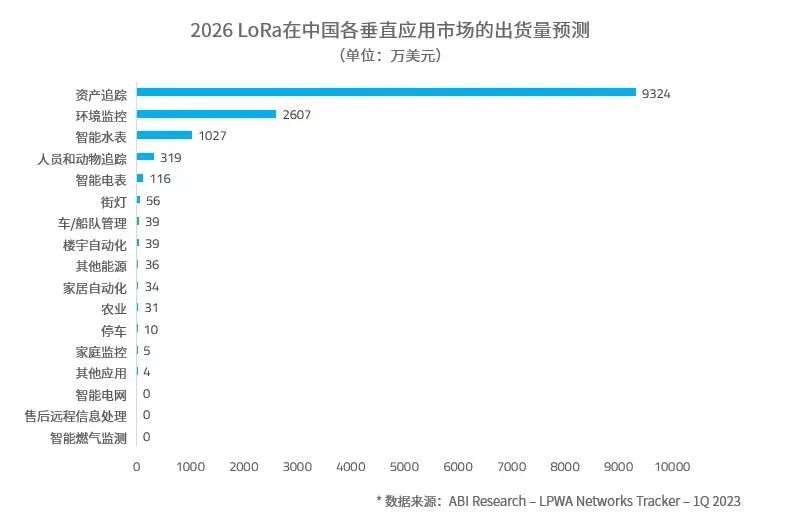
At the application level, asset tracking has become the largest vertical application market for LoRa in China, and its market size is expected to continue expanding. According to ABI Research, by 2026, the revenue from LoRa chip shipments in the asset tracking sector in China will reach $93.24 million, tripling compared to 2022.
2026 LoRa Chip Shipment Forecast in Various Vertical Application Markets in China (Unit: $10,000)
Data Source: ABI Research – LPWAN Tracker 1Q 2023
Furthermore, according to ABI Research, environmental monitoring will become the second-largest application area for LoRa in China. LoRa-based devices, with their advantages of wide coverage, low power consumption, strong penetration, and easy deployment, can support customers in deploying environmental monitoring solutions at low costs. From homes, offices, hotels, apartments, schools, hospitals, and nursing homes to shopping malls, restaurants, banks, warehouses, factories, and parks, LoRa-based solutions can timely monitor and report temperature, pressure, pollution levels, and other environmental variables, detect fires, and handle alarms, helping to improve management efficiency and optimize energy consumption.
Driven by the national “dual carbon” goals, various industries are actively accelerating low-carbon development. This will create more development opportunities for LoRa, which has low-power advantages, further expanding its applications in vertical fields such as agriculture, smart cities, environmental protection, healthcare, smart buildings, industrial control, metering, and logistics, helping to control energy consumption, reduce waste, and improve efficiency. For example, devices based on LoRa integrated into water management systems can monitor water usage and reduce water resource waste; applications in logistics, food, and healthcare industries for asset tracking and management can minimize resource loss.
For LoRa, the past decade has been a period of significant growth and rapid development. Looking ahead, LoRa still has unlimited potential. LoRa will continue to innovate in technology, empowering more innovative applications, and assisting various industries in their digital and low-carbon transformation and upgrading. Semtech’s investment and commitment to the Chinese market will not change. We are dedicated to collaborating with customers and ecosystem partners for mutual benefit, further developing the LoRa ecosystem, and co-creating a smarter, more connected, and sustainable future.
-Recommended Reading-
What Does Matter and Thread Mean for Your Smart Home?
What Does Matter and Thread Mean for Your Smart Home?
How Next-Gen Wi-Fi Will Change Smart Homes?

What Does Matter and Thread Mean for Your Smart Home?
What Does Matter and Thread Mean for Your Smart Home?
The Key to Decarbonizing the Global Construction Industry: Efficiency, Electrification, and Equity

What Does Matter and Thread Mean for Your Smart Home?
What Does Matter and Thread Mean for Your Smart Home?
Smart Home Data Privacy Report | Thousands of Shares
 Click/ Read Original /