Click the star and follow ⭐️Exciting content won’t get lost
In the field of chip architecture, RISC-V is reshaping the industry landscape with its unique openness and flexibility.
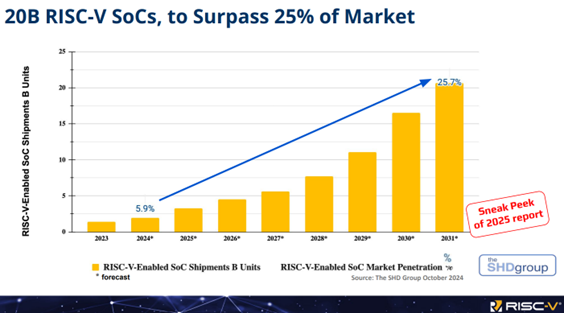
According to an industry forecast report released by SHD Group, the RISC-V architecture is expected to enter an unprecedented period of rapid development, with annual shipments of chips based on RISC-V architecture expected to exceed 20 billion by 2031, and the overall market penetration rate is expected to reach 25.7%, with the penetration rate in the automotive electronics market reaching 31%.

RISC-V Empowers Companies with Technological Leadership
As a completely open and royalty-free industry standard, RISC-V has completely eliminated the licensing fee burden of traditional architectures, significantly lowering the technical entry threshold, allowing innovation teams to quickly initiate projects; furthermore, the simplified licensing process greatly enhances product iteration efficiency, enabling companies to focus on core value creation rather than patent negotiations. This business model fundamentally reconstructs the innovation paradigm of the chip industry.
In addition, RISC-V offers extremely high flexibility, allowing companies and developers to collaboratively optimize key parameters such as chip area, power consumption, and cost according to specific workload requirements. Through this fine-tuning capability, companies can break through the limitations of traditional architectures to achieve optimization in performance, energy efficiency, and cost, thereby creating more market-competitive differentiated products.
Andrea Gallo, CEO of RISC-V International, stated at the 5th RISC-V China Summit: “In the RISC-V ecosystem, companies always maintain control over their own technological development. RISC-V has a unique advantage of an open ecosystem, with no risk of vendor lock-in, all standards and specifications are open and transparent, and there is a diverse choice of IP suppliers. Moreover, companies can not only develop customized extension instructions to accelerate product launch but also collaboratively build industry standards based on RISC-V. This rapid innovation capability is also a unique advantage of RISC-V.”
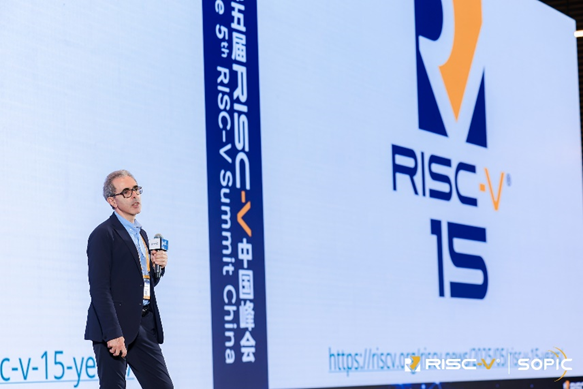
5th RISC-V China Summit, RISC-V CEO Andrea Gallo
Click to follow and star Eefocus,
to receive 20 industry reports and industry research collections.

Multi-Dimensional Approach to Accelerate Implementation
RISC-V has a unified Instruction Set Architecture (ISA) that boasts excellent scalability, with applications in automotive electronics ranging from basic ECUs to domain controllers and central computing platforms. By flexibly configuring instruction set extensions for performance optimization, it maintains the integrity of a single ISA architecture, providing unprecedented design flexibility for automotive electronics.
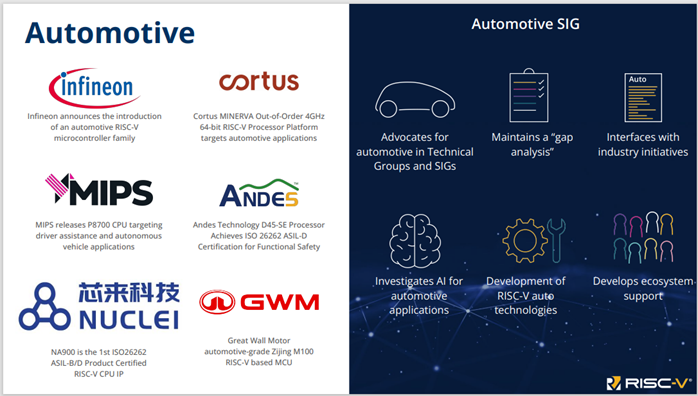
Infineon announced that it will launch a new generation of automotive microcontroller (MCU) product line based on RISC-V architecture in the coming years; the NA900 series developed by Chipone Technology has become the world’s first RISC-V automotive-grade IP core to pass ISO 26262 ASIL-D highest safety certification; Great Wall Motors has also released its RISC-V MCU chip “Zijing M100”. These significant advancements mark that RISC-V is accelerating its penetration into this critical automotive market.
However, architecture migration requires a significant amount of software adaptation work, and building a unified ecosystem is particularly critical for the acceleration of RISC-V in the automotive electronics field.
In recent years, RISC-V has closely collaborated with suppliers in many key areas such as compilers, toolchains, virtualization support, and artificial intelligence/machine learning, actively working with operating system vendors to build an ecosystem. For example, CETC recently joined RISC-V as an Autosar supplier, injecting new momentum into the development of the RISC-V automotive ecosystem. Additionally, companies like Green Hills Software, IAR Systems, and Tasking are also collaborating with RISC-V on automotive-grade toolchains.
Andrea Gallo stated: “Our work covers not only the hardware level but also establishes deep cooperation with operating system vendors. Yocto, Red Hat, and Canonical have all officially provided support for the RISC-V architecture; in the Chinese market, operating systems such as OpenEuler and openKylin have also implemented support for the RISC-V architecture. The RISC-V architecture has achieved a level of system-level support comparable to other architectures.”
In the automotive field, functional safety and information security are crucial. With the development of automotive intelligence and connectivity, vehicle systems need to operate reliably under extreme conditions while preventing malicious attacks and data breaches. Functional safety ensures that systems do not cause danger in the event of a failure, while information security protects vehicles from network threats.
To meet these safety requirements, several manufacturers, including Nuclei, SiFive, and Cortus, have launched multiple IP cores and chip products that have passed ISO 26262 functional safety certification or ASIL D highest safety level; RISC-V can provide important support for hypervisors through several key extension technologies (including RISC-V Worlds and Smmtt), achieving isolation of software domains.
In addition, RISC-V has other security extension technologies, including Physical Memory Protection (PMP), Pointer Masking, and Control-Flow Integrity (CFI), which ensure that on specific RISC-V cores, software does not experience data corruption or unexpected changes in execution flow.
RISC-V has been committed to enhancing the developer experience, building a comprehensive support system for upper-level application developers. RISC-V has provided nearly 300 development boards to core developers and project maintainers. At the same time, it continues to expand its free online course resource library and establish deep cooperation with operating system vendors.
Notably, RISC-V has also established an Automotive Special Interest Group (Automotive SIGs) in the automotive field, collecting the needs of participants in the automotive industry and mapping these needs to RISC-V extensions and technologies that can provide the best configuration for software-defined vehicles. In the future, the Automotive SIGs will successively release white papers and application notes aimed at the RISC-V software ecosystem.
In fact, the RISC-V architecture has not only achieved significant results in the automotive electronics field but has also demonstrated strong potential in data centers, AI applications, aerospace, and high-performance computing. For example, Alibaba’s Xuantie C930, the “Xiangshan” from the Beijing Open Source Chip Research Institute, and the V100 from Jintie Shikong are all based on the RISC-V architecture, optimized for data center and AI scenarios. Tech giants like NVIDIA and Meta also widely adopt the RISC-V architecture for GPU cores and AI accelerators. In the aerospace field, NASA and the European Space Agency are highly focused on RISC-V technology and promote its application in high-performance aerospace computing. The EU’s “DARE” project and China’s “Xiangshan” project are both dedicated to the RISC-V research and development in high-performance computing.
Scan to reply“Automotive Electronics,RISC-V“ keywords for industry groups and receive reports

Conclusion
RISC-V, with its unified instruction set architecture, customization capabilities, and open ecosystem, is reshaping the automotive electronics chip market. From international semiconductor giants to domestic innovative enterprises, from chip design to complete vehicle manufacturing, RISC-V application cases are continuously emerging, driving innovation in key areas such as intelligent driving, vehicle networking, and power systems, injecting new vitality into the future development of automotive electronics.
END
Industry Community


Please like

Please share

Please recommend