

 On July 24-25, the 4th China Integrated Energy Service and Energy Digitalization Conference, hosted by IESPLAZA, was grandly held at the Shangri-La Hotel in Suzhou. Song Zixin, General Manager of Shenzhen Hengshi Shengjing Technology Co., Ltd. (referred to as “Hengshi Shengjing”), attended the conference and delivered a keynote report titled “IoT × AI × Power Market: Creating a New Paradigm for Virtual Power Plants.”
As one of the first virtual power plant operators in Shenzhen and currently the largest in terms of air conditioning load aggregation, Hengshi Shengjing has made significant breakthroughs in virtual power plant technology and business models, and has participated multiple times in precise responses of Shenzhen’s virtual power plants.
1
Hengshi Virtual Power Plant 2.0
Hengshi Shengjing is a wholly-owned subsidiary of Beijing Hengtai Shida Technology Co., Ltd. Hengtai Shida is a leading domestic provider of communication design, smart IoT applications, digital energy, and integrated energy services. Around 2023, the new business model of virtual power plants in China gradually unveiled, contributing to the national energy transition and supporting the construction of a new power system. Beijing Hengtai Shida Technology Co., Ltd. established a specialized company—Hengshi Shengjing, organizing a professional team focused on the exploration and application of virtual power plant business, concentrating on technology and business model innovation.
According to Song Zixin, based on the company’s current technology, Hengshi VPP has progressed from phase 1.0 to phase 2.0. In 2019, when the company participated in the construction of the State Grid Jibei virtual power plant, the resource types (mainly HVAC loads) and profit models (mainly passive invitation to fill valley subsidy income) were relatively simple, and the technology used was also relatively basic (IoT + communication), which can be referred to as Hengshi VPP 1.0.
However, since 2019, especially after the establishment of Hengshi Shengjing, the company has continuously made breakthroughs in resource aggregation types, technical capabilities, and business models. Among them, the resource aggregation has expanded from the early HVAC loads to industrial loads, energy storage, charging facilities, and distributed power sources. In terms of technology, the integration of IoT, communication, AI, and digital twin technologies has led to significant technological breakthroughs in response speed, prediction accuracy, and trading capabilities. Therefore, driven by power reform, virtual power plants have gradually expanded from passive demand response to a multi-market profit model that combines energy markets, ancillary service markets, and spot markets, marking the entry of Hengshi VPP into the 2.0 era. During this period, the company has expanded its virtual power plant business from Shenzhen to regions such as Shandong, Shanghai, and Guangzhou.
For example, in the Shandong market, due to the high proportion of renewable energy generation, the power system has a significant demand for flexible adjustment resources. Hengshi Shengjing leverages the mature advantages of the Shandong spot market by aggregating users’ distributed power sources, energy storage, and production load resources, exploring a new multi-resource optimization scheduling model based on maximizing revenue goals. Hengshi Shengjing acts both as a virtual power plant operator and an energy storage investor.
2
Building a Technological Moat to Lead Industry Development
Song Zixin stated that due to the specialization of the business and the “power plant” attribute of virtual power plants, participating in power market transactions naturally becomes the company’s main business line. Therefore, “IoT + AI + trading capability” has naturally become the technological moat the company aims to build.
The key technology system of Hengshi Shengjing’s virtual power plant can be summarized into three aspects: smart aggregation, smart control, and smart operation.
Smart Aggregation: Ensuring Resources are Available for Adjustment.Due to the existence of grid nodes and the dispersion of aggregated resources, hierarchical and graded aggregation technical capabilities are the foundation for achieving efficient collaboration among resources at different levels and regions. During the aggregation process, it is also necessary to ensure the real-time and accuracy of operational data of aggregated resources, providing basic technical support for prediction and control. At the same time, an assessment of the adjustable capacity of aggregated resources is required. Taking load aggregation as an example, it is necessary to detail the relationship between user cluster energy consumption time and the influencing factors that affect changes in energy consumption behavior. In simple terms, when the virtual power plant controls user resources, what is the user’s acceptance and tolerance, that is, how much resource can be made available for scheduling and trading, and for how long. Additionally, research is needed in areas such as dynamic aggregation model technology and dynamic adjustment capacity correction technology.
Smart Control: Ensuring Resource Mobilization is Effective.Based on cloud-edge collaborative control technology to achieve collaborative management of multi-node resources; based on collaborative optimization scheduling technology to solve the collaborative scheduling problems of different types of resources, balancing economic and low-carbon goals; based on real-time response optimization technology, supporting the virtual power plant to provide refined response capability assessments at day-ahead, hourly, minute-level, second-level, and millisecond-level, classifying resources according to their types and response willingness.
Smart Operation: Ensuring Resource Mobilization is Valuable.Virtual power plant operators must understand power market operations, capturing real-time power market prices and policy signals to achieve parallel revenue from multiple markets. Additionally, they must manage both internal resource operations and external resource operations. Internal resources mainly involve demand mining, revenue distribution, user guidance, and privacy protection; external resources refer to constructing a virtual power plant main side chain trading architecture based on blockchain technology, adapting to the hierarchical and partitioned management and calling system of virtual power plants, supporting trustworthy and efficient transaction evidence tracing, transaction clearing, and adaptive pricing business scenarios.
Song Zixin stated that Hengshi Shengjing builds a virtual power plant operation management system based on a cloud-edge-end architecture, achieving comprehensive self-research of both software and hardware. She also pointed out that the full-stack self-research of virtual power plant software and hardware greatly enhances operational stability. She cited that currently, single resource aggregation-type virtual power plants are rare, as most virtual power plants involve source, load, and storage resources. Therefore, in managing and operating different types of resources, the collaboration of cloud, management, edge, and end is crucial. The higher the utilization rate of self-researched products, the better the algorithm collaboration among various ends, which can achieve more efficient data transmission, processing, and analysis, enabling precise control of distributed heterogeneous adjustable resources, improving system operational efficiency and response speed.
3
Detailed Testing Cases for Air Conditioning Control Potential
Song Zixin pointed out that based on practice, currently among all aggregable resources, air conditioning load is the most challenging type of resource to control. Therefore, Hengshi Shengjing has invested significant technical research and development around the aggregation, control, and operation of air conditioning loads, achieving the ability to connect over a hundred commercial air conditioning units in Shenzhen, with a total connected capacity exceeding 400 megawatts and adjustable capacity over 100 megawatts.
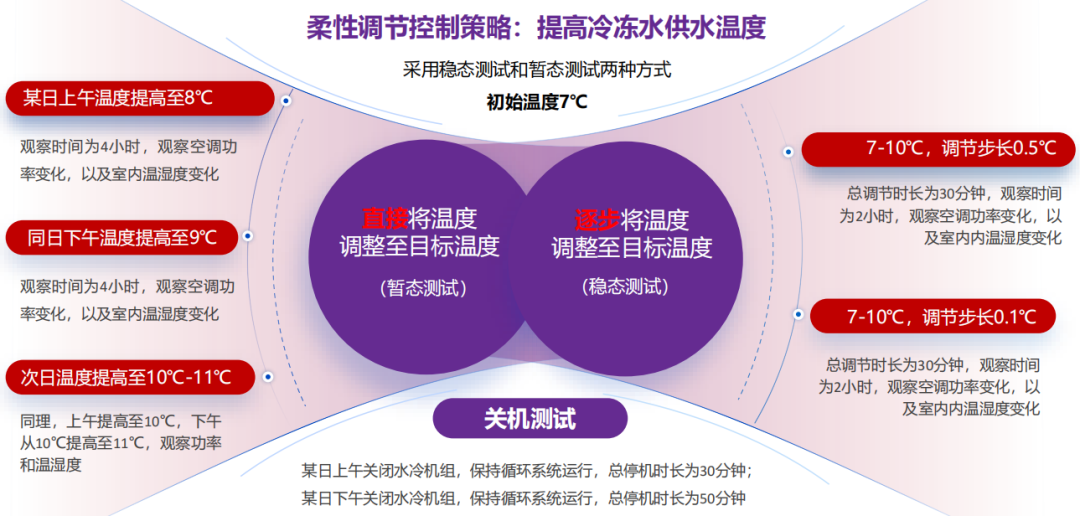
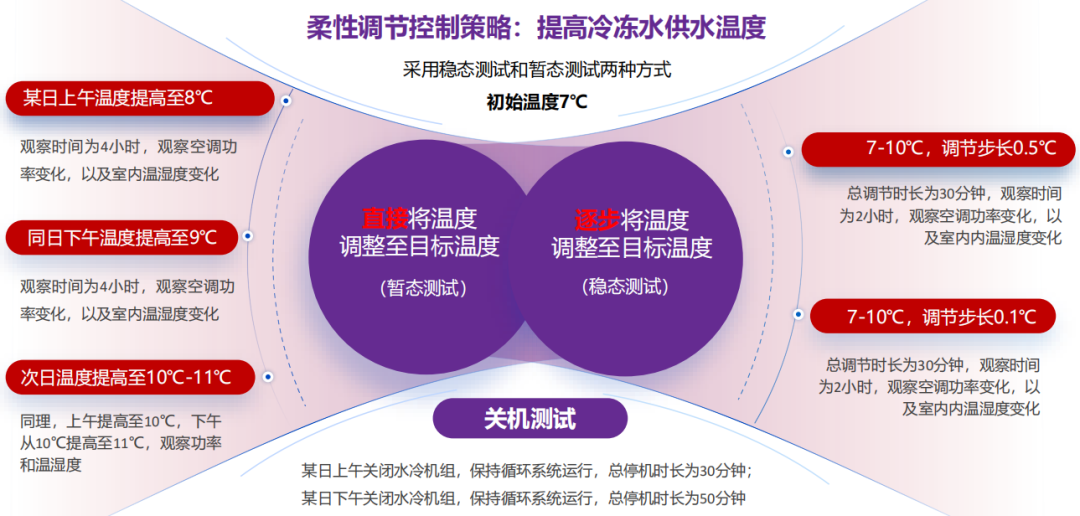
Overall, when conducting aggregation control tests on air conditioning using flexible adjustment strategies, experiments were conducted using both steady-state and transient testing methods. At the same time, to adapt to different types of market trading products, based on air conditioning feature recognition, they were classified as follows, with different types able to participate in different trading products.
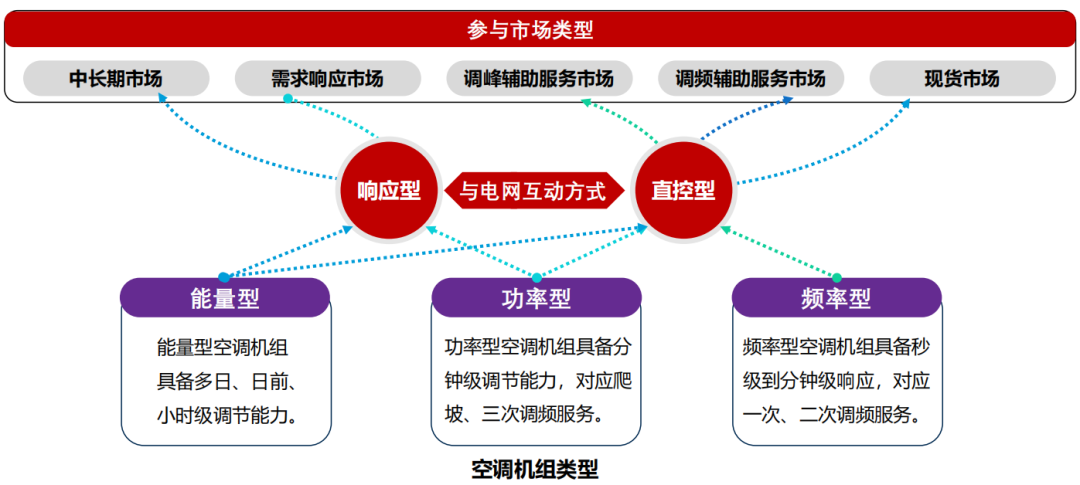
To achieve the goal of group control for air conditioning, whether in the experimental testing phase or the formal operation phase, a “one building, one strategy” approach is adopted. This also determines that the realization of group control adjustment goals (feature recognition → load forecasting → model decision-making → instruction distribution) must involve AI technology to meet the platform’s high-frequency trading automation and intelligence needs.
▲ Flowchart of Group Control Scheme Based on Air Conditioning Features
In addition, in terms of integrating charging pile loads, user-side energy storage, and distributed photovoltaics, Hengshi Shengjing has also explored and accumulated a complete set of access solutions, achieving high coordination in management and operation through full-stack self-research and application, enhancing the efficiency of utilizing aggregated resources.
Looking ahead, Song Zixin stated that virtual power plant operators need continuous innovation capabilities. For example, in terms of operations, exploring an innovative operation model of “small operation + large operation” through a virtual power plant operation alliance. Among them, “small operation” refers to platform operations based on aggregated resources and power market trading business lines, where operators independently gather dispersed power resources onto the platform, using IoT, AI, and other technologies to achieve efficient aggregation and allocation of resources, actively participating in power market trading and generating revenue.
On the other hand, “large operation” refers to the operation of an ecosystem based on derived digital, energy management, and green energy services.Operators build ecological enterprises around building loads and park user resources, collaborating with property companies, automotive companies, engineering companies, energy equipment companies, and many other partners, leveraging energy management services (such as EPC energy engineering services, energy operation and maintenance services, virtual power plant operations, etc.), ecological energy services (such as trading consulting, green credit services, channel services, etc.), and other services to create a comprehensive ecosystem covering all aspects of energy production, transmission, trading, management, and services. In this ecosystem, operators can provide users with more comprehensive and higher-quality services while exploring more business opportunities through ecological collaboration, promoting the virtual power plant’s development towards broader and deeper directions, and expanding from a single power trading business to diversified energy ecological businesses.
In terms of technological innovation, one of the core logics of the virtual power plant’s technology system is to convert heterogeneous resources into equivalent “dispatchable units,” which is also a technology that needs to be continuously tackled. Due to the different characteristics of distributed power sources, energy storage, building loads, charging piles, and other resources, in order for the virtual power plant to manage heterogeneous resources as if managing a single power source or load, it is necessary to unify and efficiently schedule the complex and diverse heterogeneous resources, transforming them into equivalent “dispatchable units,” incorporating them into a unified scheduling decision-making system, and formulating scheduling plans based on market prices, real-time resource status, etc., with the goal of maximizing revenue, achieving collaborative optimization and control of multiple resource types, and enhancing the operational efficiency and value creation capability of virtual power plants in the power market.