|
“The Performance Evaluation Initiative for Typical Server Application Scenarios” has officially launched! — To standardize the construction of a full-stack standard system, promote the iterative upgrade of product technology, better showcase the advantages of the entire architecture and computing power, and support excellent products and solution brands in enhancing and expanding their market through authoritative certification released by officials. The “Performance Evaluation Initiative for Typical Server Application Scenarios” (referred to as the Evaluation Initiative) has recently been officially launched by the Green Computing Industry Alliance! This evaluation initiative includesbig data, distributed storage, web applications, high performance computing, centralized relational database management systems, ARM native cloud phones, virtualization seven typical server application scenarios. |
Today we bring you a detailed interpretation of the “Server Application Performance Testing Methods for High Performance Computing”.
The drafting units of the “Server Application Performance Testing Methods for High Performance Computing” include Huawei Technologies Co., Ltd., China Electronics Standardization Institute, Shanghai Jiao Tong University, Tianjin Feiteng Information Technology Co., Ltd., and Arm Technology (China) Co., Ltd. We thank these units for their strong support.

We welcome you to continue following the series of articles on “Server Application Performance Testing Methods”, and we will bring you the series tour of products/solutions evaluated through the “Server Application Performance Testing Methods for High Performance Computing”!
01
Background
High Performance Computing (HPC) generally refers to systems that use many processors to execute computational tasks that ordinary personal computers cannot handle. Typically, HPC applications break down a large complex job into multiple sub-jobs for parallel computation, then compile the results to obtain a final result. Most cluster-based HPC systems use high-performance network interconnect computing servers, high-performance processors, high-bandwidth, low-latency networks, and high-bandwidth storage as obvious characteristics of HPC systems.
High performance computing is mainly used for parallel scientific computing and engineering computing, including computational fluid dynamics simulations, meteorological simulations, molecular dynamics simulations, artificial intelligence, and other scenarios where computational performance can increase with the scale of processor cores under the same solving problem. Currently, high performance computing has become a necessary means for numerical experimental work in high-end manufacturing, fundamental research, etc., reducing a large amount of physical experimental work and providing another technical means for exploring unknown fields.
At the same time, high performance computing places high demands on servers. For example, servers are required to have large-scale parallel computing capabilities for integer, single-precision, and double-precision calculations, provide a large number of effective processor cores per server, and offer task control, thread process binding, and job scheduling functions for each core; they are also required to provide high single and double precision mixed multiply-add operations per watt of power in floating-point calculations with high computation and high bandwidth load demands; and they must be capable of continuous full-load calculations for extended periods, maintaining performance throughout the entire process.
Specifically, in HPC industry applications (e.g., meteorological environmental protection, gene sequencing, industrial manufacturing, etc.), servers have specific demands for computing capabilities. Different HPC applications can be mainly divided into the following three categories based on their characteristics:
Computing-intensive applications: Large-scale scientific engineering calculations, numerical simulations, etc. Application areas include oil, meteorology, CAD, nuclear energy, pharmaceuticals, environmental monitoring analysis, system simulation, etc.
Data-intensive applications: Digital libraries, data warehouses, data mining, computational visualization, etc. Application areas include libraries, banks, securities, taxation, decision support systems, etc.
Network-intensive applications: Collaborative work, grid computing, remote control, and remote diagnosis, etc. Application areas include websites, information centers, search engines, telecommunications, streaming media, etc.
02
Testing Methods
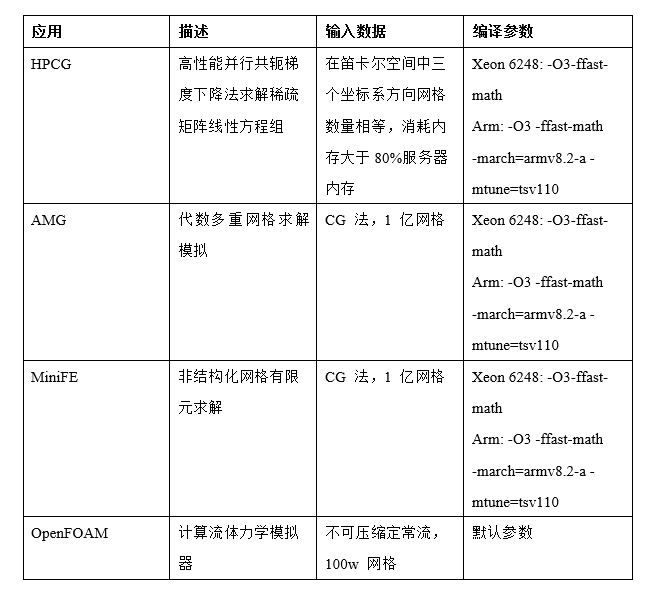
In the field of HPC, there are some very professional, influential, and representative applications that can reflect the various performances of high performance computing. The test cases selected for this testing include High Performance Conjugate Gradient (HPCG), Algebraic Multigrid Algorithm (AMG), proxy applications of unstructured implicit finite element codes (MiniFE), and commonly used computational fluid dynamics software OpenFOAM. This testing mainly focuses on typical applications related to the manufacturing industry and will gradually expand to other commonly used HPC fields such as the gene industry, meteorological industry, and astronomical industry.
The design of the testing platform framework is shown in the figure below, where the STAR model was developed by the Network Information Center of Shanghai Jiao Tong University. The testing platform consists of computing nodes, high-speed interconnect network components, storage components, and management and cooling components. Users can run tests through the STAR-panel. The computing nodes and some high-speed interconnect components provide performance information feedback to STAR-microbench and STAR-proxy. The computing nodes, high-speed interconnect network components, storage components, and cooling and management components provide power consumption information feedback to STAR-panel.
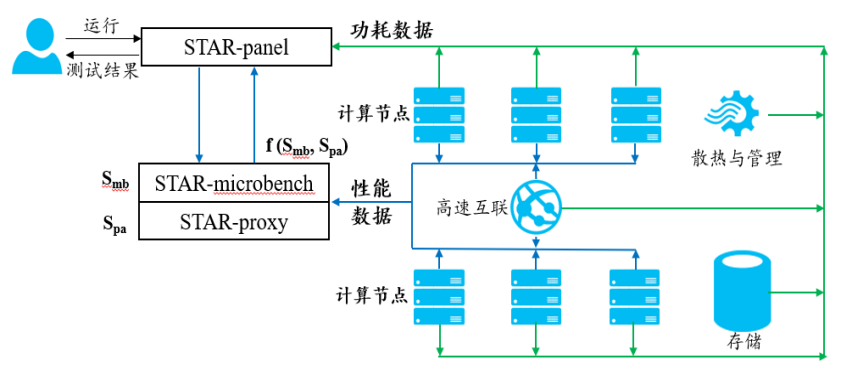
Design diagram of the high performance computing scenario testing platform
The input data and compilation parameters during the testing process are shown in the table below:
Running Method:
mpirun –prefix <path_to_mpi> –map-by core –bind-to core -np <# of processes>
<app>
Running Requirements: Continuous repeated calculations for 24 hours, taking average performance.
-
Test Configuration Description
The hardware configuration is shown in the table below:
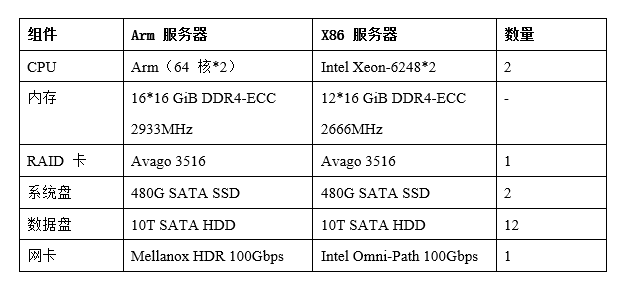
The software and dependency library information is shown below:
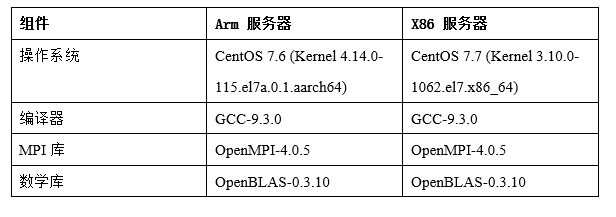
03
Testing Environment and Results
|
Testing Environment Introduction — This evaluation initiative is undertaken by the China Electronics Standardization Institute. The alliance collaborates with the China Electronics Standardization Institute to create the open laboratory “GCC Open Lab”. Registered units can apply for the professional typical application scenario software and hardware compatibility testing environment from the China Electronics Standardization Institute, or they can build their own testing environment, with experts arranged by the institute for remote guidance and review, ensuring the authority of the process and results. |
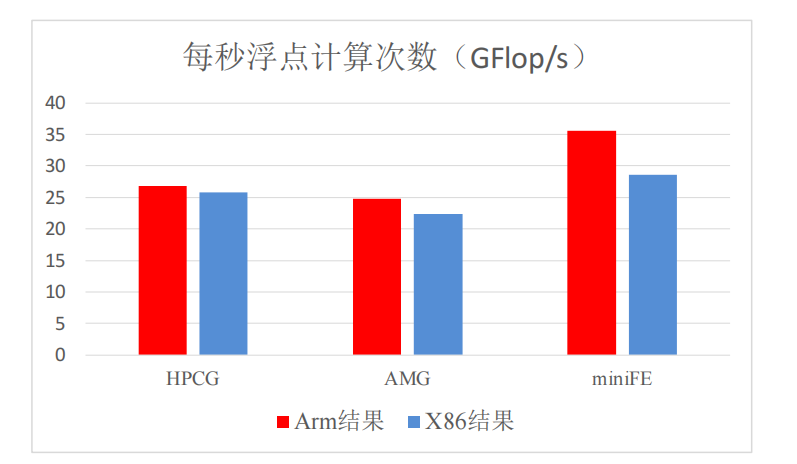
The general test case HPCG is a supplement to the high performance LINPACK (HPL) benchmark, which is currently used for ranking TOP500 computing systems. The test results indicate that there is little difference between the Arm platform and the X86 platform in this case, with the Arm server showing a slight advantage. The results of the two miniAPP case studies used in the manufacturing industry testing show that the Arm platform has a significant advantage over the X86 platform, with an average performance improvement of 17.5%.
From the above test results, it can be seen that Arm servers have good application prospects in both general industries and manufacturing industries, and their excellent computing performance is fully capable of typical applications in the aforementioned industries.
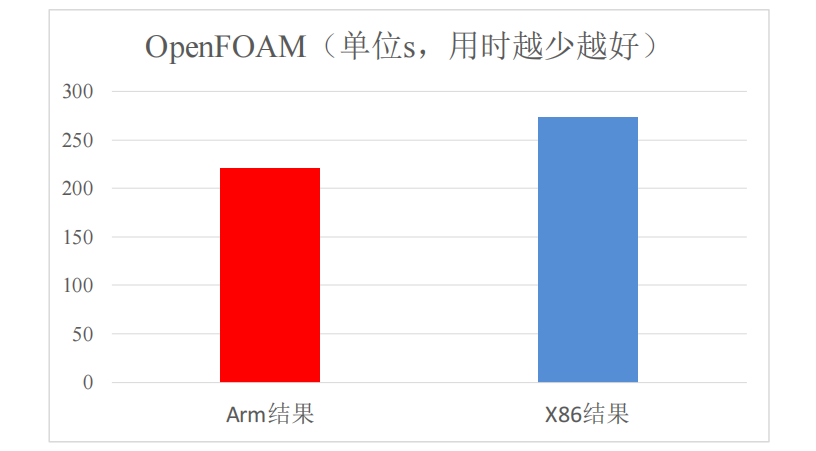
In the OpenFOAM open-source software test case, the Motorbike case provided by the software itself was specifically selected. Since the Motorbike case itself is relatively small, this test increased the grid count of the case model (1 million grids) through encrypted grids to enhance the computational intensity, thereby fully releasing the computing power of the cluster. The shorter the test result time, the better the outcome.
As can be seen from the figure, the Arm platform reduced the time compared to the X86 platform by 52 seconds, with a performance improvement of 23.5%. The results indicate that Arm architecture servers have excellent computational acceleration capabilities in the field of computational fluid dynamics, significantly reducing computation time and improving the utilization of computational resources, making them suitable for solving complex engineering and scientific problems under large-scale grid counts.
In summary, Arm architecture processors can fully leverage the advantages of strong multi-core computing capabilities, high memory bandwidth, high I/O throughput, and high energy efficiency in typical HPC scenarios, achieving better performance than traditional architectures. Practices have also shown that high performance computing users can build high-performance, low-power new computing platforms based on Arm servers.
04
Conclusion and Outlook
From the results of this test, green computing servers based on the ARM architecture are highly competitive compared to traditional architectures. At the overall solution level, green computing servers combined with commercial software solutions have shown significant advantages in this evaluation compared to traditional architecture servers combined with open-source software solutions, fully meeting the performance needs of applications across various industries.
We welcome you to continue following the series of articles on “Server Application Performance Testing Methods”, and we will bring you the series tour of products/solutions evaluated through the “Server Application Performance Testing Methods for High Performance Computing”!
In the future, the Green Computing Industry Alliance will continue to promote the performance evaluation of typical computing business scenarios, driving the joint optimization of underlying server hardware and upper-layer application software to reflect the overall competitiveness of full-stack solutions. At the same time, we will also collect more industry needs from alliance members, include more typical server application scenarios (such as edge computing, etc.), and more configurations of green computing servers, making typical application scenario evaluations a core competitiveness of the Green Computing Industry Alliance.
Additionally, the alliance will conduct evaluations and research on green computing servers from more dimensions, such as artificial intelligence servers, green energy-saving (power management), etc. The alliance will also study the system and mechanism for promoting the implementation of alliance standards through evaluation certification, and carry out preliminary research on the latest technical standards for green computing, as well as the upgrading of testing environments, laying the foundation for subsequent compliance testing certification services.
The Green Computing Industry Alliance will continue to promote certification activities for green computing technology products, services, and management, enhance the compliance, compatibility, and quality consistency of products and services, and promote product interoperability, building trust throughout the entire industry chain. The alliance is committed to promoting the recognition of certification results based on alliance standards by end-users and all relevant parties, fully reflecting the value of standards, and ensuring the effective implementation of standards!
*Special thanks to Huawei Technologies Co., Ltd. for providing material support for this article.
|
Welcome to register for participation in the “Evaluation Initiative”! Boost brand enhancement, customer recognition, and business opportunity acquisition —
|
|
Don’t wait any longer… Participate in the “Evaluation Initiative”! How to participate? The “Performance Evaluation Initiative for Typical Server Application Scenarios” has received enthusiastic responses from alliance members since its launch. The first batch of products and solutions that pass the evaluation will be officially released at the “Green Computing Industry Alliance White Paper and Standard Achievement Release Conference” in July. In addition, the Green Computing Industry Alliance GCC will provide marketing support for products that pass the evaluation through various forms such as “continuous online publicity, publishing evaluation lists, and excellent case tours”.
|

Click below on “Read the Original” to visit the alliance’s official website, download and view the standard text of “GCC 7003-2020 – Server Application Performance Testing Methods for High Performance Computing”.

Thank you for your long-term attention and support for the Green Computing Industry Alliance GCC! The alliance values your thoughts and feelings, and we welcome you to scan the QR code above to enter the alliance survey to provide valuable feedback and suggestions for our work, and work together with the alliance to build a new development for the green computing industry! (This survey will close on August 10, 2022, and the alliance will draw lucky winners to receive exquisite gifts!) Come and scan the code to participate~~
———End of Full Text———
About the Green Computing Industry Alliance Since its establishment in 2016, the Green Computing Industry Alliance aims to collaboratively build a green, open, autonomous, and shared ecological system, dedicated to promoting the development of the green computing industry and building a platform for industry exchange and cooperation, to enhance enterprises in fields such as PC, servers, storage, operating systems, databases, etc., and promote win-win cooperation in the computing field. It has now become a global alliance with the most complete Arm infrastructure server chip partners, including Kunpeng, Feiteng, Ampere, Marvell, etc.