MIPI (Mobile Industry Processor Interface) is a mobile device interface standard established by the MIPI Alliance, founded in 2003 by companies such as ARM, Nokia, and TI. Its core goal is to standardize internal interfaces of mobile devices (such as cameras, displays, baseband chips, etc.) to reduce design complexity, enhance flexibility, and address compatibility issues. Currently, MIPI has become the mainstream interconnection solution for smartphones, automotive electronics, and IoT devices, covering specifications for the physical layer, protocol layer, and application layer.
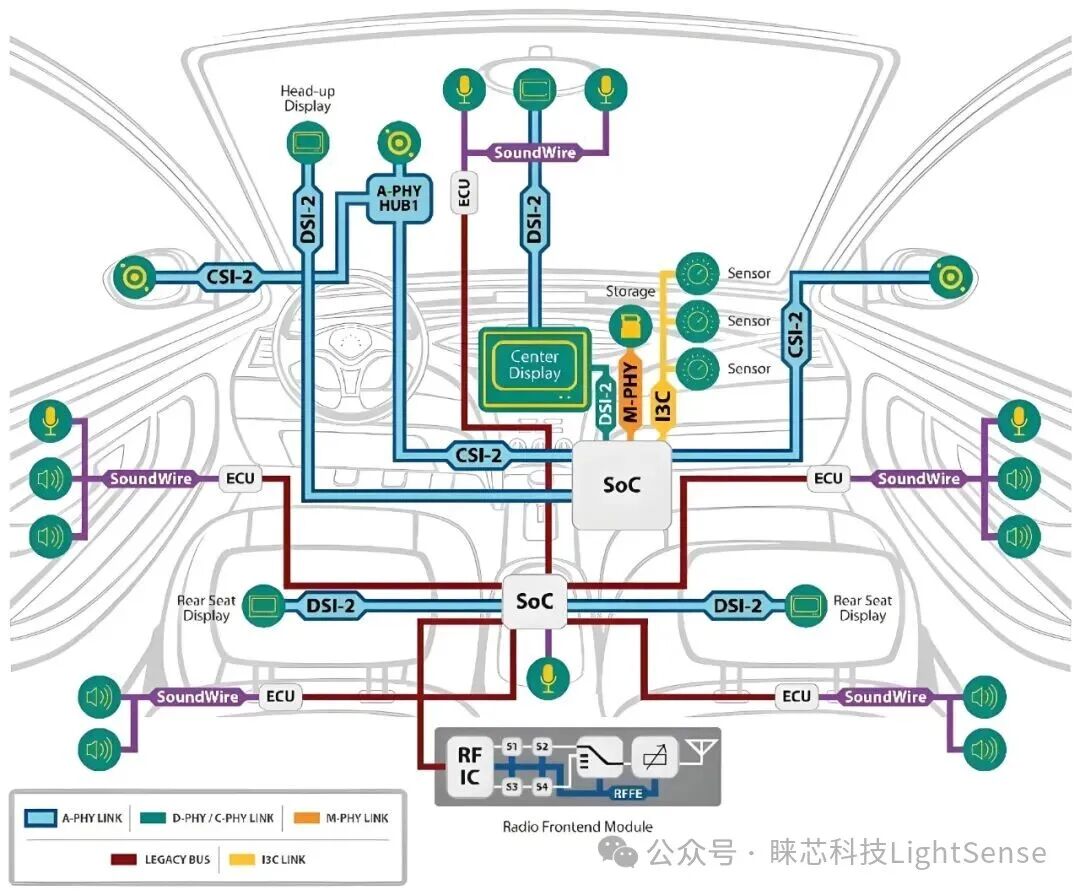
The MIPI protocol family includes various dedicated interfaces:
-
MIPI DSI (Display Serial Interface)
-
Purpose: Connects processors to displays (LCD/OLED), transmitting video data and control commands.
-
Features:
-
Supports high resolutions (4K/8K) and high refresh rates (144Hz).
-
Utilizes differential signaling (D-PHY) or three-wire (C-PHY), with bandwidth up to 2.5Gsym/s/channel (C-PHY v1.2).
-
Reduces wiring count (to 1/3 of traditional parallel interfaces), lowering power consumption.
-
MIPI CSI (Camera Serial Interface)
-
Purpose: Connects camera sensors to processors, transmitting image/video streams.
-
Features:
-
Supports RAW/YUV/RGB data formats, with bandwidth up to 1.5Gbps/channel (D-PHY v1.2).
-
Multi-channel aggregation (e.g., 4 channels) achieves 6Gbps+ transmission rates, meeting 4K@120fps requirements.
-
Built-in error detection mechanism enhances stability.
-
Low-speed control protocols
-
MIPI I3C: Replaces I²C bus, supporting higher bandwidth (12.5MHz) and lower power consumption, compatible with I²C devices.
-
SLIMbus: Used for audio subsystem interconnection (microphones/speakers).
Physical layer technologies: D-PHY vs C-PHY
| Feature | D-PHY | C-PHY |
|---|---|---|
| Signal Type | Differential signal (1 pair of clock + 1~4 pairs of data) | Triple signal (three-wire, no independent clock) |
| Transmission Rate | 1.5Gbps/channel (v1.2) | 2.5Gsym/s/channel (v1.2) → 6Gsym/s (v2.0) |
| Power Consumption | Supports HS (high-speed)/LP (low-power) dual modes | 30% bandwidth increase at the same power consumption |
| Application Scenarios | Mainstream cameras (CSI-2), displays (DSI) | High-resolution screens (8K@120Hz), automotive sensors |
Key Advantages:
-
Low Power: LP mode current is only in the microamp range, suitable for battery-powered devices.
-
Interference Resistance: Differential signaling suppresses common-mode noise, combined with adaptive equalization technology to enhance stability.
-
Flexibility: Decoupling of protocol layer (e.g., CSI-2/DSI) and physical layer accommodates various scenario requirements.
Application Fields
-
Mobile Devices: Mobile phone cameras (Sony IMX989 sensor → CSI-2), AMOLED screens (Samsung E6 material → DSI).
-
Automotive Electronics: In-vehicle cameras (Tesla Autopilot → CSI-2), central control screens (Qualcomm SA8155P → DSI), supporting a wide temperature range of -40°C to 105°C.
-
IoT and Industry:
Drone video transmission (DJI Air 3 → CSI-2), industrial cameras (Basler 3D ToF → CSI-2), AR/VR displays (Meta Quest 3 → DSI).
Signal Integrity
-
Differential pair routing must be of equal length (±5mil), with impedance matching (100Ω±10%), avoiding right-angle bends.
-
Reference layers should have a complete ground plane to reduce signal reflection.
The MIPI interface, with its low power consumption, high bandwidth, and strong anti-interference characteristics, has become the cornerstone of interconnection in mobile and embedded systems. Its modular design of protocol family (DSI/CSI/I3C) and physical layer (D-PHY/C-PHY) accommodates various scenario requirements for display, imaging, and control. With the development of automotive electronics and AIoT, MIPI is breaking into long-distance, ultra-high-speed fields through new standards like A-PHY, providing foundational support for intelligent driving and the metaverse.