On Tuesday, I discussed the importance of sample collection, see “This Might Be the Weakest Link in IVD: How Will Sample Collection Determine the Quality of Diagnostic Products?”. On Wednesday, we provided an example of tuberculosis samples, see “From Sputum to Tongue Coating! How IVD Companies Can Seize New Opportunities in Tuberculosis Testing Through ‘Sample Innovation’?”. Today, I will talk about the issue of home self-testing samples.
In Tuesday’s article, we discussed that home self-testing is a low-frequency operation for disease diagnosis. Even simple sampling operations can easily encounter problems.
For health monitoring, there may be consumers interested in collecting blood or urine daily, but they are certainly very limited. Therefore, it is best to choose a sample that does not require additional actions for collection.
What about sweat?
Compared to invasive methods that require blood draws, sweat is not only easier to obtain but can also continuously reflect the body’s metabolic state and health information through non-invasive means.
In particular, lactic acid, as a key metabolic product, can not only reflect energy metabolism during exercise but may also be an early signal of critical illnesses such as sepsis, organ failure, and tissue hypoxia.
Although sweat samples seem promising, they still face serious sampling issues—not everyone can easily excrete large amounts of sweat.
For the average person, sitting in an office typing, resting at home, or even lying in a hospital bed, the body hardly sweats significantly.
These “low-intensity” or “zero-intensity” daily states are precisely the scenarios where we need continuous, non-invasive, real-time health monitoring the most.
However, traditional sweat sensors rely on high sweat secretion to function. Once the sweat volume is insufficient, they face the awkward situation of having “no sweat to measure.”
A few days ago, I saw a product that might solve this problem.
A cross-disciplinary research team from Penn State University in the United States has developed an innovative wearable sweat sensor based on Granular Hydrogel Scaffold (GHS), which can sensitively capture the extremely small amount of sweat on your skin surface even if you are just lying on the sofa watching TV, replying to emails at the computer, or walking slowly on a treadmill, and detect key biomarkers such as lactic acid, paving a new path for future personalized, non-invasive, continuous health management.
Solving the Sweat Sampling Challenge
Sweat has long been considered an “ideal” biological fluid.
It is naturally secreted by sweat glands, requires no puncture, is easy to obtain, and contains rich biomarkers such as lactic acid, glucose, sodium, potassium, and urea.
These substances can reflect the body’s energy metabolism, hydration status, electrolyte balance, and even the occurrence and development of certain diseases.
In particular, lactic acid, a small molecule often mentioned during intense exercise, has broader significance in medicine.
When body tissues are hypoxic, cells switch to anaerobic metabolism, producing large amounts of lactic acid. Therefore, elevated lactic acid levels may be an early warning signal of serious diseases such as inadequate tissue perfusion, sepsis, shock, and organ failure.
For athletes, the accumulation and clearance rate of lactic acid is also an important indicator of endurance and recovery ability.
For this reason, in recent years, real-time monitoring of lactic acid using sweat has become a major focus in the development of wearable devices.
However, the problem is that most sweat sensors currently rely on “high secretion” sweat to function properly.
These devices typically require the wearer to engage in high-intensity exercise, such as running fast, cycling, or even using drugs or heat stimulation to “force” the body to sweat profusely to collect enough samples for analysis.
In most of our daily lives—such as working at a desk, resting at home, taking care of children, or commuting—the body’s sweat secretion is actually very low.
Research has shown that during rest or low-intensity activities, the human body secretes only 10 to 100 nanoliters of sweat per square centimeter of skin per minute.
In comparison, the volume of a drop of tear is about 40 microliters, which is 40,000 nanoliters, thousands of times this value.
Such a small amount of sweat is difficult to capture with traditional sensors, let alone analyze stably.
Not Wasting a Drop of Sweat
To achieve effective monitoring under low sweat secretion conditions, the research team at Penn State decided to start from the most basic aspect of sweat collection and conduct a complete redesign.
They did not continue to use the common “block hydrogel” found in traditional sensors but adopted a technology previously developed by Professor Sheikhi’s team in the field of tissue engineering—Granular Hydrogel Scaffold (GHS).
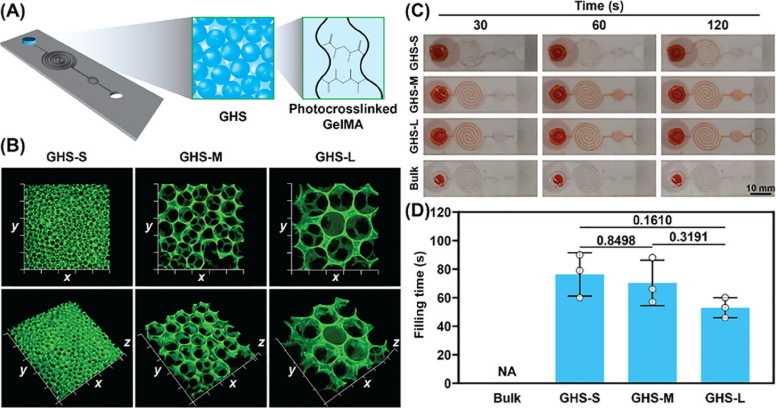
This hydrogel is not a traditional “solid block” gel but a porous structure composed of countless micron-sized “microgel particles” physically stacked and chemically cross-linked, resembling a “soft network” formed by small “particles” loosely yet orderly aggregated together.
Between these tiny particles, there are numerous small gaps and capillary channels.
It is these naturally existing “microchannels” that allow GHS to utilize capillary action to “suck” the tiny amount of sweat from the skin surface through the small sweat gland openings, just like plant roots absorb water from the soil, and firmly “lock” it within the structure to prevent premature evaporation or loss.
We can think of it as a highly porous sponge, but it is smarter than an ordinary sponge. The gaps between these particles create more pathways for liquid to rise, allowing sweat to be efficiently absorbed and transported even at extremely low secretion rates.
Compared to traditional block hydrogels, this granular structure not only significantly enhances sweat absorption capacity but also allows sweat to be effectively captured through a mechanism called “capillary-driven fluid uptake,” rather than dripping or evaporating the moment it contacts the material.
The research team found through experiments that this granular hydrogel can maintain efficient sweat collection capability even at low sweat secretion rates of 10 to 100 nanoliters per square centimeter per minute, and can transport sweat more quickly and completely to subsequent detection modules, thus solving the problem of “not enough sweat, and it’s gone before detection.”
Transporting Trace Sweat
Of course, just “collecting” is not enough; sweat also needs to be quickly and stably transported to the detection area to achieve real-time monitoring.
To this end, the researchers designed a highly sophisticated “microfluidic system”—a tiny fluid channel shaped like a “spiral coil” made using laser engraving technology.
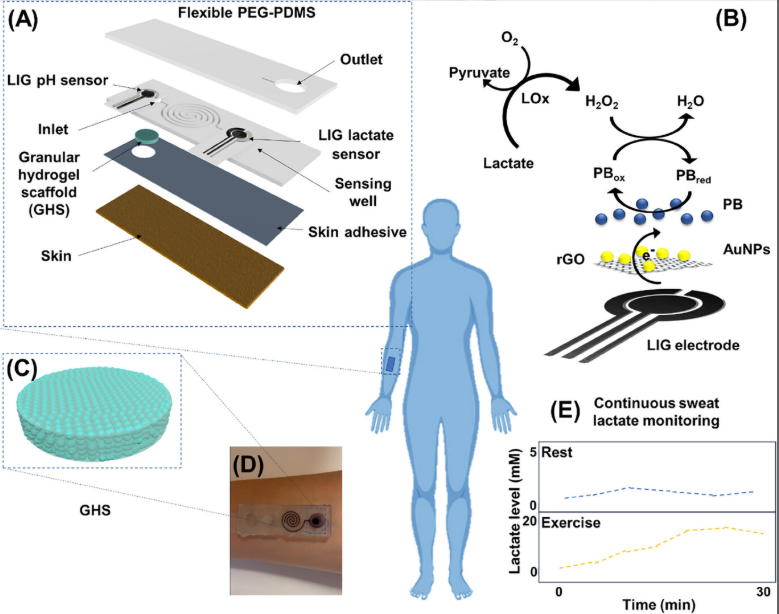
Why make it spiral? Because this structure maximizes the surface area in contact with the fluid, thereby further promoting the efficiency of liquid transport while reducing sweat evaporation loss during transport.
More importantly, this microfluidic channel is not made of ordinary plastic or silicone tubing but is directly made from Laser-Induced Graphene (LIG) material.
LIG is a nanostructured graphene created by “burning” carbon-based materials (such as graphite or polymer films) with a laser, possessing extremely high conductivity, chemical stability, and excellent biocompatibility.
Moreover, it can be precisely “printed” or engraved into various complex microstructures, such as the spiral channel used here and the subsequent sensor “detection wells.”
At the end of this spiral channel, the research team placed a specially modified LIG electrode, which integrates lactate oxidase (LOx) and other biomolecular recognition elements that can convert lactic acid molecules in sweat into signals that can be electrochemically detected, thus achieving precise measurement of lactic acid concentration.
To further enhance detection accuracy, they also added an independent pH sensor to the system—because the acidity (pH) of sweat directly affects the response of the lactic acid sensor. By synchronously measuring and calibrating pH, it can significantly reduce errors and improve the reliability of detection results.
In other words, from the moment sweat is “captured” by the GHS on the skin surface, to being “transported” through the spiral microfluidic channel, and finally being “recognized” and converted into electrical signals at the LIG electrode, the entire process is not only coherent and smooth but also exquisitely clever and efficient.
Reliable Data Even After Sitting for Two Hours
To verify the actual performance of this system, the research team conducted a series of rigorous experiments.
They placed this soft, thin sensor on the skin of volunteers’ forearms and then had the volunteers in the following states: sitting at a desk, low-intensity walking, moderate-intensity cycling, and high-intensity exercise.
The experimental results showed that even in a scenario like sitting at a desk with almost no sweating, the sensor was still able to collect enough micro sweat for analysis within about two hours and accurately detect lactic acid concentration.
During exercise such as cycling, the sweat secretion naturally increases, making collection and detection faster and data more accurate.
Notably, this sensor does not require any external stimulation or specific actions from the wearer; it simply adheres to your skin and “reads” information about your body state from the tiny amount of sweat you naturally secrete.
Home Testing Needs to Be Unobtrusive
This sensor currently mainly monitors lactic acid, but its design concept and technical architecture have strong scalability.
By changing the biomolecular recognition elements on the sensor surface, such as using different enzymes or nanomaterials, this system could potentially be used to detect other key biomarkers in sweat, such as glucose, sodium ions, potassium ions, cortisol, and even certain disease-related metabolites.
This also means it can be used not only in sports health to help athletes optimize training and recovery but also in chronic disease management, such as monitoring blood glucose fluctuations in diabetes patients and assessing cardiac load in cardiovascular disease patients; it could even enter intensive care units to provide continuous, real-time physiological monitoring for critically ill patients who cannot engage in high-intensity exercise.
“Our ultimate goal is to build a low-cost, highly sensitive, comfortable, and continuous monitoring health technology platform that allows everyone to easily obtain real-time feedback on their health status in daily life,” Lorestani wrote in the paper.
Final Thoughts
This article is also the last in this week’s series on sample collection.
Many testing devices are currently pursuing better performance parameters and more powerful functions.
However, I believe that such products can only lead to increasing competition in the industry, as they do not provide diagnostic services to patients who previously did not receive diagnosis. Simply put, the market scale has not expanded.
We cannot always rely on the outbreak of epidemics.
The research from Penn State University returns to the most fundamental question—how to solve the sweat sample problem to achieve accurate, continuous, non-invasive monitoring under various conditions?.
They have provided an answer: a sweat sensor that is as soft as a band-aid, as smart as a chip, and as sensitive as laboratory equipment.
It does not require you to exercise, does not require you to sweat, and does not even require you to make any changes; it can silently guard your health in your most natural and relaxed state.
I believe this may be the future of home monitoring—unobtrusive yet powerful; non-intrusive yet caring; unintentional yet precise.

Welcome to follow 【Diagnostic Science】 to observe changes in the diagnostic market from a compliance perspective.