Dear friends, have you ever found company networking particularly troublesome? For instance, when the headquarters and branches need to connect, or when employees on business trips want secure access to company systems, and also need smooth connections to various cloud applications… Upon researching, the terms MPLS, VPN, and SD-WAN pop up. What do they mean? Today, let’s explain them in the simplest terms!
1. MPLS: A “Dedicated Highway” Built by the Carrier
MPLS stands for “Multiprotocol Label Switching”. It sounds complex, but it can be understood as: the carrier builds a “private network highway” specifically for your enterprise.
It’s like your company is particularly wealthy and tells the carrier, “Build me a road that only our company can use”—this way, data transmission is very stable and reliable, making it a safe choice for core systems in the company (like financial systems or important video conferences).
However, the drawbacks are also obvious: it’s expensive! And not flexible enough. If you open a new branch and want to connect it to this “dedicated highway”, the adjustments are slow and costly, making it unsuitable for frequently changing businesses.
2. VPN: An “Encrypted Tunnel” on a Public Network
VPN stands for “Virtual Private Network”, and its concept is quite simple: it creates an “encrypted tunnel” on the public internet (like a regular road that everyone can use).
Data is transmitted through this tunnel, making it invisible and secure from theft. Moreover, it is much cheaper than MPLS, which is why many small and medium-sized enterprises with limited budgets choose VPN for secure networking.
However, it has a small flaw: it depends on the public internet’s performance. If your office’s broadband is slow, the VPN data transmission will also be slow. Therefore, it is suitable for situations where “cost sensitivity and security are priorities, but absolute network stability is not a high requirement”.
3. SD-WAN: The Networking Expert with “Intelligent Scheduling”
SD-WAN stands for “Software-Defined Wide Area Network”. Although the name sounds mysterious, the core idea is: it can intelligently manage “internet + private connections” and combine various lines (like MPLS, regular broadband, 4G/5G) for use.
For example, SD-WAN is like an “intelligent traffic commander”: it chooses the fastest and most stable line; if a line suddenly slows down, it can automatically switch to another good line.
Additionally, it has these advantages:
- Cost-effective and flexible—there’s no need to lay down expensive MPLS lines, and it can utilize existing network resources.
- Cloud-friendly—nowadays, companies love using cloud services (like DingTalk, WeChat Work, various cloud servers), and SD-WAN can connect smoothly to the cloud, unlike older technologies that are cumbersome.
Visualizing the Differences
The following image can help you quickly understand the differences among the three:
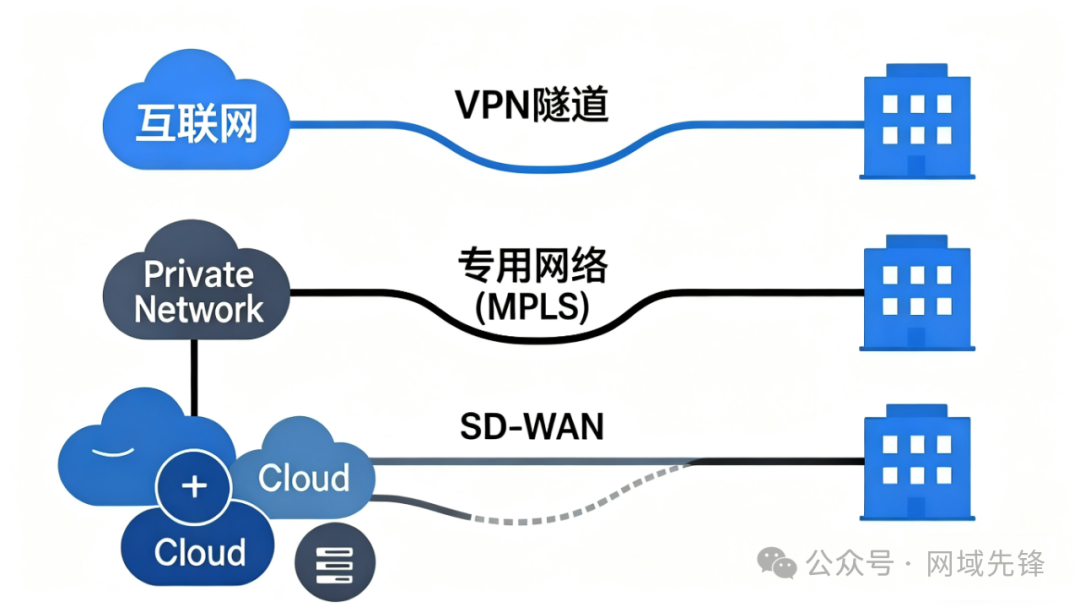
- VPN creates an “encrypted tunnel” from the “public internet” to connect to the company.
- MPLS builds a “private network” to connect directly to the company.
- SD-WAN is more flexible, intelligently connecting “private networks”, “the internet”, and even “the cloud” as needed.
Final Summary: How to Choose?
- Choose MPLS if the company has a sufficient budget and the business is particularly core (like finance or healthcare, where any mistake is unacceptable).
- Choose VPN if the budget is limited and you mainly need a secure “encrypted channel” without extreme requirements for network stability.
- Choose SD-WAN if you want high cost-effectiveness, flexibility, and easy integration with various cloud applications. Many companies are now choosing SD-WAN as it has become the “mainstream choice”.
Now, are these three networking technologies much clearer? Next time you encounter them, you won’t be confused!