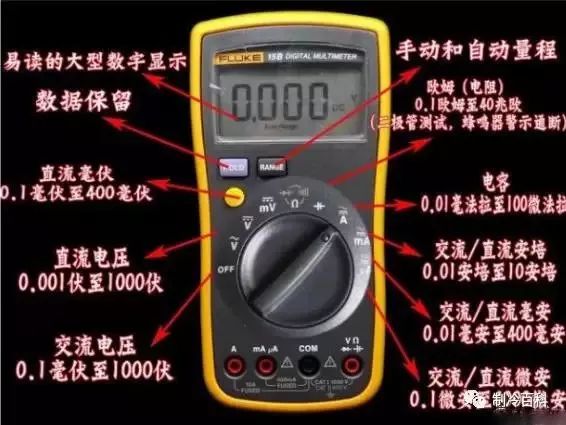
In the battery industry, it is essential to learn how to correctly use a multimeter. Besides measuring voltage and current, it can quickly identify where a fault has occurred and prevent damage to both the electrical devices and the multimeter itself. Below are some essential tips for using a multimeter.
Check the range before measuring, don’t measure without checkingDo not change the range while measuring, switch to the off position after measuringThe dial should be level, and the reading must be alignedThe range must be appropriate, and the reading must be alignedDo not measure resistance when powered, discharge capacitors before measuringZero the meter before measuring resistance, and adjust to zero when changing rangesRemember that black is negative, and connect black to + inside the meter
To measure current, connect in series; to measure voltage, connect in parallelEnsure polarity is correct; develop the habit of using one hand
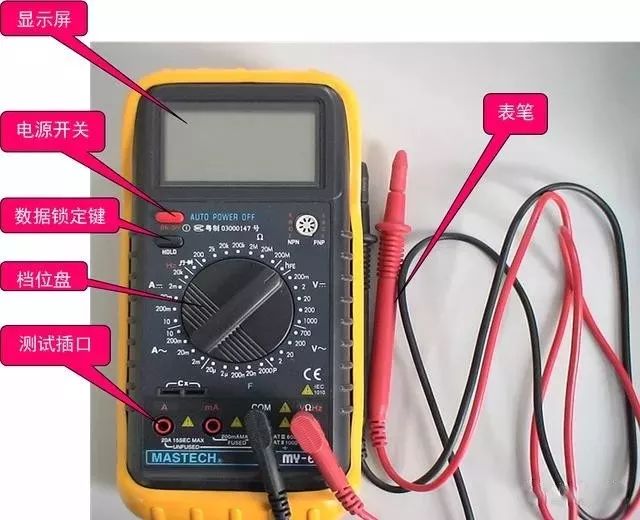
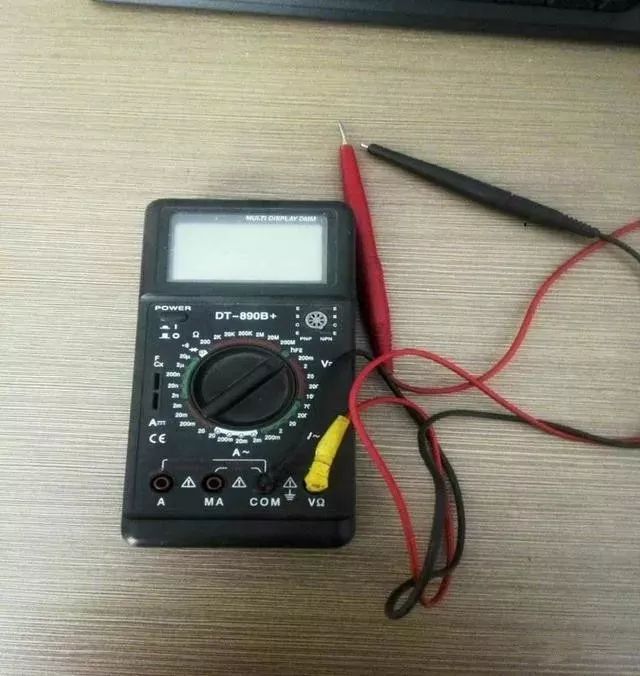
Multimeters can generally be divided into two types: analog multimeters and digital multimeters.
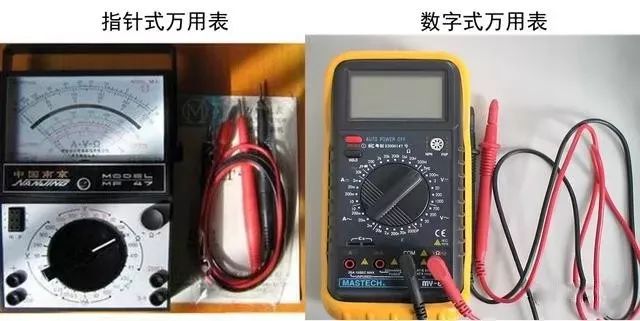
Analog Multimeter:
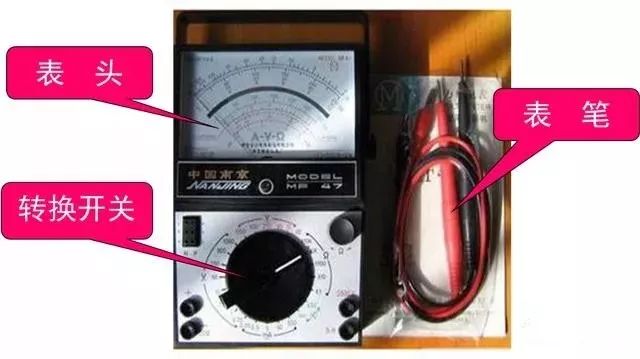
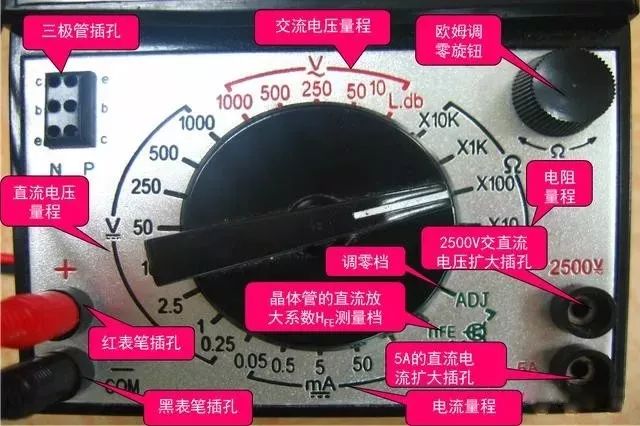
The structure of an analog multimeter varies widely, but the basic structure is similar. An analog multimeter mainly consists of three parts: the meter head, the switch (also called the selection switch), and the measurement circuit.
The meter head: This is the display device for measurements; the meter head is essentially a sensitive ammeter.
The switch: This selects the type and range (or multiplier) of the measured quantity.
The measurement circuit: This converts the different nature and magnitude of the measured quantities into a direct current that the meter head can accept.
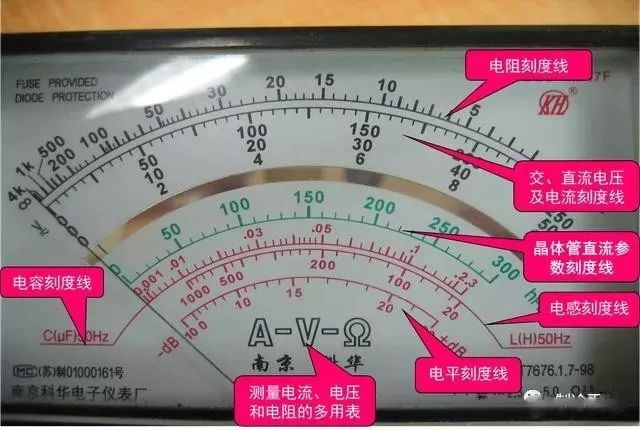
Meter Head:
Switch:
Digital Multimeter:
Dial:
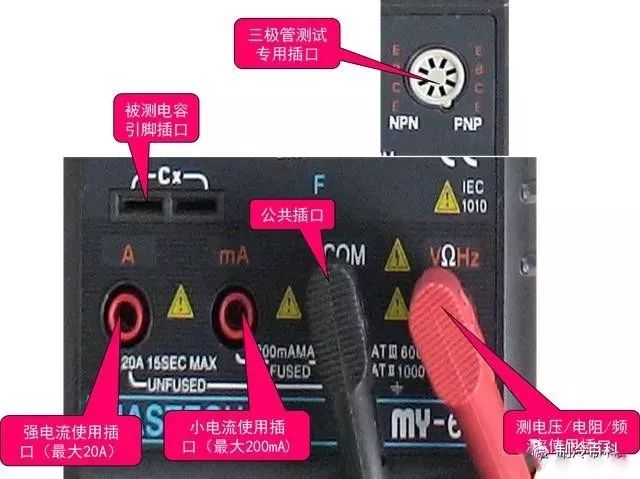
Ports:
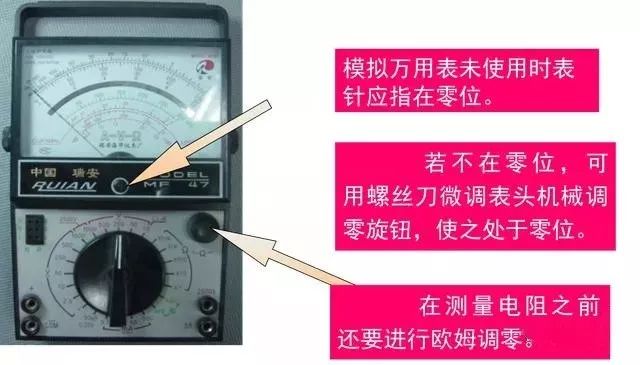
Using the Multimeter—Zero Adjustment
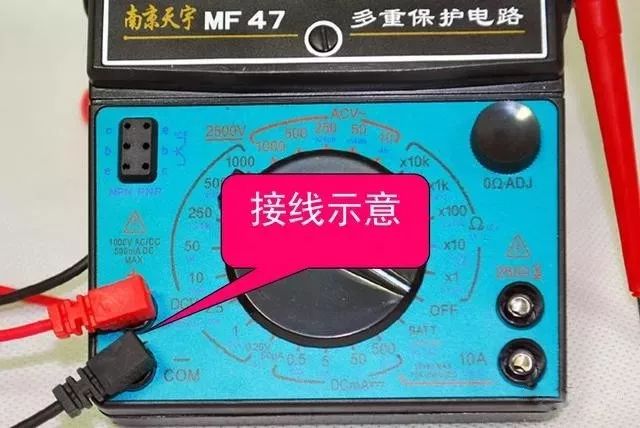
Correct Wiring:
The red probe connects to the “+” polarity socket, and the black probe connects to the “-” or “*” or “COM” polarity socket.
When measuring DC values, pay attention to the positive and negative polarities to avoid reversing the needle.
When measuring current, the meter should be connected in series with the circuit being measured; when measuring voltage, the meter should be connected in parallel across the circuit.
When measuring transistors, remember that the red probe connects to the negative terminal of the internal battery, and the black probe connects to the positive terminal of the internal battery.
Correctly Select Measurement Range:
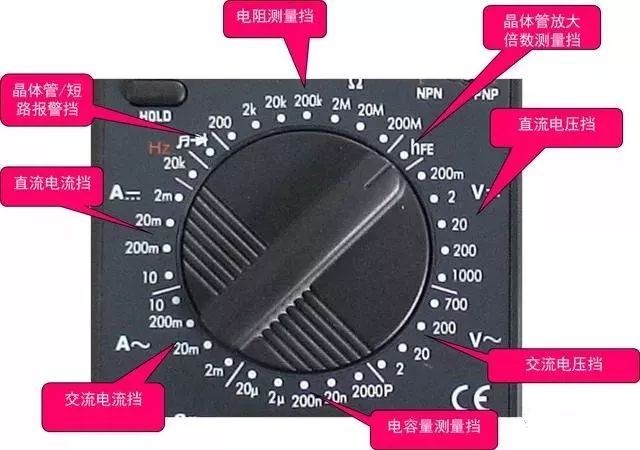
When measuring voltage, the switch should be set to the corresponding voltage range; when measuring current, it should be set to the corresponding current range, etc.
When selecting current or voltage ranges, it is best to have the needle positioned above two-thirds of the scale; when selecting resistance ranges, it is best to have the needle positioned in the middle of the scale.
When measuring, if the range of the measured value is uncertain, first turn the switch to the corresponding maximum range, then gradually reduce it to the appropriate range based on the degree of needle deflection.
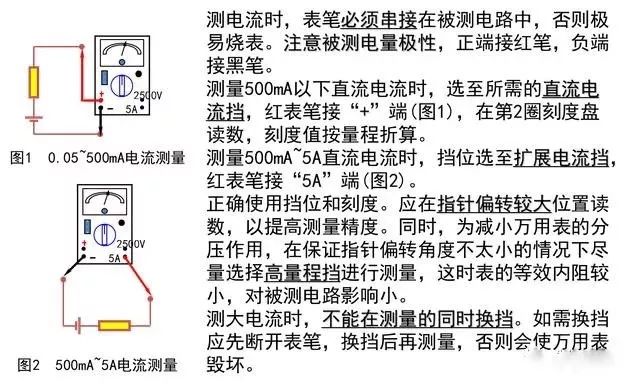
Measuring Current:
Measuring Resistance:
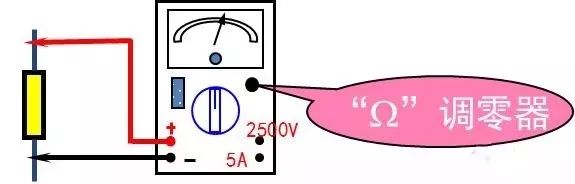
Select the range and zero adjustment: When measuring resistance, first select the appropriate resistance range, then short-circuit the probes and adjust the “Ω” zero adjuster to make the needle return to 0 (re-zero each time you change the range).
Measuring and reading: Connect the probes across the resistance and read the value. The resistance value is the reading on the resistance scale multiplied by the current selected resistance range multiplier.
Range: Choose a range that keeps the needle between one-third and two-thirds of the full scale to minimize measurement error.
Probe polarity: The battery in the multimeter is active when measuring resistance, with the battery “+” connected to the “-” on the panel. When using the multimeter’s resistance range to determine the forward and reverse characteristics of diodes or the positive and negative terminals of instruments, pay attention to the probe polarity, as current flows from the black probe and returns through the red probe via the external component.
Measuring resistance in a circuit: The power must be off during measurement. If uncertain whether the measured resistance has parallel resistance, one must first disconnect one end of the resistance from the circuit. If there are capacitors in the circuit, they should be discharged before measurement.
Checking the leakage resistance of electrolytic capacitors: Set the switch to the R×1K range, the red probe must connect to the negative terminal of the capacitor, and the black probe connects to the positive terminal of the capacitor.
Measuring the DC current gain hFE of transistors
Select the ADJ range, short the probes, and adjust the ohm zero adjuster so that the needle points to 300hFE.
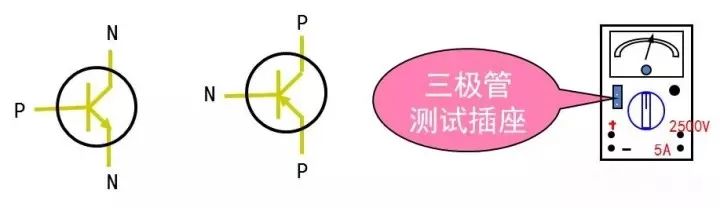
Select the hFE range, insert the legs of the measured transistor into the corresponding transistor testing sockets E, B, C, and the needle deflection indicates the DC current gain of the transistor.
Insert N-type transistors into NPN sockets and P-type transistors into PNP sockets.
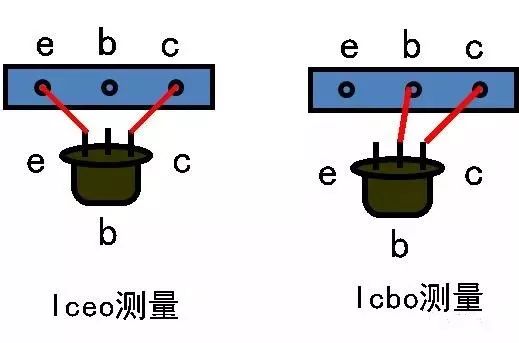
Measuring the reverse cutoff current Iceo and Icbo of transistors:
Iceo: The reverse cutoff current between the collector and emitter (base open).
Icbo: The reverse cutoff current between the collector and base (emitter open).
Set the switch to R×1K range, short the probes, and adjust the zero ohm potentiometer to make the needle return to zero (at this time, the full-scale current value is about 90μA).
Separate the probes, insert the measured transistor into the socket as shown, and the scale indicated by the needle multiplied by 12 is approximately the value of the transistor’s reverse cutoff current.
If Iceo>90μA, you can measure using the R×100 range (at this time, the full-scale current value is about 900μA).
Determining the polarity of diode pins:
A diode is a semiconductor device that exhibits significant unidirectional conductivity or nonlinear voltage-current characteristics. Typically, the forward resistance value of small power germanium diodes is 300~500Ω, while the reverse resistance is tens of kilo-ohms; silicon diodes have a forward resistance of about 1kΩ or higher, and a reverse resistance above 500kΩ. The greater the difference in forward and reverse resistance, the better.
Range selection: Generally select the R×1K range or R×100 range for measurement, and avoid using the R×1 range or R×10K range. Using the R×1 range may cause excessive current, potentially burning out the diode, while using the R×10K range may apply too high a voltage, risking breakdown of the diode.
Polarity judgment: Connect the two probes to the two terminals of the diode and compare the resistance values measured twice. The terminal connected to the black probe is the positive terminal of the diode, as in the multimeter’s resistance measurement circuit, the red probe is connected to the negative terminal of the internal battery, while the black probe is connected to the positive terminal of the internal battery.

Measuring capacitance and inductance:
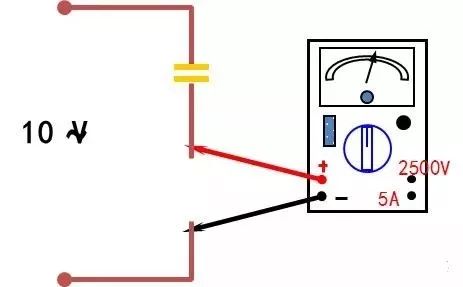
Capacitance measurement: See the figure for measurement method, select the C.L.dB (10V AC) range, and read the capacitance measurement value on the C(μF) 50Hz scale.
Inductance measurement: See the figure for measurement method (replace capacitance with inductance), select the C.L.dB (10V AC) range, and read the inductance measurement value on the L(H) 50Hz scale.
Precautions for Using a Multimeter:
Before using a multimeter, it is essential to understand its operation method, measurement principles, types of measurements, and ranges, and verify that the switch and sockets are correct.
The multimeter must be placed horizontally during use, and before use, the mechanical zero adjustment should be made.
After measurement, set the range selection switch to the highest position to prevent damage to the meter during the next measurement.
For multimeters that are not used for a long time, the battery should be removed to avoid deterioration and leakage that can damage the circuit board.
When measuring voltage in circuits with inductive reactance, the multimeter must be disconnected before cutting off the power to prevent high voltage damage to the voltmeter due to self-induction phenomena.
Source:Li Neng Electric Power Technology Platform
A group chat for the battery industry has been established. Scan the QR code below or enter WeChat ID zjdcqbj01, add Qun Jie on WeChat, and she will add you to the group.