Follow👆Public Account,Reply with「 python」 to get a zero-based tutorial!
Python has been praised as the easiest programming language to learn since its inception. With the rise of the hot AI era, it has gradually replaced Java to become the leading programming language in the industry.
Among programming languages, Python has long been in the top five. It has become an essential tool in data analysis and artificial intelligence, and is increasingly used by companies for website development.The salaries for positions in the Python field are rising, making it one of themost promising programming languages today.
【Tutorial retrieval method at the end of the article!!】
Python is a beginner-friendly, powerful, efficient, and flexible programming language. Once learned, whether you want to enter data analysis, artificial intelligence, or web development, or simply wish to master your first programming language, Python can open up infinite possibilities for your future!
If you could only choose one programming language to learn, it should be Python, apart from Python.
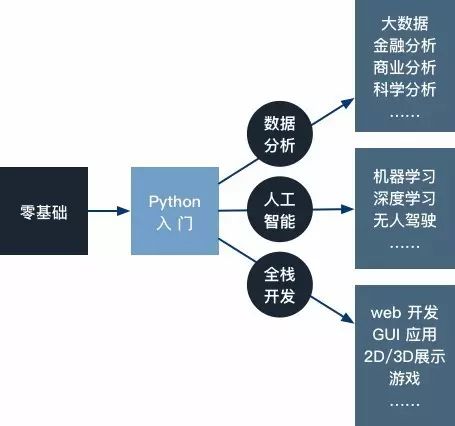
Who is suitable for learning Python?
1– Wants to start their programming journey with Python.
2– Wants to develop in the field of data analysis (big data/financial analysis/business analysis/scientific analysis, etc.).
3 – Wants to develop in artificial intelligence and deep learning.
4– Already has a programming background and wants to use Python to enhance development skills, create GUI applications, and build 2D/3D displays and games.
5– Wants to use Python to solve practical problems encountered in work and life or to do some fun projects.
So the question arises, how long does it take to learn Python? Today, I will tell you:It only takes 8 weeks to master the basic skills of Python from scratch!This will help you quickly get started with Python in 8 weeks and lay a solid foundation for further learning.
Below are the steps for self-learning Python and a rough estimate of the time required:
1. Learning Plan
(1) Beginner Stage (Estimated 2 – 3 weeks)
-
Familiarize yourself with basic syntax
-
Learn about variables, data types (integers, floats, strings, booleans, etc.). For example, define an integer variable in Python:
<span>a = 10</span>, and a string variable:<span>s = "Hello"</span>. Understanding these basic data types is the foundation for subsequent programming. -
Master basic operators (arithmetic operators, comparison operators, logical operators). For example, the addition operator:
<span>+</span>, subtraction:<span>-</span>, the comparison operator for equality:<span>==</span>, greater than:<span>></span>, etc., and logical operators:<span>and</span>,<span>or</span>, and<span>not</span>. -
Learn control flow statements, including
<span>if - else</span>statements and loop statements (<span>for</span>loops and<span>while</span>loops). For example, using<span>if - else</span>statements to determine if a number is positive or negative:
num = 5if num > 0: print("Positive")else: print("Not positive")-
Basic concept of functions, including how to define and call functions. For example, defining a simple addition function:
def add(a, b): return a + bresult = add(3, 5)print(result)-
This stage can be completed by reading the first few chapters of “Python Programming from Beginner to Practice” or taking some free introductory courses online, such as Python basic courses on Coursera or edX. Also, practice writing simple code, such as calculating the area of a circle or determining if a year is a leap year.
(2) Intermediate Stage (Estimated 3 – 4 months)
-
Basic data structures and algorithms
-
Deepen your understanding of Python’s data structures, such as lists, tuples, dictionaries, and sets. For example, a list can store multiple elements and can be manipulated with add, delete, modify, and query operations.
my_list = [1, 2, 3, 4]my_list.append(5) # Add elementprint(my_list)-
Learn basic algorithms, such as sorting algorithms (bubble sort, quick sort) and search algorithms (linear search, binary search) implemented in Python. For example, bubble sort:
def bubble_sort(lst): n = len(lst) for i in range(n): for j in range(0, n - i - 1): if lst[j] > lst[j + 1]: lst[j], lst[j + 1] = lst[j + 1], lst[j] return lst-
Object-oriented programming (OOP) is the focus of this stage. Understand the concepts of classes, objects, attributes, and methods. For example, defining a simple “Car” class:
class Car: def __init__(self, brand, color): self.brand = brand self.color = color def drive(self): print(f"{self.color} {self.brand} is driving.")my_car = Car("Toyota", "Blue")my_car.drive()-
You can read books like “Python Data Structures and Algorithm Analysis” and “Python Object-Oriented Programming Guide,” and also find some relevant programming exercises online, such as easy and medium difficulty Python problems on LeetCode to consolidate your knowledge.
(3) Application Stage (Depending on the specific application direction, it may take 3 – 6 months or even longer)
-
Web Development Direction
-
Learn web frameworks like Django or Flask. Django is a powerful full-stack framework suitable for developing large and complex web applications. For example, with Django, you need to learn the concepts of models, views, and templates.
-
Learn database operations, such as SQLite and MySQL, and how to interact with Python. In Django, you can define models through its built-in database operation module to implement data storage and retrieval.
-
For this direction, you can refer to books like “Django for Beginners” and try to develop a simple blog website or a small e-commerce site.
Data Analysis and Data Science Direction
-
Learn data analysis libraries like Pandas, NumPy, and Matplotlib. Pandas is used for data processing and analysis, NumPy provides efficient numerical computing capabilities, and Matplotlib is used for data visualization. For example, using Pandas to read and process CSV files:
import pandas as pd
data = pd.read_csv("data.csv")print(data.head())-
Learn the basic concepts and common algorithms of machine learning, such as linear regression and decision trees, and master how to implement these algorithms using Python’s machine learning library, such as Scikit-learn.
-
Recommended books include “Python Data Analysis in Practice” and “Data Analysis Using Python,” and you can participate in data competitions on Kaggle to enhance your practical skills.
-
Automation Scripts and Tool Development Direction
-
Learn how to use Python to interact with the operating system, such as file operations, process management, etc. For example, using Python’s
<span>os</span>module to traverse files in a folder:
import osfor root, dirs, files in os.walk("."): for file in files: print(os.path.join(root, file))-
Master some commonly used third-party libraries for specific tasks, such as
<span>paramiko</span>for SSH connections, and<span>requests</span>for network requests. -
You can gain experience through actual work tasks or personal interest projects, such as writing a script to automatically back up files or a web scraper to retrieve web data.
2. Factors Affecting Learning Time
-
Programming Background: If you have previous experience with other programming languages, especially those with similar syntax structures and programming concepts (like Java, C++), your learning speed for Python may be faster. This is because many basic programming logics (such as control flow, functions, etc.) are similar, and you mainly need to familiarize yourself with Python’s syntax features and some unique functionalities.
-
Time Investment in Learning: If you can dedicate a lot of time each day, such as 4 – 6 hours daily, it will be much faster than only studying 1 – 2 hours a day. Moreover, continuous learning helps maintain the coherence of knowledge and aids in the deeper understanding of complex concepts.
-
Learning Goals: If you just want a simple understanding of Python for basic automation tasks (like file organization, batch renaming, etc.), you may only need to study the beginner and some intermediate content, which could take about 2 – 3 months. However, if you aim to become a professional web developer or data scientist, you will need to delve into the application stage content and continuously practice and accumulate experience, which may take 1 – 2 years or even longer.
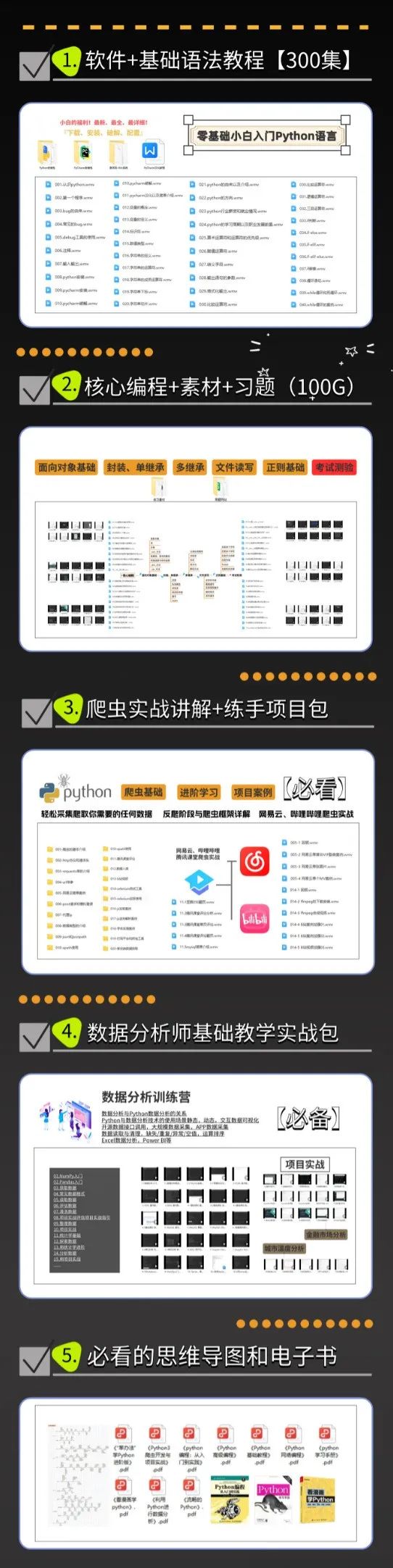
Finally, I have organized some exclusive benefits packages for Python fans, with access at the end of the article
-
How to obtain materials:
1. Like + See Again
2. Scan any QR code below and reply“Python” to get it
-
PS: You only need to scan one QR code to obtain
If you encounter frequent additions, follow the public account and click “Frequent Click Me”