
In the current rapid penetration of Internet of Things (IoT) wireless communication technology, the ability to perceive and respond to physical distances between people and objects, as well as between objects, has become key to enhancing the intelligence of devices and improving user interaction experiences.
When a smart refrigerator detects a user approaching and actively lights up to display its internal fruits and vegetables, when an access control system recognizes an authorized person approaching and automatically opens the door, or when an office detects that all staff have left and automatically turns off the lights, a series of new possibilities emerge.

The channel sounding feature supported by the BLE 6.0 specification is one of the excellent options for developers to realize these new possibilities. It not only injects true distance perception capabilities into IoT devices but also reshapes the logic of distance perception between people and objects, and between objects, with advantages such as security, reliability, low power consumption, strong anti-interference capability, and centimeter-level perception accuracy, making it a key to unlocking the intelligence of everything.
01
How Does HM-BT2401DA Achieve Accurate Distance Measurement?
The Bluetooth Special Interest Group (SIG) states that the Bluetooth channel sounding feature mainly uses two validated ranging methods: Phase-Based Ranging (PBR) and Round-Trip Time (RTT), to achieve secure and precise distance measurement between Bluetooth-connected devices, which can be widely applied in indoor positioning, distance detection, and proximity sensing scenarios.
For example, the HM-BT2401DA is a channel sounding module independently developed by Hoperf based on a high-performance BLE 6.0 chip. It supports two ranging roles: Initiator (the device that wants to calculate its distance to the target device) and Reflector (the device that responds to the Initiator). It supports dual antenna paths and can quickly establish wireless connections and distance measurements between the Initiator and Reflector using AT commands, with low resource occupation on the external MCU and a simple development process.
HM-BT2401DA
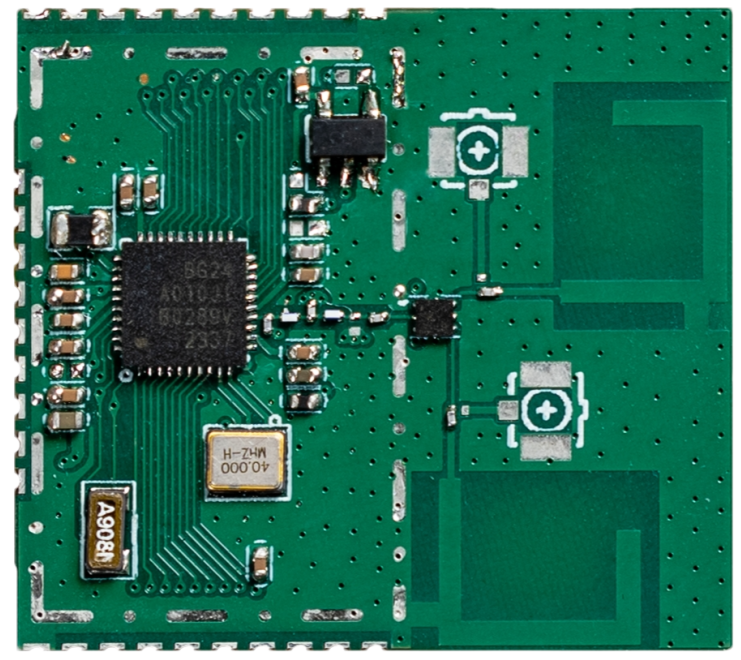
Distance Measurement Schematic
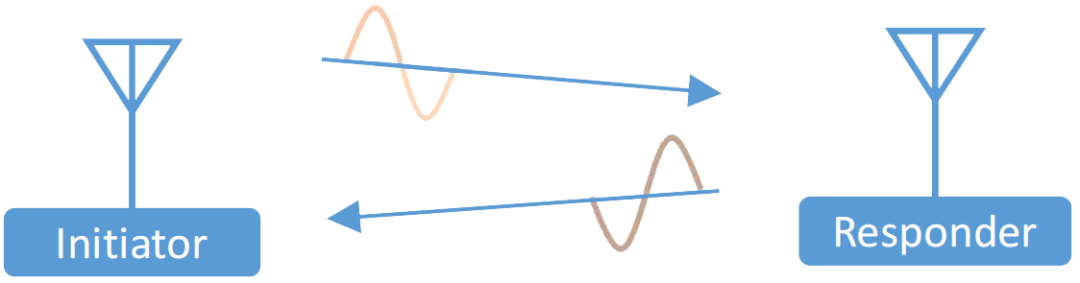
PBR
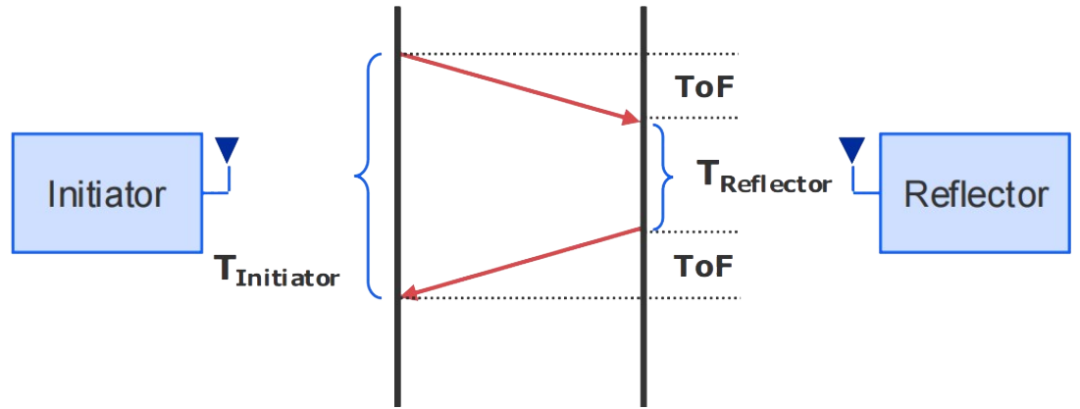
RTT
Functional Features
-
Operating Voltage: 1.71-3.8V
-
Modulation Mode: GFSK Gaussian Frequency Shift Keying
-
Maximum Transmission Power: +10dBm
-
Transmission Current: 5.0mA@0dBm, 19.1mA@10dBm
-
Receiving Sensitivity: -97.6dBm @1Mbps
-
Operating Temperature: -40°C~+85°C
-
Modulation Frequency: 2400MHz-2483.5MHz
-
Receiving Current: 4.4mA@1Mbps
-
Low Power Mode Current: 33.4uA/MHz in Active Mode (EMO) @39.0MHz
-
Deep Sleep Mode Current: 1.3uA @EM2 Deep Sleep
Typical Applications
-
Smart Access Control, Smart Keys
-
Smart Home
-
Asset Tracking
-
Positioning Systems
-
Indoor Navigation
-
Proximity Services, Geofencing
-
Building Security Systems
As shown in the figure above, the HM-BT2401DA supports RTT (Round-Trip Time) and PBR (Phase-Based Ranging) modes. During the channel sounding process, the Initiator sends carrier signals or data packets on the specified 72 2.4 GHz physical channels, while the Reflector responds by sending the carrier signals or data packets back to the Initiator;
After the Initiator obtains the round-trip time of the data packets and the phase difference data between different frequency carrier signals, it can run specific distance measurement algorithms to determine the accurate distance between the two and report the calculation results to the MCU via serial port.
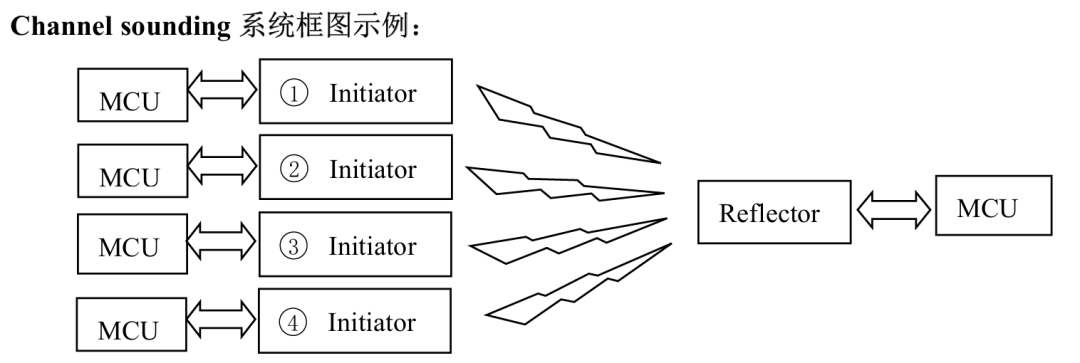
In this process, the initiator device is responsible for actively initiating distance measurement requests, collecting data, and calculating distances, interacting point-to-point with only one Reflector device during a single distance measurement process; the Reflector device passively responds to the initiator’s signals and returns the original data, interacting point-to-point with only one Initiator during a single distance measurement process.
It is worth mentioning that, thanks to its high-performance 2.4 GHz RF, low current consumption, AI/ML hardware accelerator, and secure vault features, the HM-BT2401DA can also be applied in low-power Bluetooth and mesh wireless communication solutions. IoT device manufacturers can create smart, powerful, and energy-efficient products by integrating this module, protecting against remote and local network attacks.
02
HM-BT2401DA Unlocks Infinite Possibilities for Distance Perception
To fully validate the channel sounding capability of the HM-BT2401DA, Hoperf’s laboratory conducted multiple tests. In PBR (Phase-Based Ranging) mode, within a range of 10 meters, the HM-BT2401DA has achieved positioning accuracy of about 50 cm, which can be widely applied in warehouse management, item tracking, and pet tracking in indoor environments.
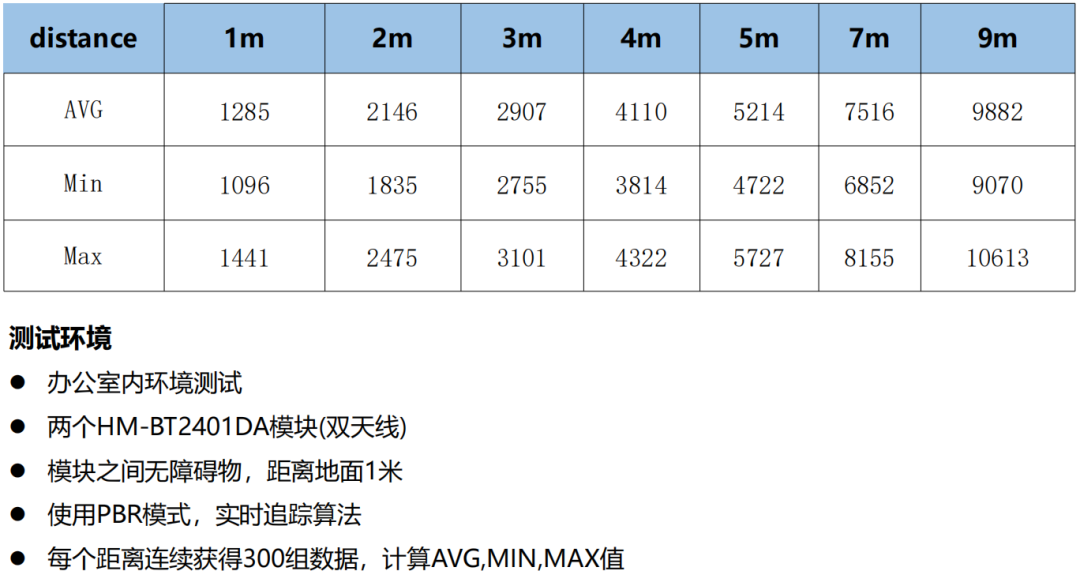
HM-BT2401DA Channel Sounding Function Test Data (PBR Mode)
It is expected that with this “centimeter-level” distance perception capability, the HM-BT2401DA will bring numerous innovative applications in interaction for industries such as automotive, home, and retail, such as keyless entry for cars and homes, and geofencing-based security policies that open doors for authorized users when they approach; if a user lingers too long in a sensitive area, an alarm will be triggered.
Bluetooth mice, keyboards, and game controllers can automatically switch between active and inactive states based on their distance from smartphones, tablets, or laptops.

Looking ahead, as the BLE channel sounding function continues to optimize towards “low power, high precision, and high reliability,” its distance perception capability will further blur the interaction boundaries between “people and devices” and accurately match people’s needs for “near-field interaction, long-term deployment, and multi-device collaboration,” empowering IoT devices to transition from “manual operation required” to “response upon approach,” making production more efficient and life more convenient.
1
END
1

About Hoperf
Shenzhen Hoperf Electronics Co., Ltd. (hereinafter referred to as Hoperf) was established in 2004 and is a national high-tech enterprise focused on independent innovation and product development of core IoT components.
Over the past 20 years, Hoperf has expanded its development from Sub-GHz wireless communication RF chips and module products to high-precision MEMS sensors and digital isolators, forming a product layout that integrates key links of information perception and information interaction.After years of accumulation, Hoperf has developed into a system-level service provider for IoT wireless communication, integrating RF chip design, firmware and protocol design, application development, and testing.
As one of the well-established IoT wireless RF chip brands in China, the company has accumulated a large number of high-quality customer resources and brand recognition both domestically and internationally, thanks to its solid R&D capabilities, reliable product quality, cost-effective advantages, and system-level service capabilities.
If you have any needs, please contact us immediately!
Phone: 400-1189-180
Email: [email protected]
Website: https://hoperf.cn/
For more information, please follow 【Shenzhen Hoperf】
↓↓↓↓
Please like

Please share

Please like