The STC8H microcontroller’s PWM functionality is considered professional-grade, which is not available in other STC8 series.
This functionality is designed by referencing and drawing inspiration from the design concepts and features of high-end timers in the STM32 series, making it very advanced. Its comprehensive capabilities surpass those of the same-level STM8 series microcontrollers.
The following compares the STC8H series and the STM8 series in terms of PWM functionality differences.
◆STC8H:The PWM functionality is extremely powerful and flexible, making it one of its core selling points. It is equipped with a dedicated high-end PWM timer that supports more channels and higher precision PWM, especially optimized for motor control (such as three-phase motors) and digital power (such as LLC, PFC) applications.
◆STM8:The PWM functionality is standard and stable, based on general-purpose timers (TIM1, TIM2, TIM3, TIM5) and is similar to the general-purpose timers of most mainstream microcontrollers (such as STM32), sufficient for common applications like DC motors, servos, and lighting dimming, but lacks the flexibility and advanced features of STC8H.
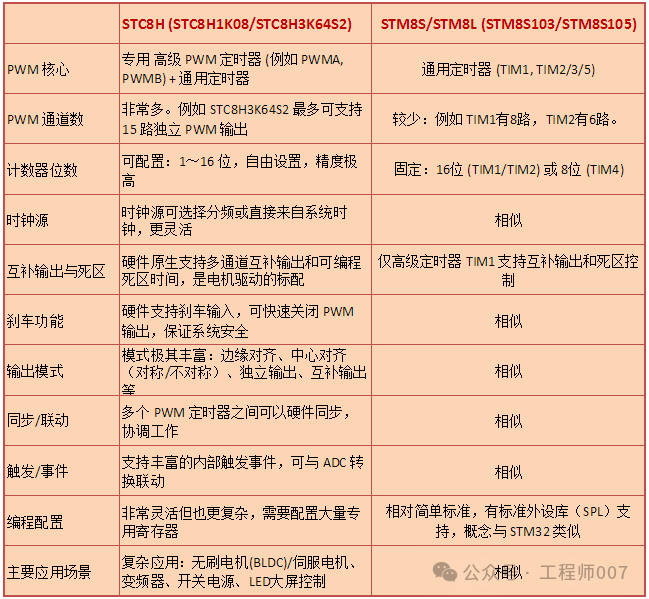
The key differences are as follows:
Configurable counter bit width (unique to STC8H): This is a significant advantage of STC8H. For example, if you need an accurate 10-bit PWM, the STM8 can only use a 16-bit timer, with the auto-reload value (ARR) set to 210 = 1024, requiring careful handling of count comparisons. In contrast, STC8H can directly set the PWM counter to 10 bit mode, making it inherently 10 bits at the hardware level, with clearer logic and better precision control.
Flexibility: The PWM of STC8H can flexibly configure almost all parameters, like a programmable logic circuit. In contrast, the PWM of STM8 only allows partial parameter flexibility.
#STM8H #PWM #Highlights