Title: Engineering crop flower morphology facilitates robotization of cross-pollination and speed breeding
Original link: https://doi.org/10.1016/j.cell.2025.07.028

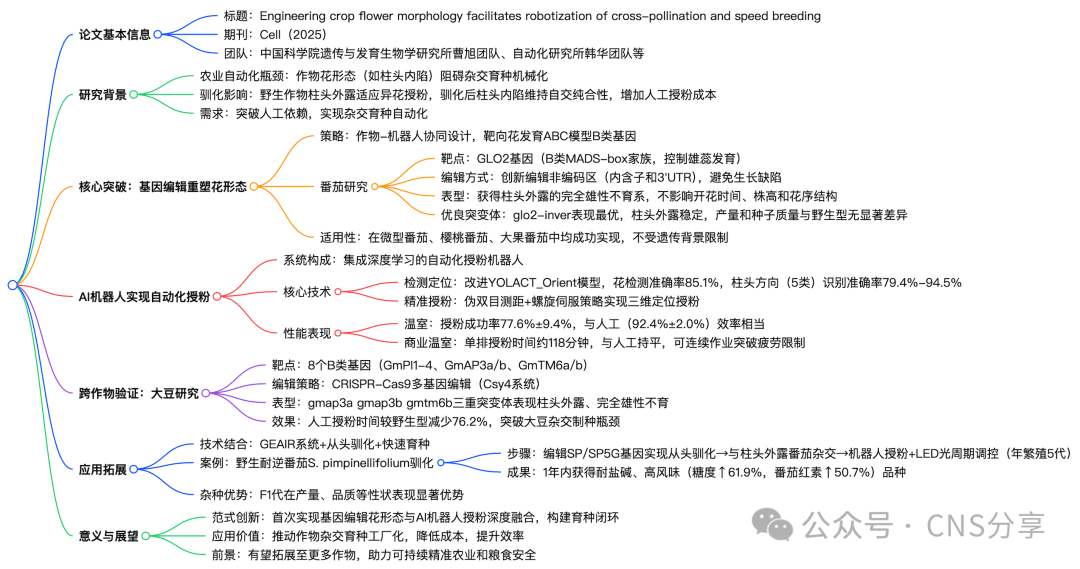
Recently, the team led by Cao Xu from the Institute of Genetics and Developmental Biology, Chinese Academy of Sciences, in collaboration with the team led by Han Hua from the Institute of Automation, published a research paper titled “Engineering crop flower morphology facilitates robotization of cross-pollination and speed breeding” in Cell. This study modified crop flower morphology through genome editing and combined it with an AI-driven robotic system to construct a breeding platform for genome editing and AI robotics collaboration (GEAIR), breaking through the bottleneck of low efficiency in manual pollination during hybrid breeding, providing a new solution for precise crop breeding and sustainable agricultural development.
Background: Flower Morphology Bottleneck Restricts Agricultural Automation
As the application of artificial intelligence and robotic technology expands in precision agriculture, the adaptability of crop traits to automated operations has become a key challenge. In hybrid breeding, the inwardly folded stigma morphology of crops such as tomatoes and soybeans severely hinders mechanized operations for emasculation and pollination, leading to a reliance on high-cost manual labor, which restricts breeding efficiency. Wild crops originally had exposed stigmas adapted for cross-pollination, but during domestication, they gradually evolved to have inwardly folded stigmas to maintain self-fertilization, which has become a major obstacle to modern breeding automation.
Core Breakthrough: Genome Editing Creates Robot-Friendly Flower Morphology
The research team proposed a “crop-robot collaborative design” strategy, targeting B-class genes in the ABC model of flower development through genome editing to reshape flower morphology for robotic operation. In tomatoes, the team innovatively edited the non-coding region (introns and 3′ UTR) of the GLO2 gene (a member of the B-class MADS-box family), resulting in a male sterile line with exposed stigmas. Compared to editing the coding region, editing the non-coding region avoids growth defects while ensuring complete male sterility without affecting flowering time, plant height, and inflorescence structure, and the length of the exposed stigma meets the requirements for robotic operation. Among them, the glo2-inver mutant exhibited optimal performance, with stable stigma exposure, and fruit yield and seed quality were not significantly different from the wild type.
This strategy has broad applicability: using the same CRISPR construct, the team successfully obtained male sterile lines with exposed stigmas in Micro-Tom, Huangjinguo cherry tomatoes, and Pingguohong large tomatoes, confirming that it is not limited by genetic background.
AI Robots Achieve Automated Precision Pollination
Based on the modified flower morphology, the team developed an automated pollination robot system integrated with deep learning. This system employs an improved YOLACT_Orient model to achieve flower detection (accuracy 85.1%), stigma positioning, and direction recognition (accuracy for five direction categories 79.4%-94.5%), and completes three-dimensional precision pollination through pseudo-stereo distance measurement and spiral servo strategies. In greenhouse environments, the robot’s pollination success rate reached 77.6%±9.4%, comparable to manual pollination efficiency (92.4%±2.0%), but significantly reduced operational time and labor costs. In commercial greenhouse validation, the robot’s single-row pollination time was approximately 118 minutes, comparable to manual operation (116.2 minutes), and it can operate continuously, overcoming the limitations of human fatigue.
Cross-Crop Validation and Breeding Application Expansion
The research further validated the universality of this strategy in soybeans. The flower morphology of soybeans, with keel petals wrapping the stigma, complicates hybridization. The team simultaneously edited six B-class genes (GmPI1-4, GmAP3a/b, GmTM6a/b) using CRISPR-Cas9, obtaining the gmap3a gmap3b gmtm6b triple mutant, which exhibited a complete male sterile phenotype with petal sepalization, stamen carpelization, and exposed stigmas. Manual pollination validation showed that its pollination time was reduced by 76.2% compared to the wild type, laying the foundation for automated hybrid breeding in soybeans. In breeding applications, the GEAIR system combined with de novo domestication and rapid breeding technology accelerated the cultivation of superior varieties. Using the wild salt-tolerant tomato S. pimpinellifolium as material, the team achieved de novo domestication by editing the SP and SP5G genes, and then hybridized with the exposed stigma tomato lines, utilizing robotic automated pollination and LED photoperiod regulation for rapid breeding (five generations per year), resulting in excellent offspring with salt-alkali tolerance and high flavor (61.9% increase in sugar content, 50.7% increase in lycopene) within just one year. Hybrid combination analysis showed that the F1 generation cultivated by GEAIR exhibited significant hybrid advantages in yield and quality traits.
Significance and Outlook
This study achieved the first deep integration of genome-edited flower morphology and AI robotic pollination, constructing a closed-loop breeding system from “genome editing to trait modification” to “robotic automated operation.” This breakthrough not only addresses the key bottleneck of hybrid breeding automation but also pioneers a new paradigm of precision agriculture driven by “biotechnology + artificial intelligence.” In the future, this strategy is expected to expand to more crops, promoting factory-based breeding and sustainable agricultural development, providing important technical support to address food security challenges under climate change.
The corresponding author of this paper is Cao Xu from the Institute of Genetics and Developmental Biology, Chinese Academy of Sciences, email: [email protected].