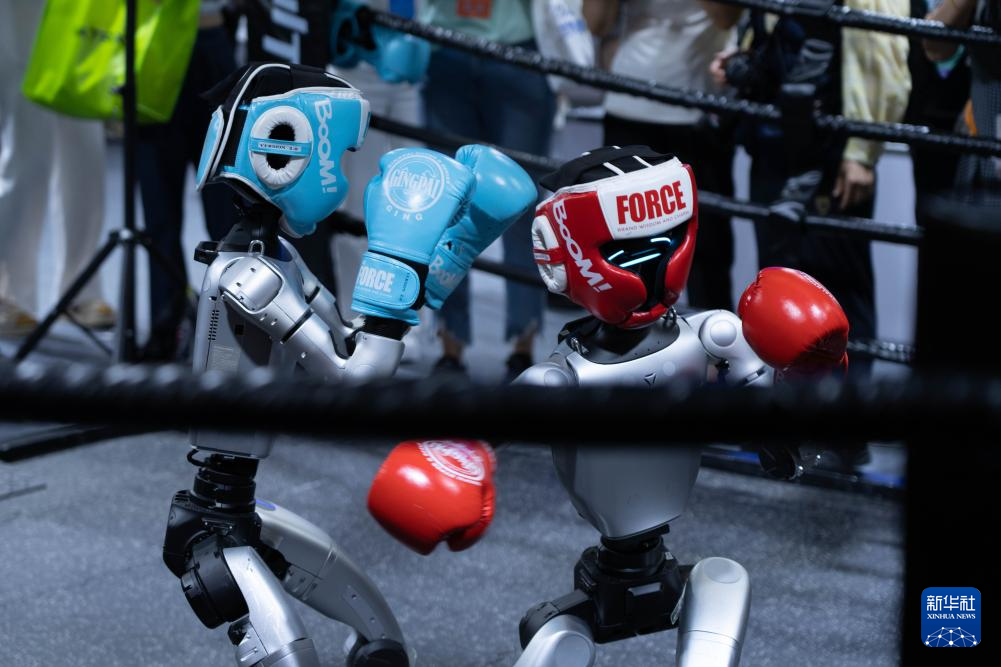
Stepping, dodging, and jabbing… In the fighting arena, a robot boxer wearing protective gear executed a series of impressive combat moves, thrilling the audience!
“Buzz…” Looking up at the sound of vibrations, a silver bionic “bee” flitted above people’s heads. Although only the size of a palm, its movements were “smooth” and agile.
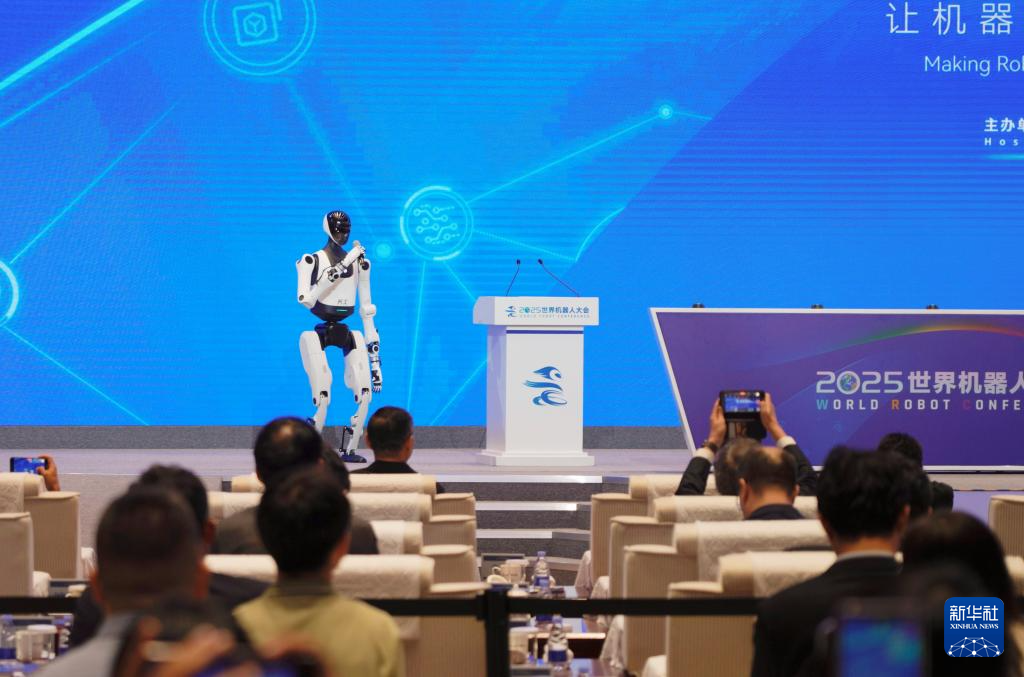
At the recently held 2025 World Robot Conference, science fiction became reality—over 200 domestic and international robotics companies showcased more than 1,500 exhibits, making future technology within reach.
Although the conference has ended, people’s reflections continue—
Source: Xinhua News Agency
1. Why Are Robots Becoming Smarter?
In front of the booth of iFlytek’s subsidiary, Lingdong General, a “embodied intelligent data collection, model training, and inference machine” attracted much attention.
“The embodied intelligent machine is mainly used for data collection, model training, and model inference. It can act as a ‘teacher’ for robots, guiding them through diverse capability training,” said a relevant person in charge of Lingdong General. “In an industrial scenario, we collect data on workers’ actions, trajectories, and visual inputs for sorting or transporting materials multiple times, inputting it into a large model to train the robots to learn this skill. Additionally, this model has certain inference capabilities, allowing robots to become ‘smarter’—that is, to autonomously judge and handle different situations in various scenarios.”
Why are robots becoming smarter now? During the conference, a frequently mentioned term by experts and entrepreneurs was embodied intelligence.
People generally believe that traditional artificial intelligence (AI) exists in a virtual form, such as smart assistants in electronic products. They can converse with humans and provide suggestions to questions, but they cannot interact with humans in the real world. Embodied intelligence is the physical manifestation of intelligent agents, meaning that intelligent agents have a physical carrier as a real “body” that can come close to humans. Therefore, embodied intelligence not only has an AI “brain” for thinking, allowing it to learn and evolve actively, but it can also use its “body” to perceive the world and act freely. Undoubtedly, embodied intelligence, which can both “think” and “act,” can become a helper for humans in solving problems in the real world.
Many industry insiders have expressed in interviews that the prospects for embodied intelligence in the robotics field are broad. To advance robot technology to a higher level of intelligence and apply it in more real-world scenarios, efforts are still needed in enhancing the robot’s “smarter brain” and “more developed small brain.”
The robot’s “brain” consists of various processors, memory, and algorithms, possessing perception and decision-making capabilities, enabling robots to sense and adapt to changes in their surroundings, understand different languages, and even actively learn new skills. The robot’s “small brain” controls the robot’s movement and balance capabilities. It consists of various controllers, actuators, and sensors. When the “brain” issues commands, the “small brain” receives and translates them into specific actions for the robot. This also places higher demands on the robot’s core components.
Source: Xinhua News Agency
In this regard, Xiong Youjun, general manager of the National Local Co-construction Embodied Intelligent Robot Innovation Center, introduced that in recent years, there have been significant advancements in the field of robotics technology. The iteration of core component technologies has been very rapid, and costs have significantly decreased. Moreover, the collaboration between upstream and downstream industrial chains has greatly improved, and the process iterations have become more stable and mature, especially in the field of motion control.
At the exhibition site, many core component companies for robots were very popular. “In the first half of 2025, we feel that the robotics industry is booming, with many complete machine manufacturers and component manufacturers achieving nearly 50% to 100% growth,” shared a participating company.
According to statistics, in 2024, China’s robot patent applications accounted for two-thirds of the global total. The core components of robots have formed a rich spectrum of proprietary products. Core technologies such as robot large models, intelligent collaborative control, and human-machine interaction continue to break through. A preliminary working system for robot standards has been established, and service systems for pilot testing, inspection, and certification are accelerating their layout.
At a recent press conference held by the State Council Information Office, Liu Liehong, a member of the Party Leadership Group of the National Development and Reform Commission and director of the National Data Bureau, introduced that since the 14th Five-Year Plan, China has made breakthroughs in a number of key core technologies in the digital field. China’s overall strength in artificial intelligence has achieved a comprehensive and systematic leap, with the number of AI patents accounting for 60% of the global total.
In recent years, AI has developed rapidly, but many industry insiders believe that its development level is still “insufficient.”
“Currently, the reason why robots have not achieved large-scale applications is still due to the insufficient AI level of embodied intelligence,” said Wang Xingxing, founder of Yushu Technology, in an interview. “However, this is not an insurmountable problem. Technological leaps in the AI field are very common, and there may be breakthrough progress at any time. Problems that cannot be solved now may suddenly be resolved at some point in the future. As long as AI technology continues to advance, the robotics industry will develop better and better.”
This conference also released the “2025 Trends in Embodied Intelligent Robot Development,” which systematically outlines the technological evolution paths, industry application scenarios, and industrial ecological patterns from ten dimensions, including embodied perception, embodied decision-making, embodied intelligent control, and embodied intelligent robot design.
2. Where Are Smart Robots Being Used?
Where should sufficiently “smart” robots be used?
“China’s robot application scenarios are continuously breaking through, with industrial robots covering 71 major categories of the national economy and 236 subcategories. The density of robots in manufacturing has risen to the third highest in the world. The application breadth and depth of service robots, agricultural robots, and special robots have significantly improved. China’s humanoid robots have made significant breakthroughs in mobility and dexterity, ranking among the global leaders, and are expected to play important roles in scenarios such as home services, manufacturing, and warehousing logistics,” introduced Xu Xiaolan, president of the China Electronics Society, at the 2025 World Robot Conference.
It is reported that over 500 application scenarios were set up at this conference, with thousands of the latest robots competing and showcasing their capabilities.
How to track tumors in real-time and ensure the accuracy of treatment is a world-class challenge in the field of radiotherapy. During radiotherapy, a patient’s breath or heartbeat can cause displacement of the radiation.
“This is our first exhibited robot—the SuperX, a real-time precise control robot for tumor radiation therapy,” said Zhang Shengjie, head of R&D at Leitai Medical, pointing to a large machine in front of him. “For radiation therapy beds, the higher the degree of freedom, the more comprehensive and accurate the irradiation for the patient. The SuperX radiation therapy bed has seven degrees of freedom, which is leading globally. It can monitor the displacement of tumors caused by breathing and heartbeat in real-time, automatically adjusting the radiation equipment to ensure adaptive precise treatment of the tumor area, minimizing damage to healthy tissues, and improving the efficiency and effectiveness of radiation therapy, reducing adverse reactions.”
Zhang Shengjie told reporters that the SuperX has been put into clinical trials in many well-known cancer hospitals across the country and is expected to be more widely used by the end of next year.
“Xiao Li, help me find a recipe.” “Xiao Li, chat with me for a while.” “Xiao Li, create a health plan based on my physical condition.”… In front of the elderly care robot “Xiao Li” launched by Senlikang, the audience eagerly interacted with it.
“Xiao Li can synchronize the elderly’s information to the local emergency center platform. If it detects that the elderly has fainted or fallen during safety patrols, Xiao Li will immediately contact the elderly’s children and family, and call the police or dial emergency numbers,” said Li Yang, product manager of Senlikang robots. Currently, Xiao Li has been put into use in many elderly care institutions across the country, and during this conference, many audience members directly ordered “Xiao Li” at the booth to take it home.
“Beijing has supported the formation of 12 categories of 200 innovative robot products, supporting the first trial and use of innovative robot products in 134 scenarios across 11 fields. The Beijing robotics industry remains in the top tier in the country,” introduced Jiang Guangzhi, director of the Beijing Economic and Information Technology Bureau, at the main forum of the World Robot Conference. In 2023, Beijing proposed the construction goal of the “Double Hundred Project” for robots, planning to cultivate 100 high-tech, high-value-added robot products and 100 application scenarios with nationwide promotion value by 2025. This goal has been successfully achieved.
It is reported that as a leader in China’s robotics industry, Beijing Yizhuang has also released a plan for the innovative application of 10,000 robots, gradually releasing a demand for nearly 50 billion yuan in embodied robot applications over the next two years, with over a thousand humanoid robots, covering key social and economic areas such as high-end manufacturing, education, landscaping, industrial parks, commercial services, medical care, power inspection, municipal management, and community property, aiming to bridge the “last mile” for robot deployment.
3. Accelerating the Commercialization of Robots
At this year’s robot conference, there are more and more commercialized robots.
In front of the world’s first comprehensive ecological platform for robots—”Robot World 2.0,” many spectators gathered around the robots, waiting for intimate interactions with them. It is reported that this platform has innovatively launched two new consumer formats this year: the world’s first embodied intelligent robot 4S store and the robot-themed restaurant “Robot Flame Research Institute.” The Beijing Economic Development Zone has collaborated with several well-known enterprises to establish a new landmark for the global robotics industry ecosystem.
Upon entering the “Robot Flame Research Institute” restaurant, the fully automated service provided by robots begins: holographic light and shadow welcoming guests, bionic humanoid robot bartenders serving… Flipping through the menu, milk tea, grilled skewers, pancakes, and other dishes are all prepared on-site by robot chefs. During the meal, performances by robot bands and historical celebrity robot stand-up shows are simultaneously staged on stage, with many people taking out their phones to capture memories in the restaurant. This restaurant aims to create an immersive new consumption scene that integrates “taste experience, cultural perception, and technological interaction.”
The embodied intelligent robot 4S store introduces the traditional car 4S store model into the robotics industry, aiming to bridge the “last mile” of industrial deployment. The store displays over 100 products across seven categories, including medical, industrial, companion, and bionic robots. It provides customized development, financial, and robot leasing services for enterprise users and offers a conversion channel from R&D to market for robot companies.
A relevant official from Beijing told reporters that in the future, robot hotels will serve as a new landmark for technology tourism and business, landing within “Robot World 2.0,” aiming to continuously lead the innovative application and integrated development of the robotics industry.
It is reported that during this conference, a total of 19,000 robots and related products were sold, with sales exceeding 200 million yuan.
“In recent years, China has continued to consolidate its position as the world’s largest industrial robot market, remaining the largest industrial robot market for 12 consecutive years and the world’s largest robot producer. Many regions have established robot innovation centers, gathering regional industrial advantages to carry out joint efforts, with complete machine manufacturers playing a leading role in building a collaborative and interactive ecosystem. Significant breakthroughs have been made in the mobility and dexterity of humanoid robots, placing them among the global leaders, and the industry scale is expected to achieve explosive growth,” Xu Xiaolan introduced. The robot conference delved into application scenarios, investment and financing connections, industry-education integration, new product releases, and project roadshows, achieving multiple cooperation intentions on-site, accelerating the commercialization of cutting-edge technologies and effectively promoting the rapid development of China’s robotics industry.
At the same time, international organizations such as the ASEAN Smart Industry Alliance, the Nepal Robotics Association, and the Cameroon Robotics Association also released demands for robot application scenarios at this conference, while the Singapore Enterprise Development Board announced 29 procurement and cooperation needs, allowing more “Made in China” robots to seize opportunities on the global stage.
Relevant industry reports estimate that by 2045, the number of humanoid robots in use in China will exceed 100 million units, with the overall market scale reaching approximately 10 trillion yuan, indicating broad commercial prospects. However, some industry insiders believe that humanoid robots are still in the early stages of commercialization, and it will take some time to effectively utilize robots. It is expected that in 5 to 10 years, general-purpose robots capable of completing basic household chores will truly become a reality.
Perhaps we should give robots more room for development, allowing the robotics industry to bear more innovative fruits that benefit our lives.
Source: Guangming Daily, images sourced from Xinhua News Agency