
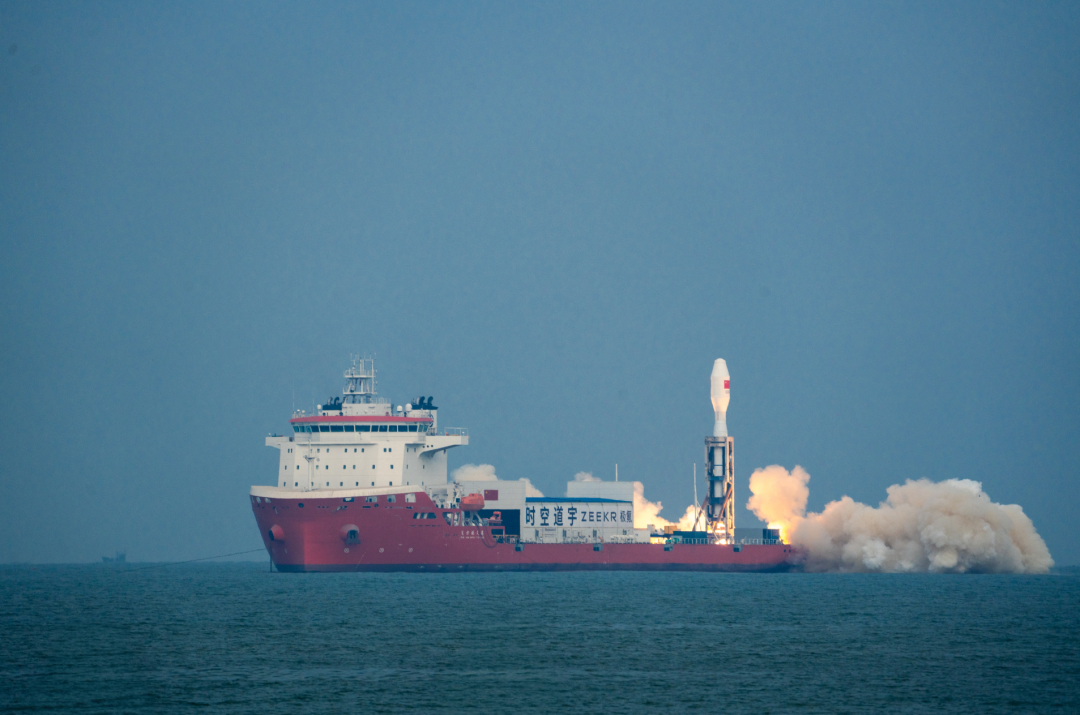
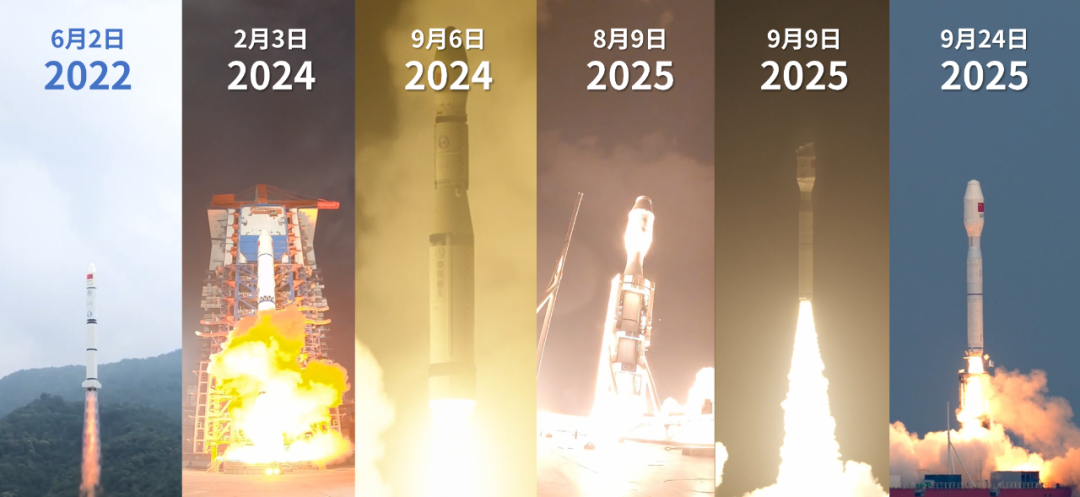
On September 24, 2025, at 15:56, the sixth orbital plane of the Geely Constellation was successfully launched into orbit with a single rocket carrying 12 satellites near the waters of Rizhao, Shandong. This marks the third network launch completed by Time-Space Dao Yu within two months, achieving a constellation of 64 satellites. The Geely Constellation is a globally low-orbit satellite IoT constellation designed, developed, constructed, and operated independently by the Chinese private commercial aerospace company Time-Space Dao Yu. The completion of Phase One of the constellation network officially enters the stage of large-scale commercial use, becoming an important milestone for China’s commercial aerospace in moving towards the global market.
In the context of the booming global satellite communication industry and the deepening applications of the Internet of Things (IoT), satellite communication has become a core infrastructure driving the intelligent transformation of multiple industries such as energy, transportation, and agriculture. Especially for the energy sector, which has a wide geographical distribution, complex environments, and difficulties in traditional communication coverage, the global real-time communication capabilities brought by satellite IoT are becoming a key support for the digital transformation of the industry.
Global Real-Time Satellite IoT Communication Coverage
Breaking Through Communication Bottlenecks in the Energy Sector
The energy sector encompasses a wide range of facilities, including oil and gas fields, pipelines, power grids, wind farms, and photovoltaic power stations. Traditional terrestrial communication networks have coverage blind spots in remote areas, offshore platforms, and desert regions, making it difficult to meet the demands for real-time monitoring, scheduling, and emergency communication. After the completion of Phase One of the Geely Constellation network, real-time communication coverage has been achieved for any location on the Earth’s surface except for the polar regions, with both network reliability and satellite in-orbit reliability reaching 100%, providing stable, low-latency, and wide-coverage communication support for the energy sector.
Unlike traditional satellite systems that focus on voice and broadband services, the Geely Constellation focuses on the vertical field of satellite IoT, particularly emphasizing low-power and high-reliability IoT communication capabilities. This constellation system has a communication capacity of 340 million times per day, supporting 20 million global users, including 5 million high-frequency users and 15 million medium and low-frequency users, capable of adapting to data return needs ranging from minute-level to second-level granularity. This capability is particularly suitable for data collection and equipment control of various sensors in energy facilities, such as pipeline pressure monitoring, power grid fault diagnosis, and wind turbine operational status feedback, truly achieving a “space-ground integration” communication closed loop.
In terms of technical architecture, Time-Space Dao Yu has achieved full-chain independent research and development and mass production of satellite communication chips, modules, and terminal series products. The company’s independently developed low-power communication chips and various terminal modules can be customized or matched with existing equipment in the energy sector, enabling remote IoT communication functions without altering the original infrastructure. This solution not only reduces deployment costs but also significantly enhances the operational efficiency and safety of energy systems in areas without terrestrial network coverage.

Deep Integration of Geely Constellation with Energy Scenarios
Promoting Digital and Green Transformation in the Industry
With the advancement of the national “dual carbon” goals and the acceleration of the construction of new power systems, the energy system is transforming towards intelligence, decentralization, and greening. Satellite IoT, as a space-based information infrastructure, will play an important role in the fields of oil and gas, electricity, and new energy.
In the oil and gas industry, satellite IoT can support applications in multiple directions. For example, in the monitoring scenario of long-distance oil and gas pipelines, sensors deployed at valve rooms and monitoring points along the pipeline can transmit data such as pressure, temperature, and leak detection in real-time through satellite IoT communication, achieving all-weather unmanned monitoring. Compared to traditional manual inspections and limited terrestrial network coverage, satellite IoT significantly enhances pipeline safety levels and operational response speed.
In the power grid system, especially in the widely distributed distribution IoT and transmission line monitoring, satellites can compensate for the insufficient coverage of public and private terrestrial networks. By deploying satellite communication terminals on power poles, substations, and distributed energy sites, remote transmission of data such as voltage, current, and equipment temperature can be achieved, supporting intelligent scheduling and rapid fault location of the power grid. In cases where natural disasters disrupt terrestrial communication, satellite links can become a key communication means for emergency command and power restoration.
Additionally, in the management of new energy sites such as wind and solar power, satellite IoT also shows broad application prospects. New energy power stations located in remote and harsh environments often lack stable communication conditions, but by integrating satellite communication functions into monitoring systems, operators can obtain real-time data on power generation, equipment health, and even environmental meteorological information, achieving centralized and intelligent management of power stations, thereby improving power generation efficiency and equipment lifespan.
Time-Space Dao Yu is currently actively promoting the implementation of typical application scenarios of “satellite + energy”. In the domestic market, energy infrastructure such as oil and gas pipelines, remote power grids, and remote water conservancy facilities can achieve intelligent operation and maintenance through satellites. In the international market, the company is focusing on layouts in the Middle East, Africa, Southeast Asia, Central Asia, and Latin America, where the Middle East is an important oil and gas production area in the world. Satellite communication plays a key role in the oil and gas industry, and Time-Space Dao Yu can provide remote monitoring, data transmission, and emergency communication services through partnerships with local operators.
In the future, as the services of the Geely Constellation continue to optimize and terminal costs further decrease, satellite communication will no longer be just an emergency backup means, but will gradually become one of the basic communication methods in the energy industry, empowering the digital, intelligent, and sustainable development of the global energy sector.
It is foreseeable that in the near future, from oil and gas fields deep in the desert to offshore wind farms, from cross-regional transmission corridors to distributed photovoltaic power stations, satellite IoT will seamlessly connect these energy nodes, constructing a truly global coverage, real-time reliable energy IoT network. The comprehensive operation of the Geely Constellation is accelerating the arrival of this future.
The successful completion of Phase One of the Geely Constellation network is a new starting point for collaborative innovation between Chinese commercial aerospace enterprises and the energy industry. This achievement not only demonstrates the leading strength and pioneering spirit of Chinese commercial aerospace in technology and industry but also reflects the profound value of aerospace technology in empowering economic and social development. With the acceleration of more industry applications, Time-Space Dao Yu is expected to play a key role in the global energy transformation, becoming an important force in promoting industrial upgrading and sustainable development.
Written by Guo Zhifu
EndFeel free to share with your friends!Produced by | China Energy News (cnenergy)AdvertisementEditor | Li Huiying