Recently, Huawei launched an AI smart emotional companion toy – the Smart Huan Huan. Coupled with the recently popular “Zootopia 2,” Wanda Cinemas has also strategically positioned itself in the trendy toy and AI emotional interaction toy market. With a rich background in consumer scenarios and its own IP resources, we will delve into Wanda Cinemas’ future development path and whether it can mark the end of a decade-long decline.
Wanda Cinemas AI Toy Strategy In-Depth Study: New Pathways for IP Monetization Empowered by Cinema Scenarios
Introduction: Exploration of AI Toy Transformation by Cinema Giants
By 2025, the Chinese film industry is undergoing profound changes, with traditional cinema models facing growth bottlenecks, and seeking business diversification has become an industry consensus. Against this backdrop, Wanda Cinemas, as the largest cinema operator in China, is actively venturing into the AI smart toy sector, attempting to carve out a new growth curve through a unique model of “cinema scenarios + IP resources + AI technology.”
Wanda Film Co., Ltd. was established in 2005 and went public on the Shenzhen Stock Exchange in 2015, becoming the first cinema company listed on the A-share market. As of 2025, the company operates 769 cinemas nationwide, covering major cities, with over 120 million members and a market share of approximately 14.4%, maintaining the top position in the domestic market for ten consecutive years. However, the traditional “ticket sales as service” model is facing challenges, and the company urgently needs to find new growth points.
In 2024, Wanda Cinemas’ actual controller changed to Ke Liming, and the new management introduced the “Super Entertainment Space” strategy, repositioning the company from a single viewing venue to a comprehensive offline entertainment space. Under this strategic framework, the AI toy business has become one of the five key areas of focus for the company. **”Moppettale”** is an AI nurturing plush brand incubated by Wanda Cinemas’ subsidiary, Ying Shiguang, which achieves two-way emotional interaction between the doll and its owner through the integration of an AI interactive chip. It is currently in the pre-mass production debugging stage and is expected to be officially launched by the end of 2025.
This study aims to analyze the authenticity, technical characteristics, market competitiveness, and strategic transformation value of Wanda Cinemas’ AI toy business, providing a comprehensive analytical perspective for investors and industry observers.
1. Current Status of Wanda Cinemas’ AI Toy Business: Substantial Progress from Concept to Product
1.1 Strategic Positioning and Development History of Business Layout
The AI toy business of Wanda Cinemas is not a fleeting trend but an important component of the company’s “1+2+5” strategic map. In June 2025, during the 27th Shanghai International Film Festival, Wanda Cinemas officially launched three trendy toy brand lines and two original IPs incubated by Ying Shiguang, marking the transition of the AI toy business from the R&D stage to the market promotion stage.
Ying Shiguang, as the core consumer brand under Wanda Cinemas, is responsible for the R&D and operation of the AI toy business. The subsidiary has a registered capital of 161.9124 million yuan, with the paid-in capital matching the registered capital, indicating the company’s emphasis on this business. Ying Shiguang actively incubates and lays out a multi-category, all-scenario trendy toy product line around its own film and game IPs, leading authorized IPs, original IPs, and co-created IPs with artists.
In terms of investment layout, on May 12, 2025, Ying Shiguang jointly invested 144 million yuan with its affiliate, Ruyi Xingchen, to acquire a 7% stake in 52TOYS. This investment not only provides Wanda Cinemas with technical support for IP toy development but also offers deep cooperation opportunities with 52TOYS in IP toy development, sales, and promotion. Currently, 104 52TOYS cooperative specialty stores have been established in Wanda Cinemas.
1.2 Technical Specifications and Functional Characteristics of the “Moppettale” Product
“Moppettale” is an AI nurturing plush brand incubated by Ying Shiguang, with its core positioning as “nurturing AI companion plush.” The product’s biggest technical highlight is the integration of an AI interactive chip and motion sensing module, enabling two-way interactive companionship between the doll and its owner.
The product’s technical parameters are impressive:
– Emotional perception ability: Achieves a two-way companionship experience through a personalized AI engine and motion sensing module, allowing the doll to perceive the owner’s actions and respond accordingly.
– Intelligent interaction function: The built-in AI chip supports both active and passive interactions, enabling voice conversations, emotional exchanges, and more.
– Artist collaboration: The brand’s debut artist is South Korean artist Yislow, who designed five uniquely styled AI plush dolls.
– Material craftsmanship: Made from high-quality plush material, combined with micro-innovation technology, ensuring durability while maintaining a soft touch.
From a product form perspective, “Moppettale” is not a traditional smart toy but an intelligent companionship system that integrates emotional computing, behavior prediction, and adaptive learning algorithms. Unlike the common “one-way interactive plush” toys on the market, this product achieves genuine two-way emotional communication through AI technology.
1.3 Launch Plans and Product Planning
According to official disclosures from Wanda Cinemas, the “Moppettale” product is currently in the pre-mass production debugging stage and is expected to be officially launched by the end of 2025. The concurrently developed digital rights confirmation platform, Rtime Link, was launched in July 2025, binding physical trendy toys with an “electronic ID card.”
In terms of product planning, Ying Shiguang has established a clear development path:
Short-term planning (2025-2026):
– Launch the first batch of five basic AI plush dolls designed by Yislow.
– Collaborate with 52TOYS to develop IP derivatives, focusing on Wanda Cinemas’ own IPs such as “Nezha: Birth of the Demon Child” and “Detective Chinatown”.
– Set up a “Moppettale” experience area in Wanda Cinemas to provide offline experiences and sales services.
Mid to long-term planning (2026-2028):
– Expand the product line to include smart plush accessories, series doll clothing, and more forms of AI plush toys.
– Develop limited edition products synchronized with movie content, such as character-specific AI toys launched alongside new film releases.
– Explore interactive experience models of “cinema + AI toys,” where dolls interact with film plots during screenings.
2. AI Toy Market Environment Analysis: Opportunities and Challenges in a Trillion-Yuan Blue Ocean
2.1 Global and Chinese AI Toy Market Size and Growth Trends
The AI toy market is experiencing explosive growth, becoming the most promising segment in the toy industry. According to predictions from several authoritative institutions, the global AI toy market is showing strong growth:
Market Size 2024 2025 2030 2033 Compound Growth Rate
Global Market (Billion USD) 18.1 – 58-60 60 14-20%
Chinese Market (Billion Yuan) 24.6 29 70-85 – 25-70%
Data shows that the global AI toy market size reached 18.1 billion USD in 2024, and is expected to grow to 60 billion USD by 2033, with a compound growth rate of about 14% from 2024 to 2033. The Chinese market is growing even more rapidly, with a market size of approximately 24.6 billion yuan in 2024, expected to increase to 29 billion yuan in 2025, and potentially reach 70-85 billion yuan by 2030, with an annual compound growth rate as high as 25-70%.
The explosive growth of the AI toy market is primarily driven by three factors:
Technological breakthroughs: The maturity of large models represented by ChatGPT and DeepSeek, along with the technological maturity and cost reduction of hardware such as chips and sensors, has allowed AI toys to evolve from simple command responses to deeper emotional connections.
Upgraded consumer demand: The rise of the “loneliness economy” has led to a sustained increase in demand for emotional companionship products among children, elderly care, and young singles. Particularly, parents from the 80s and 90s have a high acceptance of technology products, making them early adopters of AI toys.
Policy support: The “Artificial Intelligence +” initiative was included in the government work report for the first time in 2024, and the “Special Action Plan to Boost Consumption” released in March 2025 explicitly proposed promoting “Artificial Intelligence + Consumption,” providing policy support for the development of the AI toy industry.
2.2 Competitive Landscape and Major Players Analysis
The competitive landscape of the AI toy market is characterized by diversification, mainly encompassing four types of companies:
First category: Traditional toy companies
Represented by Aofei Entertainment, Shifeng Culture, and Gao Le Co., these companies enhance product premium through the “technology + IP” model, leveraging manufacturing capabilities and IP resources. Among them, Aofei Entertainment relies on top IPs such as “Pleasant Goat and Big Big Wolf” and “Balala the Fairies,” with smart toy revenue growing by 23% year-on-year in 2024, and a gross margin of 41.2%, significantly higher than the industry average of 32%.
Second category: Technology startups
Represented by HAIVIVI (Yue Ran Innovation) and FOLOTOY, focusing on niche scenarios such as emotional companionship and interaction, creating differentiated products through the integration of software and hardware and large model adaptation. Yue Ran Innovation’s BubblePal has sold over 250,000 units, completing a 200 million yuan Series A financing in August 2025, with a post-investment valuation of 1 billion yuan.
Third category: Internet technology companies
Huawei’s “Smart Huan Huan” is equipped with its self-developed AI model, priced at 399 yuan, selling out immediately upon release, with a secondary market premium exceeding 50%. Xiaomi, iFLYTEK, and others have also launched their own AI toy products.
Fourth category: IP reserve companies
Film companies like Wanda Cinemas and Light Media leverage their own IP resource advantages to layout AI toys. Light Media’s derivatives from “Nezha: Birth of the Demon Child” have generated over 1 billion yuan in revenue, with a gross margin of 73.24%.
2.3 Technology Development Trends and Consumer Demand Characteristics
AI toy technology is evolving towards multi-modal interaction, emotional computing, and cognitive intelligence. According to industry research, technological evolution can be divided into two stages:
Recent developments (2025-2027):
– Enhanced multi-modal perception capabilities: Voice recognition accuracy exceeds 98%, visual recognition supports 3D spatial modeling, and tactile feedback systems achieve refined emotional mapping.
– Lightweight large model deployment: Using efficient distillation technology, a large model with 7 billion parameters is compressed to 1.5GB, allowing it to run locally on edge devices.
– Basic cognitive abilities: Toys possess preliminary context understanding and personalized dialogue capabilities.
Long-term outlook (2028-2030):
– Entering the “cognitive intelligence” stage: Integrating emotional computing, behavior prediction, and adaptive learning algorithms.
– Personalized interaction: Dynamically adjusting interaction content based on children’s age, interests, and emotional states.
– Ecological linkage: Achieving seamless integration with family smart ecosystems (such as smart speakers and educational tablets).
From the perspective of consumer demand characteristics, the AI toy market exhibits the following features:
Diverse user groups:
– Children’s market (0-12 years): The largest segment, with parental decision-making accounting for over 70%, focusing on product safety and educational value.
– Adult market (19 years and older): Generation Z views AI toys as emotional support and stress relief tools, with rapid growth in the single adult market.
– Elderly market: Empty-nest seniors have become an important audience for adult-oriented AI toys, with products positioned as memory aids and companionship.
Consumer behavior characteristics:
– Price sensitivity: Parents are willing to pay a premium of over 30% for products with AI educational functions and authoritative content endorsements.
– Purchasing channels: Online e-commerce platforms dominate, while offline experience stores and cinema scenarios are growing rapidly.
– Decision factors: Safety, educational value, data privacy protection, and brand reputation are the main considerations.
3. Core Competitiveness Analysis of Wanda Cinemas’ AI Toy Business
3.1 Resource Endowment Advantages: IP Library, Channel Network, and Membership System
Wanda Cinemas possesses three core resource advantages in its AI toy business, forming its unique competitive barrier:
IP Resource Advantage
Wanda Cinemas has built a diversified and sustainably evolving IP resource library, covering four categories:
– Wanda Cinemas’ own film, animation, game, and artist IPs: Including phenomenon-level IPs such as “Nezha: Birth of the Demon Child,” “Detective Chinatown” series, and “Ghost Blows Out the Light.”
– Global top authorized IPs: “Genshin Impact,” “Identity V,” “Light and Night Love,” Sanrio, Cute Town, Emoji, etc.
– Self-developed original IPs: Momo & Friends, Vexel virtual boy band, etc.
– Artist co-created IPs: Collaborations with internationally renowned creators such as South Korean artist Yislow.
Notably, the “Gift Series” themed IP derivatives launched by Wanda Cinemas during the summer of 2025 achieved good sales results, attracting a large young audience through collaborative activities with top game IPs like “Love and Deep Space.”
Channel Network Advantage
Wanda Cinemas has the largest cinema network in China, which is a unique advantage for its AI toy business layout:
– Number of cinemas: 769 cinemas nationwide, covering all major cities.
– Market position: 51 seats in the top 100 cinemas by box office nationwide, 246 seats in the top 500 cinemas, 18 provincial champions, and 167 city champions.
– Channel value: 800 million annual cinema admissions provide a natural display and sales channel for AI toys.
Currently, Wanda Cinemas has launched 30 “Time Art Stores” nationwide, selling over 500 derivative product SKUs. The 105 specialty stores in cooperation with 52TOYS have been established in Wanda Cinemas, boosting non-ticket revenue by over 30% during the 2025 Dragon Boat Festival.
Membership System Advantage
Wanda Cinemas has a large and highly engaged membership base:
– Membership scale: Over 120 million members, with a year-on-year growth of approximately 40% in new members in the first half of 2025.
– Self-channel proportion: The proportion of self-channel box office has increased to 37.6%, further consolidating membership advantages.
– Consumption capacity: The member group has high consumption capacity and brand loyalty, providing a quality customer base for high-value products like AI toys.
3.2 Product Differentiation Features: Technological Innovation and Scenario Integration
Wanda Cinemas’ “Moppettale” has formed significant differentiation advantages in technology and product design:
Technological Differentiation
Compared to competing products in the market, the technological characteristics of “Moppettale” are reflected in:
Comparison Dimension Moppettale Market Competitors (e.g., Huawei Smart Huan Huan)
Interaction Method Two-way emotional interaction, able to perceive the owner’s actions One-way voice interaction
Technical Architecture AI interactive chip + motion sensing module Single voice recognition chip
Emotional Capability Possesses emotion recognition and response capabilities Simple voice dialogue
Application Scenarios Cinema scenario linkage, interacting with film plots Primarily family scenarios
Pricing Strategy Expected price range of 300-500 yuan 399 yuan
Data Source: Compiled from public information
The biggest technical highlight of “Moppettale” is achieving genuine two-way emotional communication. The product, through the integration of an AI interactive chip, allows the doll to perceive the owner’s touches, hugs, and other actions, responding with emotional reactions such as “being spoiled when patted on the head.” This multi-modal interaction capability far exceeds traditional voice dialogue toys.
Scenario Integration Advantage
Wanda Cinemas’ AI toys have a unique cinema scenario linkage function:
1. Synchronized interaction during screenings: The doll can interact with film plots, simulating “weightlessness” during the viewing of “The Wandering Earth.”
2. Deep IP binding: Deeply binding with characters from films released by Wanda Cinemas, allowing audiences to purchase related AI toys immediately after viewing.
3. Limited edition strategy: Launching limited edition products related to specific films to enhance collectible value.
This scenario-based product design makes “Moppettale” not just a toy but an extension of the audience’s viewing experience and emotional support.
3.3 Business Model Innovation: Rtime Link Digital Rights Confirmation System
The Rtime Link digital rights confirmation platform independently developed by Wanda Cinemas is an important embodiment of its business model innovation. The core value of this system lies in:
Technical Features:
– Adopting a “physical trendy toy art product + digital certification” dual-track model.
– Assigning a unique “digital ID card” to each product.
– Enabling users to query copyright information, collection numbers, and circulation records with a simple tap using NFC chips.
Commercial Value:
1. Anti-counterfeiting traceability: Effectively addressing the issue of counterfeiting in the trendy toy market, protecting consumer rights.
2. Collectible appreciation: Enhancing the collectible value of products through limited numbering and circulation records.
3. Secondary trading: Supporting gifting functions within the platform, forming a complete collectible ecosystem.
This innovative model not only enhances the product’s added value but also builds a sustainable IP monetization ecosystem for Wanda Cinemas.
4. Value and Financial Impact Analysis of Wanda Cinemas’ Business Transformation
4.1 Revenue Structure Optimization and Profitability Improvement
Wanda Cinemas is fundamentally improving its revenue structure through new businesses like AI toys. According to the latest financial data for 2025, the company’s revenue structure exhibits the following characteristics:
Business Segment 2025H1 Revenue (Billion Yuan) Proportion Year-on-Year Growth Gross Margin
Viewing Revenue 41.77 62.45% +14.78% 4.91%
Merchandise and Catering 8.63 12.90% +6.07% 73.42%
Advertising Revenue 5.03 7.52% -14.41% –
Film and Television Business 3.22 4.82% +44.84% –
Gaming Business 1.85 2.77% -44.05% –
Other Businesses 6.39 9.55% – –
Data Source: Wanda Cinemas 2025 Semi-Annual Report
From the data, it can be seen that traditional viewing revenue, while still the main source of income, has decreased from over 80% at its peak to 62.45%. More importantly, high-margin non-ticket businesses are becoming the main drivers of profit growth:
– Merchandise business: Gross margin reaches 73.42%, a year-on-year increase of 12.46 percentage points, becoming the company’s second-largest source of income.
– Derivative business: Sales of derivatives during the summer of 2025 reached 106 million yuan, a year-on-year increase of 94%, with total sales exceeding 200 million yuan for the year.
– IP licensing business: Collaborating with Pop Mart, 52TOYS, etc., to obtain stable income through IP licensing.
The addition of the AI toy business will further optimize the revenue structure. According to industry analysis, the gross margin of AI toys generally ranges from **50%-85%**, far exceeding traditional ticketing business. For example, the AI toy developed in collaboration with the “Nezha” IP by Wanda Cinemas is priced at 399 yuan, with a cost of less than 80 yuan, resulting in a gross margin exceeding 80%.
4.2 Deep Value of Strategic Transformation
The AI toy strategy of Wanda Cinemas has multiple strategic values:
1. Reducing dependence on box office revenue
In the first half of 2025, the company’s non-box office revenue accounted for approximately 35%, an increase of 8 percentage points year-on-year. By developing new businesses like AI toys, the company is moving away from the “weather-dependent” dilemma, building a more stable revenue structure.
2. Enhancing user stickiness and repurchase rates
AI toys, as “cinema memory carriers,” can continuously evoke the audience’s viewing experience, encouraging users to return to cinemas. Especially for family users, AI toys can become an emotional link between cinemas and homes, increasing the frequency of parent-child viewings.
3. Expanding consumption scenarios
The company is transitioning from “ticket sales as service” to “immersive experience + multi-dimensional consumption,” creating a “super entertainment space” that integrates entertainment, consumption, and social interaction. The AI toy business is a crucial support for this transformation.
4. Building an IP ecological closed loop
Through a closed industrial chain of “content creation – IP incubation – derivative landing,” Wanda Cinemas can fully explore IP value. AI toys are not only tools for IP monetization but also new carriers for IP dissemination.
4.3 Financial Impact Forecast and Investment Return Analysis
Based on market size and Wanda Cinemas’ competitive advantages, we forecast the financial impact of the AI toy business:
Revenue Contribution Forecast:
– Conservative estimate: Assuming Wanda Cinemas captures 1% of the Chinese AI toy market in 2026, based on an 85 billion yuan market size, it could achieve revenue of 850 million yuan.
– Neutral estimate: Considering channel advantages and IP resources, it is expected to capture 3-5% of the market share, corresponding to revenue of 2.5-4.2 billion yuan.
– Optimistic estimate: If “Moppettale” becomes a blockbuster product, it is expected to capture over 10% market share, with revenue exceeding 8.5 billion yuan.
Investment Return Analysis:
– Initial investment: Including R&D investment, production line construction, market promotion, etc., the total investment is estimated at 300-500 million yuan.
– Gross margin level: Based on industry average levels, the gross margin of the AI toy business is expected to be between 60-70%.
– Investment payback period: Based on conservative estimates, the initial investment is expected to be recouped in 2-3 years.
Based on Wanda Cinemas’ financial status in 2025, if the AI toy business can achieve 2.5 billion yuan in revenue (neutral estimate), it will increase the company’s total revenue by approximately 15%, and net profit growth may exceed 50%.
4.4 Risk Factor Assessment
Despite the broad prospects, Wanda Cinemas’ AI toy business still faces multiple risks:
Technical risks:
– Rapid iteration of AI technology may lead to a decline in product competitiveness.
– Multi-modal interaction technology is still developing, and user experience needs improvement.
– Increasingly stringent data security and privacy protection requirements.
Market risks:
– Intense competition in the AI toy market, with many homogeneous products.
– Uncertainty in consumer acceptance, especially with high price sensitivity.
– Industry standards and regulatory policies are still not well established.
Operational risks:
– High product return rates, with the industry average reaching 30-40%, and some products even reaching 70%.
– Complex supply chain management, requiring a balance between cost control and quality assurance.
– The synergy with cinema business needs time to validate.
5. Comparative Analysis with Industry Peers
5.1 Comparison with Light Media’s IP Derivative Business
Light Media is a pioneer in the domestic IP derivative business, and its successful experience is of significant reference value for Wanda Cinemas:
Comparison Dimension Wanda Cinemas Light Media
IP Resources “Nezha,” “Detective Chinatown,” “Ghost Blows Out the Light,” etc. “Nezha: Birth of the Demon Child,” “Big Fish & Begonia,” etc.
Derivative Revenue Estimated at 500-1,000 million yuan in 2025 Over 1 billion yuan (only from “Nezha”)
Gross Margin Estimated at 60-70% 73.24%
Product Forms AI toys, figurines, plush, etc. Figurines, plush, digital collectibles, etc.
Sales Channels 769 cinemas + online Primarily online, supplemented by offline experience stores
Development Strategy Cinema scenario linkage + deep IP binding IP licensing + brand operation
Data Source: Compiled from public information
Light Media’s success is primarily attributed to the blockbuster effect of “Nezha: Birth of the Demon Child,” whose derivative development has covered over 30 categories and 500 products. Wanda Cinemas’ advantage lies in its more diverse IP matrix and strong offline channels, but it still needs to enhance its ability to create blockbuster single products.
5.2 Comparison with Huayi Brothers’ Transformation Path
Huayi Brothers was once a leader in the Chinese film industry but fell into difficulties due to a single business structure, and its lessons are worth pondering:
Huayi Brothers’ Issues:
– Over-reliance on box office revenue, lacking diversified income sources.
– Rich in IP reserves but insufficient development capabilities, with derivative business accounting for only 15%.
– Lack of offline channel support, unable to fully realize IP value.
Wanda Cinemas’ Advantages:
– A large cinema network as a display and sales channel.
– Building a complete ecosystem of “content + channels + derivatives.”
– Enhancing product added value and user experience through AI technology.
5.3 Comparison of Competitive Advantages with Traditional Toy Companies
Compared to traditional toy companies like Aofei Entertainment and Shifeng Culture, Wanda Cinemas has unique advantages:
Wanda Cinemas’ Advantages:
1. Scenario advantage: 769 cinemas create a natural experience and sales channel, with 800 million annual admissions unmatched by any toy company.
2. IP advantage: A large number of high-value film IPs, which have continuous content updates and topicality.
3. Technological innovation: Achieving product differentiation through AI technology, enhancing technological content and added value.
4. Membership base: 120 million members provide precise marketing channels and seed users.
Disadvantages of Traditional Toy Companies:
– Lack of content creation capabilities, high costs of acquiring IP.
– High costs of building offline channels, limited coverage.
– Relatively weak technological innovation capabilities, leading to severe product homogeneity.
6. Investment Value and Development Prospects Assessment
6.1 Valuation Impact Analysis
Wanda Cinemas’ AI toy strategy is driving the reconstruction of the company’s valuation system:
Valuation Model Changes:
– Traditional valuation: Based on box office revenue, with a cyclical valuation of PE around 20-25 times.
– Post-transformation valuation: Aligning with “IP operation + technology entertainment,” PE has risen to 35 times.
– Expected valuation: If the “1+2+5” strategy succeeds, a diversification premium of 10-15% can be obtained, with a reasonable market value range of 27.5-34.5 billion yuan.
Valuation Enhancement Logic:
1. Business model reconstruction: Transitioning from cyclical box office dependence to a diversified revenue structure.
2. Growth potential: The trillion-yuan AI toy market provides long-term growth momentum.
3. Profitability improvement: High-margin new businesses enhance overall profit margins.
4. Valuation system switch: Transitioning from film stocks to consumer technology stock valuation systems.
6.2 Development Prospects Outlook
Based on a comprehensive analysis of the market environment, competitive landscape, and company capabilities, Wanda Cinemas’ AI toy business has broad prospects:
Short-term prospects (2025-2026):
– The “Moppettale” product will be officially launched, with expected first-year sales of 300-500 million yuan.
– Deepening cooperation with 52TOYS, with 175 specialty stores fully rolled out.
– Non-ticket revenue proportion will increase to over 40%.
Mid-term prospects (2027-2028):
– AI toy business revenue will reach a scale of 1-2 billion yuan.
– Forming 3-5 blockbuster IP products.
– Becoming a leading brand in the domestic AI toy market.
Long-term prospects (2029-2030):
– AI toy business will become the company’s third-largest source of income, accounting for over 10%.
– Building a virtuous cycle of “content-to-toy-to-content.”
– Exploring overseas markets to achieve global IP operations.
6.3 Investment Recommendations
Based on the above analysis, we provide the following recommendations for different types of investors:
For stock investors:
– Investment rating: Buy (based on a 35 times PE in 2025, target price of 14.46 yuan/share).
– Investment logic:
1. The company is at a critical period of business transformation, with new businesses like AI toys providing new growth momentum.
2. The reconstruction of the valuation system brings revaluation opportunities, and the diversification premium has not yet been fully reflected.
3. The 120 million member base and 769 cinema network form a strong moat.
– Risk warning: Pay attention to AI toy market acceptance, technology iteration risks, and intensified competition risks.
For industry observers:
– Wanda Cinemas’ transformation path represents the development direction of the Chinese cinema industry.
– The integration of AI technology with the traditional entertainment industry will create immense value.
– Cinemas are no longer merely viewing venues but comprehensive entertainment experience centers.
For practitioners:
– The AI toy industry is on the verge of explosion, with a strong demand for talent.
– Compound talents with AI technology and IP operation capabilities are the most sought after.
– Focus on the innovative business model of “cinema + AI + IP.”
Conclusion: A New Paradigm for IP Monetization Empowered by Cinema Scenarios
The AI toy strategy of Wanda Cinemas is a microcosm of the transformation and upgrading of the Chinese film industry. By organically combining cinema scenarios, IP resources, and AI technology, the company is exploring a unique path for IP monetization.
Core Findings Summary:
1. Business authenticity: Wanda Cinemas’ AI toy business has progressed from concept to product, with “Moppettale” in the pre-mass production debugging stage, expected to launch by the end of 2025. The company has invested 144 million yuan in 52TOYS and established a complete R&D and operational system.
2. Competitive advantages: Wanda Cinemas has three core advantages: the scenario advantage of 769 cinemas, the traffic advantage of 120 million members, and the content advantage of a rich IP library. Through innovations like the Rtime Link digital rights confirmation system, it has built differentiated competitive barriers.
3. Market prospects: The Chinese AI toy market is expected to reach 29 billion yuan by 2025 and may exceed 85 billion yuan by 2030. With its unique advantages, Wanda Cinemas is expected to capture 3-5% of the market share, corresponding to revenue of 2.5-4.2 billion yuan.
4. Transformation value: The AI toy business will drive the optimization of the company’s revenue structure, increasing the proportion of non-ticket revenue to over 40%, and improving profitability. More importantly, this marks the company’s strategic transformation from a single cinema to a “super entertainment space.”
Future Outlook:
Wanda Cinemas’ AI toy strategy is not only a business innovation but also a disruption of the traditional cinema business model. When audiences can “bring home” movie characters, and cinemas become the entry point for IP experiences and consumption, a new entertainment ecosystem is forming.
Driven by the dual forces of the AI technology wave and consumption upgrades, Wanda Cinemas is expected to become a pioneer and leader in the “cinema + AI + IP” model in China. For investors, this is not only an investment opportunity but also a historical opportunity to witness the transformation of the Chinese cultural and entertainment industry.
Risks and opportunities coexist, challenges and hopes are intertwined. Wanda Cinemas’ journey in AI toys has just begun, and let us look forward to the exciting performance of this cinema giant in the new track.
Conclusion: Attached is the annual line chart
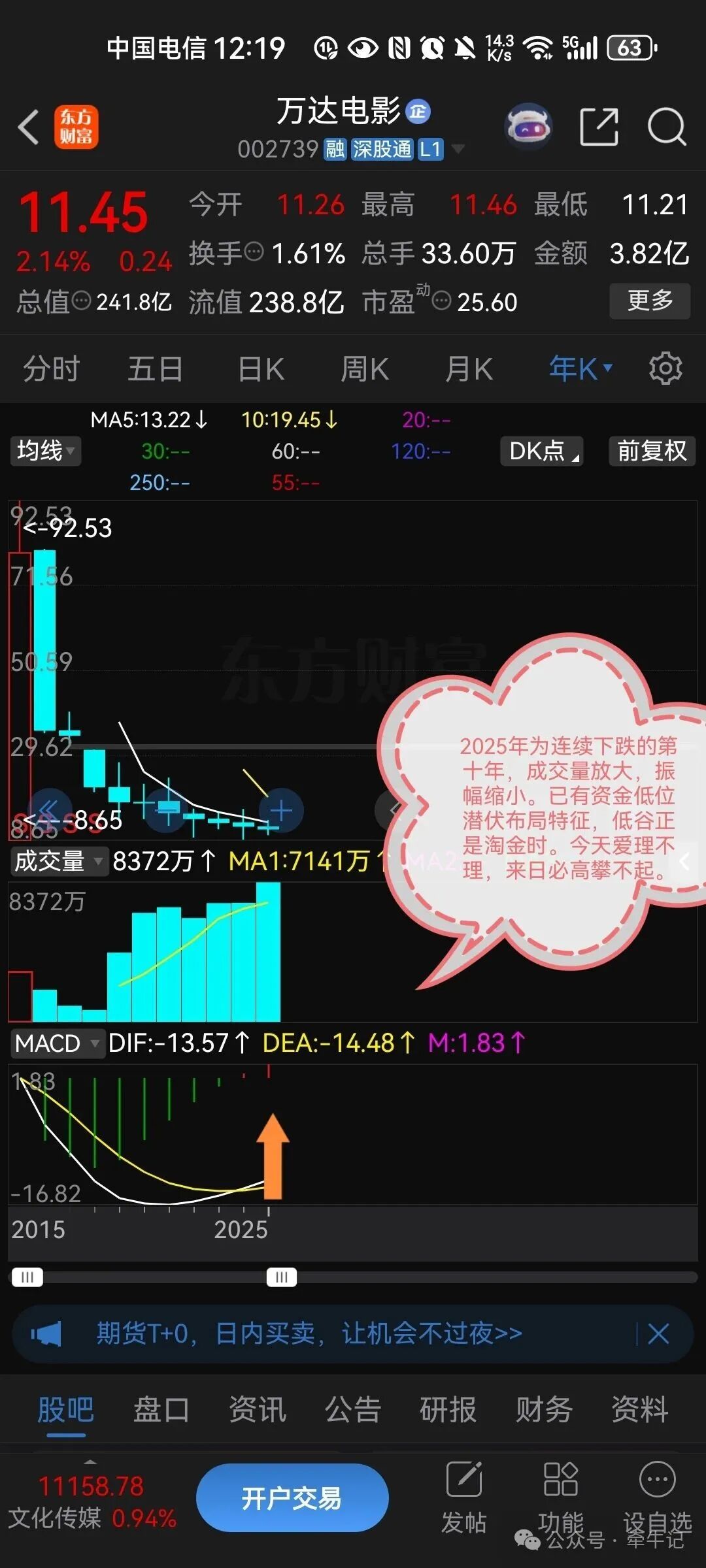
Lessons from others can be beneficial; this is merely a sharing of thoughts and perspectives, not a direct recommendation. It should not be used as a direct basis for investment or operational advice. Entering the market based on this carries risks. The stock market is risky; investment requires caution.