The following is a hardware comparison and selection guide for mainstream ESP32 development boards, covering core parameters, expansion capabilities, power consumption design, and applicable scenarios to help you accurately match project requirements:
1. Comparison of Core Parameters of Mainstream ESP32 Development Boards
| Development Board Model | Core Chip | Flash/PSRAM | Wireless Features | Key Interfaces | Power Consumption Features |
|---|---|---|---|---|---|
| ESP32-DevKitC | ESP32-WROOM-32 | 4MB Flash | Wi-Fi 4 + BT 4.2 | GPIO 34, ADC×7, DAC×2, UART×3 | Basic LDO power supply, no deep optimization |
| NodeMCU-32S | ESP32-S | 4MB Flash + None | Wi-Fi 4 + BT 4.2 | Compatible with NodeMCU pins, UART×2, I2C×1 | CH340C USB to serial (static 1.5mA) |
| TTGO T-Display | ESP32-WROVER | 4MB Flash + 4MB PSRAM | Wi-Fi 4 + BT 4.2 | 1.14-inch LCD screen (240×135), 2 buttons | Integrated screen backlight control circuit |
| FireBeetle ESP32 | ESP32-WROOM-32E | 4MB Flash | Wi-Fi 4 + BT 4.2 | Gravity sensor, RGB light, low-power GPIO×8 | Deep sleep current <10μA |
| M5Stack Core2 | ESP32-D0WD | 4MB Flash + 4MB PSRAM | Wi-Fi 4 + BT 4.2 | 2-inch touch screen, IMU, microphone, speaker | Battery management (AXP192 chip) |
| LilyGO T-PicoC3 | ESP32-C3 | 4MB Flash | Wi-Fi 4 + BLE 5.0 | Type-C interface, lithium battery management | RISC-V architecture, sleep current 5μA |
2. Expansion Capabilities and Hardware Design Highlights
1. Sensor Integration
| Development Board | Built-in Sensors | Expansion Interfaces |
|---|---|---|
| M5Stack Core2 | 6-axis IMU (MPU6886) + Microphone | GROVE interface (I2C/ADC/UART) |
| FireBeetle ESP32 | None (reserved I2C/ADC dedicated low-power pins) | Gravity standard interface (reverse polarity protection design) |
| TTGO T-Display | None | No dedicated interface (GPIO multiplexing) |
2. Deep Optimization of Power Management
| Development Board | Power Solution | Deep Sleep Current | Battery Interface |
|---|---|---|---|
| FireBeetle ESP32 | Ultra-low static current LDO (TPS70933) | <10μA | JST 2.0 + charging IC |
| LilyGO T-PicoC3 | Sync rectification DC-DC + LDO dual stage | 5μA | Type-C direct charge |
| M5Stack Core2 | Full-featured PMU (AXP192) | 15μA | Magnetic charging interface |
3. RF Performance Comparison
+------------------+----------------+----------------+
| Development Board | Wi-Fi TX Power | Reception Sensitivity |
+------------------+----------------+----------------+
| ESP32-DevKitC    | +19dBm         | -98dBm (11b)   |
| TTGO T-Display   | +21dBm (PCB Antenna)| -100dBm (11b)  |
| FireBeetle       | +18dBm (Ceramic Antenna)| -97dBm (11b)   |
+------------------+----------------+----------------+Note: Boards with external IPEX antenna interfaces (such as TTGO T-Beam) can increase signal strength by more than 3dB
3. Development Board Selection Decision Tree
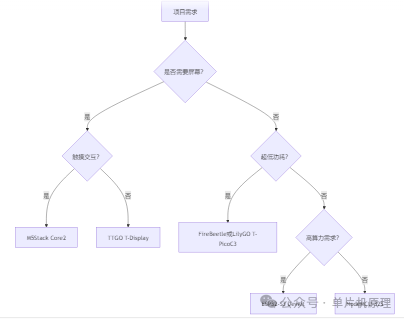
4. Recommended Typical Scenarios
1. Ultra-low Power Sensor Nodes
- PreferredFireBeetle ESP32Advantages:
// Dedicated low-power GPIO configuration pinMode(LOW_POWER_GPIO, INPUT_PULLDOWN); esp_sleep_enable_ext0_wakeup(LOW_POWER_GPIO, HIGH); - Deep sleep current <10μA (button battery can last 5 years)
- Dedicated low-power GPIO (supports RTC wake-up)
2. HMI Human-Machine Interaction Devices
- PreferredM5Stack Core2Advantages:
- 2-inch capacitive touch screen + six-axis sensor + microphone
- Modular expansion (camera, RFID module plug and play)
3. Wireless Communication Gateway
- PreferredTTGO T-BeamAdvantages:
- Dual antenna design (Wi-Fi + LoRa)
- Integrated GPS module (ublox MAX-7Q)
- 18650 battery compartment + solar charging interface
5. Hardware Design Pitfall Guide
-
Antenna Selection Trap
- PCB Antenna saves space but has low efficiency (-3dBi), avoid metal casing interference
- Ceramic Antenna must strictly follow manufacturer layout requirements (e.g., no copper around the ANT pin of FireBeetle)
- IPEX External Antenna increases cost but improves wall penetration capability by 2 times
GPIO Conflict Warning
- ADC2 and Wi-Fi do not occupy ADC2 channels (GPIO 0/2/4/12-15) when using Wi-Fi
// Error example (reading ADC2 after Wi-Fi starts):
adc2_config_channel_atten(ADC2_CHANNEL_0, ADC_ATTEN_DB_11); // This will fail!
Mass Production Transition Risks
| Development Board | Mass Production Difficulty | Recommended Alternative Module |
|---|---|---|
| NodeMCU-32S | High (CH340 chip) | ESP32-WROOM-UE |
| LilyGO T-PicoC3 | Medium (Type-C interface) | ESP32-C3-MINI-1 |
6. Advanced Recommendations (2023 New Models)
-
ESP32-S3-Box
- Dual-core 240MHz + 8MB PSRAM
- 2.4-inch LCD + microphone array + speaker
- Designed for voice AI (supports TensorFlow Lite)
Seeed Studio XIAO ESP32C3
- Ultra-mini size (21×17.5mm)
- Supports CircuitPython
- Deep sleep current 7μA
Selection Maxim:
- Power-sensitive → Choose FireBeetle or LilyGO RISC-V architecture
- Rapid Prototyping → M5Stack ecosystem dominates
- RF Performance Priority → Choose IPEX antenna interface + independent RF circuit design
- Mass Production Cost Control → Directly purchase official modules (ESP32-WROOM) + self-developed baseboard
ESP32 IoT CompassThree Days to Master Microcontrollers