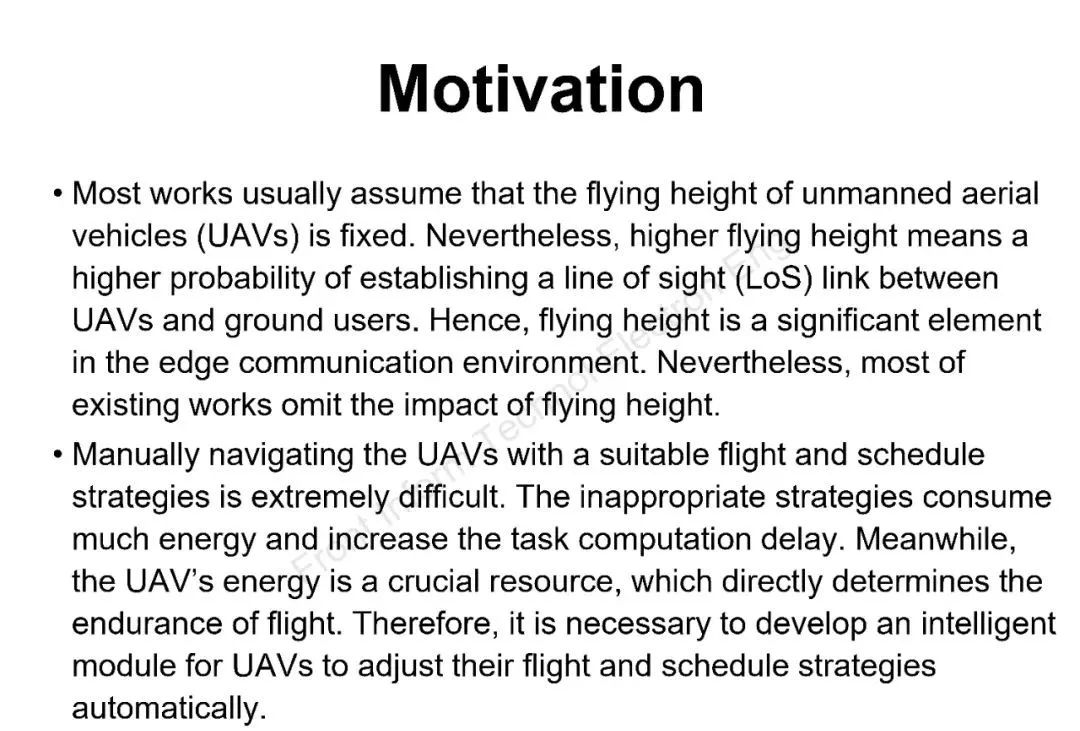
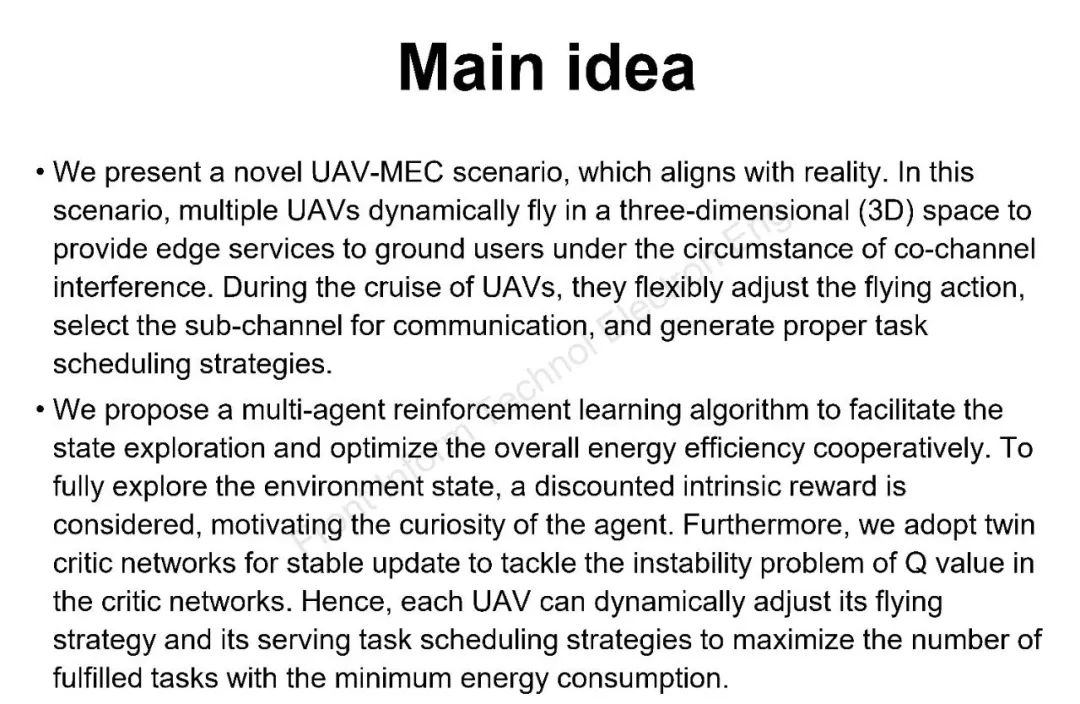
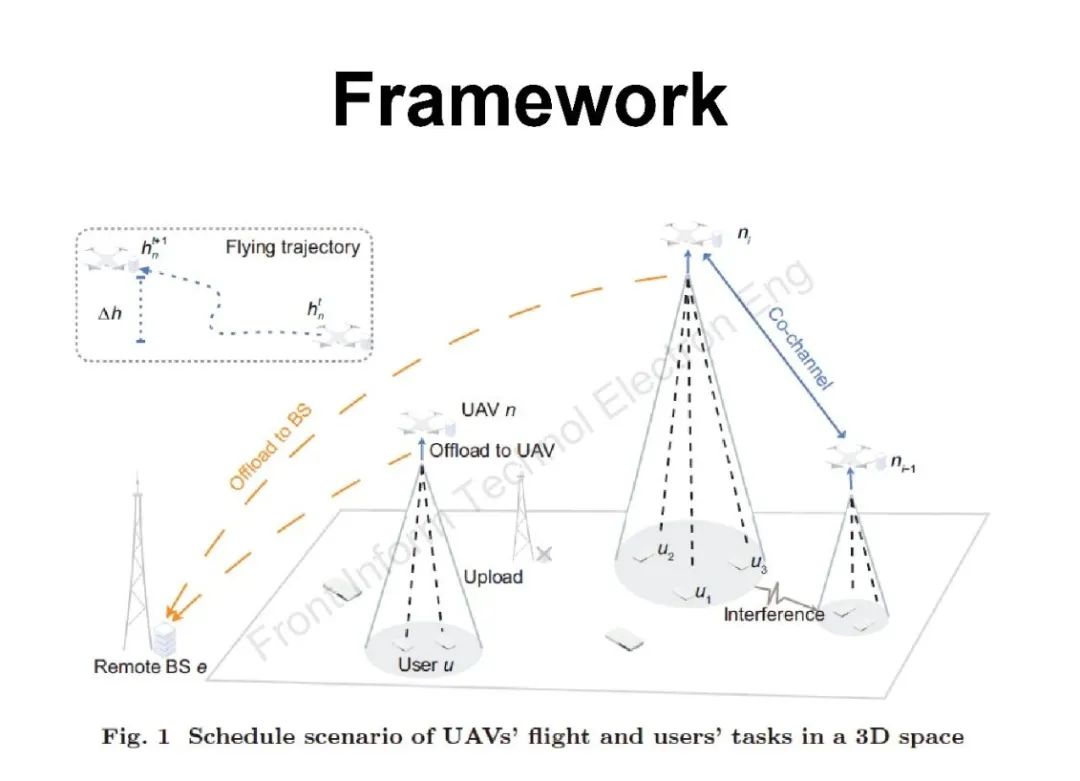
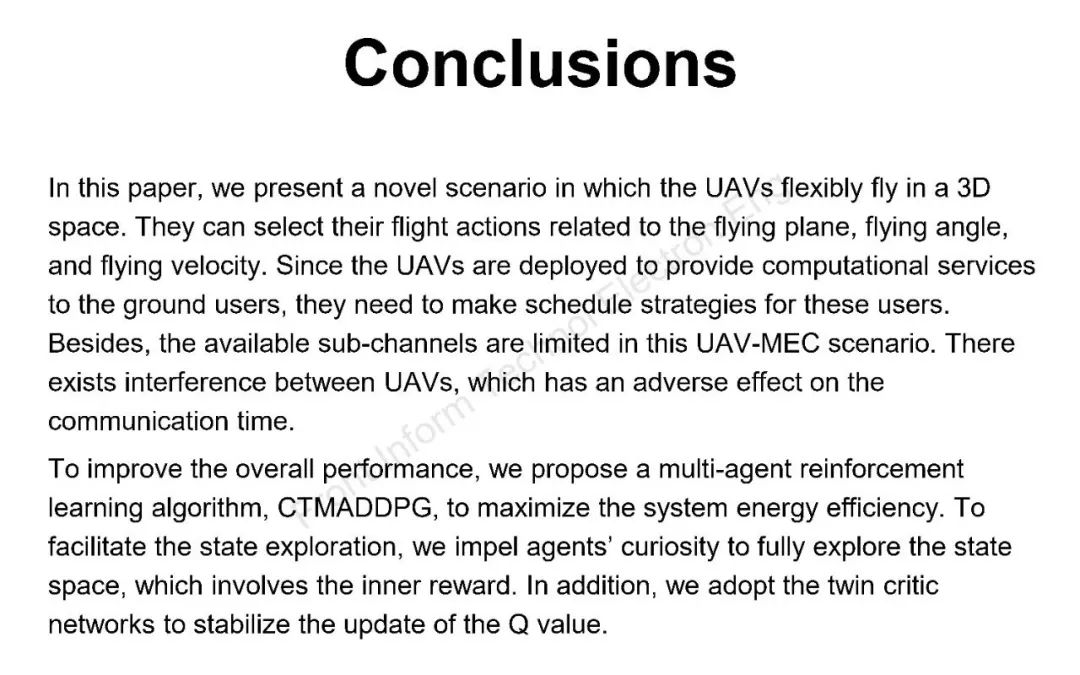
Abstract: In response to the computational needs of intelligent applications, multi-access edge computing (multi-access edge computing,MEC) provides computational services at the network edge. Unmanned aerial vehicles (unmanned aerial vehicle,UAV) possess excellent maneuverability and can serve as temporary aerial edge nodes to provide edge services for ground users within the MEC environment. However, the MEC environment is complex and dynamically variable, posing challenges in formulating suitable service strategies for multiple UAVs. Additionally, many existing UAV-MEC related works assume a fixed flight altitude for UAVs, operating within a two-dimensional plane, neglecting the importance of flight altitude. Under the premise of co-channel interference, this paper maximizes task completion through energy efficiency optimization, enabling multiple UAVs to collaborate in three-dimensional space to provide computational services for ground users. To achieve energy efficiency optimization goals, maximizing task completion while minimizing flight energy consumption requires the formulation of optimal flight strategies, sub-channel selection strategies, and task scheduling strategies. Based on the multi-agent deep deterministic policy gradient algorithm (multi-agent deep deterministic policy gradient,MADDPG), this paper proposes a curiosity-driven and twin-networks-structured multi-agent deep deterministic policy gradient algorithm (curiosity-driven and twin-networks-structured MADDPG,CTMADDPG) to address the aforementioned optimization issues, promoting agent state exploration through internal rewards and avoiding convergence to suboptimal strategies. Simultaneously, the use of dual critic networks reduces the probability of Q-value overestimation, achieving stable updates. Simulation results indicate that the CTMADDPG algorithm excels in maximizing overall system energy efficiency, outperforming other benchmark algorithms. Keywords:Multi-access edge computing; Multi-agent reinforcement learning; Unmanned aerial vehicle; Task schedulingAuthors:
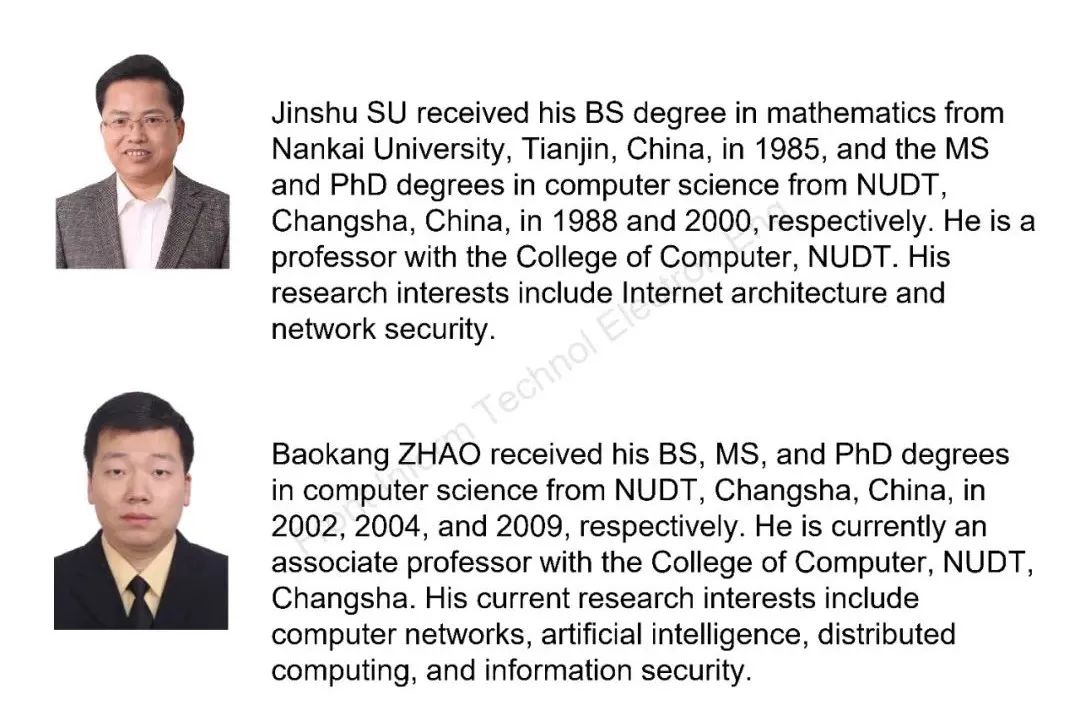
| Li Yang1, Wei Ziling1, Su Jinshu1,2, Zhao Baokang1
Affiliation: 1National University of Defense Technology, College of Computer Science, Changsha, China,410073 2Academy of Military Sciences, Beijing, China,100091
Reference format: Yang LI, Ziling WEI, Jinshu SU, Baokang ZHAO, 2024. A multi-agent collaboration scheme for energy-efficient task scheduling in a 3D UAV-MEC space. Frontiers of Information Technology & Electronic Engineering, 25(6):824-838.https://doi.org/10.1631/FITEE.2300393 |
Summary:


Scan the QR code below to read the full text: Hot Articles
1. Academician Pan Yunque | On Visual Knowledge
2. Academician Pan Yunque | Five Fundamental Questions of Visual Knowledge3. Academician Pan Yunque | On Visual Understanding4. Ma Yi, Shen Xiangyang et al. | On the Principles of Simplicity and Coherence in Intelligent Origins
5. Academician Duan Baoyan | Special Topic on the Evolution and Innovation of 5G and 6G Antenna System Technology
6. Academician Zhang Ping, Professor Peng Mugen et al. | Special Topic on Simplified Wireless Network Theory and Technology
7. Academician Wu Jiangxing’s Team | Discussion on the New Paradigm of Inherent Security in 6G Networks
8. Yang Yi and Zhuang Yueting from Zhejiang University et al. | Multiple Knowledge Representations Under Big Data Artificial Intelligence: Framework, Applications, and Case Studies
9. Su Jinshu and Zhao Baokang from National University of Defense Technology et al. | Development Trends of Network Technology in Large-Scale Efficient Network Computing
10. Ye Peijun and Wang Feiyue from the Institute of Automation, Chinese Academy of Sciences et al. | Parallel Cognition: Towards Human-Machine Interaction and Management of Mixed Intelligence
11. Wang Feiyue from the Chinese Academy of Sciences, Zhang Jun from Wuhan University et al. | Knowledge Automation and Hybrid Augmented Intelligence in Human-Machine Mutual Trust: Cognitive Control Mechanisms for Complex Systems and Their Applications
12. Liu Zhiming from Southwest University and Wang Ji from National University of Defense Technology | Human-Machine-Object Integration Systems: Concepts, Challenges, and Research Opportunities
13. Hu Jinwen from Northwestern Polytechnical University et al. | Research on Obstacle Detection of Intelligent Vehicles Based on Multi-Sensor Fusion in Outdoor Environments
14. Zhang Jianhua et al. from Beijing University of Posts and Telecommunications | Channel Measurement and Modeling for 6G: Current Status and Prospects
15. Wang Haonan and Li Dongsheng from National University of Defense Technology et al. | Overview of Deep Reinforcement Learning
16. Niu Zhongqian and Zhang Bo from University of Electronic Science and Technology of China et al. | Mechanical Reliability Study of 3-dB Branch Waveguide Directional Couplers in the Submillimeter and Terahertz Band
17. Lu Jianquan from Southeast University et al. | Binary Asynchronous Pulse Tracking Consistency of Multi-Agent Systems
18. Da Kai from National University of Defense Technology and Li Tiancheng from Northwestern Polytechnical University et al. | Research Progress on Multi-Sensor Multi-Target Tracking Based on Random Finite Sets
19. Xie Ying and Ma Jun from Lanzhou University of Technology et al. | Phase Synchronization and Energy Balance Between Neurons
20. Zhang Kaiqing et al. from the University of Illinois | Progress in Decentralized Multi-Agent Reinforcement Learning with Networked Agents
21. Branislav REHÁK et al. | Leader-Follower Synchronization of Multi-Agent Systems with Heterogeneous Delays
22. Xiao Renbin et al. from Huazhong University of Science and Technology | Firefly Algorithm for Role Division in Complex Optimization Scheduling
23. Wen Guanghui et al. from Southeast University | Research Progress on Distributed Economic Scheduling in Smart Grids: A Review
24. Bu Mingxuan and Pi Xiaodong from Zhejiang University | Semiconductor Nanocrystal-Based Synaptic Devices
25. Yu Junzhi et al. from Peking University | Visual Detection Algorithm for Underwater Garbage Cleaning Robots Based on Improved YOLOv4
26. Zhou Jie and Zhang Junping from Fudan University | ChatGPT: Potential, Prospects, and Limitations
27. Zhang Ping, Xu Xiaodong, Dong Chen, Niu Kai from Beijing University of Posts and Telecommunications et al. | Modulation Division Multiple Access Technology for Semantic Communication28. Xu Chi and Yu Haibin from the Institute of Automation, Chinese Academy of Sciences et al. | Industrial Wireless Network Edge Collaboration Resource Allocation Based on Multi-Agent Deep Reinforcement Learning29. Wang Yuying and Li Jindong from the China Academy of Space Technology et al. | Progress in Space Applications of Medium and Long-Wave Infrared Detection Technology30. Xiao Renbin from Huazhong University of Science and Technology: Four Development Stages of Collective IntelligenceJournal UpdatesThe China Association for Science and Technology has released the “Comprehensive Directory of High-Quality Science and Technology Journals,” and FITEE has been selected for the T1 directory in the information and communication field!The first Youth Academic Frontier Forum in the field of Information and Electronic Engineering was successfully held, led by Academician Duan Baoyan.2021 latest impact factor announced FITEE has exceeded 2.0 for the first timeFITEE impact factor increased by 55%, entering Q2 zone for the first timeFITEE released the first list of outstanding papers/topics and distinguished editorial board members/communication experts! FITEE editor-in-chief and editorial board article list (2019.1~2021.8)FITEE communication expert article list (2019.1~2021.8)Focusing on advanced integrated circuit technology and industrial innovation, the 5th issue of the “China Academy of Engineering Information and Electronic Engineering Frontier Forum” was successfully held! The China Academy of Engineering released 10+10 global engineering frontiers in the field of information electronicsFITEE WeChat has launched a new feature, allowing users to read each issue’s Chinese and English abstracts and full texts without downloading PDFsFrontiers of Information Technology & Electronic Engineering (FITEE) Second Expanded Meeting of the Second Editorial Board was successfully held. The first appointment ceremony for FITEE communication experts and the first meeting were held at Zhejiang UniversityThe first meeting of the second editorial board of FITEE was held at Zhejiang University
About this Journal
Frontiers of Information Technology & Electronic Engineering (abbreviated as FITEE, Chinese name 《信息与电子工程前沿(英文)》, ISSN 2095-9184, CN 33-1389/TP) is a comprehensive English academic monthly journal in the field of information electronics, indexed in SCI-E and EI, with the latest impact factor of 2.7, ranked in the JCR Q2 zone. It was formerly known as the English edition C of the Journal of Zhejiang University: Computer and Electronics, founded in 2010, and was renamed in 2015. It is now a sub-journal of the Chinese Academy of Engineering’s journal in the field of information and electronic engineering. It covers fields such as computer science, information and communication, control, electronics, and optics. Article types include research papers, reviews, personal viewpoints, and commentaries. The current editor-in-chief is Academician Pan Yunque and Fei Aiguo of the Chinese Academy of Engineering. The journal implements an international peer review system, with initial feedback generally provided within 2-3 months. Once accepted, articles will be published online quickly.
In 2019, it was funded by the Excellent Action Plan for Chinese Science and Technology Journals launched by the China Association for Science and Technology and other seven ministries (Tiered Journals).From 2021 to 2022, it was selected for the high-quality science and technology journal grading directory in the information communication field (organized by the China Communication Society) and the computing field (organized by the China Computer Society), both listed as the highest T1 level; and selected for the recommended international academic conference and journal directory of the China Computer Society – 2022 (cross-disciplinary/comprehensive/emerging).
Official website:http://www.fitee.zjujournals.com
Springer journal homepage:
http://www.springer.com/computer/journal/11714
Submission:http://www.editorialmanager.com/zusc
Postal Publication Code: 32-324
Address: 148 Tianmushan Road, Xihu District, Hangzhou, Zhejiang Province, China
Phone: +86-571-88273162
Email: [email protected]
WeChat GroupTo facilitate communication and discussion among researchers, this platform has established the following subject WeChat groups. Users who need to join a group, please add the editor’s personal WeChat ID fitee_xb and leave a message indicating your institution and the group you wish to join. The editor will add you to the group. Marketing and advertising personnel, please do not disturb.
|
Computer Science and Technology Group |
Optical Engineering and Technology Group |
|
Control Science and Technology Group |
Information and Communication Group |
|
Electronics Discussion Group |
Artificial Intelligence Group |
Follow Us ID: fitee_caeThis official WeChat account is for the journal Frontiers of Information Technology & Electronic Engineering (SCI-E, EI indexed journal), with functions including: disseminating academic articles from the journal; providing convenient services for associated scholars (readers, authors, reviewers, editorial board members, etc.); publishing information related to academic writing, reviewing, editing, and publishing; introducing academic figures, thoughts, and achievements in the field of information and electronic engineering, showcasing cutting-edge progress in scientific research in this field; and providing a friendly interactive platform for scholars at home and abroad in this field.