
Click the blue textto follow us
In the wave of deepening the reform of the three systems of state-owned enterprises, the Beijing Institute of Automation Control Equipment (hereinafter referred to as the “Institute”), as a core unit engaged in inertial control technology research under the China Aerospace Science and Industry Corporation, deeply realizes that activating the innovative potential of talents is key to maintaining core competitiveness. Faced with thousands of research and management personnel distributed across various locations, traditional performance management methods face severe challenges in precision, efficiency, and collaboration. Therefore, the Institute actively seeks change, combining Objectives and Key Results (OKR) with 360-degree assessments, embarking on a digital transformation journey in performance management, injecting new momentum for high-quality development.
01
Based on Aerospace Mission, Anchoring New Direction for Performance Reform
Founded in 1965, the Institute currently has over 2,800 employees distributed in Beijing, Zhuozhou, Qingdao, Chengdu, and other locations. It is a professional research institute for navigation and control systems that integrates research design, testing, and production. With the expansion of business scale and the increasing complexity of research tasks, the original 360-degree assessment model, which mainly relied on qualitative evaluation, although advantageous in comprehensive evaluation, has shown signs of fatigue in quantifying employee job performance and accurately aligning with strategic goals. Meanwhile, the “sparks” of innovation from researchers need to be captured and incentivized more agilely, and the large-scale organizational operation requires more efficient management collaboration, while the implementation of strategic goals needs clearer path decomposition.
Based on this, the Institute has established a performance management reform direction guided by the principles of “goal-oriented, scientific evaluation, positive incentives, and continuous improvement.” The core lies in introducing the OKR concept, combined with the original 360-degree assessment,to construct a PDCA closed loop of “performance goal setting – performance execution and communication – performance assessment – result application”. This system aims to scientifically evaluate employee job performance and comprehensive capabilities while highlighting the role of positive incentives, ensuring that organizational goals and individual goals resonate in harmony, providing solid support for the “talent-driven enterprise” strategy.
02
Digital Empowerment, Reshaping the New Ecology of Performance Management
After clarifying the reform direction, the Institute partnered with Hongjing Company to localize the deployment of the human resources system, migrating the entire performance management process online, achieving a leap from “experience-driven” to “data-driven”.
Goal Collaboration
Strategic Implementation “Runs Through”
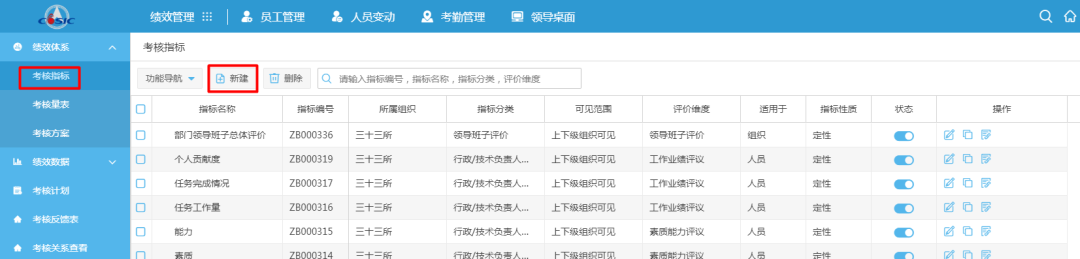
On the digital platform, the formulation of performance goals has become clear and collaborative. At the beginning of the year, employees online set an “Annual Performance Goal Responsibility Document” containing 3-5 key objectives. The formulation process is flexible, with participation from both superiors and subordinates to ensure that the goals are focused, feasible, and mutually recognized. At the end of each quarter or year, the completion status of the goals is filled out, and assessors evaluate based on the completion status. Through this mechanism, strategic intentions can be accurately conveyed to every employee, achieving a “through-and-through” management approach.
Precision Assessment
Evaluation Dimensions “Have Depth and Breadth”
For different job sequences, the system can set different weights for differentiated configuration. For departmental administrative leaders, the assessment focuses on annual performance, evaluated by the main leaders of the institute and the leaders in charge, combined with a 360-degree comprehensive evaluation; for other leaders and ordinary employees, quarterly assessments are implemented, with participation from their direct superiors, peers, and subordinates.
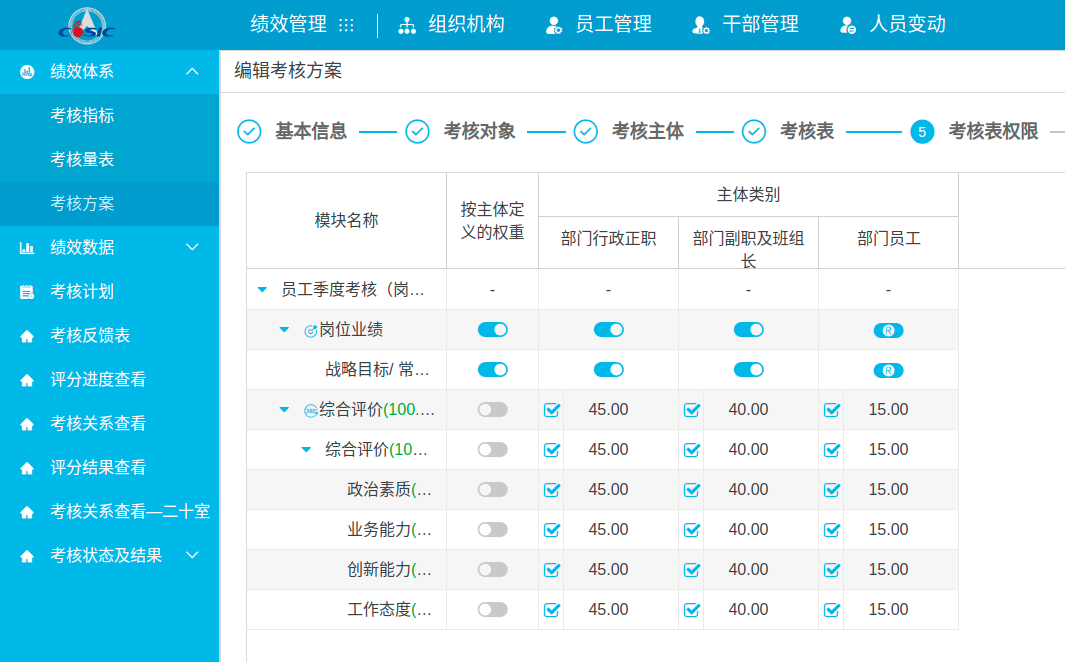
The system has set calculation formulas based on performance policies: The performance evaluation of leaders emphasizes both performance and comprehensive evaluation (each accounting for 50%), while ordinary employees emphasize performance contribution more (performance accounts for 70%). This “depth and breadth” evaluation system, combined with the system’s flexible weight configuration function, ensures precision and fairness in assessments.
Intelligent Processes
Management Efficiency “Accelerates”
Based on digital tools, the productivity of performance management at the Institute has been greatly enhanced.
Smart To-Do and One-Click Operations

After the assessment is initiated, tasks are automatically pushed to the relevant personnel’s to-do list. Managers can give a “one-click score” to subordinates and then make individual adjustments, significantly increasing efficiency when dealing with multiple team members.
Dynamic Monitoring and Real-Time Feedback

The HR department can monitor the entire process of goal reporting, progress updates, and assessment scoring status, promptly identifying issues and intervening. Employees can also check their goal progress and feedback at any time, significantly enhancing participation and transparency.
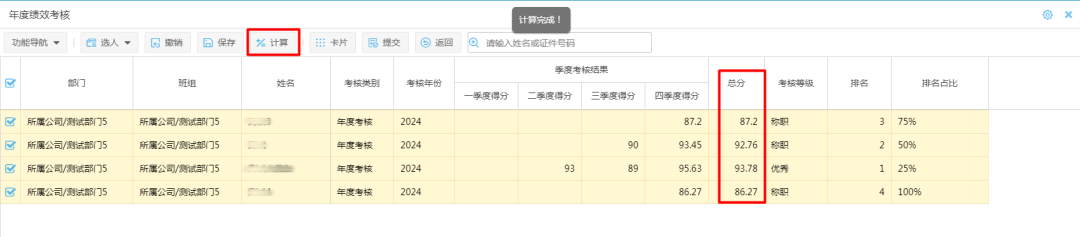
Automated Result Calculation and Archiving

The system automatically summarizes quarterly scores, generating annual results based on established formulas (e.g., annual score = average score of the first three quarters × 20% + fourth quarter score × 40%) and archives them automatically, eliminating human error and ensuring the authority and traceability of the data.
Regular Communication
Performance Coaching “Precisely in Place”
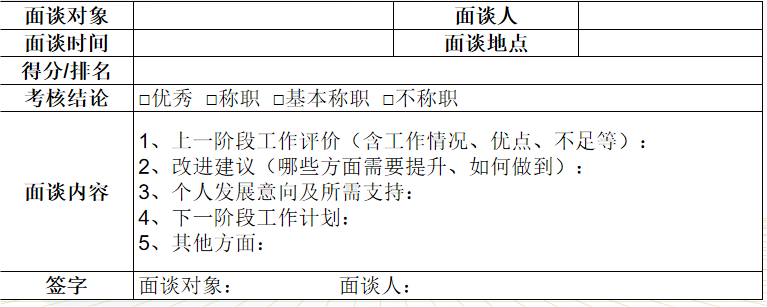
Relying on the digital platform,the Institute has established a regular performance coaching communication mechanism: Performance discussions for leaders are organized by the HR department, held at least once a year; annual and regular performance discussions for employees are organized by the party and government leaders, with a principle of at least two times a year (including one annual performance result feedback).
The built-in “Employee Performance Discussion Record” in the system achieves structured management of communication content, ensuring that key information such as previous work evaluations, improvement suggestions, next steps, and resource needs are clearly recorded and retained. Managers can track the progress of subordinates’ goals online in real-time, promoting the shift of performance coaching from an annual “one-time task” to agile and precise “continuous interaction,” effectively enhancing management penetration and employee recognition.
Application Effectiveness
Talent Vitality “Fully Flows”
Performance assessment results are no longer “dormant files” but have become “vital factors” directly linked to employees’ personal interests and development prospects. The system supports the precise application of assessment results in various scenarios such as promotions (positions, qualifications), incentives (performance bonuses, annual salary adjustments), training (capability enhancement and gap filling), and dismissal of incompetent employees.
Especially for performance bonus distribution, the system automatically applies formulas based on performance coefficients and year-end assessment scores,achieving precise incentives of “rewarding the excellent and punishing the poor”. For incompetent employees, assessment data provides the basis for “able to enter and exit”; for example, if an employee is assessed as incompetent for two consecutive quarters, or fails the annual assessment, or is assessed as basically competent for two consecutive years, the processes for suspension, reassignment, or even contract termination can be initiated, ensuring a healthy cycle of the talent pool.
03
Value Demonstration, Initial Achievements of Intelligent Performance
Through digital transformation, the performance management of the Institute has achieved a leap from “control-based” to “empowerment-based”.
Management Efficiency Multiplied: Standardization and automation of processes have liberated HR personnel from heavy transactional work, allowing them to engage in more valuable strategic support roles.
Employee Experience Optimized: Real-time online goal feedback and regular performance discussion mechanisms enable employees to receive timely guidance and recognition during their work processes. The structured discussion records and continuous tracking in the system ensure effective implementation of communication content and orderly advancement of improvement plans, enhancing management transparency and employee growth.
Organizational Resilience Enhanced: The “through-and-through” supervisory capability allows leaders to clearly perceive the performance pulse of the organization, providing real-time and accurate data support for strategic decision-making, significantly strengthening organizational compliance management and strategic execution.
04
Future Outlook: A New Journey from Digitalization to Intelligence
Looking ahead, the Institute will further deepen data analysis and application, exploring the use of big data and artificial intelligence technologies to mine talent growth patterns from historical performance data, predict team and individual performance trends, and provide intelligent decision support for talent inventory, echelon construction, and personalized training. At the same time, the Institute will continue to optimize system experience, deepen performance communication and cultural shaping, and build an intelligent performance ecosystem that involves all employees, continuous feedback, and co-growth, providing solid talent support for building a world-class professional research institute in navigation and control technology.

Previous Recommendations
-
Breaking the Deadlock of Title Reform: The National Think Tank Financial Science Institute Reshapes the Talent Evaluation Ecology
-
Digital Empowerment Expedition: PowerChina International Constructs a New Paradigm of Global Project Performance Management
-
Digital Navigation | Breaking the “Only” and Establishing the “New” – The Digital Transformation Path of Talent Evaluation in Research Institutes
-
From the 93rd National Day Parade, Observing New Thinking on the Digital Transformation of Human Resources in State-Owned Enterprises