
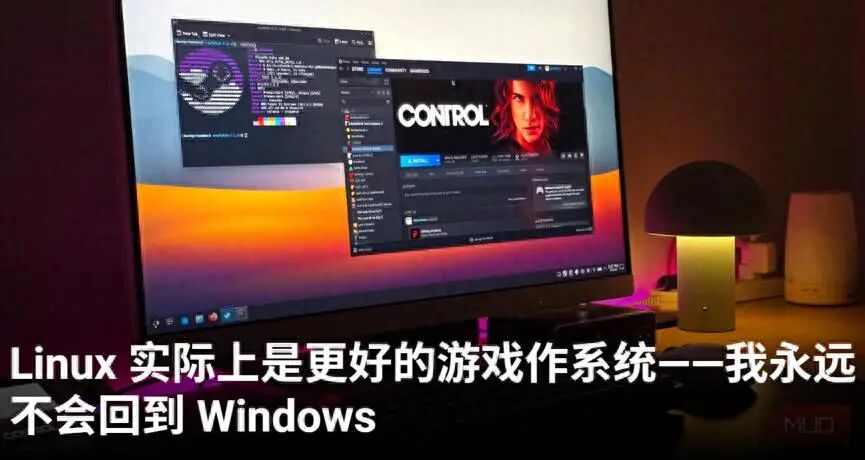
Recent tests and evaluations show that in certain handheld gaming scenarios, the Linux-based SteamOS (built on Arch Linux, combined with components like Proton/DXVK) achieves frame rates that even surpass those of the Windows version running on the same hardware for games originally designed for Windows. This phenomenon challenges the long-held perception that “Windows systems have a long-standing advantage in native gaming performance” and prompts many players and developers to reassess the potential for cross-platform compatibility.
Testing Background and Comparison Subjects
– Hardware Environment: Represented by devices like the ASUS ROG Ally, equipped with an AMD Ryzen Z1 Extreme (Zen4 architecture), 12 CU RDNA3 graphics card, and 16GB 6400 MT/s LPDDR5 memory, which is considered mainstream for handheld devices.
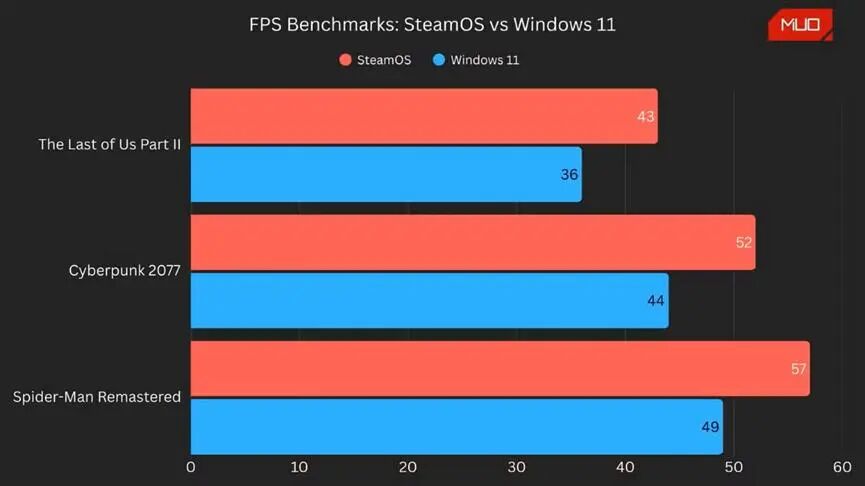
– Test Subjects: A comparison of three representative “blockbuster” games running on the same platform: Windows 11 and SteamOS (SteamOS + Proton/DXVK): “The Last of Us Part II”, “Cyberpunk 2077”, and “Spider-Man: No Way Home”.
– Key Results: In the comparison of these three titles, the average frame rates in the SteamOS (Linux) environment were approximately 16%, 18%, and 19% higher than those in Windows 11, with an overall advantage of about 18%.
Results Interpretation and Underlying Principles
– The Core Role of Compatibility Layers
– Proton on Linux translates Windows API calls into calls that Linux can understand through Wine, while DXVK translates DirectX commands into Vulkan commands, and VKD3D-Proton further maps some Direct3D functionalities to Vulkan.
– The optimization and deep integration of this chain is one of the key factors for achieving high frame rates in the Linux version in specific scenarios, especially when Vulkan drivers are mature and GPU drivers are well-optimized.
– Why is there a “higher than native Windows” situation?
– Differences in driver and graphics stack optimization: On certain hardware and driver combinations, the Vulkan route on Linux and the implementation of DXVK can utilize GPU scheduling more efficiently.
– System overhead and background load: In handheld environments, Windows’ background services, system updates, and power policies may have a perceptible impact on gaming performance at certain times; the lightweight and customizable nature of Linux may lead to more stable frame timing.
– Limitations to Emphasize
– The sample size of the cases is typically small and mostly limited to handheld environments and specific hardware combinations. The results from a single environment cannot be directly generalized to all PCs or laptops.
Modern games’ support for different driver versions, DX11/12/Vulkan, as well as varying resolutions/quality settings can significantly affect comparison results. Therefore, the conclusion should be understood as “under specific conditions, the Linux+Proton+DXVK stack shows considerable performance for these three representative blockbusters and may outperform Windows in certain situations,” rather than “Linux is superior to Windows in all cases.”
Implications for Players, Developers, and Manufacturers
– For Players
– The cross-platform experience in handheld and small desktop scenarios is improving. If you have the opportunity to try it, the combination of SteamOS and Proton is worth exploring, especially when GPU drivers and Vulkan optimizations are in place, which may lead to a smoother experience.
– However, be aware of individual case differences: different hardware, games, resolutions, and settings can alter results. It is recommended to conduct actual performance tests of your games before upgrading or changing systems.
– For Developers and Publishers
– Cross-platform compatibility, driver collaboration, and ongoing adaptation to DXVK/VKD3D-Proton are key directions for enhancing cross-system experiences. Transparency in official documentation and community tools, as well as rapid adaptation to new hardware, are particularly important.
– It is necessary to clearly define the scope of “relative performance improvements” in promotional materials to avoid misleading statements about “universal conclusions.”
– For Platform and Manufacturer Ecosystems
– The growth of the Linux gaming ecosystem relies on Valve’s continued investment (such as iterations of Proton, community contributions to Wine, and support from hardware manufacturers for Linux drivers).
– In terms of short-term strategies on the Windows side, manufacturers should focus on the long-term value of cross-platform experiences rather than promoting based on a single result from a comparison.

Potential Controversies and Media Responsibility
– Data Sources and Reproducibility: Such comparisons often come from individual bloggers’ tests or specific media reports, and results may vary due to differences in driver versions, system settings, and test cases. It is recommended to indicate key parameters such as testing environment, version numbers, and resolutions in reports to facilitate readers in reproducing the experiments.
– Caution in Content Presentation: Avoid conclusive statements like “Linux completely surpasses Windows”; emphasize that “under specific scenarios and particular hardware combinations, the compatibility layers of the Linux ecosystem show significant performance potential.”
Conclusion: The Boundaries of Cross-Platform Are Blurring
This set of comparisons reflects a trend: through efficient compatibility layers, optimized cross-platform graphics stacks, and more flexible system customizations, Linux indeed shows strong competitiveness in gaming performance in certain scenarios, even surpassing native Windows in specific environments. For players, this is a measurable testing option; for developers and manufacturers, it is a new driving force for promoting cross-platform collaboration and optimization.
Sources and Acknowledgments
– Public reports and evaluation summaries (including but not limited to MakeUse Of, SteamOS community discussions, and comparative reports from relevant media). For formal releases, please refer to official comparative data and authoritative third-party benchmarks, and indicate testing environments and parameters.