ECU (Electronic Control Unit) is the core component of the automotive electronic system, primarily used to receive sensor signals, process data, and control actuator actions. It contains various electronic components, which can be categorized into the following functional modules: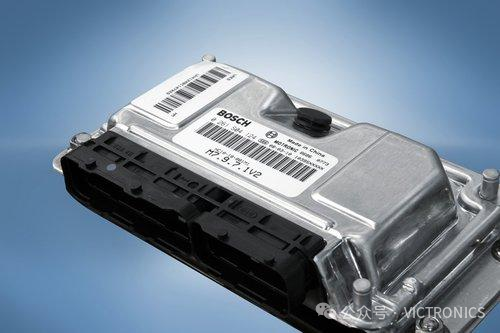
1. Core Processing Module
Microcontroller (MCU)
Function: The “brain” of the ECU, responsible for computation, logic control, and data processing.
Type: Automotive-grade MCU (e.g., Infineon AURIX, Renesas RH850, NXP S32K series), featuring high reliability, anti-interference capability, and real-time processing ability.
Memory
ROM (Read-Only Memory): Stores the control programs and fixed parameters (e.g., engine MAP maps) of the ECU, commonly used types include Flash ROM (erasable).
RAM (Random Access Memory): Temporarily stores operational data (e.g., real-time sensor signals, intermediate calculation values), data is lost when power is off.
EEPROM (Electrically Erasable Programmable ROM): Stores data that needs to be retained when power is off (e.g., fault codes, user configuration parameters).
2. Signal Input Processing Module (Sensor Interface)
Signal Conditioning Circuit Components
Operational Amplifier (Op-Amp): Amplifies weak signals output from sensors (e.g., voltage signals from temperature sensors, pressure sensors).
ADC (Analog-to-Digital Converter): Converts analog signals (e.g., throttle position sensor output) into digital signals for processing by the MCU, some MCUs integrate ADC, while external independent ADC chips may also be used (e.g., TI‘s ADS series).
Filter Components: Resistors, capacitors, and inductors form filter circuits to eliminate noise interference in signals.
Voltage Regulator Diodes/Zener Diodes: Protect circuits from transient voltage spikes, ensuring stable sensor signals.
Special Interface Chips
Used to process specific sensor signals, such as wheel speed sensor interface chips (handling magnetic or Hall effect sensor signals); temperature sensor interface chips (e.g., NTC thermistor matching circuits).
3. Power Management Module
Voltage Regulators
DC-DC Converters: Converts the vehicle battery’s 12V/24V voltage to the stable voltages required by the ECU, such as 5V and 3.3V, commonly using LDO (Low Dropout Regulator) or switching power supply chips (e.g., TI‘s LM2576, TPS series).
Power Monitoring Chips: Monitor power voltage, triggering reset or protection mechanisms when voltage anomalies occur.
Protection Components
TVS Diodes (Transient Voltage Suppressor Diodes): Suppress surge voltages in vehicle circuits (e.g., back EMF during startup).
Fuses/ Self-resetting Fuses: Prevent overcurrent from damaging internal circuits.
ESD Protection Devices: Protect against electrostatic discharge damage to chips.
4. Drive Output Module (Actuator Interface)
Power Driver Devices
MOSFET (Metal-Oxide-Semiconductor Field-Effect Transistor): Used to control low-power actuators (e.g., injectors, solenoids), with fast switching speeds and low power consumption.
IGBT (Insulated Gate Bipolar Transistor): Drives high-power loads (e.g., motors, heaters), combining the advantages of MOSFETs and transistors.
Relay Driver Chips: Control relay coil on/off, indirectly driving high-power devices such as headlights and compressors.
Current/ Voltage Drive Circuits
Continuity circuits made of resistors and diodes (to prevent back EMF damage to chips when inductive loads are powered off), such as flyback diodes across relay coils.
5. Communication Interface Module
CAN Bus Chips
CAN Controllers: Some MCUs are integrated, while external independent controllers can also be used (e.g., Philips‘s SJA1000);
CAN Transceivers: Convert the logic levels of the MCU to differential signals on the CAN bus, commonly used chips include TI‘s SN65HVD230 series.
Other Communication Interfaces
LIN Bus Chips: Used for low-speed communication (e.g., door control modules);
SPI/I2C Interface Chips: For communication between internal modules or with external sensors (e.g., EEPROM, real-time clock chips);
Some ECUs include USB and Ethernet interfaces (e.g., in-vehicle network control units).
6. Clock and Crystal Oscillator
Crystal Oscillator (Quartz Crystal Oscillator): Provides stable clock signals for the MCU, ensuring accurate timing for computation and communication, common frequencies include 8MHz and 16MHz.
RC Oscillators: Used as backup clocks in some scenarios, with lower power consumption but less accuracy than crystal oscillators.
7. Passive Components and Auxiliary Devices
Resistors, Capacitors, Inductors
Resistors: Voltage division, current limiting, biasing;
Capacitors: Filtering, decoupling, energy storage;
Inductors: Power filtering, EMI suppression (e.g., common mode inductors).
EMI Suppression Components
Ferrite beads, EMI filters: Reduce ECU radiation interference while suppressing external electromagnetic interference on internal circuits.
Connectors and Plugs
Used for connecting the ECU to external wiring harnesses, such as pin connectors and waterproof plugs, ensuring reliable transmission of signals and power.
8. Other Special Components (Depending on ECU Type)
Security Chips: Some high-security ECUs (e.g., autonomous driving domain controllers) include hardware encryption chips to prevent program tampering or data leakage.
Temperature Sensors: Monitor the internal temperature of the ECU, triggering protection mechanisms when overheating occurs.
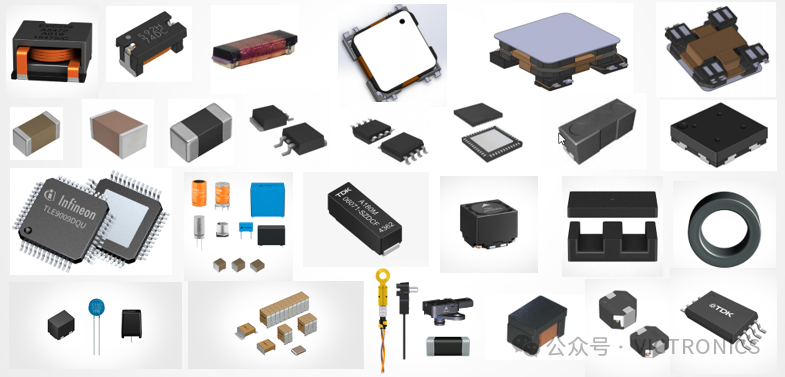
Selection of components for the ECU must meet automotive-grade standards (e.g., AEC-Q100/101/200 certification), featuring high-temperature resistance, vibration resistance, and electromagnetic interference resistance. The core is to achieve precise control of various automotive systems through “sensing– processing– execution” closed-loop control.
For quality reading on our public account, click the following links:Summary of 40 major electronic component distributors in Europe and America30 packaging forms of MOSFETsMajor global connector manufacturersIGBT iterations and 45 global IGBT single tube and module manufacturersInfineon and Siemens’ past collaborationsIf you want to know more information, feel free to leave a message in the comments.Welcome to scan and follow us Note: The images related to this article are sourced from the internet. If there is any infringement, please contact the author for removal. Please correct any errors in the related content. Reproduction without permission is prohibited.