With the rapid popularization of smart connected vehicles, the In-Vehicle Infotainment (IVI) system is no longer a simple audio and video playback platform, but a complex system that integrates multiple technologies, terminals, and scenarios, becoming the core “brain” of the smart cockpit. This article will detail the key technology implementation paths, architectural evolution trends, and future innovation directions based on a typical IVI system architecture, taking you deep into the technical core behind the smart cockpit.
IVI SystemOverall Technical ArchitectureCONTENT
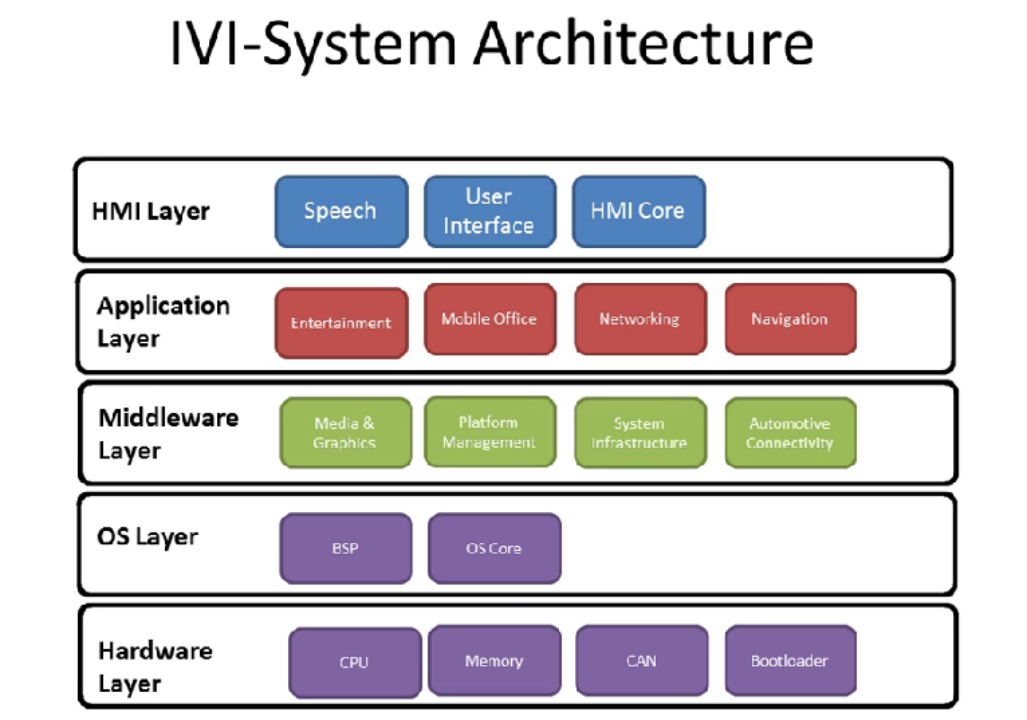
The overall architecture of the In-Vehicle Infotainment system can be divided into five layers: hardware layer, operating system layer, middleware layer, application layer, and human-machine interaction layer (HMI Layer), with the functions of each layer as follows:
Hardware Layer
Includes the computing core (CPU), memory module, in-vehicle communication bus (CAN), and bootloader. The hardware layer builds the basic computing and communication platform of the system, ensuring efficient and stable data processing and peripheral connections.
Operating System Layer (OS Layer)
Composed of the hardware support package (BSP) and the operating system core, responsible for low-level hardware management, driver control, and system resource scheduling, ensuring real-time performance and multitasking concurrency.
Middleware Layer (Middleware Layer)
Includes media and graphics processing, platform management, system infrastructure, and automotive networking functions, serving as a bridge connecting the underlying hardware and upper-layer applications, responsible for unified interfaces, service management, and system security.
Application Layer (Application Layer)
Hosts core applications such as entertainment, multimedia office, network connectivity, and navigation, directly providing users with diverse services and functions.
Human-Machine Interaction Layer (HMI Layer)
Covers voice interaction, user interface design, and core HMI modules, providing multimodal interaction methods to achieve efficient communication between users and the system.
 Core Computing of IVI SystemPlatform and System Software FoundationCONTENT
The technical foundation of the IVI system lies in a highly integrated computing platform and a secure and reliable software architecture. This is reflected in the following aspects:
High Integration SoC Platform Application
Current mainstream IVI systems widely adopt automotive-grade system-on-chip (SoC) solutions, such as Qualcomm Snapdragon 8155/8295, NVIDIA Orin series, Huawei Kirin A2, and Horizon Journey 3, etc. These SoCs integrate multi-core CPUs, powerful GPUs/self-developed BPUs (Horizon), dedicated NPUs, and multimedia processing units, capable of supporting high-definition video encoding/decoding, multi-screen interaction, and local complex neural network inference, meeting the smart cockpit’s demands for high computing power and multitasking. For example, the IVI system of the Li Auto L9 model is based on the Qualcomm Snapdragon 8155 SoC as the core hardware platform, which features an 8-core Kryo CPU and Adreno 640 GPU, providing excellent multimedia and AI computing power. The L9’s IVI system supports seamless collaboration and partition control of five high-definition displays, including the central control, co-driver, instrument panel, HUD, and rear seat, allowing for independent display as well as interconnected interaction. The system utilizes a powerful Hexagon AI engine to support a full vehicle multi-microphone array for far-field voice recognition, enabling multi-turn dialogue, dialect recognition, and multi-task voice control, allowing users to efficiently operate multiple applications such as air conditioning, music, and navigation simultaneously.
Advantages of Heterogeneous Computing Architecture
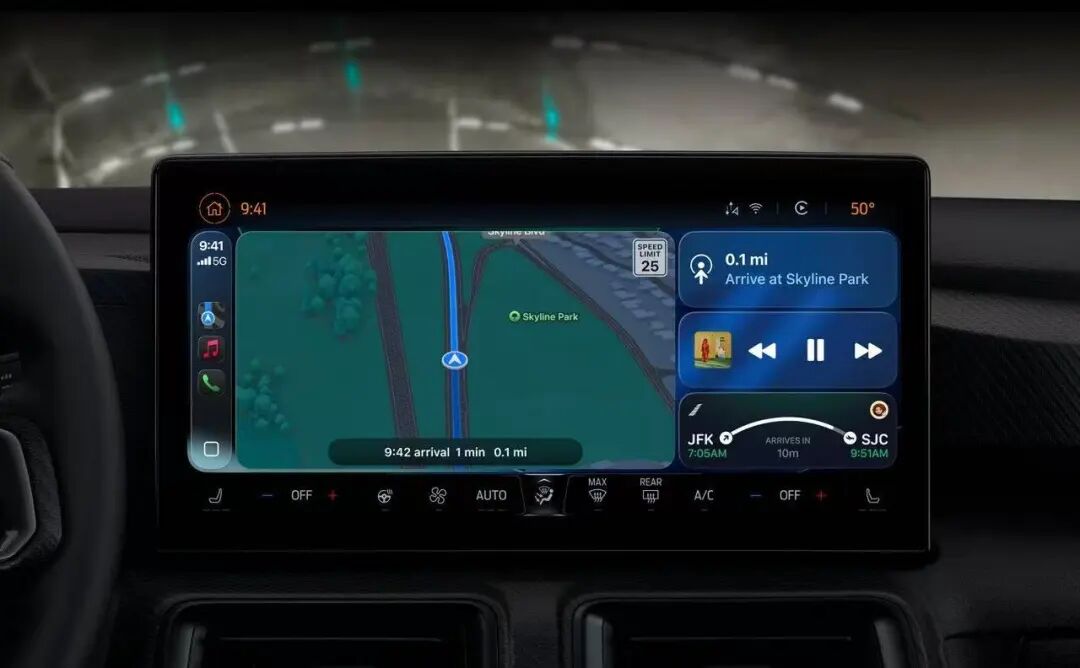
Modern IVI core platforms adopt heterogeneous computing architectures, with CPUs focusing on system scheduling and general computation, GPUs responsible for graphics rendering and 3D interface acceleration, and NPUs specifically handling AI inference tasks such as voice recognition and gesture control. Meanwhile, co-processors process in-vehicle sensor inputs in real-time, achieving data fusion and rapid response, significantly enhancing system efficiency and multitasking capabilities. For instance, the IVI system of the NIO ET7 model is based on the intelligent cockpit platform powered by NVIDIA Orin X. The Orin SoC integrates a 12-core ARM CPU, 2048 CUDA core GPU, and multiple deep learning acceleration units (DLA), with an overall AI computing power of up to 254 TOPS. The system can simultaneously process massive data from multiple high-definition cameras, radars, and microphone arrays, enabling synchronized multi-screen content, 3D virtual instruments, high-precision AR navigation, and multimodal emotional interaction.
High-Performance In-Vehicle Memory and Storage Design
To ensure the long-term stable operation of the system in harsh environments, mainstream IVI platforms are equipped with high-speed LPDDR4/5 memory and UFS/eMMC flash storage. These storage devices not only possess automotive-grade characteristics such as high-temperature resistance and long lifespan but also support data partitioning and power-off protection, effectively preventing critical data loss and enhancing overall vehicle information security and system reliability. For example, the IVI system of the Tesla Model Y adopts high-bandwidth LPDDR4 memory and high-speed eMMC/UFS flash storage, supporting efficient switching and concurrent operation of the central touch screen and multiple background applications. Tesla’s IVI system integrates functions such as in-vehicle navigation, streaming entertainment, real-time vehicle status monitoring, and OTA upgrades, ensuring high-speed data read/write and instant response whether switching maps, playing high-definition videos, or running entertainment center applications. In extreme temperatures or power-off situations, the storage system can ensure the safe storage of critical configurations, user data, and log information, preventing data loss.
Intelligent InteractionTechnology and Multimodal ExperienceCONTENT
As user demands continue to upgrade, IVI systems’ human-machine interaction methods are becoming increasingly intelligent and diverse, mainly reflected in the following aspects:
Natural Voice Interaction and Edge-Cloud Collaboration
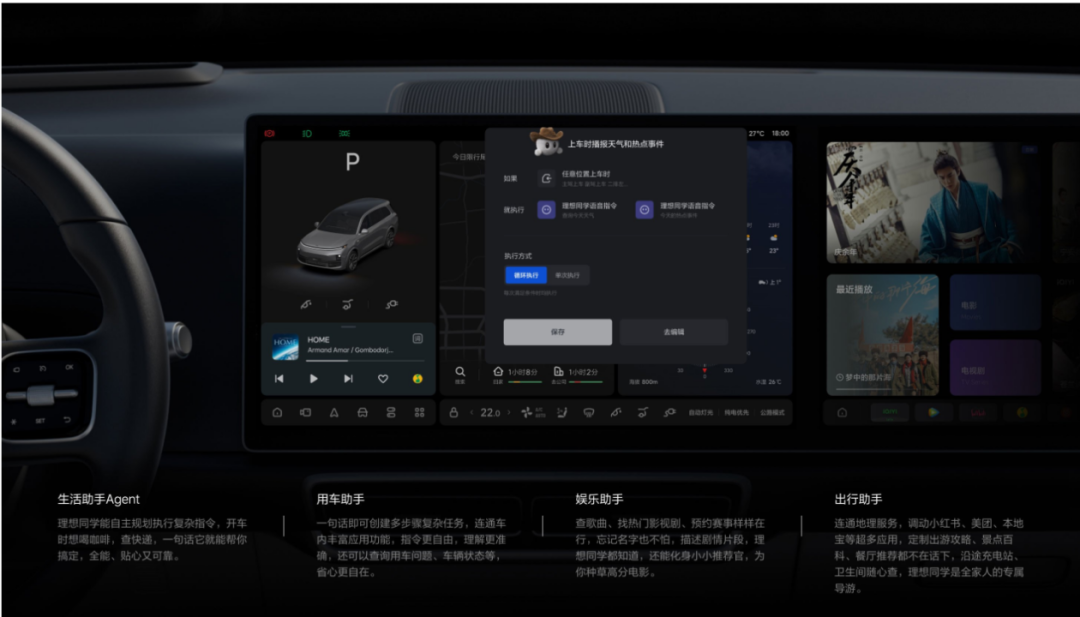
Modern IVI systems integrate far-field voice recognition and natural language processing technologies based on deep learning models such as Transformer, enabling multi-language, multi-turn dialogue, and complex semantic understanding. For example, Li Auto L9 and Xpeng G9 IVI systems both support far-field voice wake-up and multi-turn continuous dialogue throughout the vehicle, allowing users to control multiple functions such as air conditioning, navigation, and music using natural language, and ensuring smooth response to basic voice commands relying on local models even in weak network environments.
Visual Perception and Gesture Recognition
With the help of in-vehicle cameras and advanced machine vision algorithms, IVI systems can capture users’ gesture actions, facial expressions, and gaze direction in real-time. The NIO ET7’s intelligent cockpit supports gesture operations such as waving to change songs and nodding to confirm, while also using cameras for driver fatigue detection and distraction reminders, enhancing interaction fun and driving safety.
Touch and Haptic Feedback Technology
High-precision capacitive touch screens, multi-point operations, and Haptics haptic feedback technology integration provide users with a more intuitive and realistic feedback experience when interacting with the interface. For instance, the central control screen of the Li Auto L9 not only supports multi-point touch operations but also integrates multi-level vibration feedback technology ( Haptics), making sliding, clicking, and other operations smoother and more realistic.
Multi-Screen Collaboration and Ecological Interconnection
IVI systems support multi-screen interaction and content synchronization among the central control screen, instrument panel, co-driver screen, and rear entertainment screen. Both the Li Auto L9 and Mercedes-Benz S Class MBUX systems can freely transfer navigation, entertainment, and other information between different screens, meeting the personalized needs of passengers in the front and rear seats. Meanwhile, through cloud services, models like the Tesla Model Y have achieved application data synchronization between the vehicle, mobile phone, and smart home, creating a seamless digital travel experience.
Open Ecosystem and Application Innovation
Automakers generally open APIs and application stores, actively attracting third-party developers to connect, continuously enriching in-vehicle applications and service content. For example, Tesla’s IVI system provides an application market where users can download various types of apps such as music, video, and games; Xpeng and Li Auto have also launched ecological platforms that support third-party content access.
Operation and Maintenance Management and Security Upgrade SystemCONTENT
The high availability and security of the IVI system rely on intelligent remote operation and maintenance capabilities and multi-layer security measures, mainly reflected in the following aspects:
Layered OTA Upgrades and Efficient Operation and Maintenance
Layered OTA (Over-the-Air) upgrade technology has become an industry standard. IVI systems can perform remote layered upgrades for firmware, operating systems, middleware, and application layers separately, using differential updates and incremental downloads to significantly reduce the upgrade package size and transmission pressure. Layered OTA enables automakers to quickly release security patches, system optimizations, and new features, ensuring vehicles remain up-to-date and compliant with safety standards. For example, both Tesla and Li Auto’s IVI systems have achieved multiple OTA incremental upgrades throughout the year, continuously enhancing user experience and addressing potential issues.
Intelligent Diagnosis and Remote Maintenance
IVI platforms can collect vehicle operation logs and key status data in real-time, utilizing cloud big data and AI analysis to achieve device health monitoring, intelligent fault prediction, and remote diagnosis. In case of anomalies, maintenance personnel can analyze remotely and push repair solutions, with some issues even being automatically resolved without needing to visit a service center, significantly reducing maintenance costs and improving overall vehicle lifecycle management efficiency. For instance, NIO and Xpeng’s intelligent operation and maintenance platforms have achieved remote diagnosis and automatic alerts for in-vehicle faults, enhancing user satisfaction and brand reputation.
Multi-Layer Security Protection System
To address complex network threats and data security risks, mainstream IVI systems generally establish a multi-layer security architecture that includes secure boot, code integrity verification, dynamic permission management, intrusion detection, and network security protection. Through the collaboration of software and hardware, user data privacy, system stability, and protection against malicious attacks are ensured. For example, the Mercedes-Benz MBUX and NIO ET7 IVI systems both integrate hardware security modules ( HSM) and encryption boot mechanisms, effectively defending against external threats and data leaks.
Technological Evolution and Ecological Security
With the continuous improvement of chip computing power and AI capabilities, IVI systems are also evolving in security design, integrating cutting-edge security technologies such as hardware security modules ( HSM) and trusted execution environments ( TEE) to further enhance vehicle information security levels. As the data and ecological hub of smart vehicles, IVI systems not only ensure their own security but also build a solid trust foundation for in-vehicle payments, content distribution, and vehicle-cloud interconnection in open application ecosystems, promoting smart travel towards a more intelligent and secure direction.
ConclusionCONTENT
The In-Vehicle Infotainment system, as the digital hub of smart vehicles, greatly enhances the interaction experience and functionality richness of the smart cockpit through multi-layered hardware-software integration, multimodal interaction, and cloud ecological linkage. With the continuous advancement of chip performance and AI technology, IVI systems will become smarter and safer, serving as a key entry point connecting users’ lives and vehicle travel, driving smart travel to new heights.
—end—