Limited-time offer, military technology 2024 full-year package original price 720 yuan, limited-time discount price 699 yuan!
Influenced by the performance of drones in recent local conflicts, drones have become a focus of development for various countries in recent years, and various drone products have become hot sellers in the international military trade market. As a major country in drone technology development and product export, many of China’s products are highly praised abroad, including the Wing Loong series of drones. Among the Wing Loong family, the Wing Loong-3 drone, which made its debut at the Zhuhai Airshow in 2022, is undoubtedly very eye-catching.
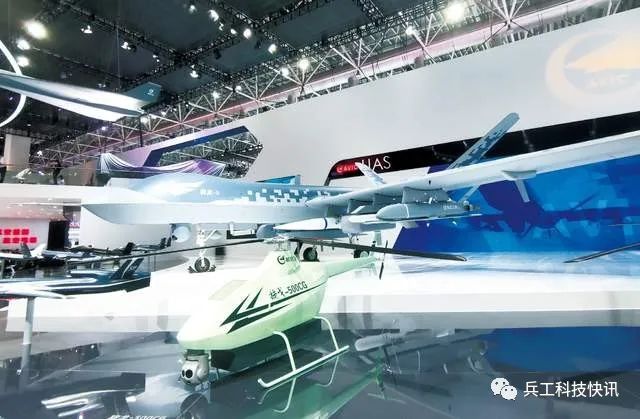
Wing Loong-3 Drone
Key Feature: Large
The most notable feature of the Wing Loong-3 is its size! According to data from the Aviation Industry Corporation of China at the Zhuhai Airshow, the maximum takeoff weight of the Wing Loong-3 is 6200 kg, with a length of 12.2 meters, a height of 4.3 meters, and a wingspan of 24 meters. It can carry 2000 kg of external payload and an internal payload of 300 kg, with a range of 40 hours and a range of 10,000 km. Foreign media have even referred to the Wing Loong-3 as China’s first “intercontinental” drone. This is significantly larger than the Wing Loong-2, which has a similar appearance and aerodynamic layout.
In fact, as a long-endurance reconnaissance-strike drone, the Wing Loong-3’s true counterpart for comparison is the United States’ MQ-9 Reaper and its maritime reconnaissance patrol variant, the Sea Guardian. The MQ-9 has a wingspan of 20 meters, a maximum takeoff weight of 4.76 tons, an internal payload of 360 kg, and six external hardpoints, capable of carrying a total of 1.4 tons of ammunition or reconnaissance pods. Its cruising speed is 313 km/h, with a loiter time of up to 15 hours, a combat radius of 1852 km, an operational altitude of 7.5 km, and a service ceiling of 15 km. From the main parameters, the Wing Loong-3 and the MQ-9 are basically in the same class, but in terms of takeoff weight, payload, loiter time, and operational range, the Wing Loong-3 is clearly superior to the MQ-9. The flight performance of the Wing Loong-3 is also gradually approaching that of the MQ-9, basically reaching the same level, with no longer a significant gap as seen before.
Why is the Wing Loong-3 so large? The main reason is that the larger the payload, the longer the loiter time, and the stronger the long-range capability. According to the chief designer of this drone, Zhou Yi, in an interview at the exhibition: “Long range, heavy payload, versatile use.”

Close-up of the Wing Loong-3 large drone
Outstanding Payload Capacity
The larger the unmanned aerial vehicle (UAV), the greater its payload capacity. The most impressive aspect of the Wing Loong-3 is that it has as many as eight external hardpoints under its wings. The Western reference model, the MQ-9, has only seven. The external payload capacity of the Wing Loong-3 significantly exceeds that of the MQ-9, which has a maximum payload of only 1700 kg, including 1400 kg external and 300 kg internal. The internal 300 kg is mainly for mission equipment, such as electro-optical sensors, satellite navigation, and data links. The Wing Loong-3 is similar in that its internal payload is mainly used to carry various mission equipment, while the external payload consists of weapon loads. Neither of these drones has an internal weapons bay, so they cannot carry missiles or bombs internally, and there is no need to make it that complicated.
The Wing Loong-3 not only has a larger external payload but also has more hardpoints, and the variety is astonishing. At the Zhuhai Airshow, the displayed equipment included not only common small missiles (air-to-ground missiles, anti-tank missiles, anti-radiation missiles, etc.) and small bombs but also advanced PL-10 short-range air-to-air missiles, PL-12 medium-range air-to-air missiles, electronic warfare pods, and munitions dispensers. This means that the Wing Loong-3 can not only serve as a bomb truck but also perform electronic reconnaissance and suppression, cluster munitions dispensing tasks, and even limited air self-defense strikes and air superiority combat missions.
At the 2022 Zhuhai Airshow, a full-size model of the Wing Loong-3 was displayed with a large number of airborne weapons to showcase its astonishing weapon load capacity. Next to the full-size Wing Loong-3, there was also a scaled-down model of the Wing Loong-3, which used eight composite hardpoints to carry a total of 16 aerial munitions, half of which were air-to-ground missiles and guided bombs, fully demonstrating its outstanding load capacity as a “bomb truck” capable of performing ground attack, air defense, and air superiority missions.
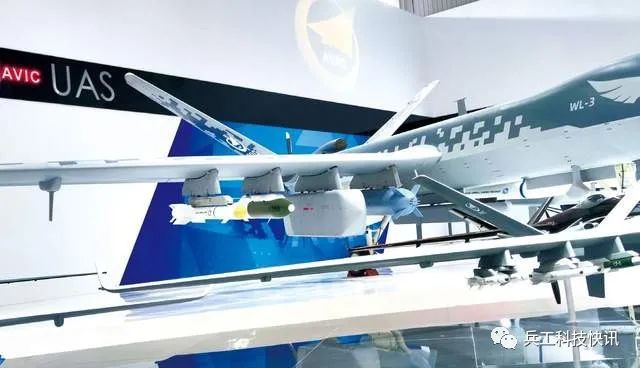
Close-up of the details of the Wing Loong-3 right wing hardpoint display
In the war on terror, the U.S. military proposed the concept of “persistent strike,” where long-endurance aircraft linger on the battlefield for extended periods, ready to strike or actively attack when a target appears. This greatly shortens the OODA loop, which is a key to winning in combat. A faster OODA loop not only improves one’s combat efficiency but also disrupts the enemy’s OODA loop, forcing them to repeatedly restart their OODA loop and ultimately leading to a preemptive strike and seizing the initiative.
Of course, fundamentally, the Wing Loong-3 is still a MALE (Medium Altitude Long Endurance) drone, but it not only has the capability to confront enemy field air defense systems but also has limited self-defense air combat capabilities, which is rare among existing drones.
In addition, the Wing Loong-3 can also carry a specially developed anti-submarine mission module to perform long-duration maritime patrol and anti-submarine missions.
Power System
For a long time, Chinese drones have mainly used piston engines, not only because piston engines are low-cost and fuel-efficient but also because turbine engines have been China’s shortcoming. The so-called “heart disease” mainly refers to turbine engines, including turbofans, turbojets, turboprops, and turboshafts. As long as the thrust levels are the same, these different turbine engines can share core engines.
For many years, China’s efforts in turbine engines have focused on high-thrust, high thrust-to-weight ratio fighter engines, followed by larger thrust, low fuel consumption, and high reliability civil aviation engines, and only then did it turn to medium and low thrust engines for helicopters and turboprop aircraft, but the engines for drones have been neglected. The U.S. advantage lies in having a complete engine spectrum, with the MQ-9’s engine being the TPE331, widely used in various small aircraft from Cessna to Beechcraft and also used in helicopters. Adapting it for the MQ-9 is straightforward. China once lacked such conditions, but this issue has now been resolved.
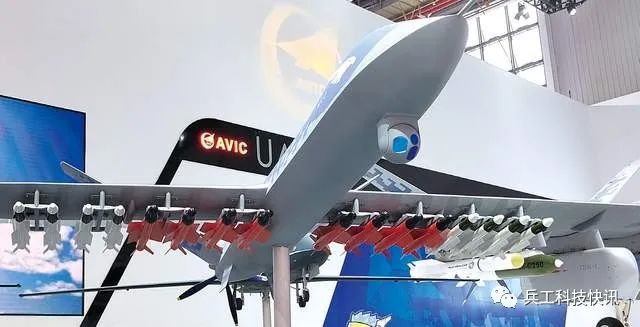
Wing Loong-3 small model demonstrating composite hardpoints and high-capacity mounting schemes
The Wing Loong-2 has already adopted a small turboprop engine, while it is unclear what technical lineage the Wing Loong-3’s turboprop has with the Wing Loong-2, but it is certain that the power has increased. The TPE331-10 of the MQ-9 is rated at 900 horsepower, and the larger Wing Loong-3 is estimated to exceed 1000 horsepower. There are claims that the Wing Loong-3’s engine is likely to use the AE80 turboprop engine developed by Chinese Aero Engine Corporation, which has a maximum power of 800 kilowatts, equivalent to nearly 1100 horsepower.
Small thrust turboprops are particularly significant for drones and cruise missiles. The Iranian “Shahed-136” is technically quite crude, and while its motorcycle engine is simple and cheap, it has few advantages, especially due to its large diameter. The development trend for cruise missiles is to use tube launch systems, which makes integration with various ground and airborne systems easier. Another key technology for tube launch is foldable wings. However, this limits the diameter of the missile body, and only by solving the small diameter engine issue does tube launch make sense.
The development momentum of China’s small diameter engine represented by the Wing Loong-3 is also very significant in this regard. This does not mean that the Wing Loong-3’s engine will be directly used in cruise missiles, but it has broken through the barrier of small diameter turboprop technology, laying the foundation for the future development of small diameter engines in China.

To prevent loss of connection, please follow the backup account below:↓↓↓
Important Notice: Due to WeChat’s redesign, it is recommended to star and follow + like, the system will mark you as a long-read user; otherwise, you may not receive the next article.
End