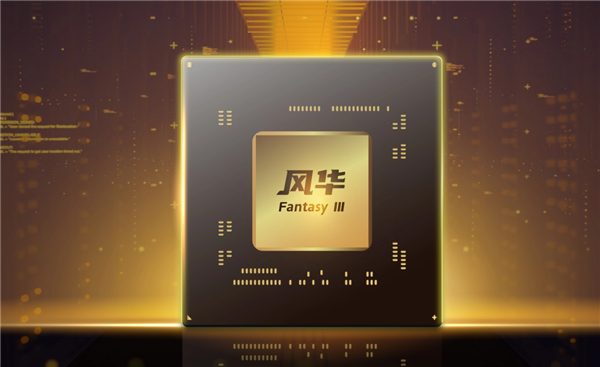
Recently, based on the requirements of the “Guidelines for Security and Reliability Evaluation Work V3.0”, the China Information Security Evaluation Center and the National Confidentiality Technology Evaluation Center, two national-level authoritative institutions, jointly released a significant document – the Security and Reliability Evaluation Results Announcement (2025 No. 3), valid for three years from the date of publication.
Since 2023, a total of 6 evaluation announcements have been released, 5 of which involve CPU evaluation results.
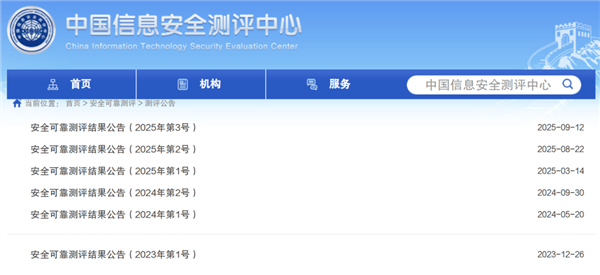
The security and reliability evaluation mainly targets CPU processors used in computer terminals and servers, AI training and inference chips, operating systems, databases, as well as main control chips in laser or inkjet printers.
By assessing the core technologies, security guarantees, and sustainable development of the products and their R&D units, the evaluation determines the safety and sustainability of the products, achieving a comprehensive measurement and objective evaluation of the safety and reliability throughout the entire lifecycle of product R&D design, manufacturing, supply assurance, and after-sales maintenance.
The latest evaluation announcement focuses primarily on CPU processors and operating systems, with the Loongson 3B6000M and HiSilicon Kirin 9000X receiving the highest II-level rating, while the others are rated I-level.
II-level is the highest security level in this evaluation system, indicating that the products have passed strict reviews in terms of core technology autonomy, supply chain security, and intellectual property compliance, meeting national information security standards, and reflecting a high level of safety and reliability throughout the product lifecycle.
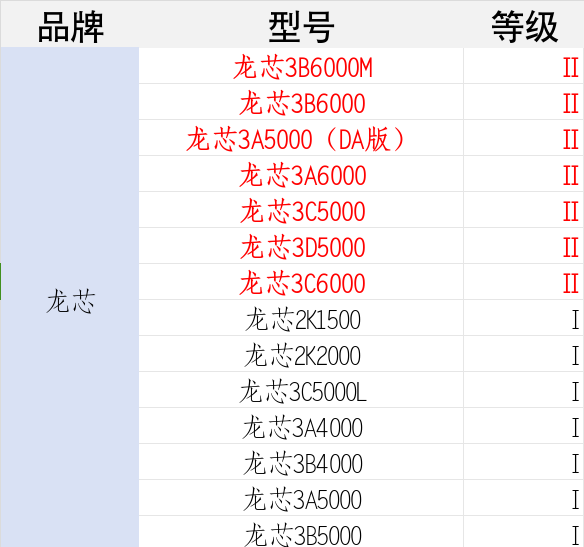
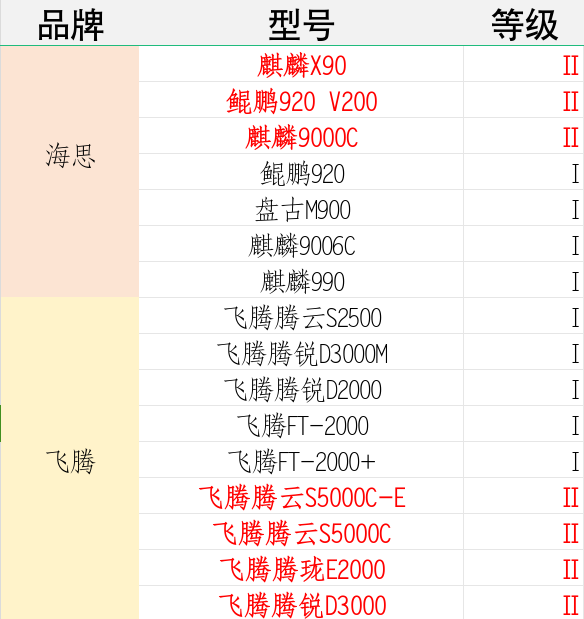
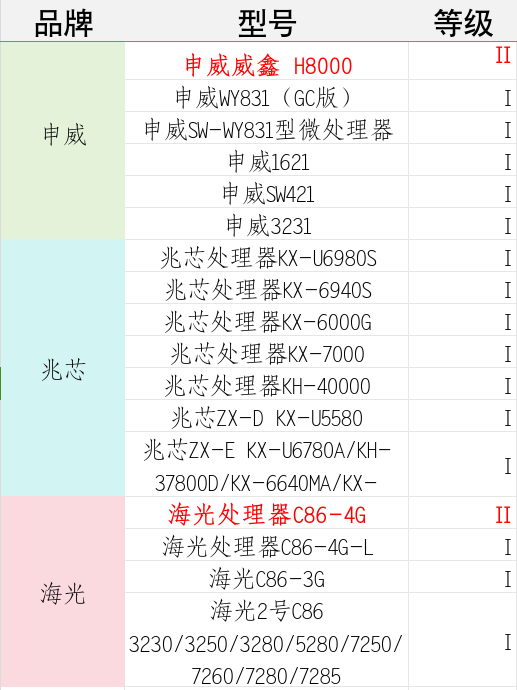
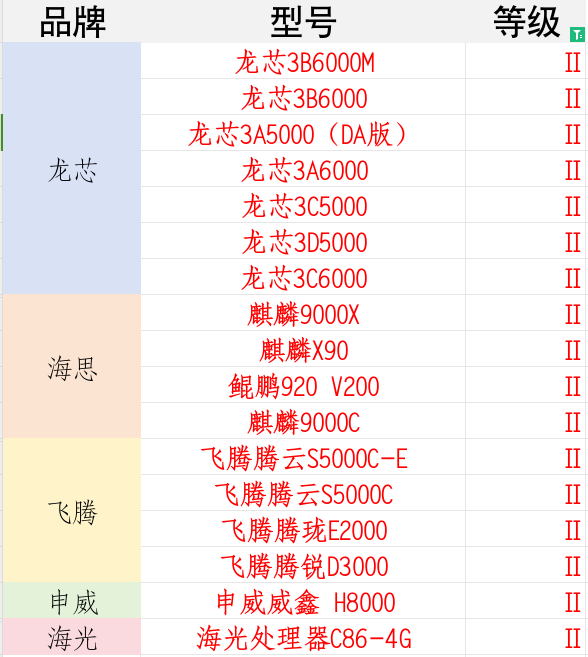
Since December 2023, a total of 5 manufacturers have had 17 CPU models qualify for II-level.
Loongson 7 models:
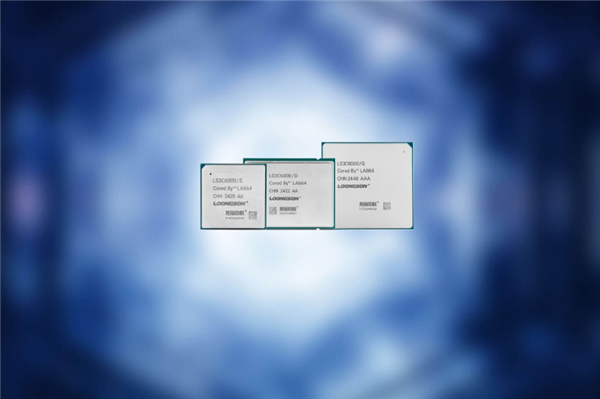
Loongson, with a 41.2% share, has become the company with the most types of chips selected for the II-level security rating. The 3C6000 series server CPUs, 3A6000 desktop CPUs, and 3B6000M terminal CPUs have all entered the current highest security level, forming a complete high-security product matrix covering desktop, server, and terminal lines.
HiSilicon 4 models:
With a 23.5% share, including Kirin 9000X, Kirin X90, Kunpeng 920 V200, and Kirin 9000C.
Feiteng 4 models:
Also with a 23.5% share, covering Tengyun S5000C-E, Tengyun S5000C, Tenglong E2000, and Tengrui D3000, with the number of entries comparable to HiSilicon.
Shenwei 1 model:
With a 5.9% share, the selected model is Shenwei Weixin H8000.
Haiguang 1 model:
Like Shenwei, with a 5.9% share, is the Haiguang processor C86-4G.
Additionally, several I-level certified CPU products include major manufacturers such as Loongson, HiSilicon, Feiteng, Shenwei, Zhaoxin, and Haiguang.
 Not only CPUs, but domestic GPUs have also made significant breakthroughs recently. Not long ago, Lishuan Technology’s 7G100 performance caught up with the RTX 4060, and Loongson also has the RX 550 level GPU card 9A1000, and now there is a new Fenghua 3 all-purpose GPU.
The Fenghua 3 is launched by Xindong Technology. You may remember their Fenghua 2 GPU from two years ago; this time, the Fenghua 3 has even more powerful performance.
Xindong Technology has not disclosed specific metrics, but the promotional report highlights that this GPU is a high-performance GPU targeting AI, rendering, and ray tracing design, making it a leader among domestic GPUs.
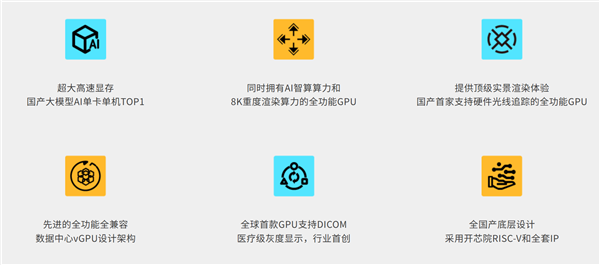
It is equipped with 112GB of video memory, claiming to be the top single card for domestic large model AI, capable of running the full-blooded DS-R1 670B large model with 8 cards.
In terms of rendering, it claims to be the first domestic GPU supporting ray tracing functionality for 8K resolution heavy rendering, fully compatible with mainstream graphics interfaces such as DirectX12, Vulkan1.2, and OpenGL4.6, running AAA and esports games like “Tomb Raider”, “Delta Force”, and “Valorant” very smoothly.
For workstations, the Fenghua 3 is the first domestic GPU supporting YUV444 lossless video encoding technology, while also supporting 6 screens at up to 8K30 high-definition display functionality, and globally first to support DICOM medical-grade grayscale display, an industry innovation.
As for the GPU’s functionality, more empirical data will be discussed later. This time, the Fenghua 3 also features an innovative design, which integrates a domestic open-source CPU core – the Xiangshan “Nanhai” processor IP core, which is performance-matched to the ARM Cortex-A76.
This CPU core is mainly used for the GPU’s main control, responsible for offloading some key functions from the main CPU, including: computing data scheduling preprocessing, chip power consumption control, inter-chip data communication control, temperature monitoring and fan management, power management, BMC control, and anomaly monitoring, etc.
Of course, the specific performance of these functions has not yet been detailed, but from the perspective of design and innovation, the Fenghua 3 indeed impresses, not only making significant progress in the GPU field but also achieving breakthroughs in RISC-V open-source CPU, with fully domestic underlying design helping to enhance autonomy.